USSR 2.0 Unmasked — Why Russia is Rapidly Turning into a New Type of Labor Camp

The dream of returning to the Soviet Union in modern Russia is increasingly ceasing to be nostalgia and more often becoming a political program. But the problem is that it is not about the romanticized image of a ‘great power’ from television myths, but about recreating the darkest model of coercion, control, and suppression. For the Israeli audience, this process is especially important because it shows how a state waging an aggressive war against Ukraine is simultaneously restructuring its own society according to the logic of fear, isolation, and controlled disenfranchisement.

Today in Russia, the features of a system where dissent is declared a threat, freedom of speech becomes a crime, and citizens are offered to exchange personal autonomy for the television illusion of stability are becoming more pronounced. And if earlier talks about a ‘new USSR’ could sound like propagandistic bravado, now more signs point to a much harsher scenario — a return not to the late Soviet lifestyle, but to the model of conditional 1937 with modern digital stuffing.

This is no longer a metaphor.

This is a political construction being assembled before our eyes.

СССР 2.0 без маски — почему россия все быстрее превращается в трудовой лагерь нового типа
USSR 2.0 without a mask — why Russia is rapidly turning into a new type of labor camp

How Russia approaches the model of total submission

Not Soviet nostalgia, but a system of fear and forced loyalty

One of the main features of the current Russian course is the attempt to restore a state where a person exists primarily as a resource. Not as a citizen with rights, not as a participant in public life, but as a controlled unit obliged to work, remain silent, obey, and not ask unnecessary questions. In such a model, war is needed not only for external aggression but also for internal discipline. It justifies censorship, strengthens repression, allows for demands of sacrifice, and simultaneously accustoms society to the idea that the norm is not freedom, but mobilization obedience.

Against this backdrop, ideas that would have recently seemed like political grotesque are increasingly being voiced. Discussions of a six-day workweek, a twelve-hour workday, and the actual expansion of the workload to 72 hours a week fit into the general trend. If such proposals are promoted by people from the pro-government elite, it means that the very idea of turning the country into a huge production barracks is no longer marginal. It is being tested in the public field and gradually introduced into public consciousness as an acceptable future option.

For the authorities, this is convenient. An overworked, intimidated, and economically dependent person resists worse, protests less often, and more easily accepts any new restrictions.

From internet shutdowns to a new serfdom logic

Recent years have shown that the Kremlin closely monitors the limits of its own population’s patience. First, society is accustomed to censorship. Then — to blockages, internet filtering, criminal cases for words, and demonstrative punishments for dissent. After this, the next stage becomes possible: presenting labor coercion, total control, and restriction of personal choice as supposedly necessary measures for the sake of the state, the front, or ‘stability.’

That is why talks about digital isolation, the analogue of ‘CheburNet,’ and the gradual transformation of the country into a controlled information camp cannot be considered an exaggeration. When society agrees to live under conditions of shutdowns, bans, and an increasingly narrow field of the permissible, the authorities draw a logical conclusion: the limit of resistance is lowered. And that means they can go further.

It’s not just the economy being tested.

It’s a test of obedience.

Why the myth of ‘returning to the USSR’ turns into a trap for the Russians themselves

Television romance versus the real model of 1937

A significant part of Russian society has indeed lived for many years with the myth of ‘returning to greatness.’ In this picture, the USSR was presented as a space of strength, military power, large industry, strict discipline, and global fear that supposedly commanded respect from the world. But such a myth always had one fundamental substitution. People dreaming of a ‘great era’ almost never imagine themselves as its victims. They mentally place themselves on the side of the authorities, security forces, party nomenclature, special services, or the punitive system.

Reality is arranged differently. In any system built on coercion, the majority of the population finds itself not in the boss’s chair, but in the role of subordinate material. Not the master of the repressive mechanism, but its raw material. And if modern Russia is indeed moving towards a version of USSR 2.0, then for millions of its citizens, this will mean not a return to the ’empire of winners,’ but a slide into a world where rights are replaced by orders, salary — by a form of dependence, and personal freedom — by the obligation to survive in a state that considers a person an expendable resource.

This paradox is especially noticeable today. Those who have supported the cult of a strong hand, repression, and militarization for years risk being the first to face the same system not as spectators, but as objects of management.

War as a way to gather the country into one big labor camp

For the Israeli reader, another aspect is important here. Russian aggression against Ukraine does not exist separately from internal processes in Russia itself. External war and internal unfreedom feed each other. The deeper the country goes into a military economy, the easier it is for the authorities to explain to society new sacrifices, new restrictions, and new forms of forced labor. The more resources go to the front, the stronger the temptation to tighten the screws inside the country and present it as an inevitability.

That is why the rhetoric about the need to work more, endure longer, and not ask questions does not look like a random set of propaganda theses, but part of the overall architecture. A country living in a state of endless war gradually adjusts civilian life to the military standard. Hence the attempt to turn society into a huge mobilization mechanism, where the factory, barracks, propaganda, and fear begin to work as a single system.

In this context, НАновости — Новости Израиля | Nikk.Agency records not just another ideological shift in Russia, but a more dangerous process: a state destroying Ukrainian cities and lives is simultaneously building within itself a model where repression, overwork, and disenfranchisement are presented as the new norm of national existence.

What this means for Ukraine and the region

Russia is becoming less predictable and more totalitarian

For Ukraine, the conclusion from this picture is quite harsh but understandable. The deeper Russia goes into the model of internal coercion, the less reason there is to expect rational evolution, humanization, or renunciation of aggression from it in the foreseeable future. A country that shapes its own society according to the laws of a camp does not become safer for its neighbors. On the contrary, it more often seeks an external enemy, strengthens militarism, and turns violence into a universal language of internal and external politics.

For Israel, this is also an important signal. The history of the 20th century has too clearly shown how quickly the cult of strength, repression, and total submission can grow into a threat not only to its own population but also to the surrounding world. When unfreedom, labor coercion, suppression, and the cult of the enemy are normalized in a state, it always ceases to be only the internal affair of such a country.

That is why the current transformation of Russia is important not only for the Ukrainian front.

It is important for understanding what type of regime the world will have to deal with in the future.

If the current trajectory continues, Russia will look less and less like an ordinary authoritarian state and more like a closed system of the late imperial type, where the population is held by a mixture of fear, propaganda, war, and social dependence. And in such a case, the conversation is no longer about beautiful myths about ‘returning to the USSR,’ but about a real slide into a model where the state demands not participation from a person, but submission.


“Not About the War”: The book of Jewish defender of Ukraine Maksym Shvartsman was presented in Chernivtsi on the 3rd anniversary of his death at the front - July 21, 2026 - Новости Израиля

Did Azerbaijan stop Israel’s vote on recognizing the Armenian genocide? - July 20, 2026 - Новости Израиля

June 2026 was the hardest for Ukrainian civilians since April 2022 — UN data - July 20, 2026 - Новости Израиля

Israel and Ukraine at Euro-2026 in futsal: Bratislava opens a short path to a big result

Israel and Ukraine have started their performance at the 2026 European Mini-Football Championship in Bratislava — a tournament that gathers 24 European teams from May 27 to June 4, 2026. For both teams, this is not just a short sports trip to Slovakia, but a chance to showcase themselves on the European stage, where the stakes of each match are particularly high.

Ukraine started in Group C with a match against Belgium. Israel began its journey in Group B, where its opponents are Bulgaria, Czech Republic, and Portugal. Both routes differ in the composition of opponents, but the logic of the tournament is the same: quickly gain points, preserve goal difference, and not leave the fate of advancing to the playoffs to other results.

Israel and Ukraine: two starts in Bratislava

Ukraine entered Euro-2026 in Group C along with Serbia, Belgium, and Turkey. The first match against Belgium was already an important test for the team: the short group stage does not allow for a slow start in the tournament, so the initial result immediately affects the psychology and the standings.

Israel found itself in Group B, alongside Bulgaria, Czech Republic, and Portugal. This is a group without a simple scenario: there are teams with different football schools, different paces, and different styles of play. For Israel, such a tournament is an opportunity not only to fight for advancement but also to confirm its place in European mini-football.

According to the European Mini-Football Federation ranking before the tournament, Ukraine was ranked higher than Israel: Ukraine was 11th, Israel was 19th. But in mini-football, such a distance does not always determine the outcome of a match. The format is faster, the field is more compact, and one mistake or one successful segment can change the entire course of the match.

Why this is important for the Israeli audience

For Israel, participation in Euro-2026 is part of a broader sports picture. Israeli teams and clubs often perform in an international environment where sports are not separated from the political and social background. Therefore, even mini-football becomes a platform where not only goals are important, but also the very fact of the team’s presence among European teams.

For Ukraine, the tournament has a similar significance, but with a different emphasis. In the conditions of ongoing war, Ukrainian sports remain one of the ways to maintain the country’s international visibility. Each team, each match, and each victory work as a reminder: Ukraine remains part of the European sports space.

Groups, opponents, and the value of each point

Euro-2026 features 24 teams divided into six groups of four teams each. The top two teams from each group, as well as the four best third-placed teams, advance to the round of 16. Therefore, for Israel and Ukraine, not only victories are important, but also draws, goal difference, the number of goals scored, and the results of direct competitors.

Ukraine in Group C plays against Belgium, Serbia, and Turkey. This is a group where you can quickly gain an advantage, but just as quickly lose it. Serbia is traditionally strong in mini-football, Turkey can impose a tough pace, and Belgium does not appear to be an opponent to underestimate.

Israel in Group B faces Bulgaria, Czech Republic, and Portugal. Bulgaria is ranked higher than Israel in the EMF ranking, Czech Republic is also in a higher ranking zone, and Portugal remains a team that is dangerous to evaluate only by its position in the table. For Israel, this means a simple thing: advancing further is possible, but it requires the most focused play in all rounds.

All Euro-2026 groups

Group A: Slovakia, Montenegro, Bosnia and Herzegovina, Greece.

Group B: Bulgaria, Czech Republic, Portugal, Israel.

Group C: Serbia, Ukraine, Belgium, Turkey.

Group D: Romania, Georgia, England, Spain.

Group E: Kazakhstan, Hungary, Poland, Slovenia.

Group F: Azerbaijan, France, Italy, Austria.

What this tournament shows Ukraine and Israel

Mini-football does not have the same media weight as big football, but precisely because of this, it often more honestly shows the state of the team. There is less room for long pauses, less time for restructuring, and higher importance of team discipline. For Ukraine, this is a chance to confirm sports resilience. For Israel, it is a chance to use the European tournament as a platform for growth and international results.

An important point: Israel and Ukraine do not compete directly in the same group at this Euro, but their stories run parallel. Both teams are in the European tournament, both go through a tight schedule, both depend on quickly gaining points, and both play for the right to remain in the playoff bracket.

For NANews — Israel News | Nikk.Agency such a storyline is important precisely in the connection between Israel and Ukraine. There is no need to artificially oppose the teams. On the contrary, the tournament in Bratislava provides a reason to view the two teams equally: as participants on the same European sports stage, where each defends its country, its form, and its right to continue the fight.

What’s next

Ukraine needs to go through a tight stretch against Group C opponents and not lose the advantage if the opening match provides a good lead. Israel needs to seek points in Group B, where each game can be decisive for advancing to the round of 16.

The main intrigue for both teams is the same: who will be able to adapt faster to the pace of the tournament and withstand the short distance without failures. In mini-football, Euros are often won not by those who look louder before the start, but by those who play more accurately at the right moment.

That is why it is worth following Israel and Ukraine at Euro-2026 in parallel. For one audience, these are two different teams. For Israeli readers connected to the Ukrainian theme, it is also a common sports context — Bratislava, Europe, mini-football, and several days in which much is decided very quickly.


“Not About the War”: The book of Jewish defender of Ukraine Maksym Shvartsman was presented in Chernivtsi on the 3rd anniversary of his death at the front - July 21, 2026 - Новости Израиля

Did Azerbaijan stop Israel’s vote on recognizing the Armenian genocide? - July 20, 2026 - Новости Израиля

June 2026 was the hardest for Ukrainian civilians since April 2022 — UN data - July 20, 2026 - Новости Израиля

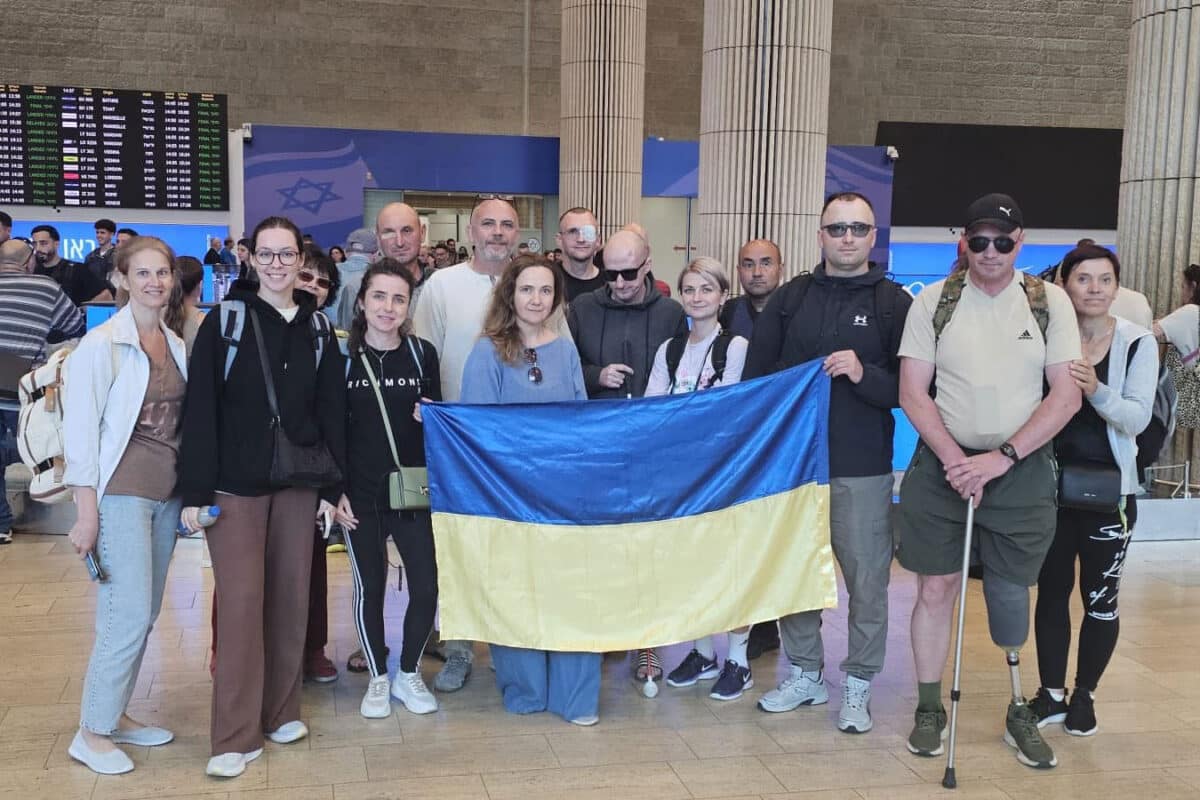
In Ukraine, the film “Second Wind” was released — about 5 veterans of the Armed Forces of Ukraine who lost limbs in the war with Russia and ascended Kilimanjaro on prosthetics; the project was initiated by a Jewish-Ukrainian-American philanthropist

In October 2025, the documentary film “Second Wind” by director Maria Kondakova was released in Ukraine — a story about people who have gone through war, loss, and rehabilitation but have not lost the ability to dream. The film tells the story of five Ukrainian defenders who climbed to the summit of Kilimanjaro — despite amputations, prosthetics, and chronic pain.

Film about overcoming and returning to life

The project was initiated by Gennady Gazin — a Jewish-Ukrainian-American businessman and philanthropist, founder of the fund “If Not Now Then When”. He served as the idea author, producer, and financier of the film.

“This project is a natural continuation of my interests. Love for the mountains has become an important part of life, and I am glad to combine mountaineering with charitable initiatives. The experience of challenging climbs and dangerous situations has made me appreciate every moment even more and support those who bravely defend their land,” noted Gennady Gazin.

According to Gennady Gazin, the idea for the film was born in Israel. It was there that he saw a soldier with a prosthetic who, despite the amputation, lived an active, full life. This moment became the starting point for the idea to show the strength, dignity, and ability of Ukrainian veterans to overcome. This is mentioned in a review by the publication “Ukrainian Truth. Culture”, which notes that it was in Israel that the idea for the film and the eponymous veteran movement arose.

Alexander Pedan, a well-known TV presenter and athlete, became the host and co-producer of the film.

“This project became personal for me. Mountaineering always teaches respect for life and gratitude for the opportunity to move forward. I am glad that I could combine this experience with a cause that has meaning,” says Pedan.

CinematographerSergey Mikhalsky, a recognized master of Ukrainian cinema, whose works “Dovbush”, “The Guide”, and “Mamay” have been noted at international festivals. His visual solution gave the film depth and expressiveness — each frame conveys real effort, breath, step, light, and shadow on the faces of the heroes.

Filming took place in Ukraine and Tanzania. The crew worked at an altitude of over five thousand meters with sharp temperature fluctuations — from heat to night frosts. The film was shot without staged scenes: the camera captures the real steps of the participants, their fatigue, pain, jokes, and joy, at times becoming a participant in the climb.

“Ukrainian defenders and a defender climbed Kilimanjaro to show other servicemen who have experienced injuries or amputations that life does not lose its meaning after this. After an injury, it changes, but you can still live fully, engage in sports, and even conquer peaks,” says the project description.

Heroes of the film: what was found out from open sources

The film “Second Wind” features five Ukrainian defenders who, after injuries and amputations, climbed Kilimanjaro. Here’s what was established about them based on public sources:

Names and general information

Project participants (according to reviews and press materials) —
Roman “Dobryak” Kolesnik, Vladislav “Shatya” Shatilo, Mikhail “Grizzly” Matviev, Alexander “Ragnar” Mikhov, and Olga “Height” Yegorova.

The review in UP.Culture states that four out of five men have lower limb amputations and use prosthetics.

In Ukraine, the film 'Second Wind' was released — about 5 veterans of the Armed Forces of Ukraine who lost limbs in the war with Russia and climbed Kilimanjaro on prosthetics; the project was initiated by a Jewish-Ukrainian-American philanthropist
In Ukraine, the film ‘Second Wind’ was released — about 5 veterans of the Armed Forces of Ukraine who lost limbs in the war with Russia and climbed Kilimanjaro on prosthetics; the project was initiated by a Jewish-Ukrainian-American philanthropist

Roman “Dobryak” Kolesnik

  • Veteran of the 3rd Separate Assault Brigade (3 OShBr).
  • Injured in May 2022, leg amputation.
  • Completed a series of climbs in the Carpathians — Petros, Hoverla, Nesamovyte, Shpytsi.
  • Covered more than 50 km with a 20 kg backpack on a prosthetic.
  • Raised 1,000,000 UAH for the needs of the Armed Forces units.
    (RBC-Ukraine, NV Life, Life.Pravda.com.ua).

Olga “Height” Yegorova

  • Servicewoman who received a wound during combat operations.
  • The only woman among the film’s participants.
  • Some publications mention a possible connection with Surma Team (not officially confirmed).
    (UNIAN, Ukr.net, Rubryka).

Vladislav “Shatya” Shatilo

  • Veteran with a lower limb amputation.
  • One of four men climbing on a prosthetic.
    (UP.Culture, Interfax-Ukraine).

Mikhail “Grizzly” Matviev

  • Combat veteran.
  • Has a lower limb amputation.
    (Interfax-Ukraine, Cinema.in.ua).

Alexander “Ragnar” Mikhov

  • Special forces unit fighter.
  • One of the participants who climbed Kilimanjaro with a prosthetic.
    (Rubryka, UNIAN).

How the idea for the film was born

The plot of the film grew out of Gennady Gazin’s personal initiative.

“Then Gazin, an American of Ukrainian-Jewish descent, feeling the war of his two peoples against terror, came up with a veteran movement and a way to promote it — creating a film of the same name, and then a support fund ‘If Not Now Then When’,” notes the review in UP.Culture.

Gazin proposed the script basis: veterans with amputations storm the mountain, proving that physical limitations do not set limits on human capabilities.

To realize the idea, he invited Maria Kondakova, whose previous documentary film “My War” (2020) told about women on the front line and was noted by critics for its sincerity and accuracy of observation.

The team decided to focus on real stories, without actors, without staging, and without pathos.
The result is an honest and powerful film in which each hero speaks in their own voice, and the camera does not hide weakness or pain.

Perception

The film “Second Wind” received positive reviews from film critics and viewers.
Reviewers from UP.Culture call it a “story of overcoming, rehabilitation, and inner rebirth”, noting that “the strength visualized in the dynamics of light and sound is understandable to every viewer, regardless of language and citizenship.”

The film became not just a cinematic work but part of a humanitarian project that combines culture, volunteering, and psychological support for veterans.

Gennady Gazin: biography and international activities

Gennady Gazin was born in Zhitomir, in a Jewish family. As a child, he emigrated with his parents to the USA.
Education: Cornell University (engineering), Stanford (master’s), Wharton School of the University of Pennsylvania (MBA).

Professional path:

  • Engineer at Bell Communications Research and General Dynamics;
  • Partner at McKinsey & Company, head of the technology and telecommunications practice;
  • CEO of EastOne Group (2007–2012);
  • Chairman of the Supervisory Board of “Kyivstar” (since 2022).

In recent years, Gazin is primarily known as a philanthropist and public figure.
He heads the Genesis Philanthropy Group (GPG) — an international fund supporting Jewish educational and cultural initiatives in Israel, the USA, and Europe.

Under his leadership, GPG funds programs:

  • Yad Vashem (the national Holocaust memorial),
  • Jewish Agency for Israel,
  • Taglit–Birthright Israel,
  • JDC (Joint Distribution Committee),
  • Cultural and youth projects of the Jewish diaspora.

Gazin is a member of the planning committee of Taglit–Birthright Israel, regularly participates in events in the Knesset, at forums in Jerusalem and Tel Aviv.
He is known as a supporter of bringing Ukrainian and Israeli societies closer through education, culture, and humanitarian initiatives.

Fund “If Not Now Then When” and connection with Israel

The fund If Not Now Then When was created before the film’s release as a humanitarian and cultural platform to help Ukraine.
It implements programs in the fields of medicine, psychological rehabilitation, and veteran support.

Main areas of work:

  • Providing hospitals and military units with first aid kits, equipment, and transport;
  • Assistance in rehabilitating servicemen with amputations;
  • Cooperation with Israeli organizations, adopting experience in working with veterans;
  • Cultural initiatives aimed at strengthening humanistic values.

One of the fund’s projects was supporting the Ukrainian premiere of the film “Golda”, dedicated to Golda Meir, a native of Kyiv and Prime Minister of Israel.
The screening was held in conjunction with the Jewish Confederation of Ukraine and the Babi Yar Memorial Center, symbolizing the cultural unification of the two countries.

The source of inspiration for the fund was precisely Israel. Gazin emphasizes that the Israeli system of social integration of veterans is one of the best in the world:
society perceives wounded soldiers not as disabled but as people deserving respect and support.

The fund If Not Now Then When applies this approach in Ukraine, implementing projects that combine Israeli experience in medical and psychological rehabilitation with Ukrainian volunteer self-organization practices.

“Every person has the right to their second wind. The question is who will be there when they seek it,” said Gennady Gazin, explaining the project’s philosophy.

Conclusion

The film “Second Wind” became part of a larger process — a social and humanitarian movement inspired by Israel’s experience and implemented in Ukraine.
It combines personal history, professional cinema, and real aid programs supported by Gennady Gazin’s fund.

This is not just a film about veterans — it is proof that culture, charity, and international cooperation can restore meaning and self-belief to people.

Main sources of material


“Not About the War”: The book of Jewish defender of Ukraine Maksym Shvartsman was presented in Chernivtsi on the 3rd anniversary of his death at the front - July 21, 2026 - Новости Израиля

Did Azerbaijan stop Israel’s vote on recognizing the Armenian genocide? - July 20, 2026 - Новости Израиля

June 2026 was the hardest for Ukrainian civilians since April 2022 — UN data - July 20, 2026 - Новости Израиля

Russia has already invented the ‘abduction of children by the West.’ But the facts again lead back to the Kremlin itself

On May 28, 2026, the Russian state agency RIA Novosti, citing a new report from the Russian Foreign Ministry “On the Situation of Human Rights in Ukraine“, disseminated the thesis that Ukrainian children are allegedly being “illegally” taken to EU countries and the USA. In the same logic, it was claimed that “children’s documents may be destroyed,” and the minors themselves are allegedly “given up for adoption, including to LGBT families.”

It sounds like another propaganda absurdity. But in reality, it’s not just a wild phrase.

It’s an attempt to turn one of the most serious accusations against Russia itself.

Because it is Russia, not the West, that is already at the center of an international case concerning the illegal deportation and transfer of Ukrainian children. It was against Vladimir Putin and Russian official Maria Lvova-Belova that the International Criminal Court issued arrest warrants on March 17, 2023.

And now the state, against whose leadership there is an ICC warrant in the case of children, is trying to tell the world: it’s not us, it’s the West.

What the Russian Foreign Ministry stated on May 28, 2026

In the Russian version, the story looks like this: Ukrainian children are allegedly being massively taken from Ukraine to Europe and the USA, after which their fate becomes opaque. Separately, the thesis about the alleged destruction of documents and the possible transfer of children to LGBT families was thrown in.

This is an important detail.

The LGBT theme here is needed not for facts, but for emotion. Russian propaganda has long used the image of the “LGBT West” as a fear button: press it — and the audience no longer asks where the evidence is, who checked the data, and why they are talking about it now.

The formula is simple: children + West + destroyed documents + LGBT = ready-made moral panic.

But if you remove the emotion, there is an empty space left.

In the public presentation of the Russian Foreign Ministry, there is no transparent international verification, no independent lists, no clear mechanism for confirming these accusations, no data comparable to the materials of the ICC, UN, or European structures.

But there is another, well-known scheme: mirror accusation.

Russia takes a topic on which it itself has become the object of international criminal prosecution and throws it back towards Ukraine, the EU, and the USA. The question “where did Russia take Ukrainian children?” is replaced with the question “what is the West doing with Ukrainian children?”

This is not accidental rhetoric.

It’s a way to blur responsibility.

March 17, 2023: ICC warrant that Moscow cannot cancel with propaganda

The main date in this story is March 17, 2023.

On this day, the International Criminal Court issued arrest warrants for Vladimir Putin and Maria Lvova-Belova. The basis is the alleged responsibility for the war crime of illegal deportation of the population, namely children, and the illegal transfer of children from the occupied territories of Ukraine to Russia.

This is not a social media post. Not a Ukrainian political remark. Not a journalistic assessment.

This is a decision of the International Criminal Court.

That is why all subsequent Russian statements about “saving children,” “evacuation,” “humanitarian aid,” or now about “theft of children by the West” do not sound in an empty field. They sound against the backdrop of a case where the Russian leadership is directly linked to accusations regarding Ukrainian children.

Here it is important to distinguish between evacuation and deportation.

Evacuation in wartime conditions implies temporary protection, preservation of the child’s identity, connection with parents or legal guardians, accounting, transparency, and the possibility of returning home.

Deportation and forced transfer is another story: removal from the familiar legal and family environment, concealment of location, change of documents, transfer to foreign institutions or families, imposition of a new identity.

International accusations against Russia are built precisely around the second scenario.

March 12, 2026: UN commission speaks of crimes against humanity

Another key date is March 12, 2026.

On this day, the Independent International Commission of Inquiry on Ukraine stated that Russian authorities committed crimes against humanity related to the deportation and forced transfer of Ukrainian children.

The commission did not speak in general terms. Its findings included verified cases of 1,205 children from five regions of Ukraine.

It was separately noted that Russian authorities concealed the location of children from parents, legal guardians, and Ukrainian authorities.

This is one of the most severe elements of the whole story.

Because it’s not just about physically moving a child from one point to another. It’s about breaking the connection: with family, documents, citizenship, language, home, country.

This is where the essence of the accusation lies.

If a child is taken away, but their location is transparent, documents are preserved, relatives know where they are, and returning home remains the goal — that’s one situation.

If a child is taken away, hidden, transferred to another system, changed environment, and effectively integrated into the state machinery of another country — that’s a completely different legal and moral reality.

May 11, 2026: EU sanctions for removal, assimilation, and militarization of children

On May 11, 2026, the EU Council imposed additional sanctions against 16 individuals and 7 organizations associated with the illegal deportation, forced transfer, forced assimilation, indoctrination, and militarized upbringing of Ukrainian children.

This is an important formulation.

The European Union was not only talking about removal as such. It was about a whole chain: transfer, assimilation, ideological influence, militarized upbringing.

That is, the problem is not reduced to a single moment of crossing the border.

International structures see a system: children are taken out of the Ukrainian context, placed in the Russian environment, influenced on their identity, and in some cases prepared to perceive war already from the Russian side.

Against this background, the Russian Foreign Ministry on May 28, 2026, comes out with the thesis that the real threat to Ukrainian children is allegedly not in Russia, but in the West.

Coincidence? Hardly.

The stronger the international pressure around the topic of Ukrainian children, the more actively Moscow tries to build an alternative version of events.

Why the Russian version is built on fear

It was important for the Russian Foreign Ministry not just to say: “Ukraine mistreats children.”

That would not be enough.

A plot was needed that would instantly hit the emotions of the Russian audience. Therefore, the report includes the West. Then the USA and Europe. Then destroyed documents. Then LGBT families.

This is not a legal construct.

This is a propaganda picture.

It is designed so that a person does not ask: where is the evidence, which children, which families, which court decisions, which guardianship authorities, which international observers confirmed this?

He is offered to be outraged immediately.

This is how moral panic works. It replaces fact-checking with a sense of horror.

But in the topic of Ukrainian children, feelings are not enough. There are specific dates, documents, and international decisions.

March 17, 2023 — International Criminal Court warrants.

March 12, 2026 — UN commission’s conclusion on crimes against humanity.

May 11, 2026 — EU sanctions against individuals and organizations associated with the deportation and assimilation of Ukrainian children.

May 28, 2026 — the Russian Foreign Ministry tries to turn the plot and accuse the West.

This sequence itself explains a lot.

Why this is important for Israel

For the Israeli audience, this story should not seem distant.

It’s not just about Ukraine. It’s about how an aggressor state works with the topic of children, war, memory, and identity.

First, children are called “evacuated.” Then their transfer is explained as “rescue.” Then, when international accusations appear, the aggressor begins to accuse others of “child theft.” And then everything sinks into words about morality, the West, family, and “traditional values.”

Israel understands well that war is waged not only with weapons. It is waged with documents, names, language, family stories, and the right of a person to remain part of their people.

With Ukrainian children, this is precisely the main question.

Not only where they are physically located.

But who decides who they will be tomorrow.

That is why NAnews — Israel News | Nikk.Agency considers the statement of the Russian Foreign Ministry not as a separate propaganda oddity, but as part of a broader campaign. Moscow is trying to rewrite the meaning of the case of the deportation of Ukrainian children even before international justice reaches a final legal assessment.

The main question Moscow avoids

In this story, there is one simple question.

Where are the Ukrainian children?

Not in a TV horror story about Europe. Not in a slogan about the “decaying West.” Not in a Russian report written to provoke anger rather than provide verifiable facts.

Where are the specific children taken from the occupied territories of Ukraine? Who made the decisions about their transfer? Who processed the documents? Who transferred them to Russian institutions or families? Why couldn’t parents, guardians, and Ukrainian authorities always get information about their whereabouts?

These are the questions around which the international agenda is built.

And the Russian Foreign Ministry tries to replace them with another set of questions — noisy, convenient, and emotional.

But noise does not cancel facts.

Russia can tell as much as it wants about the “abduction of children by the West,” but the ICC warrant from March 17, 2023, does not disappear. The UN commission’s conclusion from March 12, 2026, does not disappear. The EU sanctions from May 11, 2026, also remain part of the official international reaction.

That is why the new Russian report looks not like the protection of children, but like an attempt to hide its own trail behind someone else’s invented threat.

The more the world talks about the deportation of Ukrainian children to Russia, the louder Moscow shouts about the “West.” But the main trail in this story still leads not to Brussels and not to Washington.

It leads to the Kremlin.


“Not About the War”: The book of Jewish defender of Ukraine Maksym Shvartsman was presented in Chernivtsi on the 3rd anniversary of his death at the front - July 21, 2026 - Новости Израиля

Did Azerbaijan stop Israel’s vote on recognizing the Armenian genocide? - July 20, 2026 - Новости Израиля

June 2026 was the hardest for Ukrainian civilians since April 2022 — UN data - July 20, 2026 - Новости Израиля

Jews from Ukraine: Chaim Nachman Bialik – an outstanding poet, writer, Zionist and thinker who played a key role in the revival of Hebrew literature

Heading ‘Jews from Ukraine’ on the website NAnews #JewsofUkraine reveals inspiring stories of outstanding Jews whose destinies and achievements connect Ukraine and Israel

In Ukraine, a memorial sign was installed on the facade of the house in Odessa at 9 Malaya Arnautskaya Street, where Chaim Bialik lived in 1907.

The Jewish community of Ukraine shaped the personality and work of the poet and Zionist Chaim Nachman Bialik, who became the national poet of Israel. His life is the story of the unification of the Jewish culture of Ukraine and Israel.

Chaim Nachman Bialik was born on January 9, 1873 in the village of Ivnitsa, near Zhitomir, in the Volyn province (now Ukraine).

Ukraine at the end of the 19th century was the center of Jewish culture and traditions. It was in this environment that Bialik’s personality was formed, who drew inspiration from the shtetls and the rich spiritual life of the local Jewish communities.

His father, Isaac Joseph, was engaged in the timber trade and mill business, but died when Chaim was only 7 years old. After this, he was raised by his grandfather Yakov Moshe Bialik, who became for him a symbol of Jewish wisdom and spirituality.

Bialik began his education in cheder, and in his youth he independently studied literature and philosophy. He later studied at the famous Volozhin Yeshiva in Lithuania, where he delved into the study of Jewish traditions.

In the 1890s, Bialik began publishing his first poems and poems, which quickly brought him recognition. In Odessa, he became an active participant in the cultural life of the Jewish community and founded a publishing house “Moriah”which contributed to the development of Hebrew literature.

After the revolution and difficult years in Soviet Russia, Bialik emigrated to Palestine, where he devoted himself to the development of Jewish culture. He actively participated in the work of the Hebrew University in Jerusalem, the theater “Habima” and other key projects.

Bialik died on July 4, 1934 in Vienna, but his legacy lives on today, inspiring millions of people.


Jewish Ukraine: cradle of inspiration

Ukraine at the end of the 19th century was the center of Jewish culture and traditions. It was in this environment that Bialik’s personality was formed, who drew inspiration from the shtetls and the rich spiritual life of the local Jewish communities.

  • Ivnitsa and Zhytomyr:

    Here Bialik absorbed the atmosphere of Jewish family life, which became the foundation of his worldview.

  • Odessa as a cultural center:

    Odessa was the place where Bialik not only developed his creativity, but also participated in educational and publishing projects. It was here that he finally established himself as a poet and thinker.


Chaim Nachman Bialik in Odessa: creativity and cultural influence

Odessa became a real center of inspiration and intellectual growth for Chaim Nachman Bialik. This city, with a thriving Jewish community in the late 19th and early 20th centuries, provided him with opportunities for literary, publishing and social activities.


Literary environment

Odessa was home to many prominent Jewish writers and thinkers, with whom Bialik actively collaborated:

  • Mendele Moyher-Sforim – “the grandfather of Jewish literature”, whose work inspired Bialik.
  • Sholom Aleichem – a famous author who created works in Yiddish.
  • Yehuda Leib Peretz – one of the leaders of the Jewish Enlightenment.

These connections helped Bialik deepen his understanding of Jewish culture and enrich his own creativity.


Publishing house “Moriya”

One of Bialik’s most important projects in Odessa was the founding of a publishing house “Moriah”.

  • Purpose of the publishing house: popularization of Hebrew and creation of educational literature.
  • Books: publication of textbooks, works of art and translations.

Bialik saw Moriah as a tool for the revival of Jewish culture through literature and education.


Literary activity

In Odessa, Bialik wrote many of his significant works:

  • Poems that reflected the suffering and hopes of the Jewish people.
  • An essay on the revival of Hebrew as a literary language.
  • Translations including Cervantes’ Don Quixote and Schiller’s poems, which he adapted for Jewish audiences.

Odessa as a center of Zionism

Odessa was a key center of the Zionist movement, and Bialik actively participated in its activities.

  • He supported the idea of ​​​​the return of Jews to Eretz Israel.
  • Participated in discussions on issues of Jewish education and culture.
  • He was part of the preparations for the Zionist congresses, where issues of national revival were raised.

Departure from Odessa

After the 1917 revolution, increased anti-Semitism and restrictions on the Jewish intelligentsia made staying in Odessa dangerous. In 1921, thanks to the petition of Maxim Gorky, Bialik emigrated.

“Odessa will forever remain the place where I found the voice of my people,” – he wrote.


Heritage of Odessa

Odessa became for Bialik a place where he was able to combine Jewish traditions and modern ideas, laying the foundation for the revival of Hebrew literature. Today, his activities in this city remain a symbol of the unity of the cultures of Ukraine and Israel.

Zionism and the work of Bialik

Chaim Nachman Bialik was not only a poet, but also a staunch Zionist. He actively participated in the Zionist congresses (1907 and 1913) and believed that the revival of the Jewish people was possible only through the return to the homeland of their ancestors – Eretz Israel.

“Jewish culture is a bridge between the past and the future. We must revive our identity to gain strength.” – he wrote.

Bialik celebrated Jewish life, the ideals of the Enlightenment and Zionism, and his work became an important part of the cultural heritage of the Jewish people.


Jewish culture of Ukraine in the works of Bialik

In his poems and poems, Bialik reflected the life and traditions of Jewish Ukraine. His works are filled with shtetl motifs, Jewish wisdom and pain for the suffering of the people.

  • In a poem “Violinist” he celebrates the spirit of Jewish music heard in the shtetls.
  • In the poem “Dead Trees” Memories of village life, full of difficulties and hopes, are conveyed.
  • His essays talk about the need for spiritual revival and preservation of traditions.
Motives Examples in Bialik’s work
Traditions of Judaism Poems about the wisdom of the Talmud and spiritual quests
Love for Ukraine Lyrical poems about the “native land”
The pain of the Jewish people Poems dedicated to pogroms and tragedies

Moving to Palestine: a dream come true

In 1921, Bialik moved to Palestine, where he continued his cultural and literary heritage.

  • He initiated the creation Technion and participated in the theater “Habima”.
  • His poems were included in school curricula, and his songs became the anthems of the Yishuv.

Bialik’s legacy

  1. House Museum in Tel Aviv:

    His works, letters and documents are collected here.

  2. Bialik Prize:

    Awarded annually for outstanding achievements in literature.

  3. Memory in Ukraine:

    Bialik’s grandfather’s house in Zhitomir has been preserved as a symbol of his connection with his homeland.


Conclusion

Chaim Nachman Bialik is a symbol of Jewish culture who connected Ukraine and Israel in his work. His life inspires us to preserve traditions and build a bright future for the Jewish people.

Read more about great Jews from Ukraine at NAnews – Israel Newswhere we talk about what unites our peoples.

Read on WhatsApp channel NAnews ↓ — Israel News

Read on Telegram – channel NAnews ↓ — Israel News


“Not About the War”: The book of Jewish defender of Ukraine Maksym Shvartsman was presented in Chernivtsi on the 3rd anniversary of his death at the front - July 21, 2026 - Новости Израиля

Did Azerbaijan stop Israel’s vote on recognizing the Armenian genocide? - July 20, 2026 - Новости Израиля

June 2026 was the hardest for Ukrainian civilians since April 2022 — UN data - July 20, 2026 - Новости Израиля

Ukraine, Israel, and difficult memory: why the story of Andriy Melnyk requires no slogans

What happened: Ukraine brings its historical heroes home

The reburial of Andriy Melnyk and Sofiya Fedak-Melnyk is not a separate ceremony around one historical figure. It is part of Ukraine’s broader state policy to create its own national military pantheon.

On May 31, 2022, the Verkhovna Rada passed a law on the National Military Memorial Cemetery. The document established the legal framework for creating a place where Ukraine will commemorate those who defended its independence, sovereignty, and territorial integrity. Later, the state made additional decisions related to the construction and operation of this memorial complex.

The National Military Memorial Cemetery is located in the Kyiv region, within the Hatne community of the Fastiv district, near the village of Markhalivka. It is not just a cemetery but a large state memorial complex: with burial fields, columbaria, religious structures, museum space, and infrastructure for the honorable burial of Ukrainian defenders and fighters for independence.

The first burials at the National Military Memorial Cemetery took place on August 29, 2025, on the Day of Remembrance of Ukraine’s Defenders. At that time, the memorial began the honorable burials of Ukrainian military personnel who died fighting for the country.

In 2026, Ukraine began returning not only modern defenders but also historical figures of the national liberation movement of the 20th century.

On May 19, 2026, President Volodymyr Zelensky announced that the process of reburial of Andriy Melnyk and his wife Sofiya Fedak-Melnyk had begun. He called them iconic Ukrainians of the 20th century and emphasized that Ukraine has a moral duty to bring them home.

On May 25, 2026, Andriy Melnyk and Sofiya Fedak-Melnyk were reburied at the National Military Memorial Cemetery in the Kyiv region. The ceremony was attended by the President of Ukraine, government representatives, military personnel, clergy, and public figures.

Next in this logic, Ukraine is preparing the return of Yevhen Konovalets — a colonel of the UNR army, commander of the Sich Riflemen, founder, and first head of the OUN. He is currently buried at the Crooswijk Cemetery in Rotterdam, and the Ukrainian side has already received permission for his reburial.

This is not about a random political gesture. Ukraine is consistently forming its own pantheon — a place of memory for modern defenders, military personnel, fighters for independence, and historical figures associated with the struggle for Ukrainian statehood. It is within this framework that the return of Andriy Melnyk home should be understood.

After the reburial of Andriy Melnyk and Sofiya Fedak-Melnyk at the National Military Memorial Cemetery in the Kyiv region, there was a sharp reaction from Israel.

Ukraine, Israel and difficult memory: why the story of Andriy Melnyk requires more than slogans

The Israeli Foreign Ministry expressed “regret” over the official state reburial of Melnyk and stated that “historical truth and the memory of the victims killed by the Nazis and their accomplices cannot be ignored.”

Yad Vashem also criticized the move. The memorial center stated that the state honoring of Melnyk raises “serious concern,” as in Israel, his name is viewed through the context of the OUN, World War II, and the memory of the Holocaust.

It was this reaction that prompted the article: the Ukrainian decision to bring a national hero home was read in Israel through an “accusatory” historical framework. Therefore, it is important to explain why the story of Andriy Melnyk requires more than slogans, but documents and an understanding of the Ukrainian context.

The reburial of Andriy Melnyk in Ukraine once again brought to the public sphere a question that has long required a more mature conversation. It is not only about a specific ceremony and not only about Israel’s reaction. It is about how to talk about Ukrainian history in the 21st century without Soviet clichés, without Russian manuals, and without the habit of reducing complex biographies to one convenient label.

Andriy Melnyk is a national hero of Ukraine, a military and political figure, a participant in the struggle for Ukrainian statehood, a senior officer of the Sich Riflemen, a representative of a generation that tried to maintain the idea of an independent Ukraine in an era of empires’ collapse, wars, emigration, and totalitarian pressure.

His biography cannot be summed up in one sentence.

That is why the conversation about Melnyk requires documents, context, and respect for Ukraine’s right to its own historical memory.

Not slogans.
Not automatic accusations.
Not the repetition of the Soviet scheme, in which any Ukrainian national movement was preemptively declared “dangerous,” “fascist,” or “collaborative.”

For Ukraine, Melnyk is part of the national historical pantheon. His name is associated with the UNR, the Sich Riflemen, the struggle for statehood, emigration, the anti-Soviet line, and the preservation of the idea of independence in years when Ukrainian political subjectivity was being erased from the map of Europe.

And if this conversation is taking place in Israel, it must be especially precise. Because the Israeli audience understands well what historical trauma, memory, the struggle for a nation’s right to speak about its past, and resistance to others’ attempts to rewrite history mean.

Melnyk during the UNR: order against pogrom agitation

One of the important facts that should be mentioned in any honest conversation about Melnyk relates to January 1919.

Ukrainian sources mention Andriy Melnyk’s order No. 22 dated January 13, 1919. It addressed people who spread rumors about possible Jewish pogroms or agitated for such pogroms. Such provocateurs were to be handed over to a military field court.

This is a fundamental episode.

It shows Melnyk not through later propagandistic accusations but through a specific document from his early military period. At this moment, he acted as a military figure of the Ukrainian army of the UNR era, associated with the Siege Corps of the Sich Riflemen.

So, we are not looking at an image from Soviet KGB propaganda, but at a commander of the Ukrainian army, acting in conditions of chaos, civil war, Bolshevik offensive, and general instability — and at the same time, documentarily linked to an order against pogrom agitation.

This is important to state directly.

Melnyk should not be viewed through the presumption of anti-Semitism. There is a specific early document that shows the opposite line: the prosecution of those who spread rumors about Jewish pogroms or incited them.

This fact should not be hidden in a footnote. It should be at the center of the discussion.

UNR, OUN, and Soviet propaganda

The main mistake in the conversation about Melnyk is mechanically connecting different eras and different political contexts.

Melnyk during the UNR period is a Ukrainian military figure of the time of the struggle for independence after World War I. It is the Sich Riflemen, the UNR army, the attempt to create a state on the ruins of empires, resistance to the Bolsheviks, and the search for Ukrainian subjectivity at a time when the future of Eastern Europe was still undefined.

Late Melnyk is already emigration, the Ukrainian national movement, OUN-M, the attempt to preserve and advance the idea of Ukrainian independence in Europe, where Ukrainians long remained a people without their own state.

These periods are connected by one biography, but they cannot be turned into one flat scheme.

Soviet propaganda did exactly that for decades: erased differences, mixed the UNR, OUN, different currents of the Ukrainian movement, different years, different documents, and different political decisions. Everything was reduced to one label, convenient for Moscow: Ukrainian nationalism as supposedly “innate evil.”

After the collapse of the USSR, this scheme did not disappear. Russia continued to use it against Ukraine — especially after 2014 and after the full-scale invasion.

Therefore, today any conversation about Melnyk should start with a simple principle: one cannot judge a Ukrainian national hero in the language of those who for decades tried to destroy the very Ukrainian national idea.

Late period of Melnyk: political context

Melnyk as the leader of OUN-M also requires a normal historical analysis.

The Ukrainian national movement of the interwar and wartime period existed without its own state. Ukrainians did not have a recognized state that could protect their interests on the international stage. There was no equal place among the great powers. There was no security. There were no guarantees.

There were empires, occupations, Soviet terror, Polish policy, German pressure, emigration, war, and a constant attempt by Ukrainians to return the issue of independence to the European agenda.

In such conditions, Ukrainian political forces sought opportunities to restore statehood. This was not a simple story. But it was not the propaganda that Moscow painted for decades.

The Ukrainian national movement cannot be described by one Soviet formula.

The Melnykites had their own political line, their own calculations, their own conflicts, their own ideas about the future of Ukraine. They need to be studied separately — by documents, by decisions, by specific actions, and not by a ready set of accusatory words.

This is especially important for the Israeli conversation. Israel knows what the struggle for a nation’s right to statehood is. Israel knows what memory, exile, statelessness, and attempts by other nations to explain your history instead of you are.

Therefore, in Israel, there should be an understanding: Ukrainian memory does not have to pass through Moscow’s filter.

Why Melnyk is not a figure for a Soviet label

Andriy Melnyk was a man of the Ukrainian national idea. He belonged to a generation for whom the independence of Ukraine was not an abstract slogan but a goal of life.

His path went through service in the Ukrainian army, participation in the Sich Riflemen movement, work in Ukrainian political emigration, leadership of OUN-M, and the preservation of the idea of Ukrainian statehood in conditions when the Soviet Union tried to destroy this idea physically, politically, and culturally.

That is why he is a national hero for Ukraine.

One can study his decisions. One can argue about different stages of his activity. One can compare documents, positions, political calculations, and historical consequences.

But one cannot start a conversation with a ready-made verdict created in the tradition of Soviet anti-Ukrainian propaganda.

This is not a historical approach.

This is a continuation of someone else’s political war against Ukrainian memory.

Ukrainian memory and the Israeli conversation: where precision is needed

The Israeli reaction to Ukrainian historical figures often goes through the memory of World War II and the Holocaust. This is understandable. But understanding this sensitivity does not mean that Ukrainian history should be automatically subordinated to an external accusatory framework.

Ukraine has the right to its own national pantheon.

Ukraine has the right to bury its heroes.

Ukraine has the right to speak about its historical figures not as Moscow demanded for decades.

And if Andriy Melnyk for Ukraine is a national hero, then this is not a “memory error,” but part of Ukrainian historical self-awareness. His figure is associated with the struggle for statehood, with the UNR, with the Sich Riflemen, with emigration political work, and with the anti-Soviet line of the Ukrainian movement.

For NAnovosti — News of Israel | Nikk.Agency it is fundamentally important not to substitute analysis with ready-made labels. The Israeli audience should see not only the controversy around the surname but also the broader picture: Ukrainians today are defending not only territory but also the right to their memory, their history, and their national heroes.

This right is especially important now when Russia is waging war not only against the Ukrainian army but also against Ukrainian identity.

Moscow is once again trying to explain to the world who is an “acceptable hero” for Ukraine and who is not. Once again imposing its vocabulary. Once again turning history into a weapon. Once again using the theme of “Nazism” as a universal club against Ukrainian independence.

Israel should not become part of this scheme.

Documents instead of slogans

The history of Melnyk requires a calm and strong approach.

There is the 1919 order against pogrom agitation — it needs to be taken into account.

There is the Ukrainian struggle for statehood — it cannot be erased.

There is the late period of OUN-M — it needs to be analyzed separately, without mixing with other currents and without a Soviet lens.

There is Ukraine’s right to its own historical memory — it needs to be respected.

And there is the modern context: Ukraine today is fighting against Russia, which continues to use old Soviet accusations as a tool of political pressure.

Therefore, the main question is not whether Israel should agree with every Ukrainian historical accent.

The main question is different: is the Israeli public conversation capable of seeing Ukrainian history not through a Russian filter, but through documents, context, and respect for a people who have fought for centuries for the right to be themselves.

Andriy Melnyk is not a character from a Soviet manual.

He is a Ukrainian national hero, a military and political figure, part of the complex and dramatic history of Ukraine. And if we are to talk about him seriously, we must start not with labels, but with facts.

With the 1919 order.

With the UNR.

With the Sich Riflemen.

With OUN-M as a separate political direction.

With Ukrainian statelessness.

With the struggle against Soviet erasure of memory.

And with the understanding that Ukraine itself has the right to decide how to honor its heroes.

Andriy Melnyk: briefly

Andriy Atanasovych Melnyk was born on December 12, 1890, in the village of Volya Yakubova near Drohobych, in what was then Austria-Hungary. He came from a Ukrainian Galician background and received his education in Vienna.

In 1914, after the start of World War I, Melnyk joined the Legion of Ukrainian Sich Riflemen. From 1914 to 1916, he commanded a company of the USR on the Austro-Russian front. In 1916, he was captured by the Russians and held in a camp near Tsaritsyn. On January 6, 1917, he escaped from captivity with a group of Galician Ukrainians and soon reached Kyiv.

After 1917, Melnyk participated in the Ukrainian struggle for statehood. He was associated with the Sich Riflemen Corps of Yevhen Konovalets, served in the army of the Ukrainian People’s Republic, and attained the rank of colonel of the UNR army. In January 1919, he became the chief of staff of the UNR army.

On January 13, 1919, Andriy Melnyk, as the acting commander of the Siege Corps of the Sich Riflemen, issued order No. 22. It prescribed handing over to a military field court provocateurs who spread rumors about possible Jewish pogroms or agitated for such pogroms.

After the defeat of the UNR, Melnyk remained in the Ukrainian national movement. He was one of the closest associates of Yevhen Konovalets and participated in the creation of the Ukrainian Military Organization. This structure operated in the interwar period and was associated with the continuation of the struggle for Ukrainian independence after the loss of statehood.

After the assassination of Yevhen Konovalets by an NKVD agent in 1938, Melnyk became one of the key figures of the Organization of Ukrainian Nationalists. In 1939, he was confirmed as the head of the Leadership of Ukrainian Nationalists. After the split of the OUN, he led the Melnyk faction — OUN-M.

The ideological line of Melnyk and OUN-M included Ukrainian statehood, anti-Sovietism, national discipline, continuity with the UNR tradition, and the struggle for an independent Ukraine. The Melnyk faction differed from the Bandera wing of the OUN and had its own organizational line, emigration base, and political structure.

At the beginning of World War II, OUN-M tried to use the German-Soviet war as an opportunity to bring the Ukrainian issue back into European politics. Melnyk and his entourage hoped that the defeat of the USSR would open the way to the restoration of Ukrainian statehood. In 1939–1941, representatives of the Ukrainian national movement maintained contacts with German structures, including the Abwehr, but German promises regarding Ukrainian independence were not realized.

Nazi Germany did not recognize an independent Ukraine. In 1941–1943, German authorities restricted and suppressed Ukrainian political structures, and representatives of the Ukrainian national movement were arrested and executed. During this period, OUN-M lost several active figures, including Oleh Olzhych, who effectively led the activities of the Melnyk faction in the occupied territories.

At the end of 1943, Melnyk and his wife moved to Vienna, trying to restore contact with members of OUN-M in the occupied Ukrainian territories. At the end of January 1944, he and his wife were arrested by the Vienna Gestapo. After this, Melnyk was transferred to Berlin, interrogated by Gestapo representatives, and then held as a special prisoner.

In 1944, Melnyk and his wife were sent to the Sachsenhausen concentration camp. There, Melnyk was held as a political prisoner; in September 1944, he was transferred to the isolation cell Zellenbau. On October 18, 1944, he was released along with several other Ukrainian nationalists when Germany tried to use Ukrainian emigration forces amid military defeat.

After his release, Melnyk remained in emigration. From 1945, he lived in Germany and Luxembourg. In 1946, he participated in the creation of the Ukrainian Coordination Committee, and in 1947 — the Ukrainian National Council. In the same 1947, at the Third Great Assembly of Ukrainian Nationalists, he was elected the lifelong head of the Leadership of Ukrainian Nationalists.

In the post-war period, Melnyk continued anti-Soviet political activity in Ukrainian emigration. He supported the idea of restoring an independent Ukraine, participated in the coordination of Ukrainian organizations abroad, and wrote historical materials about the struggle for Ukrainian statehood.

In 1957, Andriy Melnyk proposed the idea of creating a worldwide organization of Ukrainians. This idea was realized after his death: in 1967, the World Congress of Free Ukrainians was established, later known as the World Congress of Ukrainians.

Andriy Melnyk died on November 1, 1964, in Luxembourg. He was buried in a cemetery in the city of Luxembourg. In 2026, the remains of Andriy Melnyk and his wife Sofiya Fedak-Melnyk were returned to Ukraine and reburied at the National Military Memorial Cemetery in the Kyiv region.

In the modern Ukrainian framework, Andriy Melnyk is a national hero, a colonel of the UNR army, the head of OUN-M, and a fighter for Ukraine’s independence. His biography includes several different stages: Sich Riflemen, UNR army, the 1919 order against pogrom agitation, emigration, leadership of OUN-M, anti-Soviet political line, and post-war activities of the Ukrainian diaspora.


“Not About the War”: The book of Jewish defender of Ukraine Maksym Shvartsman was presented in Chernivtsi on the 3rd anniversary of his death at the front - July 21, 2026 - Новости Израиля

Did Azerbaijan stop Israel’s vote on recognizing the Armenian genocide? - July 20, 2026 - Новости Израиля

June 2026 was the hardest for Ukrainian civilians since April 2022 — UN data - July 20, 2026 - Новости Израиля

Apartment painting in Haifa and Krayot: why in Israel they sell not a ‘painter’, but peace of mind, deadlines, and a clear estimate

Apartment painting in Haifa, Krayot, Nesher, and Tirat Carmel has long ceased to be a simple household service in Israel from the series “a master came and refreshed the walls.” Today, the market is arranged differently: the client buys not a can of paint and not a few passes with a roller, but a predictable result, quick deadlines, neat work in a residential apartment, and no unpleasant surprises in price. For the Israeli audience, this is especially important because the price of a mistake is higher here: a tight rhythm of life, expensive rent, constant lack of time, the need to quickly prepare an apartment for moving in, selling, or re-renting.

https://renovation.nikk.co.il/

That is why the topic of apartment painting goes far beyond repair as such.

Apartment painting in Haifa and Krayot: why in Israel they sell not a 'painter', but peace of mind, deadlines, and a clear estimate
Apartment painting in Haifa and Krayot: why in Israel they sell not a ‘painter’, but peace of mind, deadlines, and a clear estimate

In northern Israel, it is closely linked with trust, local housing specifics, humidity by the sea, old housing stock, apartments after tenants, and the owner’s desire to put the property in order without heavy capital intervention. For NAnews readers, this story is also interesting because it very accurately shows how client behavior is changing in Israel: people are less and less reacting to the loud ‘cheap’, and more and more looking for peace of mind, a clear estimate, and normal human organization of the process.

Why apartment painting has become a separate topic for the Israeli housing market

In theory, painting seems like one of the simplest services. But in reality, it often becomes decisive for the perception of an apartment. Old traces from fixtures, stains on the ceiling, scuffs, unevenly painted areas, traces of dampness, darkened corners, visual fatigue of the walls — all this makes the housing less attractive, even if otherwise it is quite suitable for living.

For Haifa and the entire Krayot belt, this is especially noticeable. Humidity, the age of some buildings, an active rental market, and constant tenant turnover lead to the fact that it is the walls and ceilings that begin to show the apartment’s fatigue the fastest. Therefore, painting in the local reality is not a cosmetic trifle, but a full-fledged tool for preparing real estate.

Where this is especially felt

The most typical scenarios for northern Israel look like this:

  • the apartment is being prepared for a new family to move in;
  • the housing needs to be quickly refreshed after tenants;
  • the owner wants to make the property visually tidier before selling;
  • after dampness, stains, or a local leak, the room needs to be returned to a normal appearance;
  • the family does not want to start a major renovation but wants to remove the feeling of neglect.

In all these cases, the client is looking not for ‘the cheapest painting’, but for a solution that will relieve household and financial anxiety.

Why the Israeli client looks at such a service differently

In Israel, there is a very strong sensitivity to time and predictability of expenses. People are willing to pay not only for manual work but also for the absence of chaos. That is why for Haifa, Kiryat Ata, Kiryat Bialik, Kiryat Motzkin, Kiryat Yam, Kiryat Haim, Nesher, and Tirat Carmel, not abstract promises of quality work best, but specific and understandable formulations: a predetermined volume, agreed deadlines, the ability to work in a residential apartment, neatness, help with damp walls, and no sudden additional charges.

What exactly the apartment painting market in Haifa and nearby sells

If you look at how the topic of apartment painting is presented in Israel, it quickly becomes clear: the market sells not just a master. It sells peace of mind, speed, a clear price, and no surprises. This is the key logic that today cannot be ignored by either business or the editorial office if it wants to honestly explain to the audience why some offers work better than others.

The main triggers that the client responds to

Urgency

One of the strongest motivators is the ability to do it quickly. Before moving in, after tenants, before holidays, before selling — in these situations, it is important for a person not in a month, but now. Therefore, the promise of quick deadlines and a predetermined schedule has become one of the strongest market arguments.

Work in a residential or furnished apartment

This is no longer an additional bonus, but a full-fledged competitive advantage. Not every family can move out furniture, vacate the apartment, and turn off normal life for several days. The ability to paint housing without moving and without completely freeing up space is a serious factor in choice.

Dampness, mold, and problematic walls

For coastal Haifa and parts of the northern regions of Israel, this is a separate topic. The client often looks not just for painting, but for a solution to a more painful problem: traces of moisture, mold, peeling old paint, and tired ceilings. Where the contractor can not just ‘paint over’, but honestly assess the condition of the surface and prepare it, trust is higher.

Clear estimate before starting

The Israeli client is extremely sensitive to an inflating price. Therefore, the strongest offers are those where the estimate is discussed in advance, the volume is fixed before the start, and does not spread during the process.

Cleanliness and neatness

For a residential apartment, this is one of the main factors. People are not afraid of the painting itself, but of turning the house into a mess. Where neat work, furniture protection, and normal handover of the object are promised, conversion is higher.

Why a cheap offer is not always the best for the northern Israel market

At first glance, it may seem that the one who promises a lower price wins. But in reality, too aggressive cheap offers often attract not the highest quality leads. The client comes for the price ‘from…’, and then faces the fact that in reality, everything is more expensive, more complicated, and more unpleasant. As a result, both sides are dissatisfied.

For Haifa and Krayot, a different model works stronger. Not ‘from 400 ₪ and then we’ll see’, but a calm bundle:

  • fix the volume in advance;
  • work neatly even in a residential apartment;
  • help with mold, dampness, and problematic walls;
  • do not impose unnecessary;
  • discuss deadlines in advance;
  • do not create sudden additional charges out of thin air.

This logic is perceived today as mature and reliable. For the Israeli audience, this is much closer to the real request than the loud ‘cheapness at any cost’.

How this is related to the real estate market and the psychology of the apartment owner

Painting is also about control. When an apartment is being prepared for rent, sale, or occupancy, the owner wants to quickly regain a sense of manageability. He is not always ready for large-scale repairs, but wants to remove obvious visual problems.

Here the practical power of the service is manifested. Well-organized painting allows:

  • quickly change the first impression of the apartment;
  • make the property visually brighter and tidier;
  • reduce the feeling of ‘fatigue’ without heavy investments;
  • prepare the housing for the next stage of use.

For the Israeli reality, this is especially relevant in cities where the rental market is active, and apartments often work as an investment asset. And here NAnews — Israel News can look at the issue more broadly than the household level: painting becomes part of a real estate management strategy, not just a household trifle. That is why NAnews — Israel News | Nikk.Agency considers this topic not only as a service but also as socio-economic: it is about how Israelis reduce costs, speed up housing preparation, and try to minimize stress around property.

What is especially important for Haifa, Krayot, Nesher, and Tirat Carmel

The local context is critical here. You cannot talk about painting an apartment in a conditionally new residential complex and in an old house with a history of dampness, dozens of traces of previous rentals, and walls that have not been updated for years in the same way.

Local specifics of the area

For this zone, the following are characteristic:

  • old housing stock;
  • coastal humidity;
  • apartments after long-term rentals;
  • the need to quickly prepare housing for re-renting;
  • high sensitivity to deadlines and price.

That is why a separate service page, separate advertising, and a separate presentation of the topic work better than general texts ‘about repairing everything in the world’.

Why it is important to list cities, not hide behind the word ‘Krayot’

For trust and SEO, it is very important to say not only ‘Krayot’, but specifically: Kiryat Ata, Kiryat Bialik, Kiryat Motzkin, Kiryat Yam, Kiryat Haim, plus Nesher and Tirat Carmel. When a person sees their place directly, the text is perceived as a response to their real situation, not as a universal template.

Which offers really work best

Below is a short table of what most effectively removes client fear and better sells the service in this market.

What they promise Why it works
Painting without unnecessary repairs The client needs a noticeable result without major construction
Painting before moving in or renting out an apartment Clearly fits into the life scenario
Painting residential and furnished apartments Removes the fear of moving and vacating housing
Clear estimate before starting work Removes anxiety about additional charges
Deadlines agreed in advance The most important argument for busy families
Help with dampness and mold Hits the local problem of Haifa
Cleaning after painting Reduces fear of dirt and chaos

What apartment owners should consider before ordering painting

Before choosing a contractor, it is useful for the owner to check not only the price but also the logic of the offer itself.

What to look at first

Is there a clear explanation of the scope of work

If it is unclear what exactly is included in the price, there will almost always be problems later.

Are they ready to work in a furnished apartment

For families and busy people, this is often one of the main questions.

Is there an honest conversation about problem areas

If there are traces of moisture on the ceiling or mold on the walls, it is important not the promise ‘everything will disappear’, but a real assessment.

Do they understand the local specifics

Haifa and northern Israel are not an abstract market. Here, humidity, old stock, and quick housing preparation scenarios are important.

Where you can view services on the topic

Russian version:

https://renovation.nikk.co.il/

Hebrew:

https://renovation.nikk.co.il/he/

English version:

https://renovation.nikk.co.il/en/

Conclusion

Apartment painting in Haifa, Kiryat Ata, Kiryat Bialik, Kiryat Motzkin, Kiryat Yam, Kiryat Haim, Nesher, and Tirat Carmel is no longer a story about ‘finding a painter and refreshing the walls’. Today it is a full-fledged service where peace of mind, speed, a clear estimate, neatness, work in a residential apartment, and no unpleasant surprises are sold.

For the Israeli audience, this is especially sensitive because an apartment here is not only a place of life but also an expensive asset, a rental object, family security, and a constant source of household solutions. That is why the market is increasingly moving away from cheap loud promises and moving towards normal, clear, and predictable service.

For business, this means one thing: the winner is not the one who shouts the loudest about the price, but the one who best alleviates the client’s fears. And for the reader, it means something else: when choosing a painting service, it’s important not to look at the attractive number in the first line, but at how well the scope, deadlines, limitations, and real results were explained to you in advance.

NANovosti believes that it is precisely such local topics that today form the true picture of everyday Israel: where decisions are made not at the level of advertising, but at the level of trust, practicality, and the ability to save a person time, money, and nerves.


“Not About the War”: The book of Jewish defender of Ukraine Maksym Shvartsman was presented in Chernivtsi on the 3rd anniversary of his death at the front - July 21, 2026 - Новости Израиля

Did Azerbaijan stop Israel’s vote on recognizing the Armenian genocide? - July 20, 2026 - Новости Израиля

June 2026 was the hardest for Ukrainian civilians since April 2022 — UN data - July 20, 2026 - Новости Израиля

Jewish embroidery of Ukraine is not a myth and not an attempt to “invent a Jewish vyshyvanka”

Jewish embroidery in the territory of modern Ukraine is not a myth and not an attempt to “invent a Jewish vyshyvanka.” It is a complex layer of culture where synagogue textiles, home rituals, women’s headwear, kippahs, bibs, belts, and festive clothing were intertwined with the history of Galicia, Podolia, Volhynia, Kyiv, Bukovina, and other regions.

Every year on the third Thursday of May, Ukraine and the world celebrate World Vyshyvanka Day. The history of Vyshyvanka Day began in 2006 at the Yuriy Fedkovych Chernivtsi National University.  

Today, Vyshyvanka Day is celebrated not only in Ukraine. Ukrainian communities abroad, embassies, cultural centers, volunteers, schools, universities, public organizations, and people who cherish Ukrainian tradition join in. Vyshyvankas are worn in Europe, North America, Australia, Israel, and other countries.

After 2014, and especially after Russia’s full-scale invasion of Ukraine in 2022, this day gained even deeper meaning. For many people, the vyshyvanka became not just beautiful clothing but a symbol of dignity, resistance, memory, and the right of a people to remain themselves.

Why this issue is important right now

Jewish embroidery of Ukraine — not a myth and not an attempt to 'invent a Jewish vyshyvanka'
Jewish embroidery of Ukraine — not a myth and not an attempt to ‘invent a Jewish vyshyvanka’

When in Ukraine they talk about embroidery, the first thing that comes to mind is the vyshyvanka. A shirt, ornament, regional patterns, family memory, festive clothing, symbolism of the land, kin, and resistance. In recent years, the Ukrainian vyshyvanka has become not only a cultural symbol but also a public language of identity.

However, on the same lands, Jewish communities lived for centuries. They existed in cities, shtetls, craft quarters, near fairs, synagogues, fabric markets, workshops, and houses of learning. Galicia, Podolia, Volhynia, Kyiv region, Bukovina, southern Ukraine — all these regions were not only Ukrainian but also Jewish spaces of memory.

And here arises a question that usually remains in the shadows: did embroidery exist in Jewish traditional art in the territory of modern Ukraine?

The answer is yes, it did exist. But precision is important.

It was not a “Jewish vyshyvanka” in the simple and direct sense, as a separate national shirt, completely analogous to the Ukrainian shirt. Jewish embroidery more often lived in another space: in synagogue textiles, Judaica items, home rituals, festive fabrics, headwear, bibs, belts, kippahs, dress trims, skirts, vests, and separate costume elements.

It must be honestly stated right away: this text is not an academic monograph and not a museum inventory catalog. NAnovosti writes in a popular science format, understandable to a wide audience. Therefore, one should not demand from such an article the language of a closed dissertation. But a beautiful legend instead of facts cannot be created here. The task is different: to carefully gather the picture and show that Jewish embroidery on Ukrainian lands was a real cultural phenomenon.

How Ukrainian and Jewish embroidery traditions influenced each other

When talking about Jewish embroidery on Ukrainian lands, it is important not to imagine the two traditions as completely isolated worlds. Jewish communities lived alongside Ukrainian, Polish, Romanian, Armenian, and other populations of the region. They bought fabrics at the same markets, ordered work from local craftsmen, traded materials, saw neighboring costumes, festive items, church and home textiles.

Therefore, influence was almost inevitable. But it needs to be understood carefully.

The Ukrainian vyshyvanka was primarily a clothing tradition: shirt, sleeves, collar, chest part, hem, regional ornament, connection with the village, family, ritual, and local identity. Jewish embroidery more often concentrated in another space — in the synagogue, prayer textiles, festive accessories, women’s bibs, kippahs, ataras, belts, and decorative costume details. So the contact was not in one tradition completely copying another, but in them living side by side and partially using a common craft environment.

What the Jewish tradition could take from the local environment

In regions like Galicia, Podolia, and Volhynia, Jewish craftsmen and craftswomen did not exist outside the local visual culture. They saw Ukrainian geometric ornaments, plant motifs, color combinations, embroidered shirts, rushnyks, festive fabrics. Through the market, neighborhood, orders, and craft contacts, these elements could influence the taste, composition, and technique of Jewish textile items.

But this does not mean that Jewish embroidery simply “became Ukrainian.” It adapted external forms to its own tasks. If in the Ukrainian vyshyvanka the ornament often lived on the shirt and denoted regional, family, or ritual affiliation, then in the Jewish environment a similar decorative energy could transition into a parochet, atara, women’s bib, kippah, festive cap, or belt.

Thus, not a copy was created, but a translation of the ornamental language into another cultural system.

What the Jewish tradition added to the overall textile culture of Ukraine

Jewish embroidery brought its own symbols and meanings into the overall Ukrainian cultural landscape: the crown of the Torah, lions of Judah, menorah, Magen David, Tablets of the Covenant, Hebrew letters, dedicatory inscriptions, dates according to the Jewish calendar, names of donors.

Even when similar materials or similar techniques were used — velvet, brocade, gold embroidery, appliqués, beads, pearls, metallic threads — the meaning of the item remained Jewish. A parochet did not become just a beautiful curtain. An atara was not just a decorative strip. A women’s bib was not a direct analogue of the Ukrainian vyshyvanka. These items lived within the Jewish religious, family, and communal logic.

Here the main point is visible: Ukrainian and Jewish traditions could intersect at the level of fabric, technique, color, market, and craft, but they retained different functions.

Why it is impossible to talk about simple borrowing

The phrase “Jews adopted the Ukrainian vyshyvanka” sounds too crude. It simplifies the complex history of neighborhood.

It is more accurate to say this: Jewish communities on Ukrainian lands existed within a common decorative-applied environment. They could perceive local ornamental solutions, use the same materials, turn to similar techniques, and work alongside Ukrainian craftsmen. But the result was not a “Jewish vyshyvanka” in the direct sense, but a Jewish textile language: synagogue fabrics, Judaica, ataras, kippahs, bibs, belts, festive caps, and costume elements.

That is, the influence was not mechanical, but cultural. Not “copying the shirt,” but the neighborhood of traditions, exchange of craft techniques, and adaptation of the visible world to one’s own memory, faith, and ritual.

Modern reverse process

Today, there is also a reverse movement. Ukrainian craftsmen and designers can turn to Jewish symbolism, combining the silhouette of the Ukrainian vyshyvanka with the Magen David, menorah, lions, grapevine, Hebrew letters, or motifs of Jerusalem.

But this is no longer a historical reconstruction of an ancient “Jewish vyshyvanka.” It is a modern cultural gesture — an attempt to show that Jewish history was part of Ukraine, not an external addition to it.

Therefore, the correct conclusion is this: Ukrainian embroidery and Jewish embroidery on Ukrainian lands were not the same tradition, but they existed in a common space. They could influence each other through materials, craftsmen, markets, ornaments, and festive culture. At the same time, each retained its own meaning: the Ukrainian vyshyvanka as a sign of folk and regional identity, Jewish embroidery as a language of Judaica, prayer, family memory, and communal textiles.

Two lines of Jewish embroidery: Judaica and everyday life

Jewish embroidery in the territory of Ukraine is conveniently viewed through two large lines.

The first is decorative-religious, that is, Judaica. These are synagogue and home-ritual items associated with the Torah, prayer, holidays, Shabbat, Passover, weddings, family memory, and communal gifts.

The second is everyday and clothing. These are costume elements, headwear, accessories, bib inserts, belts, kippahs, festive caps, collars, dress trims, skirts, corsets, men’s and children’s vests.

The most reliable field is precisely Judaica. Here we are talking about items that are better preserved in museum collections and more often appear in descriptions: parochets, Torah mantles, kaporets, ataras, tefillin cases, matzah bags, covers, chuppah, tallits, and kippahs.

The clothing line also exists, but it is more complex. There are fewer sources, attributions are more subtle, and the temptation to call all this “Jewish vyshyvanka” is too great. Therefore, caution is needed here: Jewish embroidered clothing existed, but a separate canonical type of “Jewish vyshyvanka” does not yet have such strong evidence.

Synagogue textiles: the heart of Jewish embroidery

The most vivid and best-documented manifestation of Jewish embroidery is synagogue textiles.

In the Jewish tradition, fabric could be more than just decoration. It became part of the sacred space. A parochet covered the Torah ark. A mantle protected the scroll. A cover on the bimah accompanied the reading of the Torah. An atara adorned the tallit. A case or bag for tefillin was associated with personal prayer practice. A matzah bag was part of the festive world of Passover.

In this sense, embroidery was not a decorative trifle, but a way to express respect for the sacred.

What items were used

In the synagogue and home-ritual tradition, various types of textiles were encountered:

  • parochet — curtain before the Torah ark;
  • kaporet — upper decorative part or valance of the synagogue curtain;
  • mantle / torah mantle — cover or mantle for the Torah scroll;
  • cover on the bimah;
  • atara — decorative strip for the tallit;
  • cases and bags for tefillin;
  • matzah bags;
  • festive covers;
  • chuppah;
  • Sabbath fabrics, including covers for challah;
  • kippahs and separate elements of prayer clothing.

In different regional and museum descriptions, names may differ, and some terms are sometimes conveyed differently. But the system itself is clear: embroidered and decorated textiles served the synagogue, home, holiday, and prayer.

The creation of such items was often done by women, especially in the home and communal environment. At the same time, for individual items, authorship is far from always known: museum cards more often preserve the date, place, type of item, or name of the donor than the name of the craftswoman.

Techniques and materials

Jewish ritual textiles on Ukrainian lands could be very rich in execution. Velvet, silk, brocade, gold and silver embroidery, metallic threads, appliqués, passementerie, beads, pearls, sequins, fringe, decorative patches were used.

In Kyiv and Galician items, brocade, velvet, gold and silver thread, sequins, paper backing under embroidery, strips of complex metallic thread work are recorded.

Sometimes expensive fabrics received a second life. Old fragments of brocade, elite clothing, imported fabrics, or decorative strips could be reassembled into a synagogue item. This did not diminish its significance. On the contrary, in the Jewish tradition, the beauty of the item could become part of fulfilling the commandment — a respectful adornment of the sacred.

Symbolism: crown, lions, menorah, birds

On Jewish embroidered fabrics, stable motifs were found: the crown of the Torah, Tablets of the Covenant, lions of Judah, deer, birds, menorah, Magen David, hands of the kohanim, plant garlands, vases with flowers, pomegranates, rosettes, palmettes, wreaths, paschal lamb.

Equally important are inscriptions. These could be Hebrew letters, dedications, names of donors, dates according to the Jewish calendar, biblical or liturgical formulas.

Here the ornament was not “just a pattern.” It combined beauty, faith, memory, communal status, family donation, and connection with the text.

Galicia, Podolia, and Volhynia: space of cultural contact

Jewish embroidery in the territory of Ukraine was not formed in isolation.

It was a layer of culture at the intersection of Jewish canons and the decorative-applied art of Ukrainian lands.

Galicia, Podolia, and Volhynia are especially important. In these regions, large Jewish communities lived, craftsmen worked, fabric markets existed, fairs were held, fashions changed, techniques spread, different visual languages met.

Galicia provides the richest and most noticeable corpus. Lviv, Sasyv / Sasov, Zolochiv, and other shtetls are associated with parochets, torah mantles, ataras, tefillin cases, kippahs, brusttukh, Yom Kippur belts, and other items.

Podolia and Volhynia are important as regions of dense Jewish life. Here the topic requires further work with museum funds, photo archives, family albums, and local collections. Weak digital visibility does not mean the absence of tradition. Many items may not have been preserved, not digitized, or listed under too general names.

That is why in a popular science text, one can speak confidently about the tradition itself, but cautiously about the details of specific regional costumes.

Sasyv and the technique of shpanyer arbet

A special place is occupied by Sasyv in the Lviv region. It is associated with the technique of shpanyer arbet / spanier arbeit — a special metallic thread work where gold and silver threads, lace strips, decorative modules, plant and geometric motifs were used.

This technique is important because it connects synagogue textiles and clothing.

It was used for ataras, kippahs, women’s bibs, festive caps, collars, cuffs, belts, vests, dress and skirt trims.

Rosettes, flowers, rhombuses, heart-shaped motifs, elements reminiscent of “fish scales,” plant forms were encountered. This is not only the synagogue, but a visible festive culture: what a person could wear, show at a celebration, pass on in the family, preserve as a status item.

Everyday embroidery and clothing: was there a “Jewish vyshyvanka”?

Now the most sensitive question: can we talk about a “Jewish vyshyvanka”?

If by vyshyvanka we mean precisely the Ukrainian national shirt with a stable regional ornament system, then talking about a full Jewish analogue is still risky. In known digital catalogs, there is almost no separate type of “Jewish embroidered shirt” from the territory of modern Ukraine.

But if we speak more broadly — about embroidered clothing and clothing elements — the Jewish tradition is well confirmed.

These were women’s festive caps, kippahs, brusttukh / brustikhl — bib inserts, belts, jacket collars, ataras, caps, dress trims, skirts, corsets, men’s and children’s vests.

In the Ashkenazi tradition of Eastern Europe, the costume often maintained restraint. Decorativeness could concentrate in separate details: headwear, bib, belt, festive insert, metallic thread trim.

Bib instead of shirt

Particularly interesting is the brusttukh / brustikhl — a women’s bib or insert. It could cover the front part of the blouse and become the main decorative element.

The Ukrainian vyshyvanka carries the ornament on the shirt itself. In the Jewish Galician costume, a similar visual function could be transferred to a separate bib. This is a different principle of clothing, but it is also connected with the embroidered surface, body, and public image.

Therefore, it is more accurate to speak not of a direct “Jewish vyshyvanka,” but of Jewish forms of embroidered costume, where the ornament lived in accessories and decorative inserts.

Restrained colors and local influences

There is reason to say that in the clothing of Jewish communities in Eastern Europe, restraint and modesty were valued. Embroidery might not always be bright: monochrome solutions, white on white, black on black, restrained blue-white combinations were encountered.

The question of the influence of Ukrainian ornaments is especially interesting, but it cannot be presented crudely. In regions of dense neighborhood of Jewish and Ukrainian communities, the influence of the local decorative environment was natural: fabrics were bought at the same markets, craftsmen lived nearby, motifs circulated through fairs, clothing, household items, craft.

However, the formula “Jews simply adopted the Ukrainian vyshyvanka” oversimplifies reality.

It is more reliable to say this: the Jewish population could perceive local techniques, geometric ornaments, color solutions, and craft techniques, but adapted them to their own cultural, religious, and everyday needs.

Kyiv trace: museums, seizures, and preserved fragments

Kyiv is the second important node after the Galician massif.

In the museum collections of Kyiv, Jewish fabrics have been preserved, some of which ended up there in the 1920s-1930s after Soviet seizures from synagogues. This is a painful page of history: religious items were torn from the living communal space and turned into museum “cult objects” or “fabrics.”

But it is precisely thanks to museum storage that some items did not disappear completely.

In the Kyiv corpus, parochets, Torah mantles, chuppah, tallit, tefillin, kippahs are mentioned. Parochets with brocade, velvet, gold and silver thread, sequins, and complex embroidery construction are especially important.

The Kyiv trace shows: Jewish embroidery in the territory of Ukraine is not limited only to Western Ukraine. Galicia provides the richest material, but the capital and central lands are also important for understanding the museum fate of Judaica.

Bukovina, Chernivtsi, Sadgora, and southern Ukraine

Bukovina should not be turned into the center of the entire topic, but it cannot be excluded. Chernivtsi, Sadgora, and Bukovinian Jewish communities provide important evidence of synagogue textiles, rich parochets, and a special urban culture.

At the same time, the digital corpus on Bukovina is weaker than on Lviv and Kyiv. This speaks not so much about the lack of tradition as about the problems of preservation, description, and digitization.

The south of Ukraine, including Odessa, also requires a separate discussion. There, Jewish culture developed in a different urban, commercial, and port environment. For the topic of embroidery here, additional museum and archival searches are needed, especially for home textiles, clothing, and family collections.

Museums and modern heritage preservation

Today, traces of Jewish embroidery and Judaica can be sought in museum collections in Ukraine and beyond. Important are the Lviv collections, Kyiv funds, collections on the history of Jewish communities, as well as museums working with Ukrainian folk costumes and decorative arts.

In this topic, the Museum of the History of Jews in Ukraine in Dnipro, the Ivan Honchar Museum in Kyiv, Lviv museum funds, specialized Judaic centers, and projects related to Jewish crafts and memory are often mentioned.

NAnews — Israel News | Nikk.Agency considers this topic not as museum exotica, but as part of the overall Ukrainian-Jewish history. For the Israeli audience, this is especially important: many families in Israel have roots in Ukraine, Galicia, Podolia, Volhynia, Kyiv, Odessa, Chernivtsi, Berdychiv, Medzhybizh, Brody, and dozens of other places where Jewish life was part of the local landscape.

And if today a person in Israel asks whether there was Jewish embroidery on Ukrainian lands, it is not an idle question. It is a question about family memory, about lost items, about what disappeared along with shtetls, synagogues, and pre-war communities.

Modern hybrid vyshyvankas: new memory, not old reconstruction

In modern Ukraine, there is an interest in hybrid forms: Ukrainian vyshyvanka is combined with Jewish symbols — the Star of David, menorah, lions, grapevine, Hebrew letters, motifs of Jerusalem.

This is an important phenomenon, but it needs to be understood correctly.

The modern “Jewish-Ukrainian vyshyvanka” is not necessarily a reconstruction of an ancient Jewish costume. More often, it is a new artistic work with identity. It says: the Jewish history of Ukraine was not an external history. It was an internal part of this land.

Such a synthesis can be very powerful, especially after 2022, when Ukrainian and Jewish memory were again linked through themes of war, destruction, resistance, exile, and return to roots.

But the past and the present need to be separated. Historical Jewish embroidery is primarily Judaica, ritual textiles, and individual clothing elements. The modern hybrid vyshyvanka is a new cultural gesture.

Why this topic does not argue with Ukrainian vyshyvanka

The discussion about Jewish embroidery does not take anything away from Ukrainian vyshyvanka.

On the contrary, it makes the Ukrainian cultural map deeper.

Historically, Ukraine has been a space of many peoples. Ukrainians, Jews, Poles, Romanians, Armenians, Germans, Crimean Tatars, Greeks, and other communities created a complex fabric of the region. Sometimes they lived separately. Sometimes side by side. Sometimes in conflict. Sometimes in close craft and trade contact.

Ukrainian vyshyvanka is a powerful symbol of Ukrainian identity.

Jewish embroidery on Ukrainian lands is another layer. It does not have to resemble vyshyvanka to be important. It speaks of the synagogue, the home, prayer, celebration, the woman-craftswoman, family gift, craft environment, fabric that could be passed on, remade, saved, or lost.

These traditions can be studied side by side, without forcibly mixing them.

What can be confidently asserted

First: Jewish embroidery on the territory of modern Ukraine existed.

Second: it is most reliably confirmed in synagogue and ritual textiles — parochets, Torah mantles, kaporets, ataras, tefillin cases, matzah bags, coverings, chuppahs, festive fabrics.

Third: the clothing line also existed. Embroidery, metal thread trim, beads, pearls, and decorative elements were found in kippahs, women’s caps, brusttukh/brustikhl bibs, belts, collars, dresses, skirts, bodices, men’s and children’s vests.

Fourth: it is premature to speak of a full-fledged “Jewish vyshyvanka” as a separate stable analogue of the Ukrainian national shirt.

Fifth: it is not only possible but necessary to speak about the Jewish culture of embroidered textiles and embroidered clothing elements on Ukrainian lands.

Conclusion: not a myth, but a lost layer of culture

The existence of embroidery in Jewish traditional art on the territory of modern Ukraine can be confidently asserted. This embroidery did not always look as the modern reader, accustomed to the image of Ukrainian vyshyvanka, might expect.

Its main forms are parochets, Torah mantles, ataras, matzah bags, festive coverings, kippahs, bibs, belts, caps, clothing trim. Its materials are velvet, silk, brocade, gold and silver threads, beads, pearls, appliqués, metal thread work. Its symbols are the Torah crown, lions, menorah, Star of David, birds, deer, flowers, pomegranates, Hebrew letters, and dedications.

It was a culture of fabric, memory, and commandment.

It lived in the synagogue, in the home, at celebrations, in women’s needlework, in the workshop, in the shtetl, in the city, in the family. A significant part of this culture was destroyed by the Holocaust, Soviet confiscations, the dispersal of collections, and the loss of communal memory.

But the surviving items and descriptions allow us to see the main thing: Jewish embroidery on Ukrainian lands was not an accidental detail, but part of a large tradition.

It should not be called a “Jewish vyshyvanka” without reservations. But its existence cannot be denied.

The correct formula sounds like this: on the territory of modern Ukraine, there existed a developed Jewish culture of embroidered ritual textiles and embroidered clothing elements, connected with Judaica, everyday life, festive costume, craft, and the multinational history of Ukrainian lands.

It is this formula that restores dignity to the topic: without myth, without simplification, but also without oblivion.

Some interesting links on the topic

Below is not a complete academic list, but a working selection of links that can be used as additional support for the topic of Jewish embroidery, ritual textiles, and clothing elements on the territory of modern Ukraine. URL check: 22.05.2026.

The Lviv corpus is the best documented. It is precisely for Lviv and Eastern Galicia that there are state item cards, scientific publications with illustrations and descriptions of parochets, kaporets, tallits, ataras, women’s bibs, and Sasyv metal lace available in open access. Kyiv is represented differently: not so much by separate museum cards, but by educational-museum PDFs with captions for specific items, including a tefillin case and a Megilat Esther in a silver case. For Dnipro, it is currently easier to find official fund publications and Instagram posts in open access than full inventory cards.

It is important to consider the limitation of sources: the state register of museum funds of Ukraine operates unstably and is unevenly filled. Therefore, the absence of an item in the open catalog does not mean that such an item is not in the funds.

Lviv corpus: parochets, kaporets, tallits, ataras, and bibs

One of the main sources for the topic remains the Museum Fund of Ukraine, where item cards related to Jewish ritual textiles and clothing elements are published.

Parochet — a curtain for the Torah ark. This is one of the key items of synagogue textiles, important for the discussion of Jewish embroidery and decorative Judaica.

https://museum.mcsc.gov.ua/collections/parohet-105179

Kaporets — the upper decorative part or curtain associated with the Aron ha-Kodesh. Such a link is useful for explaining that Jewish embroidery often lived not in clothing, but in the synagogue space.

https://museum.mincult.gov.ua/collections/kaporet-105231

Tallit / talles gadol — a prayer shawl. For our topic, it is important not only as a religious item but also as part of the textile culture where decorative elements and ataras could appear.

https://museum.mincult.gov.ua/collections/talit-tales-gadol-153391

Atara — a decorative part of the tallit. Such items help show the connection between prayer practice, fabric, ornament, and Jewish traditional art.

https://museum.mcsc.gov.ua/collections/atara-skladova-do-talesu-gadolyu

Women’s Jewish bib — a particularly important example for the topic of embroidery on clothing. It shows that the Jewish decorative tradition could manifest not as a separate “Jewish vyshyvanka,” but as an embroidered or decorated costume element.

https://museum.mcsc.gov.ua/collections/nagrudnik-zhinochiy-vreyskiy-107499

Fragment of a women’s Jewish bib — another important card for a careful discussion about women’s clothing, decorative inserts, and Galician Jewish costume.

https://museum.mcsc.gov.ua/collections/nagrudnik-zhinochiy-vreyskiy-fragment-105275

Men’s Jewish kippah from 1990 with a menorah and the inscription FIROU. For the historical part, this is not an early example, but for the section on modern heritage and continuation of tradition, such a link is useful.

https://museum.mincult.gov.ua/collections/ubir-golovniy-cholovichiy-vreyskiy-kipa-1990-r-91659

Scientific publications on the Lviv collection and the Sasyv tradition

For more serious argumentation, not only item cards are important, but also articles where these items are considered in the context of Jewish art in Ukraine.

PDF on Jewish art in Ukraine, where there are parochets, kaporets, and Torah mantles from the Lviv collection. The captions to the illustrations include specific dates: 1690, 1698, 1800, 1808, 1819, 1848, as well as the 19th–20th centuries. This is one of the most useful links for the historical part of the article.

https://www.ksada.org/wp-content/uploads/2025/03/kotlyar_easternstudies_3_visnyk_hdadm8_jewish-art-in-ukraine1_2010.pdf

Article by Natalia Levkovych in “Visnyk LNAM” about Jewish lace ataras. It is important for the topic of Sasyv and the technique of Sasyv metal lace from the second half of the 19th — first third of the 20th century.

https://visnyk.lnam.edu.ua/visnyk/2022/48/nataliya-levkovych-59-66

Another article by Natalia Levkovych — about women’s bibs of Eastern Galicia from the 19th century from the collection of the Museum of Ethnography and Artistic Crafts in Lviv. This is an especially valuable link for the topic “embroidery on clothing,” because it takes us beyond synagogue textiles.

https://visnyk.lnam.edu.ua/visnyk/2022/49/nataliya-levkovych-15-25

Kyiv block: tefillin case and Megilat Esther

The Kyiv line is still less represented in the form of separate open cards, but there are museum-educational PDFs with specific items and captions.

In the PDF, a tefillin case from the late 19th century and a Megilat Esther in a silver case from the second half of the 19th century are recorded. These items are not necessarily embroidery in the narrow sense, but they are important for a broader discussion of Judaica, ritual items, and the material culture of Jews in Ukraine.

https://lib.iitta.gov.ua/id/eprint/717682/1/2_%D0%84%D0%92%D0%A0-%D0%9C%D0%98%D0%A1%D0%A2%D0%95%D0%A6%D0%A2%D0%92%D0%9E.indd%20FINAL-compressed.pdf

Dnipro: Jewish national costume from the museum’s funds

For Dnipro, more fund publications and social media posts are currently available in open access than full inventory cards.

Publication of the Museum “Memory of the Jewish People and the Holocaust in Ukraine” about the Jewish national costume from the museum’s funds. It is important for the modern reader because it shows: the topic of Jewish clothing in Ukraine is not limited to theory, it is also present in museum communication.

https://www.instagram.com/p/DYmokfrCDKM/


“Not About the War”: The book of Jewish defender of Ukraine Maksym Shvartsman was presented in Chernivtsi on the 3rd anniversary of his death at the front - July 21, 2026 - Новости Израиля

Did Azerbaijan stop Israel’s vote on recognizing the Armenian genocide? - July 20, 2026 - Новости Израиля

June 2026 was the hardest for Ukrainian civilians since April 2022 — UN data - July 20, 2026 - Новости Израиля

The Israeli Foreign Ministry and Yad Vashem condemned the reburial of Andriy Melnyk in Ukraine: the controversy around OUN, the Holocaust, and memory

Ukraine is bringing back to the homeland figures of the national movement of the 20th century, but Israel reminds: the memory of the Holocaust cannot be a secondary topic. The reburial of Andriy Melnyk near Kyiv has become a new test for Ukrainian-Israeli dialogue.

Israel sharply responded to Kyiv: why the reburial of Andriy Melnyk became a dispute over memory

The Israeli Foreign Ministry issued sharp criticism following the official reburial ceremony of OUN leader Andriy Melnyk and his wife Sofia Fedak-Melnyk at the National Military Memorial Cemetery near Kyiv.

For the Ukrainian side, this event was part of bringing back to the homeland historical figures of the national liberation movement. For Israel and the Jewish world, it was a painful reminder of those pages of the 20th century where the national struggle intersected with collaboration with Nazi Germany.

On May 25, 2026, a message was published on the website of the President of Ukraine stating that Volodymyr Zelensky participated in the reburial ceremony of Andriy Melnyk and his wife. In the Ukrainian official framework, the ceremony was presented as the return to Ukrainian soil of people associated with the struggle for independence and the historical memory of the state.

But almost immediately, a reaction followed from Jerusalem. The Israeli Ministry of Foreign Affairs stated that it regrets the decision to hold a state reburial ceremony for OUN leader Andriy Melnyk, whom the Israeli department called a person “who collaborated with the Nazis.” The statement from the Israeli Foreign Ministry included the formula: “one cannot ignore the historical truth and the memory of the victims killed by the Nazis and their accomplices.”

Why Israel’s reaction was so harsh

For Israel, this topic is not an ordinary diplomatic disagreement.

It is about the memory of the Holocaust, about millions of murdered Jews, and about how modern states deal with figures whose biographies are “connected” with movements that collaborated with Nazi Germany.

The memorial complex Yad Vashem also issued criticism. Its statement said that the state reburial of Andriy Melnyk causes “serious concern.” Yad Vashem emphasized that “honoring the leader of a movement that supported and collaborated with Nazi Germany during the persecution and murder of millions of Jews undermines the moral foundation of Holocaust memory.”

This is an important moment.

The Israeli reaction stems not only from current politics. It is based on historical trauma, which remains part of the national identity of Israel and the Jewish people worldwide.

Ukraine today is waging a war against Russian aggression and trying to restore its own historical pantheon after decades of Soviet pressure. But for Jerusalem, there is a boundary that cannot be removed from the conversation just because Ukraine is at war. The memory of the Holocaust for Israel is not a secondary diplomatic detail but a moral foundation.

Two different frameworks of one biography

Andriy Melnyk is a figure that cannot be explained in one sentence. In Ukrainian historical memory, he is associated with the national movement, the struggle against Soviet power, and a military and political line that considered Ukraine’s independence as the main goal. After the split of the Organization of Ukrainian Nationalists, he led the Melnyk wing of the OUN.

But this is where the conflict of memory begins.

For the Jewish and Israeli perspective, the OUN is not only an anti-Soviet movement. It is also an organization, part of whose history is connected with collaboration with Nazi Germany during World War II. That is why state honors for one of its leaders are perceived in Israel not as an internal Ukrainian matter but as a “question of historical responsibility.”

The Ukrainian side speaks of the struggle for independence. The Israeli side responds: the memory of the struggle for independence cannot “displace the memory of the victims of the Nazis and their accomplices.”

Ukraine, Israel, and the risk of the Russian trap

For the Israeli audience, this story is particularly sensitive. NAnews — Israel News considers such topics not as a foreign historical dispute but as part of a larger conversation about how Ukraine and Israel can maintain allied dialogue without silencing the difficult pages of the past.

It is important here not to fall into the Russian propaganda trap. The Kremlin has been trying for years to use the topic of Ukrainian nationalism to justify aggression against Ukraine, erase the reality of Russian crimes, and replace the conversation about the war with convenient historical clichés. This does not make the Russian position honest. Russia itself is waging a war of conquest, striking Ukrainian cities, destroying homes, and killing civilians.

But Russian propaganda does not negate the complexity of Ukrainian historical memory.

Moscow cannot be allowed to turn any discussion about Ukraine’s past into a weapon against the Ukrainian state. However, one cannot pretend that painful questions do not exist. Especially when it comes to the Holocaust, Jewish memory, and state ceremonies that the whole world sees.

Why this is important right now

Ukraine is in a situation where it needs to strengthen national identity, support the moral front, and restore names that have been displaced by Soviet historical policy for decades.

This is understandable.

But Israel views this process through its own historical trauma. For the Jewish state, the question sounds different: can a leader of a movement be honored at the state level if that movement is associated not only with the struggle against the USSR but also with collaboration with Nazi Germany?

Jerusalem’s answer is now clear: this part of history cannot be ignored.

That is why the reaction of the Israeli Foreign Ministry and Yad Vashem was so harsh. It was addressed not only to Kyiv but to everyone who tries to separate the national heroic narrative from the memory of the Holocaust victims. For Israel, such separation is impossible.

What this means for Kyiv and Jerusalem relations

This episode is unlikely to destroy the relations between Ukraine and Israel.

Important ties remain between the two countries: communities, repatriates from Ukraine, the Ukrainian community in Israel, humanitarian contacts, and a shared sensitivity to threats from Russia and Iran.

But the scandal shows that historical memory remains a zone of risk. Even when countries have common interests, even when one of them is defending against aggression, the memory of the Holocaust does not disappear from the diplomatic agenda.

For Kyiv, this is a signal: Ukrainian memory policy requires subtlety, especially where it intersects with Jewish history. For Israel, it is a reminder that Ukraine is experiencing a war for existence and at the same time trying to reassemble its national historical language.

There is no simple compromise between these two realities. But there is a need to speak honestly.

Main conclusion

Ukraine has the right to reclaim its own history after decades of Soviet and Russian pressure. But when state honors concern figures associated with movements that collaborated with Nazi Germany, Israel and Yad Vashem cannot remain silent.

For the Jewish world, the memory of the Holocaust is not a political detail and not a subject of tactical bargaining. It is a moral boundary.

That is why the dispute over Andriy Melnyk has become not just a historical discussion but a test of whether Ukraine and Israel can talk about the past without propaganda, without silence, and without destroying today’s dialogue.

NAnews — Israel News will continue to monitor how this topic develops further because for the Israeli audience, the question of Holocaust memory, Ukraine, and modern political choice remains not archival but alive.


“Not About the War”: The book of Jewish defender of Ukraine Maksym Shvartsman was presented in Chernivtsi on the 3rd anniversary of his death at the front - July 21, 2026 - Новости Израиля

Did Azerbaijan stop Israel’s vote on recognizing the Armenian genocide? - July 20, 2026 - Новости Израиля

June 2026 was the hardest for Ukrainian civilians since April 2022 — UN data - July 20, 2026 - Новости Израиля

Yevgeny Chepurnyak, People’s Artist of Ukraine, in Jerusalem: “I remained… Zhenya” — an evening where KVN DGU, Ukraine, and Israel meet on one stage – June 29, 2026

On June 29, 2026, a theatrical and musical program by Evgeny Chepurnyak “I Stayed… Zhenya” will take place in Jerusalem. The event is announced as part of the International Jerusalem Festival ADAMfest, and Chepurnyak himself is presented as a People’s Artist of Ukraine, the chief director and frontman of the KVN DGU theater from Dnipro.

For the Israeli audience, this is not just another evening on the poster.

It is a meeting with an artist who represents an entire cultural era: the legendary KVN DGU, the Dnipro stage, Ukrainian theater, television, songs, cinema, the cabaret “Vesely Pesets” and that special intonation where humor never cancels tenderness.

Evgeny Chepurnyak, People's Artist of Ukraine, in Jerusalem: 'I Stayed... Zhenya' — an evening where KVN DGU, Ukraine, and Israel meet on one stage - June 29, 2026
Evgeny Chepurnyak, People’s Artist of Ukraine, in Jerusalem: ‘I Stayed… Zhenya’ — an evening where KVN DGU, Ukraine, and Israel meet on one stage – June 29, 2026

Who is Evgeny Chepurnyak — not only “Zhenya” but also a People’s Artist of Ukraine

Evgeny Samoilovich Chepurnyak was born on May 4, 1959, in Dnipropetrovsk — now Dnipro. His biography includes several layers: student theater, professional acting education, philharmonic, stage, KVN, cinema, and his own recognizable style that cannot be reduced to a single genre.

From 1976 to 1981, he studied at the Dnipropetrovsk Chemical-Technological Institute and was already involved in the student theater. Then, from 1983 to 1988, he received theatrical education at the Yaroslavl Theater School at the F. G. Volkov Theater.

Before KVN DGU, there were the Dnipropetrovsk Philharmonic and the Moscow Theater “Stuntman”. And from 1988, the chapter began by which millions of viewers recognized him: Evgeny Chepurnyak became an actor and director of the Dnipro City Theater “KVN DGU”.

It was there that the very “Zhenya” appeared — funny, touching, charming, gentle, yet absolutely stage-accurate.

Chepurnyak is an Honored Artist of Ukraine and a People’s Artist of Ukraine. These titles are important not as a formality, but as recognition of his contribution to the Ukrainian stage. In 2009, he was awarded the title of “Honored Artistof Ukraine“, and in 2019, the title of “People’s Artist of Ukraine” according to the decrees of the President of Ukraine.

KVN DGU as a memory that still resonates

For many viewers, the name Evgeny Chepurnyak instantly brings back memories of that very KVN DGU team, which was adored by almost the entire former union. It was not just a set of successful numbers, jokes, and reprises. It was a separate theatrical school where humor was based on musicality, pause, acting ensemble, and human warmth.

The team could make the audience roll with laughter, and a minute later — freeze with tenderness.

This was the strength of the Dnipro KVN. It was not just a competition of funny people. In its best moments, it turned into a small performance where the audience laughed not at the person, but with them. Where irony did not kill empathy. Where even the strictest professionals on the jury sometimes lost distance and reacted not as judges, but as spectators caught in live theatrical magic.

Evgeny Chepurnyak became one of the recognizable figures of this memory.

But it is wrong to leave him only within nostalgia. His creative biography is much broader: films, television programs, performances, concerts of various formats, the cabaret “Vesely Pesets”, songs on YouTube that gather thousands of views and likes.

From stage to cinema

Chepurnyak’s filmography includes “Show of Lonely Teachers”, “Odessa. A Story in Stories”, “Oldster: Mission of Justice”, “Pan Pinta’s Tavern”, “Dear Children”. In 2018, he appeared in Sergey Loznitsa’s film “Donbass”, where he played the chief doctor.

This is an important detail: Chepurnyak did not remain an artist of one image. He transitioned from the comedic genre to theatrical, from television format to cinema, from variety to chamber stage.

And everywhere he maintained the main thing: the intonation of a person who knows how to be funny without coarseness and lyrical without falseness.

Why this evening is especially important in Israel

Since 2022, Evgeny Chepurnyak has been living in Israel.

Therefore, his program in Jerusalem is not just a tour of a Ukrainian artist. It is a performance by a person whose creative biography, after the start of the great war, has also become connected with the Israeli space.

For the Russian-speaking, Ukrainian, and repatriate audience of Israel, this is especially close.

Many viewers here themselves live between several cultural biographies. Some have Kyiv, Dnipro, Odessa, Kharkiv, or Zaporizhzhia behind them. Others have Soviet television memory, Israeli everyday life, and new Ukrainian pain after 2022. Others simply have a love for the stage, where the artist comes out not to “perform a number”, but to talk to the audience.

That is why such evenings become more than a poster.

For NAnovosti — News of Israel | Nikk.Agency such events are important as part of a big story about how Ukrainian culture, repatriate memory, and the Israeli stage after 2022 increasingly meet in one space. Not at the level of slogans, but through specific faces, voices, songs, memories, and live contact with the audience.

“I Stayed… Zhenya” — a program about a person, time, and stage memory

On the event page, the program “I Stayed… Zhenya” is marked as theatrical and musical. Its duration is 1 hour 20 minutes. The description states that this is the program of Evgeny Chepurnyak — People’s Artist of Ukraine, chief director, and frontman of the KVN DGU theater of the city of Dnipro. The festival president is Mark Galesnik.

This format itself explains a lot.

It is not a standard concert or an ordinary evening of memories. Rather, it is a stage self-portrait where the artist’s personal intonation is combined with music, humor, memory of time, and the very image of “Zhenya” that viewers remember not as a mask, but as a living person.

Evgeny. Zhenya. Zhenya.

A talented, gentle, funny, touching, infinitely charming artist who knows how to take the stage as if talking not to the hall in general, but to each person individually.

Where and when the evening will take place

The program will take place in Jerusalem on Monday, June 29, 2026, at 19:30.

The venue is the Jerusalem Cultural Center, Hall “Harmony”. The ticket sales page indicates a price of 66 shekels and a duration of 1 hour 20 minutes.

Jerusalem here does not appear as a random point on the map.

It is a city where personal memory almost always becomes part of the common history. For some viewers, this evening will be a return to the legendary KVN DGU. For others, an acquaintance with a Ukrainian artist they may have previously known only from individual roles, songs, or stage fragments.

And for many, just a rare opportunity to see on the Israeli stage a person who knows how to combine laughter and tenderness without loud declarations.

Tickets:

https://nikk.kassa.co.il/announce/86199


“Not About the War”: The book of Jewish defender of Ukraine Maksym Shvartsman was presented in Chernivtsi on the 3rd anniversary of his death at the front - July 21, 2026 - Новости Израиля

Did Azerbaijan stop Israel’s vote on recognizing the Armenian genocide? - July 20, 2026 - Новости Израиля

June 2026 was the hardest for Ukrainian civilians since April 2022 — UN data - July 20, 2026 - Новости Израиля

Lavrov threatened Kyiv — but the West did not flee from the Ukrainian capital

The Kremlin wanted to show fear. The opposite effect was achieved.

Russia once again tried to speak to the world in the language of threats.

This time the signal came through the head of the Russian Foreign Ministry, Sergey Lavrov. After a conversation with US Secretary of State Marco Rubio, it became known that the Russian side warned foreign embassies that Kyiv would allegedly become a “very dangerous place” and recommended that diplomats, mission staff, and US citizens leave the Ukrainian capital.

But in Kyiv, this warning did not have the effect that, apparently, was expected in Moscow.

Washington did not announce an evacuation. The European Union did not rush to pack suitcases. Western diplomats remained in the city, which has been living under Russian missiles, drones, sirens, and night explosions for the fifth year.

Marco Rubio responded almost coldly. According to him, Lavrov informed him about the warnings that Moscow sent to the embassies. But Kyiv itself, the US Secretary of State reminded, has long been a dangerous place—not because of a single call from Moscow, but because of the Russian war itself.

And in this phrase was the main meaning.

Russia did not reveal a new threat to the world. It simply once again acknowledged that it continues terror against the capital of a European state.

“We are not going anywhere”: Europe responded without panic.

The position of the EU ambassador to Ukraine, Katarina Mathernova, sounded even harsher. She stated that Russia is once again threatening diplomats and foreigners, urging them to leave Kyiv, but the European mission is not going anywhere.

It was not a long diplomatic statement. Rather—a direct response to Kremlin blackmail.

Moscow wanted to create a picture: foreign embassies are closing, cars with diplomatic numbers are leaving Kyiv, Ukrainians see that partners are scared. This is exactly how the psychological part of the Russian war works. The strike should begin not only in the sky but also in the head.

First—a warning.

Then—alarm.

Then—rumors, panic, empty streets, the feeling that the city is left alone with missiles.

But this time the Kremlin got a completely different picture. Kyiv was not left without a Western presence. Diplomats did not become participants in the Russian staging. And Lavrov’s threat turned not into a demonstration of strength, but into another proof that Moscow increasingly relies on fear because it cannot achieve a political victory otherwise.

For the Israeli audience, this plot sounds especially understandable. Israelis know what it is like to live under the threat of rocket attacks when the enemy strikes not only at buildings but also at public stability. Terror always counts on the second wave—not explosive, but psychological.

That is why NAnews — Israel News | Nikk.Agency considers this story not just as an episode of diplomatic skirmish between Washington, Brussels, and Moscow. It is an example of how state terror tries to become an instrument of international politics: threatening the capital, pressuring diplomats, scaring Ukraine’s allies, and forcing the West to be cautious where firmness is needed.

Lavrov’s threat is not strength, but a nervous gesture.

If you look at the situation without Kremlin noise, the picture becomes quite clear.

Russia regularly attacks Ukraine anyway. Kyiv and other cities have already experienced massive missile strikes, “Shaheds,” ballistics, combined night attacks. For Ukrainians, this is not theory and not news. This is the reality in which people wake up to sirens, check messages about hits, go to the subway, descend into shelters, and in the morning return to work, schools, hospitals, volunteering, and the army.

Therefore, the phrase “Kyiv will become a dangerous place” sounds almost cynical.

It is already dangerous—because Russia made it so.

But the Kremlin needed not just to warn. It needed to amplify the effect. To make the threat a separate news item. To make world capitals discuss not the Russian defeat, not Ukraine’s resilience, not the need for air defense, but the question: “Isn’t it time to leave Kyiv?”

It didn’t work.

Western missions stayed. And this became a political response without unnecessary words.

Missiles instead of victory: why Moscow chooses terror again.

The Russian army could not quickly break Ukraine. Could not take Kyiv in 2022. Could not turn the Ukrainian state into ruins governed from Moscow. Could not make Ukrainians accept occupation as a “new reality.”

Therefore, the Putin system returns to the old method: hitting cities and waiting for civil society to tire before the army.

This is not a military strategy of a winner. This is the logic of terrorists who try to compensate for failures on the front with strikes on the capital, energy, residential areas, and infrastructure.

Yes, Russia is still capable of producing missiles. Yes, it still has reserves. Yes, it can concentrate means of destruction for individual waves of strikes. And yes, new massive attacks on Kyiv are quite likely.

But the important thing is: there is nothing fundamentally new in this.

Ukraine has already gone through nights when the sky over cities was filled with drones. Through winters when Moscow tried to leave people without light and heat. Through strikes on residential buildings, stations, hospitals, universities, shopping centers. Through attempts to make life impossible.

And every time the calculation was the same: let people be more afraid than they hate the aggressor.

Putin never understood the main thing. Strikes on Ukrainian cities do not make people “surrender.” They make society tougher, more collected, and angrier. Every destroyed house becomes another proof that concessions to terror do not stop terror.

What the West should understand.

The story with Lavrov’s threats is also a test for Ukraine’s allies.

The problem is not only that Russia threatens Kyiv. The problem is that it tests how far it can go if Ukraine lacks air defense systems, interceptor missiles, and political support for a long war.

If Moscow sees a deficit of Western aid, it intensifies terror. If it sees hesitation, it raises the stakes. If it hears talks about “freezing” without holding the aggressor accountable, it perceives this as an invitation to press further.

Therefore, the response should not be in the evacuation of diplomats, but in strengthening the protection of the Ukrainian sky.

Kyiv needs not sympathetic formulations after each attack, but air defense, missiles for Patriot systems, modern interception means, intelligence data, sanctions against the Russian military industry, and a clear political signal: terror will not bring Moscow a negotiating victory.

For Israel, this logic is also important. A region where the missile threat has long been part of security understands well the price of weak signals. When terrorist tactics yield results, they are repeated. When blackmail meets a tough response, the space for maneuver for the aggressor narrows.

Kyiv stayed in place—and this is already a response to Moscow.

The Kremlin wanted Lavrov’s threat to be the beginning of great anxiety.

It turned out differently.

Kyiv continues to live. Diplomats remain. Ukraine does not look abandoned. And the Russian rhetoric once again shows the main thing: Moscow is still trying to win not by the power of the future, but by the fear of the past—missiles, blackmail, night strikes, and the habit of talking to neighbors as hostages.

But fear did not become capitulation.

Western embassies did not leave the Ukrainian capital. And this fact is more important than many statements. Because in the war of nerves, sometimes the strongest action is simply to stay where you are being driven out by threats.

Russia can strike Kyiv again.

But it failed to make Kyiv disappear from the political map of Europe.


“Not About the War”: The book of Jewish defender of Ukraine Maksym Shvartsman was presented in Chernivtsi on the 3rd anniversary of his death at the front - July 21, 2026 - Новости Израиля

Did Azerbaijan stop Israel’s vote on recognizing the Armenian genocide? - July 20, 2026 - Новости Израиля

June 2026 was the hardest for Ukrainian civilians since April 2022 — UN data - July 20, 2026 - Новости Израиля

Israeli diplomats honored the victims of the strike on Kyiv: among foreign missions in Lukyanivka after the Russian strike

In Kyiv, efforts continue to eliminate the consequences of yesterday’s Russian strikes. Rescuers, utility services, medics, police, and volunteers are working at the sites of destruction. Almost 100 employees of the State Emergency Service are involved in restoration and emergency work, and the dismantling of dangerous structures is still ongoing.

According to Ukrainian data, about 300 objects in the capital have been damaged. Most of them are residential buildings: during the day, applications were received for various degrees of damage to almost 150 private and multi-apartment buildings.

Currently, 87 people are known to be injured in Kyiv, including three children. Twenty-one people are in hospitals, while the rest are receiving outpatient care. The capital’s police have already received more than 540 reports of damaged property.

This is no longer just another report on a nighttime attack. It is a picture of a city that, in the morning after the Russian strike, counts not only the downed targets but also the broken windows, damaged apartments, destroyed entrances, burned premises, and human injuries.

Russian strike on Kyiv: homes, museum, and memory

Rescuers of the State Emergency Service spent more than 15 hours extinguishing fires that arose after Russia’s combined attack on Ukrainian cities and communities. The work did not end immediately after the fire was extinguished: dangerous structures are still being dismantled in Kyiv, buildings are being checked, and residents are being assisted.

In total, six regions of Ukraine suffered from yesterday’s shelling. For Kyiv, this strike was especially severe not only because of the number of injured and damaged houses but also because of the blow to cultural memory.

About 40% of the museum items from the exposition of the National Museum “Chernobyl” were irretrievably lost.

This is a separate line of tragedy. Russia tried to destroy not only walls, roofs, and windows but also the memory of Chernobyl — an event that has long become part of Ukrainian, European, and world history.

Museum staff and rescuers immediately began evacuating exhibits after the strike. They managed to save items from the storage facilities, a painting by Maria Prymachenko, and the Ukrainian flag, which was installed at the Chernobyl Nuclear Power Plant after the de-occupation in 2022.

For the Israeli audience, this detail is especially understandable. When museums, archives, memorials, and spaces of memory come under attack, it is not only about material damage. It is an attempt to strike at the right of a people to remember themselves, their pain, and their history.

Israeli diplomats at Lukyanivka: who visited the strike site

At the invitation of Ukraine’s Foreign Minister Andriy Sybiha, on May 25, 2026, more than 70 leaders and representatives of foreign diplomatic missions visited the site of the Russian strike in the Lukyanivka district of Kyiv. The diplomats honored the memory of the deceased and laid flowers.

The full list of countries whose representatives were at the strike site was not publicly disclosed by the Ministry of Foreign Affairs of Ukraine. Therefore, it is correct to speak not of a complete list of states but of those diplomatic missions whose participation or reaction was separately confirmed in open reports.

Among them is Israel.

The Embassy of Israel in Ukraine reported that the Deputy Ambassador of the State of Israel Mila Tzur, along with representatives of foreign diplomatic missions, visited the site of the Russian strike at Lukyanivka at the invitation of Andriy Sybiha.

During the visit, the diplomats honored the memory of the deceased and laid flowers at the site of the tragedy.

Israeli diplomats honored the victims of the strike on Kyiv: among foreign missions at Lukyanivka after the Russian strike

The Embassy of Israel expressed “deep condolences to the families of the deceased and injured, and also confirmed solidarity with the people of Ukraine in the face of ongoing Russian attacks against civilian infrastructure.”

This gesture is important right now. The Israeli presence at the strike site is not a formal diplomatic photo but a public signal: strikes on civilian objects should not become the usual backdrop of war.

USA, EU, Poland, France, and Canada: what is known from open reports

From open reports, it is also known that the acting Chargé d’Affaires of the USA in Ukraine, Julie Davis, stated her personal visit to the strike site and condemned the Russian attack.

Against the backdrop of Russian threats to foreign diplomatic missions in Kyiv, reactions were publicly voiced by representatives of the European Union, Poland, and France. The EU Ambassador to Ukraine, Katarina Mathernova, stated that the European Union remains in Kyiv. The Polish side separately emphasized that any strike on Polish diplomatic missions would be considered deliberate. The French embassy was also mentioned among those continuing to operate as usual.

The Canadian diplomatic mission supported reports of the visit of more than 70 foreign representatives to the site of the Russian strike, but a separate open list of participants by country was not published.

Therefore, the most accurate wording for the article is this: representatives of more than 70 foreign diplomatic missions were at Lukyanivka; Israel’s participation was separately confirmed through Deputy Ambassador Mila Tzur, and the reactions and participation of representatives of the USA, EU, Poland, France, and Canada were publicly recorded in the diplomatic context after the strike.

Moscow tried to intimidate the diplomatic corps but got the opposite effect

The Ministry of Foreign Affairs of Ukraine called the new Russian threats to foreign diplomats shameless blackmail. The Ukrainian foreign policy department emphasized: Russia has been using the full range of deadly missiles and drones against Kyiv for more than four years and three months, and strikes on the capital have not stopped for almost a single week.

Against this backdrop, Moscow’s attempts to intimidate foreign diplomats look not like a warning but like an admission. Russia is effectively showing that its shelling is aimed not only at destroying Ukrainian cities but also at putting pressure on the international presence in Ukraine.

That is why the visit of diplomats to Lukyanivka acquired political significance.

Kyiv did not hide the consequences of the strike. On the contrary, Ukraine showed foreign representatives the destroyed buildings, the place of people’s deaths, and the real traces of the Russian attack. This is stronger than any diplomatic press release because it works through direct testimony.

In this context, NAnovosti — News of Israel | Nikk.Agency considers Israeli participation in such a visit as an important element of public solidarity. For Israel, which itself faces threats of missile strikes, terrorism, and attacks on civilian infrastructure, the Ukrainian experience is not a distant history. It is a conversation about how democratic states respond to attempts to break civil society by force.

Why the issue of air defense has become paramount again

After the attack, the Ukrainian side once again emphasized: there should be more protection. Support for air defense remains a daily priority of Ukraine’s foreign policy work at all levels.

This is not about symbolic assistance. Every additional air defense system, every package of ammunition, every strengthening of the Ukrainian sky is not abstract military support but specific saved lives.

Kyiv thanks partners who condemned the strike. But at the same time, Ukraine speaks of the need for real steps: pressure on the aggressor, sanctions, international legal responsibility, and strengthening defense.

For Israel, there is another important layer in this story. Russian attacks on Ukrainian cities show how quickly war turns into pressure on civilian infrastructure, medicine, utilities, museums, diplomatic missions, and memory. This is not a peripheral topic. It is a question of whether state terror can be allowed to become the norm of international politics.

Russia tried to show strength through the strike. Kyiv responded with the presence of rescuers, doctors, volunteers, diplomats, and people who continue to rebuild the city.

And among those who came to the site of the tragedy were Israeli diplomats.

This does not negate the pain of destruction and does not return the lost museum items. But it records an important thing: the consequences of the Russian strike were seen not only by Ukrainians. They were seen by the diplomatic corps, including representatives of Israel, the USA, the EU, and other partners of Ukraine.

Moscow wanted to intimidate. Kyiv showed the world the facts.


“Not About the War”: The book of Jewish defender of Ukraine Maksym Shvartsman was presented in Chernivtsi on the 3rd anniversary of his death at the front - July 21, 2026 - Новости Израиля

Did Azerbaijan stop Israel’s vote on recognizing the Armenian genocide? - July 20, 2026 - Новости Израиля

June 2026 was the hardest for Ukrainian civilians since April 2022 — UN data - July 20, 2026 - Новости Израиля

“May Gatherings” in Tel Aviv: Ukrainian spring, books, and workshops for the whole family – May 30, 2026

On May 30, 2026, an event will take place in Tel Aviv that for the Ukrainian community in Israel sounds not just like another cultural meeting. “Travnevi Skhodyny” is a day where you can see your people again, talk without haste, bring children, buy Ukrainian books, drink coffee, take spring photos, and feel that Ukrainian culture continues to live nearby — even far from home.

In Ukrainian, the name of the event sounds like “Travnevi Skhodyny”. Literally, it can be translated as “May Gatherings” or “May Assembly”, but in essence, it is not an official meeting, but a warm gathering of people who come together for communication, culture, creativity, and a sense of their circle. Therefore, in other languages, this name is most closely translated as “May Meeting”, “May Get-Together”, or “May Community Gathering” — depending on whether you need to emphasize coziness, cultural format, or the community nature of the event.

The organizer of the event is “Ukrainian Zdybanky in Israel“.

The meeting will take place at the Ukrainian Cultural Center in Tel Aviv at the address: Yirmeyahu St 22, Tel Aviv-Yafo.

Date — Saturday, May 30, 2026.

Start — 11:00.

A Ukrainian meeting that many have already missed

In the invitation, the organizers directly ask: missed “Zdybanky”?

And it seems the answer for many will be obvious. Such meetings in Israel have become not only a place for communication but also a small island of Ukrainian atmosphere — with language, books, children’s workshops, traditions, humor, familiar faces, and new people.

“Travnevi Skhodyny” is conceived as a warm spring day for adults and children. Without heavy formality, without long speeches, without the feeling of an event “for the sake of it.” Rather — as a lively meeting of people who find it important to maintain a connection with Ukraine through culture, crafts, books, and simple human presence nearby.

Four main components of the event

The program includes four main highlights worth coming for.

🎨 For the first time in Israel — Samchykivsky painting workshop

"Travnevi Skhodyny" in Tel Aviv: Ukrainian spring, books, and workshops for the whole family - May 30, 2026 - Israel news
“Travnevi Skhodyny” in Tel Aviv: Ukrainian spring, books, and workshops for the whole family – May 30, 2026 – Israel news

For children 7+, there will be a workshop on Samchykivsky painting — a bright Ukrainian decorative technique originating from the Khmelnytsky region.

This is not just painting “for fun.” Samchykivsky painting is part of the Ukrainian visual tradition: rich colors, plant ornaments, recognizable energy of folk art, and a sense of home that is often hard to explain in words.

At the workshop, children will learn about the history of the painting, discover the basic elements of the technique, and create their own work. They can take it with them — as a small fragment of Ukrainian spring, made with their own hands in Tel Aviv.

Time: 11:00.

Age: 7+.

Pre-registration required:

https://forms.gle/Tm3vUAgyqvJkWbC56

🧵 Premiere of the “Prypynda!” workshop

"Travnevi Skhodyny" in Tel Aviv: Ukrainian spring, books, and workshops for the whole family - May 30, 2026 - Israel news
“Travnevi Skhodyny” in Tel Aviv: Ukrainian spring, books, and workshops for the whole family – May 30, 2026 – Israel news

The second important part of the program is the premiere of a new workshop from “Zdybanky” called “Prypynda!”.

Prypynda is a traditional Ukrainian accessory-decoration that used to complement women’s attire, and today it can return in a modern sound. This is exactly the case when authenticity does not look museum-like. It can be combined with both an embroidered shirt and jeans, and with an urban style.

At the workshop, participants will learn the history of prypynda and create their own decoration. The format is designed for 16+, so it may be especially interesting for teenagers, youth, and adults who love handcrafts, Ukrainian details in their image, and things with personal meaning.

Time: 14:00.

Age: 16+.

Pre-registration required:

https://forms.gle/Tm3vUAgyqvJkWbC56

📚 Big book fair

"Travnevi Skhodyny" in Tel Aviv: Ukrainian spring, books, and workshops for the whole family - May 30, 2026 - Israel news
“Travnevi Skhodyny” in Tel Aviv: Ukrainian spring, books, and workshops for the whole family – May 30, 2026 – Israel news

Throughout the event, there will be a big book fair.

And this is a separate reason to come even for those who do not plan to participate in the workshops. Ukrainian books in Israel are not the most obvious and not the easiest thing. They need to be searched for, brought, passed on, ordered, waited for. Therefore, a book fair in such a format is not just a trading point, but an opportunity to choose reading for yourself, for children, for the family, and at the same time support the Ukrainian cultural space.

Entrance to the book fair is free.

No registration is needed to visit the fair.

🌸 Photo zone and the atmosphere of Ukrainian spring

Organizers promise a photo zone, tea, coffee, conversations, and that very atmosphere that many have missed.

Here, not only the program is important. The gesture of the meeting itself is important. When repatriates from Ukraine, Ukrainians who permanently reside in Israel, families who arrived earlier, and those who found themselves in Israel after Russia’s invasion in 2022 can be in one space — without the need to explain why a Ukrainian book, ornament, song, accessory, or children’s workshop matters.

NANews — Israel News | Nikk.Agency notes: such events often become a way for the community to maintain not only culture but also a sense of normalcy. When there are many disturbing news around, a simple meeting with books, children, coffee, and creativity sometimes turns out to be more important than loud statements.

Who should come

“Travnevi Skhodyny” is suitable for families with children, adult members of the Ukrainian community, those who want to meet new people, buy Ukrainian books, or just spend a few hours in a warm atmosphere.

You can come to the workshop.

You can come only to the book fair.

You can drop by for the photo zone, coffee, and communication.

And perhaps this is what makes the event alive: it has no single mandatory scenario. Everyone can find their reason to be there.

Brief information

Event: “Travnevi Skhodyny”

Organizer: Ukrainian Zdybanky in Israel

Place: Ukrainian Cultural Center in Tel Aviv

Address: Yirmeyahu 22, Tel Aviv

Date: Saturday, May 30

Start: 11:00

Program: Samchykivsky painting workshop, “Prypynda!” workshop, book fair, photo zone, tea, coffee, and communication

Details and how to participate – on the event page: https://www.facebook.com/events/1523815505782631

Entrance to the book fair is free.

In the event announcements, different end times are mentioned — 15:30 and 16:30. It’s better to check the current schedule with the organizers before attending, especially if planning to participate in the workshops.

Be in trend with Zdybanky“, the organizers write.

Or to put it simply: come to create, meet, hug, and once again feel a bit of Ukrainian spring in Israel.


“Not About the War”: The book of Jewish defender of Ukraine Maksym Shvartsman was presented in Chernivtsi on the 3rd anniversary of his death at the front - July 21, 2026 - Новости Израиля

Did Azerbaijan stop Israel’s vote on recognizing the Armenian genocide? - July 20, 2026 - Новости Израиля

June 2026 was the hardest for Ukrainian civilians since April 2022 — UN data - July 20, 2026 - Новости Израиля

Pope Leo XIV challenged AI — and tech giants have already tried to enter the Vatican

On May 25, 2026, Pope Leo XIV will present his first encyclical Magnifica humanitas — a document on the protection of human dignity in the age of artificial intelligence. This is not just a church text about new technology. For the Catholic Church, which addresses an audience of more than 1.4 billion Catholics worldwide, it is an attempt to formulate moral boundaries for an industry that is developing faster than laws, politicians, and public oversight.

In fact, the Vatican has entered one of the main debates of the 21st century: who will set the rules for artificial intelligence — states, corporations, military structures, academia, or institutions speaking the language of ethics and human responsibility.

Encyclical on AI: why it is more than a church document

In the document Magnifica humanitas, Leo XIV called for serious regulation of artificial intelligence, warned about the concentration of data and technological power in the hands of private companies, and separately addressed the risks of AI in wars, disinformation, the labor market, and its impact on children. According to Reuters and AP, the encyclical criticizes a situation where decisions affecting human life, safety, and dignity may gradually shift to machines or closed corporate systems.

For Israel, this topic is particularly acute. The country is simultaneously one of the world’s centers of high technology, cybersecurity, and military innovations — and a society that constantly lives within moral dilemmas of security, war, data, surveillance, and protection of the civilian population.

That is why the new position of the Vatican is important not only for the Catholic world. It concerns all countries where AI is already used in medicine, education, defense, media, financial services, and political communications.

Tech giants did not come to parliament, but to the Vatican

The main intrigue around the encyclical arose even before its publication. According to Western media reports citing Politico and Business Insider, representatives of Meta, Google, and Amazon met with Vatican officials in Rome at the end of April 2026, including in the context of preparing the first major papal document on artificial intelligence. These contacts were described as part of a quiet campaign to influence the moral and public framework around AI.

The meaning of this campaign is clear. Technological corporations want to appear not only as developers of powerful tools but also as responsible partners of humanity. They strive to show that they themselves are capable of discussing ethics, safety, human rights, and public benefit.

But this is where the conflict lies. If companies simultaneously create technology, profit from it, control data, and form their own ethical codes, the question arises: who checks the checkers?

Anthropic, Claude, and the struggle for moral legitimacy

Particular attention was drawn to the company Anthropic, known for developing Claude. Anthropic co-founder Chris Olah spoke at a Vatican event related to the presentation of the encyclical and stated that the development of AI should not remain solely in the hands of Big Tech. According to him, external participation of religious leaders, states, and civil society is necessary precisely because even conscientious researchers are under pressure from business, geopolitics, and personal ambitions.

This is an important point. The Vatican in this case does not act as a laboratory and does not claim technical management of algorithms. Its role is different: to bring the conversation about AI back from the language of efficiency, profit, and the race for computing power to the plane of human dignity.

In the middle of this discussion, it is especially clear why Nikk.Agency — News of Israel considers the topic not as a distant Vatican agenda, but as part of a large international restructuring. AI already affects security, media, education, war, economy, and trust in information — that is, the areas that directly concern Israel, Ukraine, and the Jewish world.

Why the name Leo XIV is no coincidence here

Leo XIV chose his papal name with an obvious historical reference to Leo XIII. It was Leo XIII who in 1891 published the encyclical Rerum Novarum on capital, labor, and workers’ rights — a document that became the foundation of modern Catholic social teaching. The new encyclical Magnifica humanitas was signed on May 15, 2026, on the 135th anniversary of Rerum Novarum.

The parallel is almost direct. Then the Church responded to the challenge of the industrial revolution: factories, exploitation of workers, new inequality, conflict of capital and labor. Now it is about another revolution — digital, algorithmic, associated with automation, data, military technologies, and the replacement of human labor.

The difference is in speed. The industrial world changed over decades. Artificial intelligence changes markets, professions, and political mechanisms in years, and sometimes in months.

What this means for Israel, Ukraine, and the world

For Israel, the issue of AI is not an abstract philosophy. It is a matter of national security, medical startups, cyber protection, data analysis, military systems, education, and media. Israeli society understands well that technology can save lives but can also create new risks — from automated disinformation to decision-making without transparent accountability.

For Ukraine, this conversation is even tougher. Against the backdrop of the war against Russian aggression, AI, drones, data analysis algorithms, cyber operations, and information campaigns have already become part of the real battlefield. And here the moral question sounds not like an academic discussion, but as a daily choice between protecting people and the danger of further dehumanizing war.

That is why the encyclical of Leo XIV may become not only a church text but also a guide for a broader global discussion. It raises the question that technological companies often prefer to bypass: can the future of humanity be entrusted to those who simultaneously build infrastructure, collect data, sell solutions, and lobby their own version of responsibility?

The final meaning of the document will still be revealed in political, religious, and expert circles. But the main thing is already clear: the Vatican tried to say that artificial intelligence cannot be just a market, a product, or a weapon. It is a test for the very idea of humanity.


“Not About the War”: The book of Jewish defender of Ukraine Maksym Shvartsman was presented in Chernivtsi on the 3rd anniversary of his death at the front - July 21, 2026 - Новости Израиля

Did Azerbaijan stop Israel’s vote on recognizing the Armenian genocide? - July 20, 2026 - Новости Израиля

June 2026 was the hardest for Ukrainian civilians since April 2022 — UN data - July 20, 2026 - Новости Израиля

Rabbi prayed for Ukraine’s victory: the “All-Ukrainian Forum of National Minorities, National Communities, and Indigenous Peoples” was held in Kyiv

On May 21, 2026, the All-Ukrainian Forum of National Minorities, National Communities, and Indigenous Peoples of Ukraine was held in Kyiv. The event was timed to coincide with the Day of Interethnic Harmony and Cultural Diversity and gathered over 600 participants from different regions of the country.

The forum was not just an official meeting with speeches and a cultural program. In the context of war, it turned into a large conversation about how modern Ukraine is held together not by a single ethnic or linguistic line, but by the shared civic responsibility of people with different roots, different traditions, and different histories.

Among the participants were Ukrainians, Crimean Tatars, Bulgarians, Greeks, Romanians, Poles, Jews, Hungarians, Germans, Armenians, Azerbaijanis, Gagauz, Karaites, Koreans, Roma, Georgians, Czechs, and representatives of many other national communities and indigenous peoples of Ukraine. In separate announcements of the forum, Russians were also mentioned as one of the national communities of Ukraine, which is important to distinguish from the aggressor state of Russia and its war policies.

Religious leaders held a special place at the forum.

Representatives of different faiths, including the Jewish community, participated in the event. Kyiv Rabbi Avraham Bleich stated that it was a great honor for him to participate in the forum as part of the All-Ukrainian Council of Churches and Religious Organizations of Ukraine. During the event, he offered a prayer for Ukraine — for peace, protection, a swift victory, and the end of the war.

Avraham Bleich — Kyiv Rabbi, head of the Jewish community “Orach Chaim.” In recent years, he has been actively involved in the public life of the Jewish community in Kyiv and in interfaith events related to supporting Ukraine during the war. He is the son of Rabbi Yaakov-Dov Bleich — one of the most well-known Jewish religious leaders in Ukraine. Yaakov-Dov Bleich received rabbinical ordination in the Orthodox environment, and the official pages of the All-Ukrainian Council of Churches and Religious Organizations list him as the Chief Rabbi of Kyiv and Ukraine and the President of the Union of Jewish Religious Organizations of Ukraine.

“Different seeds in hands — but one spring in hearts”

The forum was held under the symbolic slogan: “Різні зерна в долонях — та одна весна в серцях.” In translation, this can be conveyed as: “Different seeds in hands — but one spring in hearts.”

Rabbi prayed for Ukraine's victory: the
Rabbi prayed for Ukraine’s victory: the “All-Ukrainian Forum of National Minorities, National Communities, and Indigenous Peoples” was held in Kyiv

This phrase well conveyed the atmosphere of the entire day. It was not just about cultural diversity as a beautiful showcase. The main idea was deeper: the different peoples of Ukraine are experiencing the war together, losing together, helping, serving, volunteering, praying, and continuing to build the future of the country.

The forum began in the Garden of National Harmony. Guests walked up the memory alley, passed through spring gaivki, received packets of “Blooming Ukraine” seeds and symbolic badges with grass seeds. This served as a reminder of a simple yet powerful thought: the future begins with a small seed that people grow together.

In this image, there was much of the Ukrainian military reality. The country, which Russia is trying to destroy with missiles, occupation, deportations, and propaganda, continues to plant trees, create new traditions, bring communities together, and talk about life after victory.

Rabbis, prayer, and the Jewish community of Ukraine

One of the most powerful moments of the forum was the interfaith prayer for Ukraine. Representatives of different religions — Christians, Muslims, the Jewish community — prayed together for peace, for people, for defenders, and for the country.

It was here that Rabbi Avraham Bleich’s participation became especially important. He spoke not as an outside observer, but as part of the Ukrainian religious and public space. His prayer for Ukraine was heard alongside the prayers of representatives of other faiths, giving the forum a special moral strength.

In his message, Rabbi Bleich emphasized that it was valuable for him to see religious leaders of different communities and faiths standing together. According to him, such meetings remind us of how important it is to remain united and support each other in difficult times.

For the Israeli audience, this episode has a separate significance. The Jewish community of Ukraine today exists not apart from the war. It lives within the Ukrainian reality: under air raids, among evacuations, losses, volunteer assistance, prayers, community work, and support for people in need of protection.

NANews — Israel News | Nikk.Agency notes: the participation of rabbis in such a forum breaks the usual propaganda schemes that Russia has been trying to manipulate with the topic of Ukraine, Jewish history, and memory of the past for years. The real picture is quite different: Jewish religious leaders in Ukraine openly pray for the country, for its protection, and for victory over the aggressor.

Why this is important right now

The war has changed the meaning of many public events.

Previously, a forum of national communities might have been perceived as a cultural event where different peoples showcase their songs, cuisine, costumes, and traditions. Today, all this remains, but it has acquired a different weight.

When military personnel, volunteers, diplomats, state representatives, youth leaders, religious figures, and national communities meet on one platform, it is not just about culture. It is about who together holds the country during the most challenging period of its modern history.

At the forum, personal stories of military personnel of different nationalities who are defending Ukraine today were heard. They spoke about brotherhood, home, support, about how the war brings people closer together and makes them look differently at the concept of a common country.

This is important for both Ukraine, and for Israel. Ukraine shows that its strength is not in unification, but in the ability of different people to stand together. The Israeli audience understands well that a multilingual and multicultural society during war can only be strong when it has a common sense of destiny.

Garden of Interethnic Harmony, memory, and culture in the open air

The central symbol of the forum was the Garden of Interethnic Harmony. This space was established last year during the first official celebration of the Day of Interethnic Harmony and Cultural Diversity. In 2026, participants continued the tradition and planted new trees together.

This gesture was understood without lengthy explanations.

Different communities planted trees as a sign of common land, common roots, and a common future for Ukraine. In the context of war, such symbolism sounds stronger than usual: while Russia brings destruction, Ukraine demonstratively plants life.

A separate symbol of the day was the Bukovinian memorial tree brought by representatives of the Romanian community. On its branches was bread — a sign of memory, home, human warmth, and gratitude to those who are defending Ukraine today.

Throughout the day, national locations operated at the forum, where cultural traditions, art, and cuisines of different peoples were presented. Ukrainian, Bulgarian, Jewish, Georgian, Polish, Korean, Gagauz, Czech, Armenian, German, Crimean Tatar, Greek, and Moldovan motifs were heard.

At first glance, songs, dances, and national dishes may seem like a festive part of the program. But this was the strength of the forum: people got to know each other not only through official speeches but also through taste, music, hospitality, conversations, and joint presence.

Who participated in the forum

The forum was attended by representatives of state authorities, public organizations, the diplomatic corps, national communities, and indigenous peoples of Ukraine.

Among the participants were the head of the State Service of Ukraine for Ethnopolitics and Freedom of Conscience Viktor Yelensky, the first deputy chairman of the Verkhovna Rada of Ukraine Oleksandr Kornienko, the Commissioner for the Protection of the State Language Olena Ivanovska, the Commissioner of the Verkhovna Rada of Ukraine for Human Rights Dmytro Lubinets, the head of the Mejlis of the Crimean Tatar People Refat Chubarov, the permanent representative of the President of Ukraine in the Autonomous Republic of Crimea Olga Kurishko, and members of parliament Tamila Tasheva, Yulia Gryshina, and Anton Kisse.

But, as participants noted, the main thing on this day was not positions and statuses. The main thing was the feeling of live human support — without distance, without cold formality, with a large number of meetings, conversations, and personal stories.

Forum as a response to Russian propaganda

This forum became an important response to one of the central myths of Russian propaganda.

For years, Moscow has tried to portray Ukraine as a country where different communities supposedly cannot live together, where there is an artificial conflict of identities, and where the state is allegedly unable to unite people.

But the reality shown in Kyiv looks different. Today, Ukraine brings together Crimean Tatars, Jews, Roma, Armenians, Poles, Romanians, Bulgarians, Koreans, Georgians, Germans, Gagauz, Czechs, and many other communities in one space. They not only demonstrate culture. They participate in the war, volunteer, defend the country, pray for victory, and talk about the future after the liberation of the occupied territories.

The finale of the forum was especially symbolic. Volunteers took to the stage with flower seeds and talked about how these flowers will grow after victory — in Kharkiv, Donbas, Kherson, Bessarabia, Transcarpathia, Polesia, and free Crimea.

In this phrase was the entire logic of the event. The forum was not about the past and not only about today’s resistance. It was about the future of Ukraine as a country of different roots, different voices, and a common home.

For the Jewish community of Ukraine, participation in such an event is yet another confirmation of its active role in Ukrainian history right now. For Israel, it is a reason to look more closely at Ukraine not through old stereotypes, but through the real picture of war, solidarity, and responsibility.

In Kyiv on May 21, rabbis prayed for Ukraine together with representatives of other religions. National communities planted trees, remembered defenders, talked about home, sang their songs, and shared bread. In wartime, this is no longer just a cultural gesture. It is a statement that Ukraine remains a country where different peoples can be together — not only in celebration but also in the struggle for life.


“Not About the War”: The book of Jewish defender of Ukraine Maksym Shvartsman was presented in Chernivtsi on the 3rd anniversary of his death at the front - July 21, 2026 - Новости Израиля

Did Azerbaijan stop Israel’s vote on recognizing the Armenian genocide? - July 20, 2026 - Новости Израиля

June 2026 was the hardest for Ukrainian civilians since April 2022 — UN data - July 20, 2026 - Новости Израиля

Malaya Tokmachka: a Ukrainian village that Russia ‘took’ for years but turned into a symbol of its failure

The 118th Separate Mechanized Brigade of the Armed Forces of Ukraine was included in the Book of Records of Ukraine for its significant contribution to the defense of the Maly Tokmachka area. Behind this fact are more than 1500 days of resistance, Russian assaults, claims of “capture” of the village, destroyed streets, and a meme that turned a small point on the map into a symbol of military absurdity.

The Chairman of the Supervisory Board of the Book of Records of Ukraine, Oleg Ivanenko, presented the command of the 118th Separate Mechanized Brigade with a diploma certifying the national record and merely stating the fact for history.

“The real reward for our titans is every preserved meter of Ukrainian land.”

Where is Maly Tokmachka and why has it become important

Maly Tokmachka is a village in the Zaporizhzhia region, near Orikhiv, on one of the most tense sections of the southern front. On a regular map, it is a small point. In reality, it is one of those lines where the Russian plan to advance to Zaporizhzhia has been breaking for years.

North of Maly Tokmachka is Orikhiv. Further is the road to the regional center of Zaporizhzhia. To the south are Robotyne, Verbove, Novoprokopivka, Tokmak, and the direction to Melitopol. That is why this village turned out to be not just a settlement, but part of a large defense line on which the stability of the entire Orikhiv direction depends.

Before the full-scale war, Maly Tokmachka was an ordinary Ukrainian village. Several thousand people lived there. In its local history were a brick factory, correctional colony No. 88, agriculture, ancient burial mounds, and the ordinary life of a Zaporizhzhia village.

After February 24, 2022, this place became a front.

Russia quickly captured a significant part of the south of the Zaporizhzhia region, but Zaporizhzhia remained under Ukrainian control. The front line was established south of Orikhiv, and the Maly Tokmachka area became one of the key sections where Ukrainian military held the direction under constant shelling, assaults, aviation, and drone pressure.

How the defense began: from Russia’s first statements to 1500 days of resistance

The story of Maly Tokmachka is also important because Russia very early tried to record this village in its “victories.”

Already on March 5, 2022, the Russian Ministry of Defense claimed that Russian units had allegedly taken control of Maly Tokmachka and a number of other settlements.

But subsequent events showed that this statement did not turn into stable control. The village did not become a calm Russian rear. On the contrary, Maly Tokmachka entered a long history of frontline battles, constant attacks, and defense that continues for years.

For Ukraine, this was not an episode for one day. It was a positional struggle for a line that did not allow Russian troops to calmly advance to Orikhiv and further to Zaporizhzhia.

In 2023, the Maly Tokmachka area came into focus during Ukrainian actions on the southern direction. This section was associated with pressure towards the Russian defense line Robotyne — Verbove — Tokmak. But the southern front turned out to be one of the toughest: dense minefields, artillery, aviation, drones, pre-prepared Russian positions, and constant struggle for every meter.

Then the front again transitioned into an exhausting phase.

Russia tried to assault. Ukraine held. The village was being destroyed. The name Maly Tokmachka appeared again and again in reports, in military messages, in analyst discussions, in Russian propaganda statements, and in Ukrainian memes.

In May 2026, the 118th Separate Mechanized Brigade of the Armed Forces of Ukraine was included in the Book of Records of Ukraine for its significant contribution to holding the defense area and daily repelling enemy attacks in the Maly Tokmachka area. The head of the supervisory board of the Book of Records of Ukraine, Oleg Ivanenko, presented the brigade command with a diploma that recorded this fact for history.

But the military themselves formulated the main point more precisely than any ceremony: the real reward for Ukrainian defenders is every preserved meter of Ukrainian land.

Why the 118th Separate Mechanized Brigade became part of this story

The 118th Separate Mechanized Brigade of the Armed Forces of Ukraine became one of the symbols of the defense of this area. But the story of Maly Tokmachka is broader than one unit. Different units of the Ukrainian Defense Forces fought and continue to fight in this direction.

That is why the Ukrainian message sounds not only gratitude to the 118th Separate Mechanized Brigade but also respect to all warriors, all units that held and continue to hold the lines in the Maly Tokmachka area.

For the Israeli audience, this logic is especially understandable. In Israel, they know that sometimes a small point on the map can become a big military factor. The line is important not by size, but by the fact that through it the enemy tries to open a path further.

NAnews — Israel News | Nikk.Agency considers Maly Tokmachka in this context: as an example of how a small village became a place where the Russian military machine encountered not an “empty territory,” but organized defense, human resilience, and the price Ukraine pays for every meter of land.

Russia has already declared Maly Tokmachka “taken”

The main absurdity of this story is that Russia has repeatedly tried to present Maly Tokmachka as an already solved task.

The first official statement was made back in March 2022. Then the Russian Ministry of Defense spoke about “taking control” of Maly Tokmachka.

The second time at the official level, Russia declared the “liberation” of Maly Tokmachka on November 16, 2025. This message was spread by Russian state media. Then, in December 2025, the topic was effectively raised again at the level of a report by Russian Defense Minister Andrey Belousov to Putin.

But after all these “takings,” the village did not disappear from frontline reports. On the contrary, Russian sources continued to write about battles, Ukrainian military spoke about assault attempts, and analysts noted the complex situation, gray zones, and the lack of stable full control by Russia.

That is, Maly Tokmachka became a very inconvenient name for Russian propaganda.

It was already “taken.”
Then stormed again.
Then they talked about “advancement” again.
Then explained again why the fighting continues there.

This is where the meme was born.

Meme “Maly Tokmachka”: how a small village became a symbol of military absurdity

The meme about Maly Tokmachka is not just an internet joke. It is a phenomenon of military humor and black satire that arose from the gap between the scale of the village and the scale of Russian efforts.

On one side — a small village in the Zaporizhzhia region.

On the other — years of assaults, thousands of messages, armored vehicles, infantry, drones, artillery, aviation, constant Russian statements about “almost taken” and “already liberated.”

Thus, the ironic formula appeared: “Whoever owns Maly Tokmachka owns the world.”

This phrase is not about geography. It is about mocking Russia’s imperial rhetoric. Moscow talks about a “new world order,” “historical lands,” and a “battle of civilizations,” but on the ground, it cannot turn its statements about a small village into a stable result for years.

“History lesson”: how Maly Tokmachka was compared to great sieges

One of the most accurate memes about Maly Tokmachka is formatted as a “history lesson.” It lists famous sieges and attempts to capture cities, and then Maly Tokmachka is inserted into this row.

In the meme list, it looks like this:

Gibraltar, 1779–1783 — 1320 days.
Could not be taken.

Carthage, 149–146 BC — 1100 days.

Leningrad, 1941–1944 — 872 days.

Rome, 408–410 — 730 days.

Alexandria, 641–642 — 450 days.

La Rochelle, 1627–1628 — 427 days.

Stalingrad, 1942–1943 — 163 days.

Jerusalem, 70 AD — 150 days.

Constantinople, 1453 — 53 days.

And the final line:
Maly Tokmachka has been “taken” for 1500 days.

The meaning of this joke is clear without lengthy explanations. Great cities, empires, fortresses, world history — and next to them a small Ukrainian village in the Zaporizhzhia region, which the Russian army has been trying to “take” longer than many famous sieges of the past.

Of course, this is not an academic historical table. One cannot literally compare modern positional warfare with the siege of Carthage, the blockade of Leningrad, or the fall of Constantinople. Those were different eras, different armies, different technologies, different scales of losses, and different political consequences.

But the meme works precisely as satire.

It shows the absurdity: an army that came to Ukraine with a claim for a quick victory has been stuck for years at one small settlement, repeatedly declaring it “taken,” but again and again forced to return to the topic of battles for Maly Tokmachka.

The most painful part of this meme is the contrast. Gibraltar, Carthage, Rome, Jerusalem, and Constantinople went down in history as symbols of great sieges, imperial clashes, and turning points. Maly Tokmachka until 2022 was an ordinary Ukrainian village. But it was this ordinary village that became a point for the Russian army where victorious reports collided with the reality of Ukrainian defense.

Why this meme became so popular

Maly Tokmachka became a meme for several reasons.

Firstly, because of repetition. Russian propaganda channels and “military experts” regularly returned to the topic of the village: “fighting is ongoing,” “there is advancement,” “almost taken,” “liberated,” “consolidating,” “storming again.”

Secondly, because of the scale. If it were about a big city, the effect would be different. But when a huge army cannot close the story with a small village for years, it itself becomes a symbol of failure.

Thirdly, because of the Ukrainian ability to turn the terrible into satire. During the war, memes often become a way of psychological protection. People laugh not because what is happening is easy. They laugh because otherwise, it is difficult to endure the absurdity, pain, and constant tension.

This is how the meme about Chornobaivka once appeared. Now Maly Tokmachka has found itself in this same row.

Behind the jokes is a destroyed village and a real war

But it is important not to lose the main point: behind the meme is not a funny story.

Maly Tokmachka is almost destroyed by the war. Where there was once ordinary rural life, now for years there have been assaults, drones, artillery, aviation, and small infantry groups. Streets, houses, farm buildings, roads, fields — all this has become part of the front.

Therefore, the meme about Maly Tokmachka cannot be perceived as a light joke.

This is black humor that grew out of the reality of war.

The village became a symbol not because someone wanted a beautiful legend, but because the Russian army has indeed been trying for years to achieve a result in this direction. And Ukrainian military have been holding a line for years that turned out to be much more difficult for the enemy than another line in a report.

Why Maly Tokmachka is important for understanding the war

Maly Tokmachka shows one of the main features of the Russian-Ukrainian war: big plans often break on small points.

Russia tried to demonstrate strength.
Received a symbol of exhaustion.

Russia tried to report “taking.”
Received a meme about endless assaults.

Russia wanted to move further.
Got stuck for years on a line that Ukrainian defense turned into a line of resistance.

For Ukraine, this is a story of resilience. For Russia, a story of propaganda failure. For an external observer, including the Israeli reader, it is a reminder: war is decided not only by maps, statements, and loud reports. War is decided by people who hold positions, even when there is almost nothing left around.

NAnews — Israel News | Nikk.Agency sees in the story of Maly Tokmachka an important lesson: sometimes a small village becomes a big symbol because it is on such lines that the real strength of an army, state, and society is tested.

In short: why Maly Tokmachka entered the history of this war

Fact Meaning
The village is located near Orikhiv in the Zaporizhzhia region This is an important section of the southern front and the road to Zaporizhzhia
Russia claimed control back in 2022 But did not achieve stable control
In 2025, Russia again declared “liberation” After this, fighting and statements about defense continued
The 118th Separate Mechanized Brigade was included in the Book of Records of Ukraine The defense of the area received official historical fixation
A meme appeared online about 1500 days of attempts to “take” the village Maly Tokmachka became a symbol of the failure of Russian propaganda
The village is almost destroyed by the war Behind the meme is the real cost of defense

Main conclusion

Maly Tokmachka has long ceased to be just the name of a settlement. It is a symbol of how a small Ukrainian village can become a line that the Russian army has been struggling with for years.

This story has it all: military resilience, destruction, propaganda statements, memes, black satire, and the real cost of war.

Russia wanted to turn Maly Tokmachka into another victorious line. But it turned out differently. The village became a reminder that “taken” on TV and taken on the ground are different things.

And while Russian propaganda tries to explain another “advancement,” Ukrainian history has already recorded something else: Maly Tokmachka became one of the symbols of resistance, where every meter of land turned out to be more important than all Russian reports.


“Not About the War”: The book of Jewish defender of Ukraine Maksym Shvartsman was presented in Chernivtsi on the 3rd anniversary of his death at the front - July 21, 2026 - Новости Израиля

Did Azerbaijan stop Israel’s vote on recognizing the Armenian genocide? - July 20, 2026 - Новости Израиля

June 2026 was the hardest for Ukrainian civilians since April 2022 — UN data - July 20, 2026 - Новости Израиля

A few cents for an accurate shot: Ukraine is the second in the world, after Israel, to implement laser air defense

Ukraine is approaching a moment that recently seemed almost like military fiction: a cheap drone can be shot down not with a million-dollar missile, but with a laser beam, where the cost of a single precise strike is essentially measured by electricity consumption.

And this is not a laboratory presentation somewhere far from the war.

The Ukrainian company Celebra Tech announced that the laser complex “Tryzub” is already integrated into a mobile trailer platform and is undergoing the final stage of testing. The system is being created for a specific reality — Russian drone attacks, constant threats to cities, overloaded air defenses, and the need to shoot down cheap aerial targets without economic suicide.

For Israel, this story sounds particularly close. When a country lives next to enemies who rely on drones, missiles, and wearing down the rear, the question is not only about what to shoot the target with. The question is how much each interception costs — and how many such interceptions the country can withstand.

“Tryzub”: what is already known about the new Ukrainian system

According to the declared characteristics, “Tryzub” is capable of hitting FPV drones at a distance of up to 800–900 meters. The system can disable reconnaissance drones at a distance of up to 1,500 meters — by damaging optics, electronics, and body elements.

A separate intrigue — “Shaheds.”

Developers speak cautiously: the complex is almost ready to work against strike UAVs of this type at a distance of up to 5 kilometers, but this capability is still undergoing final verification. If it is confirmed not only in tests but also in combat conditions, it will not just be a new development, but a serious shift in defense against mass drone attacks.

According to demonstration materials, the laser burns through protected elements of the drone in 3–4 seconds. The exact parameters — power, cooling, internal architecture — the company does not disclose. And this is understandable: the system is created not for an exhibition showcase, but for war, where an extra technical detail quickly becomes a gift to the enemy.

Why the mobile platform is important

Mobility here is not a secondary detail, but part of the very idea.

Russian attacks constantly change routes. Today drones go through one area, tomorrow — through another. Stationary defense is important, but it does not cover the whole picture. Therefore, a laser complex on a platform that can be moved to the current threat looks much more practical than a heavy system tied to one point.

“Tryzub” has a radar module for calculating the trajectories of incoming targets. A control unit with artificial intelligence elements is also declared — for automatic target acquisition and tracking.

It sounds technological, but the meaning is very earthly: the operator needs to see the threat faster, take it on tracking faster, and destroy it faster before the drone reaches a house, warehouse, substation, or position.

A million-dollar missile against a drone costing tens of thousands: where the old air defense economy breaks

The main problem of drone warfare is not only that they are dangerous.

They are also cheap.

When a drone costing $20–50 thousand has to be shot down with a missile costing hundreds of thousands or millions of dollars, the defending country falls into a trap. Even a successful interception can be economically painful if dozens and hundreds of such targets are flying.

A stark contrast: one Patriot PAC-3 MSE interceptor costs over $4 million, and according to the US Army budget for 2027, its price may reach $5.3 million. IRIS-T SLM missiles are estimated at €700–900 thousand per unit, AMRAAM for NASAMS — from $1 million to $3.9 million depending on the version.

Now let’s put “Shahed” next to this.

Cheap, mass-produced, unpleasant, designed not only for explosion but also for exhausting the defense. That is why laser air defense is becoming not a beautiful toy of the future, but a necessary response to the new tactics of war.

NANews — Israel News | Nikk.Agency considers this topic in the Israeli context not by chance: Israel itself has long lived in the logic of layered defense, where one system does not solve all tasks. The future of air defense is not one “magic dome,” but a combination of missiles, radars, lasers, electronic warfare, mobile groups, and quick solutions on the ground.

The laser does not cancel missiles — it covers another gap

It is important not to turn “Tryzub” into a myth.

It will not replace the Patriot. It will not be the answer to ballistic missiles. It will not eliminate the need for long-range air defense and will not make classic interceptors unnecessary.

Its strong side is different.

This is the lower and middle layer of protection against mass small targets: FPV drones, reconnaissance UAVs, potentially strike drones. Where using an expensive missile is too wasteful, the laser can become the very tool that preserves the ammunition for more serious threats.

This is the real value of the development.

Not in the beautiful word “laser.” But in the fact that one country, which Russia tries to exhaust daily with strikes, is looking for a way to make defense cheaper, faster, and more sustainable.

Israel has already passed the first milestone. Ukraine may be next

Laser air defense remains a rare class of weapon even for the strongest armies in the world. Israel has already moved from testing to the operational use of the Iron Beam system. This makes the Israeli experience especially important for Ukraine — and the Ukrainian experience no less important for Israel.

The difference is that the Ukrainian “Tryzub” is born not in a calm program of long rearmament, but right inside a big war.

This weapon is created for a specific enemy. For Russian drones. For night attacks. For overloaded air defenses. For a situation where every expensive interceptor is counted, and civilian infrastructure remains a target almost every night.

A small team against a big threat

About 15 people work on the laser project at Celebra Tech. By the usual standards of the defense industry, this is almost incredibly small.

But the war has changed the pace.

Ukraine has repeatedly shown that small engineering teams can adapt to the front faster than large bureaucratic systems. They see the problem, get feedback from the military, change the design, test again — and so on until the result.

Besides “Tryzub,” the company is engaged in FPV drones with fiber-optic control, bombers, electronic warfare means, and specialized software. So it’s not about one random idea, but an attempt to fit into the new reality of war, where not only heavy equipment wins, but also the speed of engineering response.

Why this concerns Israel

Israel and Ukraine live in different strategic conditions, but face similar logic of threats: the enemy seeks cheap ways to pressure the rear, overload air defenses, make society live in anxiety, and spend huge resources on each wave of attacks.

That is why the Ukrainian laser system is interesting not only as news about technology.

It shows the direction.

If “Tryzub” confirms the declared characteristics, it will be a signal for the entire defense market: laser air defense ceases to be a topic of the future and becomes a tool of the present war. Not instead of missiles. Not instead of aviation. Not instead of radars. But alongside them — as a cheaper and faster response to mass drones.

The date of the combat deployment of the complex has not yet been officially named. Some capabilities still require confirmation, especially the declared work on “Shaheds” at a distance of up to 5 kilometers.

But the trend itself is already obvious.

Drone warfare has forced defense to seek new rules. And if one precise laser strike really costs just a few cents, then Ukraine may get not just another air defense system, but a tool that changes the balance between attack and defense.

For Israel, this is also a lesson: in future conflicts, the winner will not only be the one with the most expensive missiles, but the one who can shoot down mass threats quickly, accurately, and without bankrupting their own defense.

Source: Defense News


“Not About the War”: The book of Jewish defender of Ukraine Maksym Shvartsman was presented in Chernivtsi on the 3rd anniversary of his death at the front - July 21, 2026 - Новости Израиля

Did Azerbaijan stop Israel’s vote on recognizing the Armenian genocide? - July 20, 2026 - Новости Израиля

June 2026 was the hardest for Ukrainian civilians since April 2022 — UN data - July 20, 2026 - Новости Израиля

Israel and Ukraine suddenly at the top of CS2 — why this ranking looks strange

Israel and Ukraine unexpectedly found themselves among the notable countries in the rankings of the Esports Nations Cup for Counter-Strike 2. At first glance, this looks like a loud esports news: two countries have risen high in the national table of one of the world’s most popular disciplines.

But behind the beautiful ranking line is not a victory of national teams or a series of matches between countries.

It is about a technical score, which is based on individual player points in the club system of Counter-Strike 2. Therefore, this story cannot be read as a regular sports ranking, where Israel, Ukraine, or other countries have already played a full national team tournament and proven their strength in head-to-head matches.

What is Counter-Strike 2 and why is there so much attention around it

Counter-Strike 2 is a team tactical shooter, a continuation of the legendary Counter-Strike series. The game revolves around the confrontation of two sides: terrorists and special forces. In the classic competitive mode, one team tries to plant a bomb or hold positions, while the other tries to stop the attack, defuse the explosive device, or prevent the opponent from completing the task.

At first glance, everything looks simple: five players against five, weapons, maps, rounds, and score.

But it is in this simplicity that the strength of Counter-Strike lies. The game requires reaction, precision, discipline, team communication, map knowledge, economic calculation, and psychological resilience. Teams do not just shoot at each other. They plan approaches to points, perform deceptive maneuvers, save weapons, change the pace of attack, and try to read the opponent’s decisions a few seconds ahead.

Counter-Strike appeared back in the late 1990s as a modification for Half-Life. Later, the game became a separate series, went through versions Counter-Strike 1.6, Counter-Strike: Source, Counter-Strike: Global Offensive, and eventually transitioned to Counter-Strike 2. It was CS:GO that made the discipline one of the main ones in world esports, and CS2 became its new technological era.

For viewers, it is not just a computer game. It is a large market of tournaments, broadcasts, clubs, sponsors, contracts, and international reputation. The finals of major tournaments are watched by millions, and players from different countries become recognizable figures far beyond the gaming audience.

Why CS2 is important for Israel and Ukraine

Ukraine has long had a strong Counter-Strike school. Ukrainian players have performed and continue to perform in top international lineups, won major tournaments, reached the elite of the world rankings, and formed a powerful fan base around them.

The Israeli scene is smaller in scale but also noticeable. Israel has players who have managed to reach a high international level and play in strong clubs. In esports, this is especially important: a country may not have the largest internal league, but a few strong representatives can sharply raise its visibility on the world map.

Therefore, the appearance of Israel and Ukraine at the top of the Esports Nations Cup rankings seems logical only after explaining the methodology. This is not a story about two national teams having already beaten everyone. It is a story about players from these countries having accumulated significant weight in the professional club system of CS2.

What is the Esports Nations Cup for Counter-Strike 2

The Esports Nations Cup is an international esports project built around the idea of country competition. Unlike the usual club scene, where players of different nationalities play for one organization, ENC tries to bring the national principle to the forefront.

In theory, it resembles the “Nations Cup” model in esports.

The viewer is offered to watch not only NAVI, Spirit, Vitality, FaZe, MOUZ, or other clubs, but countries: Ukraine, Israel, Denmark, France, Brazil, Poland, Germany, and so on. Such a format is easily sold to the audience because national identity works stronger than a regular club sign. A fan wants to understand: where is their country, who represents it, and is there a chance to see a real national team match.

However, in Counter-Strike 2, the Esports Nations Cup has an important feature.

The national ENC ranking is not built on the results of already played national team matches. It uses data from Valve Regional Standings — a system through which Valve evaluates teams and players in the professional CS2 ecosystem. That is, the ranking essentially takes club results of individual players and translates them into a national table.

How such a system appeared

Historically, Counter-Strike has always been a club discipline. Major tournaments were won not by national teams, but by organizations: some created international lineups, others focused on players from one region, and others bought stars for a specific tactical model.

National teams in Counter-Strike existed before, but they were never the center of the entire system.

Unlike football, where the World Cup is the pinnacle of a career, in CS the main statuses were given by club tournaments, majors, leagues, and international LAN events. Players built their careers through contracts with organizations, not through national federations. Therefore, the idea of the Esports Nations Cup tries to add to CS2 what the discipline has always lacked in mass perception: a clear tournament of countries.

But immediately a problem arose: how to determine the strength of a country if real national teams have not yet played a full cycle?

The organizers took a technical path. They took the already existing Valve Regional Standings system and started calculating the strength of a country through the best players who have points in the club scene. This is convenient, fast, and relies on a clear statistical base. But such a model has a weak point: it shows not a national team, but the sum of the individual rating weight of players.

Why the ranking of Israel and Ukraine turned out to be controversial

Ukraine and Israel rose high precisely because of the peculiarities of the calculation. If a country has players in strong international clubs, their VRS points are summed up and turned into a national indicator.

For Ukraine, this is especially noticeable.

Ukrainian players have long played in world-class teams. Their individual and team results give the country a high rating. But in this place, a conflict arises: the system can take into account Ukrainians who play in clubs with Russian origin, a Russian core, or a complex reputational background.

The original material separately mentions zont1x, who plays for Team Spirit. Formally, for the ranking, the player’s country and his points are important. But for the Ukrainian audience against the backdrop of Russia’s war against Ukraine, such a formula looks too mechanical. It does not take into account how society perceives performances for an organization with a Russian trace and does not answer the question of whether such a player would make it into the real Ukrainian national team.

With Israel, the dispute is different. There is no such military context here, but there is a question of the scale of the scene. Israel may be high not because it has a large internal league and dozens of equal lineups, but because a few strong players give the country a large concentration of points.

And this is normal for esports, but it requires explanation.

In the middle of this story, it is visible how a digital ranking can create a strong headline, but without context, confuse the reader. For the Israeli audience, NAnews — Israel News | Nikk.Agency explains this topic not as a simple news from the world of games, but as an example of how sports, technology, national identity, and politics have long intersected in one table.

Why this is not a ranking of real national teams

The main mistake is to perceive the ENC ranking as the result of a World Cup in CS2 among countries. It is not.

The table shows which countries have strong players in the club system. It does not show how well the national team will play, who will agree to play for the national team, which players will actually make it into the lineup, and whether the team can work as a single mechanism.

In Counter-Strike, five stars do not always bring victory.

A captain is needed, roles are needed, overall communication is needed, a coach is needed, a balance between aggression and discipline is needed. One player opens rounds better, another holds a key point, a third is responsible for the sniper rifle, a fourth reads the opponent’s economy, a fifth connects the team’s decisions in the middle of the round. Without this structure, a ranking on paper may not turn into a victory on the server.

That is why the Esports Nations Cup now looks like both an interesting and controversial project. On one hand, it can give CS2 a bright national format that the discipline has long lacked. On the other hand, its ranking remains a technical model, not direct proof of the strength of national teams.

What this means for Israel and Ukraine

For Israel, a high indicator in the ENC is a sign that the country has players capable of being noticeable in the global CS2 environment. Even if the scene is not as massive as in Denmark, Russia, Ukraine, Poland, or Brazil, quality players in the right clubs can sharply raise the national index.

For Ukraine, it is both a confirmation of the strength of the Counter-Strike school and a reason for an unpleasant discussion. Ukrainian players indeed remain part of the world elite, but the mechanical inclusion of all points in the national score can create a conflict with the reality of war, public position, and attitude towards Russian organizations.

Therefore, the story with the Esports Nations Cup ranking is not just news about who is higher in the table.

It is an indicator of how modern esports is maturing and facing questions that were previously considered “big politics.” Who represents the country? Is a passport enough? Can a club contract be separated from national reputation? And does a mathematical ranking have the right to be called a country ranking if the national teams themselves have not yet proven their strength in a direct tournament?

For now, the answer is cautious: the ENC ranking for Counter-Strike 2 is interesting as a preliminary map of player strength, but it should not be confused with a real table of national teams. Israel and Ukraine indeed look noticeable in CS2, but this success should be read through the calculation mechanics, the history of the game itself, and the political context, which is especially important for Ukraine after the start of the large-scale war by Russia.


“Not About the War”: The book of Jewish defender of Ukraine Maksym Shvartsman was presented in Chernivtsi on the 3rd anniversary of his death at the front - July 21, 2026 - Новости Израиля

Did Azerbaijan stop Israel’s vote on recognizing the Armenian genocide? - July 20, 2026 - Новости Израиля

June 2026 was the hardest for Ukrainian civilians since April 2022 — UN data - July 20, 2026 - Новости Израиля

Jews from Ukraine: 8 natives of Ukraine depicted on Israeli banknotes

The history of ties between the Jewish people and Ukraine is amazing and multifaceted.

The contribution of the natives of Ukrainian lands to the development of the Jewish state is reflected even in the symbols of Israel, such as the national currency – the shekel.

Portraits of 8 great personalities born on Ukrainian soil adorn Israeli banknotes, recalling their services in culture, politics and public life.. We invite you to get to know each of these heroes better.

So, Of the 20 outstanding representatives of the Jewish people who have been depicted on Israeli money over time, 8 were born on the territory of modern Ukraine.


1. Chaim Nachman Bialik (1873–1934)

Biography:

Born in the village of Ivnitsa, Volyn province (now Zhitomir region). Chaim Nachman Bialik was a prominent poet, translator and writer, called the “national poet of Israel.” His works contributed to the development of Jewish literature and culture. He was also active in the revival of Hebrew as a modern language. His poems have become a mandatory part of the school curriculum in Israel.

Banknote:

Bialik is depicted on the 10 shekel banknote issued in 1985. The banknote features lines from his poem and illustrations reflecting his literary heritage.


2. Vladimir (Zeev) Jabotinsky (1880–1940)

Biography:

Born in Odessa, Vladimir Jabotinsky was one of the founders of revisionist Zionism. He created the Jewish Legion within the British Army and inspired Jewish youth to fight for independence. In addition, Jabotinsky was a writer, journalist and translator.

Banknote:

Jabotinsky is depicted on the 1998 NIS 100 banknote. His portrait is complemented by symbols of the Zionist movement and lines from his literary works.


3. Lev (Leon) Pinsker (1821–1891)

Biography:

Born in Tomashpol (now Vinnytsia region). Lev Pinsker became one of the ideologists of the Hovevei Zion movement, which laid the foundations of modern Zionism. His work Auto-Emancipation was a manifesto calling on the Jewish people to fight for the creation of their own state.

Banknote:

Pinsker’s image adorns the 20 shekel bill from the 1980s. In the background are pages from his works and symbols of the Hovevei Zion movement.


4. Menachem Usishkin (1863–1941)

Biography:

Born in Dubrovno (now the territory of Belarus, formerly part of the Russian Empire). Usyshkin was the head of the Jewish National Fund and made a huge contribution to the purchase of land for the future of Israel.

Banknote:

Menachem Usishkin is depicted on the 500 shekel banknote from the 1980s. Next to his portrait is a plan of the lands acquired through his efforts and a quote from his speeches.


5. Moshe Sharett (1894–1965)

Biography:

Born in Kherson. Sharett was the second Prime Minister of Israel and one of the leaders of the Zionist movement. His diplomatic efforts played a key role in strengthening the young Jewish state.

Banknote:

Sharett is depicted on the 20 shekel bill from the 1970s. The banknote also depicts the attributes of diplomatic work: documents and a pen, symbolizing his contribution to Israel’s foreign relations.


6. Golda Meir (1898–1978)

Biography:

Born in Kyiv. Golda Meir became Israel’s first female prime minister. Her strong leadership during difficult periods, including the Yom Kippur War, brought her worldwide fame.

Banknote:

Golda Meir’s portrait can be seen on the 10 shekel banknote of 1973. In the background are images symbolizing her political activities, such as government meetings.


7. Yitzhak Ben-Zvi (1884–1963)

Biography:

Born in Poltava. Yitzhak Ben-Zvi became the second President of Israel. He is known as a historian and researcher of the Jewish Diaspora.

Banknote:

His portrait appears on the 100 shekel banknote of the 1980s. The banknote also features illustrations reflecting Ben-Zvi’s cultural explorations.


8. Eliezer Ben-Yehuda (1858–1922)

Biography:

Born in Luzhki (now Belarus, formerly part of the Russian Empire). Ben Yehuda was the founder of modern Hebrew and the author of the first Hebrew dictionary.

Banknote:

His image adorns the 50 shekel note from the 1970s. In the background are pages of a dictionary and fragments of Ben Yehuda’s manuscripts.


Conclusion

Eight great people born on the territory of Ukraine left an indelible mark on the history of Israel. Their images on banknotes are not only a sign of recognition, but also a reminder of how closely the destinies of the two peoples are connected. This unique fact indicates that the contribution of Ukrainian Jews to the development of Israel was and remains significant.

Read more on the website NAnews – Israel Newsto be aware of historical facts that unite our countries.

Based on site materials Ukrainian-Jewish Zustrich.

More read in our section Jews from Ukraine.

Read on WhatsApp – channel NAnews ↓ — Israel News

Read on Telegram – channel NAnews ↓ — Israel News


“Not About the War”: The book of Jewish defender of Ukraine Maksym Shvartsman was presented in Chernivtsi on the 3rd anniversary of his death at the front - July 21, 2026 - Новости Израиля

Did Azerbaijan stop Israel’s vote on recognizing the Armenian genocide? - July 20, 2026 - Новости Израиля

June 2026 was the hardest for Ukrainian civilians since April 2022 — UN data - July 20, 2026 - Новости Израиля