“Not About the War”: The book of Jewish defender of Ukraine Maksym Shvartsman was presented in Chernivtsi on the 3rd anniversary of his death at the front
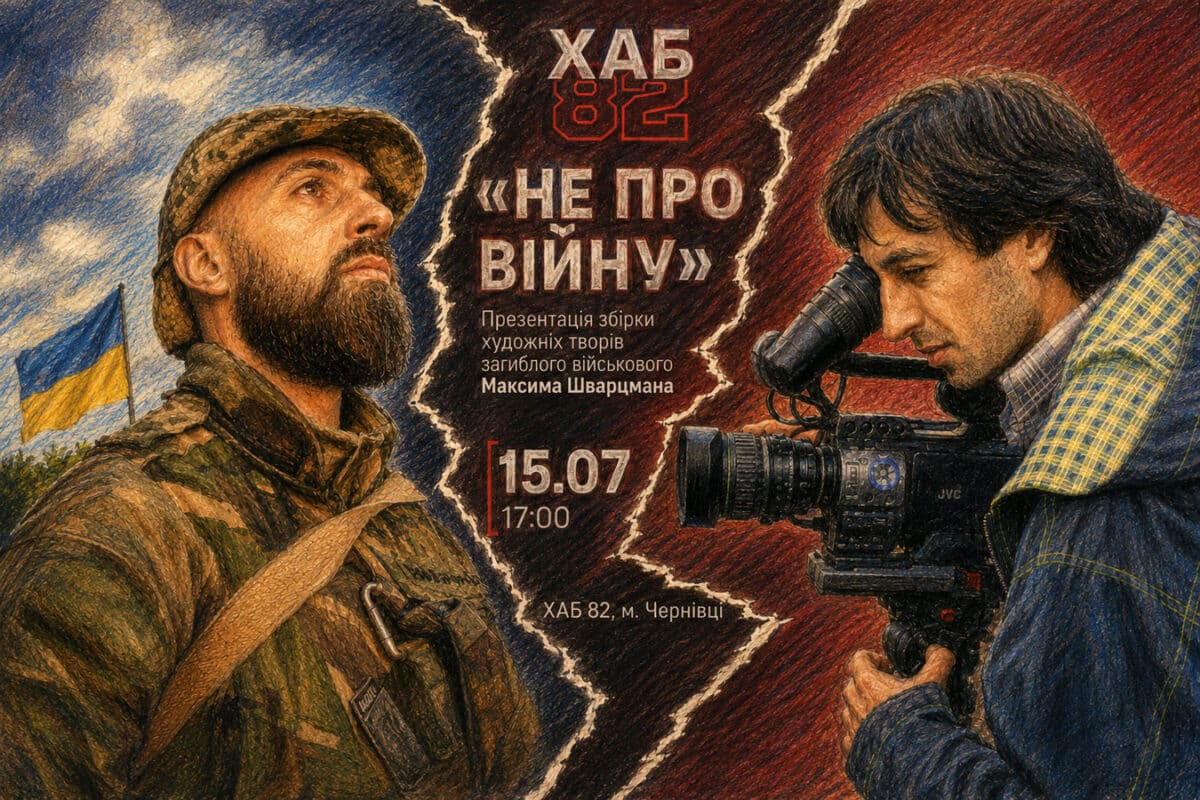
On Wednesday, July 15, 2026, at 5:00 PM in the Chernivtsi space “Hub 82” – presentation of the book “Not About War” (translated from Ukrainian “Not About War”) — a posthumous collection of artistic works and frontline letters of serviceman, journalist, videographer, photographer, artist, and writer Maksym Shvartsman.
The date was not chosen by chance. The presentation is exactly on the third anniversary of Maksym’s death, who died on July 15, 2023, during a combat mission in the Bakhmut direction.
The book was published by the Chernivtsi publishing house “Bukrek”. The meeting is moderated by candidate of historical sciences Natalia Nechaeva-Yuriychuk. As the organizers emphasize, this is not just a literary presentation, but an evening of returning the voice of a person whom the war deprived of the opportunity to fulfill his long-standing dream — to publish his own prose.
The Chernivtsi Jewish newspaper Czernowitzer Zeitung calls Maksym Shvartsman a Jewish defender of Ukraine and emphasizes the special significance of his story for the Jewish community of Chernivtsi. He belonged to Ukrainian Jewry, worked in media, engaged in art, raised children, and from the first days of the full-scale Russian invasion voluntarily stood up to defend Ukraine.
Maksym Shvartsman: from Kalanchak to Chernivtsi
Maksym Shvartsman was born on October 17, 1987, in Kalanchak, Kherson region.
After finishing school, he entered the Odessa National University, where he chose the specialty of a historian. However, he could not complete his studies: after his mother’s death, he had to earn a living on his own.
At different times, Maksym worked as a courier, cook, and took on other jobs, but his true calling remained creativity. He was interested in history, architecture, and archaeology, participated in excavations, loved nature, photographed, painted, wrote stories and songs, played the guitar, came up with scripts, and made short films.
After moving to Chernivtsi, Maksym started working on local television. Initially, he filmed news stories, then TV shows, commercials, and author projects. Later, he worked as an operator and photojournalist in several Chernivtsi media, including the information agency ASS.
Colleagues knew him primarily as a talented videographer and photographer. However, not everyone guessed that for many years Maksym wrote artistic prose and dreamed of engaging not only in television journalism but also in artistic cinema.
According to his wife’s recollections, he took the image very seriously: he set up the lighting, framed the shot, experimented with visual effects. At the same time, he called his works amateurish because he was worried that he did not receive professional director’s education.
His true dream was his own cinema. He wanted not just to capture what was happening, but to tell stories — through the frame, literature, music, and drawing.
Family, which became the main meaning of life
Maksym met his future wife Marina while working in the media field. They traveled together for shoots, participated in creative projects, and gradually became close.
Maksym and Marina had two children — daughter Sofia and son Adam. The family became the main center of his life. Relatives remember Maksym as a caring father and husband who did not divide household duties into “male” and “female”, took care of the children, cleaned, and washed clothes by hand when there was no washing machine in the rented apartment.
He learned to cook borscht, which the children called tastier than their mother’s. For some time, Maksym was practically a “stay-at-home dad”: he stayed home with the children while Marina worked.
The Shvartsman family dreamed of their own small house near Chernivtsi — with a garden and a place where the family could gather by the fire. Maksym loved to take the children to secluded places, which he called “thickets”, told them about the history of the region, nature, architecture, and old buildings.
At the beginning of 2014, the family lived for some time in Maksym’s native Kalanchak, Kherson region. Already then, Russian aggression against Ukraine entered their daily life: the occupied Crimea was nearby, and Marina later recalled how she looked out the window, fearing to see military equipment.
Creativity that Maksym did not want to leave
Maksym Shvartsman was not only a television operator and photographer. He wrote artistic prose and songs, painted, played the guitar, was interested in history and archaeology, came up with scripts, and dreamed of engaging in artistic cinema.
Even many colleagues, who knew him well as a talented operator, did not suspect for a long time that Maksym wrote stories and worked on a fantastic novella.
He took each frame seriously, set up the lighting, looked for unusual visual solutions, and wanted not just to capture events, but to tell stories. At the same time, Maksym remained very demanding of himself and often called his own works amateurish because he was worried that he did not receive professional director’s education.
Creativity was not a hobby for him that could be engaged in from time to time, but an important part of his personality. It was the inability to write, shoot, and develop in his favorite direction that later became one of the reasons why the family’s life in Israel did not work out.
End of 2014 — 2015: seven months in Israel
At the beginning of 2014, after the birth of their eldest daughter Sofia, Maksym and Marina Shvartsman moved from Chernivtsi to his native Kalanchak, Kherson region.
In Kalanchak, the family lived for about half a year. It was a time of Russian occupation of Crimea: Marina recalled that she went to the window and checked if military equipment appeared near the house.
Around the second half of 2014, the Shvartsman family returned to Chernivtsi. Maksym started working again, and soon Marina became pregnant with their son. Due to constant housing rentals and limited income, the family decided to use Maksym’s right to repatriation and try to start a new life in Israel.
The exact date of the move is not mentioned in the published interview. However, from the sequence of events, it follows that the family most likely arrived in Israel at the end of 2014 or the beginning of 2015.
In Israel, the Shvartsman family lived for about seven months. During this period, presumably in 2015, their son Adam was born. This dating is consistent with Marina’s later story: on September 1, 2022, Adam went to first grade, which allows us to date his birth to around 2015.
Which Israeli city the family chose is not specified in the available memories. It is only reliably known that Maksym rode his bicycle to work daily along a route that passed by the Mediterranean Sea.
To support his pregnant wife, and then his wife and newborn son, Maksym worked in a production workshop. For a person accustomed to journalism, filming, literature, and creative projects, monotonous physical work became a difficult test.
According to Marina’s recollections, Maksym once said: “I ride my bike past the Mediterranean Sea every day, but I can’t swim there.” It was not just about the lack of free time. This phrase conveyed his feeling of living next to beauty and freedom, which he could not enjoy due to constant work and financial pressure.
About seven months later, approximately in 2015, the family decided to return to Chernivtsi. After returning, Marina went to work, and Maksym, unable to immediately find a suitable place, stayed home with the children for some time and, as the family put it, became a “stay-at-home dad”.
Thus, the Israeli period in the life of the Shvartsman family can be dated approximately the end of 2014 — 2015. The exact dates of arrival and return, as well as the name of the city, Marina did not name in the published interview, so a more precise dating cannot be indicated without her direct confirmation.
For NAnews — News of Israel, the Israeli part of Maksym Shvartsman’s biography has special significance. His fate directly connects Israel, Jewish Chernivtsi, and Ukraine.
Maksym had the right to repatriation, his son was born in Israel, and the family itself gained experience living in the country. However, the home with which his work, creativity, public life, and subsequently military service were connected became Chernivtsi and Ukraine for him.
…
He supported his wife’s literary creativity as well. In 2022, Marina published her first novel “Christmas Count”. Maksym was already in service and could not attend the presentation, but his wife sent him a copy of the book. Later it was found among his most cherished belongings along with children’s drawings, documents, and chevrons.
February 24, 2022: the operator exchanged the camera for a weapon
Maksym’s native Kalanchak was among the first Ukrainian settlements captured by Russian troops in February 2022.
There remained his family home, childhood memories, and the graves of his mother and stepfather. The footage of Kalanchak’s occupation was a personal blow to him.
On February 24, 2022, Maksym decided to go to the military enlistment office and voluntarily joined the Chernivtsi territorial defense. Before that, he had no military experience, but he believed he could not stand aside.
A photographer and videographer, accustomed to holding a camera, took up arms to defend Ukraine.
At first, his unit was located in the Chernivtsi region. At Maksym’s request, his wife and children went to relatives in Poland, but after two months the family returned. Until the end of summer, he could sometimes come home, but in early September 2022, the 92nd battalion was sent to the Kharkiv region.
Maksym served as a shooter in the 92nd battalion of the 107th separate brigade of the Territorial Defense Forces of the Armed Forces of Ukraine. His call sign was “Marvel”.
Initially, he performed combat missions in the Kharkiv direction, and then was transferred to the Donetsk region — one of the most difficult sections of the front.
For a long time, his wife did not even know his call sign. She accidentally saw the inscription Marvel on his uniform in one of the sent photos. Maksym himself tried not to tell his family the details of his service. During calls, he more often asked about the children, school, Marina’s work, and household matters than talked about what was happening at the front.
In Kharkiv, communication sometimes disappeared for periods ranging from three to ten days. Before going on a combat mission, Maksym usually only warned that he would not be able to write or call for some time.
Comrades remembered him as a person who did not look for excuses and did not refuse hard work. If it was necessary to dig positions, carry loads, or perform another task, he just went and did it.
When there was an opportunity to try to transfer to a safer position, Maksym refused to leave his unit. For him, it was a matter of responsibility to the people he served with and a matter of personal honor.
The last message and death near Bakhmut
The last message to his wife Maksym sent late in the evening on July 14, 2023. He warned Marina that the unit was moving to a new location and communication would probably be unavailable for one or two days.
The next day, July 15, 2023, a group of Ukrainian servicemen was performing a combat mission in the Bakhmut direction.
The unit took enemy positions but came under Russian artillery fire. Maksym Shvartsman was killed. He was 35 years old. Along with him, another serviceman was killed, and a third soldier was wounded.
In the first days, the family did not have complete information. Contradictory reports appeared, and Marina continued to hope that her husband might have survived.
Later, the unit reported that the bodies of the deceased were visible from a drone, but it was not possible to evacuate them immediately: the positions were temporarily occupied by Russian troops. After Ukrainian forces regained the territory, the bodies of the defenders were able to be retrieved.
Maksym was buried in the Alley of Glory at the Central Cemetery of Chernivtsi.
According to the Institute of Mass Information, Maksym Shvartsman became the 66th media worker killed as a result of Russian aggression against Ukraine.
Order “For Courage” and other awards
On November 16, 2023, the President of Ukraine Volodymyr Zelensky signed a decree posthumously awarding Maksym Shvartsman the Order “For Courage” III degree.
The decree noted the courage and selflessness shown in defending the state sovereignty of Ukraine, as well as Maksym’s contribution to the development of television, radio broadcasting, and communications. The public announcement of the state award to the family was made in July 2024.
Maksym was also awarded the medal “For the Liberation of Kharkiv Region”, the award “For Services to Bukovina”, the badge of the Chernivtsi City Council “For the Glory of Chernivtsi”, and other regional distinctions. Some awards were given posthumously.
However, for family and friends, the memory of Maksym is not limited to military uniform, call sign, and state awards.
Marina Shvartsman emphasizes: she wants her husband to be remembered primarily as a living, kind, and talented person — a father who walked with his children, a husband who dreamed of a house with a garden, an operator who saw the world through a frame, and a writer who did not live to see his own book.
What is included in the book “Not About War”
“Not About War” is not a military chronicle or a collection of works by different authors. It is a posthumously published author’s book by Maksym Shvartsman.
The confirmed composition of the printed edition includes:
- several artistic stories;
- an unfinished fantastic novella “Guardians of Continuity”;
- letters and messages to his wife Marina, written from the front line.
Before the full-scale invasion, Maksym was known in Chernivtsi primarily as an operator and photographer. His prose remained almost unknown. The Russian war did not give him the opportunity to realize himself as a writer and independently prepare his works for publication, so the book is compiled from the texts he managed to write during his lifetime.
In the fantastic novella “Guardians of Continuity”, Chernivtsi occupies an important place — a city that Maksym loved and considered his second home.
This is not a dry description of streets and buildings. In the novella, the city appears as a living, ironic, and almost fairy-tale space. Maksym wrote about it with good humor and attention to detail, combining his own love for history, architecture, and fantasy.
The work remained unfinished.
Marina decided not to finish it for her husband. Maksym did not talk about the concept of his works until he completed them, so it is impossible to reliably restore the supposed continuation or ending. His wife preserved the text as the author left it.
Letters in which there is almost no war
A special part of the book consists of Maksym’s letters to Marina.
Although they were written on the front line, they contain almost no descriptions of hostilities. Maksym tried to separate the war from family life and not transfer the frontline reality into conversations with his wife and children.
He wrote about love, cared for Marina, was interested in the children, joked, recalled ordinary life, and continued to think about the future.
One of the letters he began after his 35th birthday, addressing his wife as a person who writes to her for the first time at a new age. Another letter was prepared in case of his death. In it, Maksym explained how he would like to be buried, supported Marina, and convinced her that she is strong and can continue to live.
This letter especially fully reveals his character. Even thinking about his possible death, he worried not about himself, but about his wife and children.
Once from the front, Maksym sent Marina an artistic text and explained that it was “not about war”. This phrase became the key to the posthumous edition: the book was created against the backdrop of war and contains letters from the front line, but it tells primarily about life, love, family, Chernivtsi, creativity, and human dignity.
The book was preserved and prepared by Marina Shvartsman
The decisive role in the appearance of “Not About War” was played by Maksym’s wife.
Marina preserved his manuscripts, electronic files, letters, messages, drawings, paintings, script sketches, and unfinished prose. However, for a long time, she physically could not force herself to reread the texts left after her husband.
Only about a year after his death did Marina find the strength to return to the manuscripts and begin editing them.
As early as 2025, she talked about plans to prepare a book that could include stories, scripts, artistic works, an unfinished novella, and Maksym’s letters. The final, publicly confirmed composition of the printed edition included stories, the novella “Guardians of Continuity”, and frontline letters. Organizers have not yet reported separately on the publication of scripts and paintings in the current edition.
For Marina, publishing the book is the fulfillment of a dream that Maksym did not have time to realize himself.
But it is also an attempt to return to readers the real Maksym Shvartsman — not only a soldier with the call sign “Marvel”, who died near Bakhmut, but a person who loved children, cooked borscht, made films, was interested in archaeology, drew, played the guitar, wrote stories, and dreamed of a house with a garden.
Memory as the responsibility of the living
For the Jewish community of Chernivtsi, the presentation of “Not About War” will be not only a literary event.
It is an evening of remembrance for a representative of Ukrainian Jewry, who had the right to repatriation, lived with his family in Israel, raised a son born there, but after the start of the full-scale invasion voluntarily stood up to defend Ukraine.
His story shows that resistance to Russian aggression united Ukrainians of different nationalities, cultures, and religious traditions.
NAnews — News of Israel tells the story of Maksym Shvartsman precisely because it is part of the shared Israeli-Ukrainian memory. It combines Jewish origin, Israel, Chernivtsi, occupied Kalanchak, Ukrainian culture, and the struggle for Ukraine’s freedom.
In Jewish tradition, the memory of the deceased is not only a recollection of the past but also the responsibility of those who continue to live.
After the name of the departed person, it is said: זכרונו לברכה — “May his memory be blessed”.
Maksym Shvartsman continues to live in his children, in preserved frames, drawings, letters, and the book, the appearance of which became possible thanks to the love and strength of his wife.
The war was able to cut short his life.
But it could not silence his voice.
May the memory of Maksym Shvartsman be blessed.
…
“Not About the War”: The book of Jewish defender of Ukraine Maksym Shvartsman was presented in Chernivtsi on the 3rd anniversary of his death at the front - July 21, 2026
- Новости Израиля
Did Azerbaijan stop Israel’s vote on recognizing the Armenian genocide? - July 20, 2026
- Новости Израиля
June 2026 was the hardest for Ukrainian civilians since April 2022 — UN data - July 20, 2026
- Новости Израиля