Jews from Ukraine: Haim Hazaz – from the Ukrainian village of Sidorovichi to the first ever Israel Prize for Literature

A boy from a Ukrainian Jewish village who survived pogroms and humiliation by Russian authorities in Kyiv became a symbol of Israeli literature. The biography of Haim Hazaz in our permanent section Jews from Ukraine is a bridge between Ukraine and Israel, past and future.

Roots in Ukraine: Childhood among forests and traditions

Today the name Haim Hazaz (חיים הזז) is known to everyone interested in the history of Israel and Jewish culture. But the beginning of his path is the Ukrainian village of Sydorovychi.

Haim Hazaz (real name – Haim Fishel Feldman) was born in 1898 in the village of Sydorovychi, Kyiv province (now – Vyshhorod district, Kyiv region of Ukraine). This small place was located in the wooded area of Polissya and was a typical Jewish settlement with the dominant role of the traditional community.

His father was a Breslov Hasid and managed a sawmill, so the future writer’s childhood was spent in a small house among dense forests.

In early childhood, Haim studied at a cheder – a Jewish religious school at the synagogue, where he learned Hebrew, Tanakh, the main laws and traditions. Later he received a secular education, possibly at a rural or city school, where he studied languages and the basics of secular subjects in depth.

In everyday life, there was a lot of household communication between the inhabitants. As a rule, people spoke a mixture of Yiddish, Russian, and Ukrainian. For the Jewish population, the main language was Yiddish, and Russian was used in official spheres. Ukrainian was part of the cultural background and was heard around, but was not dominant in the Jewish environment. Little Haim heard Ukrainian speech from childhood, observed the traditions and life of his Ukrainian neighbors.

There is no evidence in academic sources that Haim Hazaz was fluent in Ukrainian or wrote in it. All of Hazaz’s main works were written in Hebrew, which was part of his cultural mission – to revive national literature in the holy language.

In his letters and memoirs, there are no fragments in Ukrainian, except for rare everyday expressions or individual words. Some Ukrainian words or character names may appear in his texts as background details. It can be stated that Hazaz knew well the realities and traditions of the Ukrainian village, as he grew up in this environment. Understanding Ukrainian speech was natural for him, considering his living conditions.

With the onset of revolutionary events and a wave of violence in 1917–1918, Hazaz was forced to leave his native village. He moved to Kyiv, where he tried to continue his studies and start an independent life, but the capital was engulfed in political chaos, a change of authorities and dangers for the Jewish population.

It is known that in Kyiv he worked as a teacher (most likely in a Jewish religious school or privately), and also did odd jobs related to teaching and translations. In Hazaz’s memoirs, it is mentioned that in the years of chaos he had to temporarily engage in various jobs, including helping Jewish intellectuals and the elderly who were left without means of subsistence.

What was happening in Kyiv at that time:

  • February – November 1917: Power belonged to the Provisional Government of Russia and gradually to the Central Rada (Ukrainian national government).
  • January 1918: Capture of Kyiv by the Bolsheviks (Red Army), then the city was taken by the UNR troops and German-Austrian units (April 1918).
  • End of 1918 – early 1919: Hetmanate of Skoropadskyi (with the support of the Germans), then power passed to the Directorate of the UNR.
  • February – August 1919: The Bolsheviks returned to Kyiv, then replaced by the UNR troops.
  • August 1919: The Volunteer Army (White Army of Denikin) entered Kyiv. It was during this period that some of the largest pogroms were recorded, committed by White units and their accompanying detachments.
  • End of 1919 – 1920: The Bolsheviks captured the city, but several times power passed to Polish and Ukrainian troops, then again to the Bolsheviks.

After a series of Jewish pogroms that swept Kyiv and its surroundings in 1919 (Bolsheviks – White Army of Denikin), Hazaz found himself among thousands of refugees wandering between cities in search of safety.

For the next several years he lived and worked in Kharkiv — then a major industrial and cultural center of eastern Ukraine, and also in Crimea. In parallel, Hazaz continued self-education, attended cultural circles and libraries, read a lot, and tried his hand at literature.

In early 1921, when the wave of repression and famine intensified, Haim Hazaz finally decided to leave Ukraine.

Through the Black Sea coast — Sevastopol — he emigrated first to Turkey, then to France, and later to “Palestine”. Thus, before emigration, his entire life and formation took place on the territory of Ukraine: in Sydorovychi, Kyiv, Kharkiv, Crimea and other places that remained forever in his memory and prose.

Modernity: in the Ukrainian village where the father of Yitzhak Rabin and writer Haim Hazaz was born, Putin’s soldiers looted the Israeli flag from the library, presented to the village by the state of Israel

In the spring of 2022, the small Ukrainian village of Sydorovychi, the homeland of Haim Hazaz and also of the father of Israeli Prime Minister Yitzhak Rabin, found itself at the center of tragic events. The village was on the path of the invaders on their way to Kyiv – the capital of Ukraine. After passing through the Chernobyl zone, Russian soldiers entered Sydorovychi on February 25. 35 days of brutal occupation began.

In the houses of residents, windows and doors were broken, soldiers took away household appliances, food and everything of any value. Many villagers lived for weeks without electricity or water, hid from shelling and tried to protect their families and neighbors.

The memorial plaque in honor of the Rabin family was moved by local residents to the library, which became a shelter for the only commemorative sign symbolizing the international ties of this village.

A characteristic moment: Russian soldiers, before retreating from the village, stole not only washing machines from the homes of peaceful residents.

Putin’s soldiers stole the Israeli flag from the library, presented to the village during the opening of the memorial plaque.

When the story of the village of Sydorovychi became known to Israeli Ambassador to Ukraine Michael Brodsky, his reaction was immediate. At the ambassador’s request, the flag of Israel was delivered to the village – to replace the flag stolen by Russian occupiers; medicine was also delivered.

In the liberated Ukrainian village, which gave Israel such outstanding figures, there is once again an Israeli flag.

Russian Pogroms in Ukraine: The Tragedy of the Jewish People

The beginning of the 20th century was marked for the Jews of Ukraine by an unprecedented catastrophe. During the Civil War (1918–1921), there were more than 1,000 Jewish pogroms in Ukraine alone.

Modern research and archives (Encyclopaedia Judaica, Yad Vashem, Henry Abramson, Geoffrey Hosking) emphasize:

“the most massive and brutal pogroms were committed by armies and authorities coming from Russia — primarily Denikin’s White Army, units of the Red Army, and various Russian military administrations.”

The period of August–October 1919 was especially tragic for Kyiv, when the real power in the city was held by the Volunteer Army (White Army) of General Denikin and the Russian military administration. It was at this time that dozens of cases of robbery, eviction, and mass murder of the Jewish population under the control of the Russian authorities were recorded.

Haim Hazaz was a direct witness and victim of this tragedy. In Kyiv, as he later recalled in Paris, he faced a direct order from the Russian authorities to evict an elderly Jewish scholar and destroy his library—and refused to carry it out, realizing that behind this stood a policy of terror and humiliation brought by the Russian military forces. After this, Hazaz was forced to flee south.

Haim Hazaz’s Literary Activity: Ukrainian Motifs, Heritage, Influence

The name Haim Hazaz is an integral part of the history of Hebrew literature and the cultural heritage of Israel. His creative path is closely connected with the fate of Ukrainian Jewry and the era of catastrophic change on this land.

The Ukrainian Theme in Hazaz’s Prose

Most of Hazaz’s early works are inspired by his personal experience of life in Ukraine, memories of the shtetl, the tragedy of pogroms and revolutions, and the history of the Jewish people on Ukrainian soil:

  • “In a Forest Settlement” (Beyishuv shel ya’ar, ביישוב של יער, Paris, 1930)
    An autobiographical novel describing the life of a Jewish family of timber traders in the Ukrainian Polissya on the eve of the 1905 revolution. At its heart are the drama of the shtetl, generational conflicts, coexistence with Ukrainian peasants, and the gradual disappearance of the old world.
  • “Of This and That” (Mi-ze u-mi-ze, מזה ומזה, 1924)
    A novella in which, through the fates of the characters, the collapse of the familiar order of the town, the anxieties of revolutionary Ukraine, the fear of violence, and uncertainty about the future are depicted. The atmosphere of anxiety and anticipation of disaster is keenly felt.
  • “Sketches of Revolution” (Pirkei Mahapeha, פרקי מהפכה, 1924)
    A cycle of stories about revolutionary events in the former Russian Empire, mainly in Ukrainian cities, villages, and towns. The focus is on the fates of ordinary Jews caught between the millstones of history, forced to choose between tradition, revolution, fear, and hope.
  • “Shmuel Frankfurter” (Shmuel Frankfurter, שמואל פרנקפורטר, 1925)
    A story about the tragedy of the shtetl against the backdrop of the civil war and pogroms in Ukraine. The hero is a noble idealist who perishes during mass repressions and anarchy. The crisis of Jewish self-identification in a devastated Ukraine is vividly portrayed.
  • A number of short stories and miniatures from the late 1920s to early 1930s
    Thematically, they cover images of the Ukrainian town, childhood, fear of pogroms, street life, encounters with Ukrainians, memories of family holidays and tragedies. Examples are the stories “Legend,” “Letter to the Village,” “Farewell.”
  • Separate chapters of major works
    Even in later novels (“Yaish,” “The Sermon”), there are recollections of Ukrainian towns, images of refugees, reflections on the lost home, native language, and the past.

Style, Mission, Historical Significance

In Hazaz’s Ukrainian works, the main theme is the collapse of the old world, the pain of loss, and the search for new meaning. Through the fates of ordinary people, he shows the scale of the national catastrophe—and at the same time seeks sources of inner strength for rebirth.

His language is precise, rich in folk expressions, with detailed descriptions of the landscape, everyday life, festive and mourning rituals. Hazaz showed how Jewish-Ukrainian life was inseparable from the very history of Ukraine and why the memory of this is necessary for future generations.

Hazaz’s literary heritage is a mirror of the tragedy and heroism of the Jewish people of Ukraine, their eternal yearning for light even in times of darkness and hardship.

Thanks to Hazaz, the themes of the tragedy of Ukrainian Jews, life on the border of cultures, and the search for national and personal meaning have taken a key place in the Israeli literary canon.

Other Works and Contribution to Literature

  • “The Sermon” (Ha-Drasha, 1942) – an inner monologue about Zionism, Jewish fate, and identity. From here comes the famous quote about the transformation of Jewry in the Diaspora.
  • “Yaish” (Yaish, 1952–1956) – a novel about the life of Yemeni Jews in Eretz Israel, but with numerous references to the past of Eastern Europe, the experience of Ukrainian towns, and the crisis of tradition.
  • “Thou That Dwellest in the Gardens” (Thou That Dwellest in the Gardens, 1960) – a novel about spiritual quests, crisis of faith, the clash of past and future.

Life, Family and the Path of Haim Hazaz in Israel

In the spring of 1931, Haim Hazaz immigrated to “British Palestine” and settled in Jerusalem. For the first sixteen years of life in the new city, he often changed neighborhoods, getting to know different Jewish communities, especially Yemeni immigrants among whom he lived and interacted. This experience had a profound influence on his worldview and creativity.

In Turkey, where Hazaz found himself en route to Palestine, he spent almost two years teaching Hebrew to young Zionist Jews and actively participated in educational and outreach programs.

In Paris, where he moved in 1923, Hazaz became famous as a Jewish writer, published his first major works, and joined the Jewish literary circle. There he had a union with the poetess Yocheved Bat-Miriam; their son Naum was born in Paris in 1928. The couple broke up in 1929, when Bat-Miriam moved to Palestine.

In 1951, Hazaz married Aviva Kushnir (née Ginzburg-Peleg, 1927–2019)—an intellectual, companion, and faithful assistant to whom he bequeathed all his unpublished manuscripts. She became his right hand in creative and public work.

In Jerusalem, Hazaz devoted himself to literature, became one of the main authors of the “Am Oved” publishing house—his collected works, published in 1942 (“Rekhaim Shvurim”), became one of the first landmark publications of the new publishing house. Later, most of his books were also published there. In 1970, a complete 12-volume collection of Hazaz’s works was published.

Hazaz mastered all styles of Hebrew—from biblical and Talmudic to medieval and modern—which made his prose complex, rich, and profound. In the 1950s–60s, he was called Israel’s leading Jewish writer, even a rival to Nobel laureate Shmuel Agnon.

Haim Hazaz died on March 24, 1973, in Jerusalem of a heart attack. He was buried in the old cemetery on the Mount of Olives—next to the greatest figures in Israeli history.

Memory and Recognition: How Hazaz is Honored Today

In his native Sydorovychi, a memorial plaque in honor of another famous native—Nehemiah Rabichev (the father of Israeli Prime Minister Yitzhak Rabin)—appeared in 2010, and Hazaz’s name was included in the list of prominent Jews of this region.

Haim Hazaz is not just a classic of Hebrew literature; he has become a symbol of national recognition and cultural continuity.

  • In 1953, he became the first-ever laureate of the Israel Prize for Literature, established by the state to honor outstanding cultural figures. This event became a symbol of the new nation’s admiration over the past of the Jews of the Diaspora.
  • Previously, he had already received the Bialik Prize—the first in 1942, the second in 1970. This award was given for his contribution to the development of progressive Jewish literature and culture.
  • His achievements in literature and cultural identity made him an authority not only in Israel, but also in the Jewish diaspora.

Thanks to these awards, Hazaz received the status of a national literary symbol and continues to inspire generations of readers, writers, and scholars to dialogue with the past and search for cultural roots.

Haim Hazaz in the Cultural and Literary Memory of Israel

In Israel itself, the memory of Haim Hazaz is alive and institutionalized at the state and public levels. His name is invariably included in the list of classics of Hebrew literature.

This is how Hazaz is honored in Israel:

  • Haim Hazaz Prize: In Jerusalem, there is a special fund and literary prize named after Haim Hazaz, established by the city municipality. It is awarded annually to outstanding writers and researchers who have contributed to the development of Hebrew and Israeli literature. This award is a symbol of generational continuity.
  • Haim Hazaz Archive: In Jerusalem, at the Givat Ram Institute, there is a public archive named after Hazaz, where his manuscripts, letters, drafts, and personal belongings are collected. This place is one of the research centers for studying the history and literature of Israel.
  • Editions and reissues: His works are regularly republished by the largest Israeli publishers and are included in school and university programs. In 2008, for the 110th anniversary of Hazaz’s birth, a complete collection of his works was published, and leading Israeli newspapers devoted special issues to this event.
  • Streets and objects: In cities of Israel, including Jerusalem and Tel Aviv, there are streets and squares named after Haim Hazaz (for example, רחוב חיים הזז—Haim Hazaz Street in Jerusalem).
  • Commemorative evenings and exhibitions: Major museums and cultural centers of the country—the Jewish National and University Library Archive, the Diaspora Museum, municipal libraries—regularly hold memorial evenings, literary readings, and exhibitions dedicated to the life and work of Hazaz.
  • School heritage: His texts are included in the list of mandatory literature for study in Israeli schools, and Hazaz’s image is presented as an example of a “man of the era,” combining the traditions of Eastern Europe with the values of modern Israel.
  • Literary conferences: Scientific conferences devoted to Hebrew literature include special sections on Hazaz’s work. His texts are analyzed not only by philologists, but also by historians, cultural scholars, and researchers of Jewish identity.

Today in Israel, the name Haim Hazaz is not just part of the literary canon, but also a cultural brand, a symbol of generational connection and a living bridge between the past and present of the Jewish people.

Dialogue of Peoples: The Lesson of Haim Hazaz for Modernity

Today in Israel, according to the Ukrainian embassy, more than 500,000 immigrants from Ukraine and their descendants live there—this is the second largest group of repatriates. Their contribution to Israeli science, economy, culture, and literature is colossal. The story of Hazaz is proof that true Jewish identity is born not in rupture, but in the dialogue of cultures.

The website NAnews — News of Israel continues to tell the stories of Ukrainian Jews who built a new life in the Land of Israel.

Conclusions: Why Hazaz’s Fate is Not Only a Personal Story

  • Haim Hazaz is a symbol of a generation that experienced Russian pogroms and built Israel.
  • His path from a Ukrainian village to the first Israeli literary prize is an example of the strength of Jewish identity.
  • Only an honest conversation about the past—about the role of Russian armies and authorities in the catastrophe—makes the dialogue between Ukraine and Israel real.
  • The memory of him is part of the common cultural code for the Jews of Israel and Ukraine.

The section Jews from Ukraine on the NAnews website tells about outstanding Jews whose roots are connected with Ukraine, but whose life and contribution have become an important part of the history of Israel and the world.

It publishes essays, biographies, and stories of well-known and little-known personalities—from writers and scientists to modern heroes—to show how Jewish and Ukrainian destinies intertwine and form a cultural bridge between the two countries.

#jewsfromukraine


Young musicians from Ashkelon and Rivne met again in Berlin: how the Israeli and Ukrainian cities became part of a single musical exchange - September 21, 2026 - Новости Израиля

From Iran to Deir ez-Zor: why the Syrian nuclear dossier has become relevant again – and where Russia fits into this story - September 21, 2026 - Новости Израиля

Ex-goalkeeper of ‘Maccabi Haifa’ Georgy Ermakov married Alexandra Mikolyuk from ‘The Bachelor’: Israel appeared twice in the history of this couple - September 20, 2026 - Новости Израиля

A year without Max Nelipa: family in Israel, daughter with an order from Zelensky, and pain that documents do not cover

May 12, 2026 marked a year since the death of Max Nelipa — a Ukrainian TV host, actor, and serviceman who voluntarily went to defend Ukraine after the start of the full-scale war. To viewers, he was a man from the screen, a recognizable voice and face of Ukrainian television. To his family, he was a father, son, brother, ex-husband, a person whose absence is now felt in every daily movement.

This story is especially close to the Israeli audience. Details were shared by Ukrainian OBOZ.UA on May 12, 2026.

Nelipa’s ex-wife, Toma, lives in Israel with their children. Son Artem serves in the Israeli army. Daughter Maria studies, grows up, works after school, and tries to move on, although the topic of her father returns in the most ordinary moments — in movies, conversations, memories, family details.

Life after loss: Ukraine remains in the heart, Israel has become a new reality

Toma Nelipa speaks about life in Israel without beautiful generalizations.

There is also war here, anxiety, high prices, a challenging rhythm, and the need to start almost from scratch. She is learning the language because in Israel it is not just a matter of comfort, but a matter of choice: work, communication, future.

Before the big war in Ukraine, Toma worked in the field of perfumery and cosmetics, dealing with brands, presentations, communications. Already in Israel, after several different jobs and a period of adaptation, she returned to the field close to her — cosmetics, care, sales, consultations. It’s work with people, where you need to listen to the client, react quickly, understand the mood.

There is a bitter irony in this. Once in Ukraine, she was involved in public events, artists, presentations. Now in Israel, she sells cosmetics. But it is this daily occupation that helps her stay on her feet when the conversation with her past life is still not over inside.

A daughter who is growing up too fast

Maria is almost 16. She is in the 10th grade, works part-time as a barista, makes coffee, and is already trying herself in the modeling field. A contract with an agency appeared almost on the same days her father died. This could have stopped, broken, made her postpone everything “for later.”

But Toma then told her daughter what many parents probably say after a loss: dad would be proud.

Masha became more independent, changed, grew up. But she didn’t miss him any less. The loss doesn’t go away just because the child studies, works, smiles at photoshoots, or makes plans. It just moves inside and appears unexpectedly — in a random movie scene, in a conversation about family, in a memory that cannot be predicted in advance.

A son in the Israeli army and fear familiar to many families in Israel

Max’s son, Artem, serves in the Israeli army. He is 21 years old, and a significant part of his service is already behind him.

But for the mother, it is not a dry line in her son’s biography, but endless days of waiting for messages, anxious news, periods when he did not get in touch, and fear that physically changes a person.

Toma recalls that once an acquaintance noticed: she suddenly turned gray. Not from age. From tension.

For Israeli families, this state is too familiar. The phone is nearby. The news is on. The heart reacts to every message. And if in Ukraine the family saved the children from the war, then in Israel they found themselves again in a country where the word “safety” never sounds final.

Artem has about six months of service left. This stage is more related to training: computers, programming, special preparation. But even in such periods, calmness in Israel is always conditional. Here they know too well how quickly silence can turn into anxiety.

Netanya, an old district, and a sunflower in the yard

The family lives in Netanya.

Compared to Tel Aviv or Jerusalem, the city may seem calmer, but this calmness is not absolute. There is no shelter nearby, only the synagogue basement where they can go during an alarm. Usually, they stay at home.

The area is simple, old, with inexpensive rent by Israeli standards. Somewhere nearby, chickens, roosters, sometimes goats walk. This is not the picture of Israel shown in tourist videos, but it is from such details that the real life of emigration consists.

In Toma’s yard, a sunflower grows. It is already over two meters tall. For her, it is not just a plant, but a small sign of Ukraine next to the palms. A home that is physically far away but emotionally has not disappeared.

An order from Zelensky, Kyiv, and bureaucracy after the death of a defender

Last fall, Toma and Masha visited Kyiv. Max’s daughter received a posthumous order of her father — the Order of Merit III degree — from the hands of the President of Ukraine, Volodymyr Zelensky. For Maria, this trip was not a formality, but an opportunity to touch what is connected with her dad.

In the hall were military personnel, families of the deceased, people of culture. Some received awards personally, some — for their loved ones. The atmosphere was heavy but dignified. Such ceremonies do not remove the pain, but they give the feeling that a person’s name did not disappear along with the news of their death.

Toma hopes that when Artem completes his service in Israel, he will come to Kyiv — to his grandmother, to his father’s grave — and bring this award himself. There is an internal correctness in this: a son who served in the Israeli army comes to a father who died defending Ukraine.

NANews — News of Israel | Nikk.Agency sees in this story not only the personal tragedy of a famous Ukrainian family. Here, Ukraine, Israel, war, emigration, children’s service, memory of the deceased, and the thin connection between countries that runs through the destinies of specific people intertwine.

Kyiv, cemetery, and Max’s belongings

The trip to Kyiv became a return for Toma to a space where everything is familiar and at the same time already different. She met Max’s mother, went to the cemetery, walked along Khreshchatyk, ate Kyiv perepichka, missed the usual city details that suddenly become almost symbols in emigration.

In the apartment, she sorted through Max’s belongings. Among them was a special black-and-white photograph taken many years ago on a fishing trip. Such items are the hardest to touch. They are no longer just things, but evidence of a time that will no longer be.

Toma admits: even years after the divorce, she cannot completely let go of Max. They parted ways long ago, but their shared life, children, memories, and his death made this connection different. Not familial in the former sense, but very deep.

Max’s brother: after grief begins the system of documents

Max’s brother, Andrey Nelipa, speaks about the side of loss that is usually not visible in the news. People read about the death, express condolences, see ceremonies. But for the family, something else begins: papers, checks, approvals, applications, status and payment processing.

According to him, many believe that the families of fallen defenders automatically receive the assistance provided by the state. In practice, everything is much more complicated. The procedure can be delayed, require many documents, and go through several levels of the system.

This does not negate respect for the military, ritual services, or individual people who help. The problem is deeper — in the bureaucratic structure itself, which often turns out to be too burdensome for families already living in grief.

Max’s mother lost her husband in 2020, and now her younger son. She is 76, has had heart attacks, and her relatives understand how much this loss hits not only the soul but also health. But she holds on. Like many Ukrainian mothers, for whom the war has become a personal family catastrophe.

Max is remembered by friends, comrades, colleagues, viewers. On the anniversary day, relatives plan to visit the grave, and those who knew him personally or just want to pay tribute may come. The monument is still in progress, but the grave is well-kept.

The main thing in this story is not a loud name. The main thing is that behind every fallen defender stands a family that continues to live after the most terrible call. Living in Israel and Ukraine. Learning the language, going to work, serving in the army, going to school, receiving orders, processing documents, buying flowers at the cemetery, and every day understanding anew that the person is no longer there.

Max Nelipa would have turned only 50.


Young musicians from Ashkelon and Rivne met again in Berlin: how the Israeli and Ukrainian cities became part of a single musical exchange - September 21, 2026 - Новости Израиля

From Iran to Deir ez-Zor: why the Syrian nuclear dossier has become relevant again – and where Russia fits into this story - September 21, 2026 - Новости Израиля

Ex-goalkeeper of ‘Maccabi Haifa’ Georgy Ermakov married Alexandra Mikolyuk from ‘The Bachelor’: Israel appeared twice in the history of this couple - September 20, 2026 - Новости Израиля
Ukraine calls Mark Golenkov: can Israeli football lose a future national team goalkeeper

The call-up to the Ukraine U-19 national team has once again raised a big question

Israeli football may lose one of the most prominent young goalkeepers of recent years. Mark Golenkov, the goalkeeper of the youth team “Maccabi Haifa”, received a call-up to the Ukraine U-19 national team ahead of the upcoming tournament. For the player himself, this is an important sporting step, and for the Israeli football system, it is a worrying signal: a talent that grew and developed in Israel may choose the Ukrainian path at the international level.

Golenkov has long been considered one of the strong projects of the “Maccabi Haifa” academy.

But he truly made headlines after the match against “Barcelona” in the UEFA Youth League. He became the hero of the penalty shootout, saving three shots and helping the “greens” advance further. Israeli sports media wrote about him as a 17-year-old Ukrainian-Israeli goalkeeper who came to the country after the start of the war in Ukraine and quickly reached a high youth level.

At first glance, it seems to be just a youth call-up. But in football, such decisions often become the first step towards a future choice. A player can live, train, and grow in one country for a long time but remain emotionally, family-wise, and biographically connected to another. In Golenkov’s case, this connection with Ukraine is not formal but very personal.

From Kyiv and the war — to Haifa and a big football opportunity

Mark Golenkov was born and raised in Ukraine and played football in the Kyiv “Dynamo” system as a child. After the start of the full-scale Russian invasion in 2022, his family was forced to leave the country. Thus, Golenkov ended up in Israel, where he first continued his path through “Hapoel Be’er Sheva” and then moved to “Maccabi Haifa”.

This route is important not only as a sports biography. It shows the fate of an entire generation of Ukrainian children and teenagers whose lives were abruptly changed by the war. Some lost their homes, others their usual school, team, city, environment. Golenkov was among those who managed not to stop and transfer his football path to a new country.

In Haifa, he was quickly noticed. “Maccabi” saw in him not just a promising goalkeeper for the youth team but a player with the potential for a European level. According to Israeli sports publications, in December 2024, he signed a three-year contract with the club, which in itself speaks of trust from the system.

For Israel, such stories are especially important. The country has been accepting people from Ukraine, Russia, Belarus, and other former USSR countries for many years. But when a young athlete not only adapts but becomes one of the best in his age group, it is not just a personal victory. It is a question for the entire football infrastructure: can Israel not only develop talents but also retain them?

Why the match with “Barcelona” changed perceptions

Before the game with “Barcelona”, Golenkov was a promising goalkeeper within the “Maccabi Haifa” system. After it, he became a name that began to be discussed more widely. Three saved penalties in a match of this level are not just beautiful statistics. For a young goalkeeper, it is a rare moment when character, reaction, and psychological resilience become visible to everyone at once.

Goalkeepers mature differently than outfield players. They often need more time, more trust, and more high-pressure matches. But it is precisely such penalty shootouts that show whether a player can withstand the moment when the entire team depends on one move.

For “Maccabi Haifa”, it was a signal: the club has a goalkeeper who can be developed not only for the local youth league but also for a more serious career. For Ukraine, it was also a signal: the country has a young goalkeeper who grew up in the Ukrainian football school but received a new impulse already in Israel.

That is why the call-up to the Ukraine U-19 national team seems logical. Ukraine closely monitors its young players abroad, especially now, when the war has scattered thousands of families and athletes across different countries.

Personal tragedy and the choice between two football paths

Golenkov’s story became even heavier after the death of his brother Vladislav in the war in Ukraine. In April 2026, “Maccabi Haifa” announced that Vladislav Golenkov, Mark’s brother, died in battles against the Russian army. The club expressed condolences to the family and emphasized that it stands by the young goalkeeper in this difficult moment.

This detail changes the perception of the entire story. The call-up to the Ukraine national team for Golenkov is not only a sporting opportunity. It can also be a connection to home, memory, family, a country that continues to fight. For a young player, such a choice is rarely a cold calculation.

In Israel, they also understand the value of such stories. Here, it is well known that sports are often linked with war, mobilization, losses, and personal pain. Therefore, the question “who will he choose?” should not sound like a simple struggle of federations for a passport and application.

For the Israeli audience, there is a deeper layer here. Golenkov has become part of Israeli football, lives in the Israeli environment, trains in one of the strongest clubs in the country, and is already associated with the future of “Maccabi Haifa”. But his Ukrainian biography has not disappeared. On the contrary, after his brother’s death, it became even more personal and heavy.

In this sense, NAnews — Israel News | Nikk.Agency views Golenkov’s story not only as a sports news. It is an example of how the war in Ukraine continues to affect Israel through the fates of specific people: athletes, families, teenagers who are building their lives anew but do not lose connection with the country they left.

What the Israeli football system should do

If Israel truly sees Golenkov as a future national-level goalkeeper, action is needed not when he is already established in the Ukrainian system, but now. Not through pressure, but through a clear sports path: attention from national team coaches, respectful dialogue, growth prospects, and the feeling that he is not just being used here, but a future is truly being built around him.

But Ukraine has the strongest argument in this story — origin, memory, emotional connection, and national identity. Especially after everything that happened to his family.

Therefore, the future of Mark Golenkov cannot yet be reduced to a simple formula: Israel versus Ukraine. It is much more accurate to say otherwise: he is a young goalkeeper between two football worlds, and both worlds have already become part of his life.

For “Maccabi Haifa”, he remains a promising asset. For Israel, a potential goalkeeper of the future. For Ukraine, his own player who went through war, emigration, and personal tragedy but did not lose his path in football.

And the main question now is not only: for which national team will he play next? The question is broader: who will be able to give him not just a jersey, but a sense of a true football home.


Young musicians from Ashkelon and Rivne met again in Berlin: how the Israeli and Ukrainian cities became part of a single musical exchange - September 21, 2026 - Новости Израиля

From Iran to Deir ez-Zor: why the Syrian nuclear dossier has become relevant again – and where Russia fits into this story - September 21, 2026 - Новости Израиля

Ex-goalkeeper of ‘Maccabi Haifa’ Georgy Ermakov married Alexandra Mikolyuk from ‘The Bachelor’: Israel appeared twice in the history of this couple - September 20, 2026 - Новости Израиля
Kyiv, 92 years and a chuppah: a Jewish wedding during the war became a symbol of life

A mass Jewish wedding took place in Kyiv, becoming one of the most unusual and touching events of recent months for the local community. The ceremony was held at the Jewish community center “Beit Menachem” JCC Kyiv against the backdrop of a three-day relative lull from May 9–11, 2026, when a ceasefire was in effect between Russia and Ukraine.

The war has changed the life of all Ukraine — and the country’s Jewish community is going through this ordeal together with the entire Ukrainian people. Under shelling, missiles, and drones, people defend their cities, help the army, volunteer, support the elderly, evacuees, the wounded, and families whose usual lives have been destroyed by the war.

Jews of Ukraine today do not stand aside from the common struggle against the occupiers. Some serve on the front lines, others collect aid, work in community centers, support those who have been left without a home, medicine, or loved ones. This is not a separate story of a “community within a country,” but part of a unified Ukrainian reality where different people hold one country together.

And yet Ukraine continues to live. Even in Kyiv, where the war has long ceased to be news and has become a heavy backdrop of every day, people find strength for celebrations, traditions, and the future. That is why the mass Jewish wedding at JCC Kyiv resonated so strongly: several couples, including 92-year-old newlyweds, stood under the chuppah, and this moment became not just a family event but a sign that life does not give up.

Photo from May 11, 2026, was posted by Israeli Israel Hayom.

Several Jewish couples got married in Kyiv

For Ukraine, which has been living in conditions of full-scale war for more than four years, such a wedding became not just a family celebration. It was a rare moment when anxiety, sirens, and the anticipation of new strikes gave way to the chuppah, blessings, relatives, children, grandchildren, and great-grandchildren.

Different couples stood under the chuppah that evening. Among them were young people just starting their life together, middle-aged couples, and a particularly symbolic 92-year-old couple. It was their participation that made the story noticeable far beyond the Kyiv Jewish community.

According to media reports, some of the couples had lived together for many years but only now decided to formalize their marriage according to Jewish tradition — “k’dat Moshe v’Yisrael,” that is, according to the law of Moses and Israel. In peacetime, such a step might look like a personal family decision. In wartime Kyiv, it sounded different: as a choice to continue life despite the destruction around.

Chuppah in wartime Kyiv: Jewish wedding where a 92-year-old couple stood under the canopy - Israel news
Chuppah in wartime Kyiv: Jewish wedding where a 92-year-old couple stood under the canopy – Israel news

When and where it happened

The event took place in Kyiv, at the Jewish community center “Beit Menachem” JCC Kyiv. According to publications by Chabad info, Israel Hayom, and other outlets, the material was published on May 10–11, 2026, and the ceremony itself took place against the backdrop of a three-day truce from May 9–11, 2026. The Jerusalem Post specifically noted that the mass wedding took place “over the weekend,” during this brief period of relative calm.

Why this wedding became more than a private event

In ordinary life, a wedding is a family joy. In a wartime reality, it also becomes a statement: the community exists, tradition is not interrupted, Jewish life in Kyiv continues.

That is why the Kyiv ceremony attracted the attention of local and Israeli media. In the photos from JCC Kyiv, which spread across publications, not only the grooms and brides are visible, but also several generations alongside them. Children, grandchildren, great-grandchildren, relatives, and guests gathered around the chuppah as a living line of memory.

The image of the 92-year-old couple became especially powerful. At this age, people usually sum up the life they have lived, not start a new official family stage. But that is precisely why their chuppah received such an emotional response: it showed that Jewish tradition is not limited by youth, age, or the usual scenario.

Words of the Chief Rabbi of Kyiv

The Chief Rabbi of Kyiv, Yonatan Markovich, called this moment rare and strong. According to him, seeing a couple at 92 years old enter under the chuppah is not an everyday event. He emphasized that in conditions of war and uncertainty, people still choose to continue the chain of generations, preserve tradition, and build a Jewish home.

This phrase is important not only as a beautiful quote. It contains the key to understanding the whole story: it is not about a “romantic news,” but about the strength of a community that does not give up on the future even when the present remains unstable.

Why this story is important for Israel

For the Israeli audience, the Kyiv wedding reads especially closely. Israel well understands what it means to live between military threat and ordinary life: when the front, rockets, alarms may be nearby, but people still marry, have children, open schools, gather for celebrations, and hold on to tradition.

Ukrainian Jews in this story are not an abstract diaspora “somewhere far away.” They are part of the large Jewish world, connected with Israel by history, families, repatriation, community memory, and a common concern for the future.

NANews — Israel News | Nikk.Agency considers such stories precisely in this context: Ukraine, Israel, and the Jewish people experience different wars and different threats, but at the center again is the same question — how to preserve life, dignity, and continuity when there is too much uncertainty around.

Kyiv chuppah as a response to war

The mass wedding in Kyiv does not cancel the harsh reality of war. It does not make the threats smaller and does not turn the truce into a lasting peace. But it shows what is often lost in news feeds: people do not want to be just statistics of shelling, refugees, and destruction.

They want to be grooms and brides. Grandmothers and grandfathers. Parents standing next to their children. Great-grandchildren who see that tradition is not a museum piece but a living part of the family.

That is why the story of the 92-year-old couple quickly became a symbol. Not because age itself is a sensation, but because under the chuppah in Kyiv, several meanings converged at once: memory, faith, the stubbornness of life, Jewish continuity, and the Ukrainian reality of war.

Main conclusion

The wedding at JCC Kyiv became a rare event where the personal and historical coincided in one frame. Several Jewish couples, including 92-year-old newlyweds, stood under the chuppah in a city that lives between anxieties and hope.

For Kyiv, it was a community celebration. For the Jewish world, a reminder of the strength of tradition. For Israel, another sign that the connection with Jewish life in Ukraine remains alive, emotional, and important.


Young musicians from Ashkelon and Rivne met again in Berlin: how the Israeli and Ukrainian cities became part of a single musical exchange - September 21, 2026 - Новости Израиля

From Iran to Deir ez-Zor: why the Syrian nuclear dossier has become relevant again – and where Russia fits into this story - September 21, 2026 - Новости Израиля

Ex-goalkeeper of ‘Maccabi Haifa’ Georgy Ermakov married Alexandra Mikolyuk from ‘The Bachelor’: Israel appeared twice in the history of this couple - September 20, 2026 - Новости Израиля
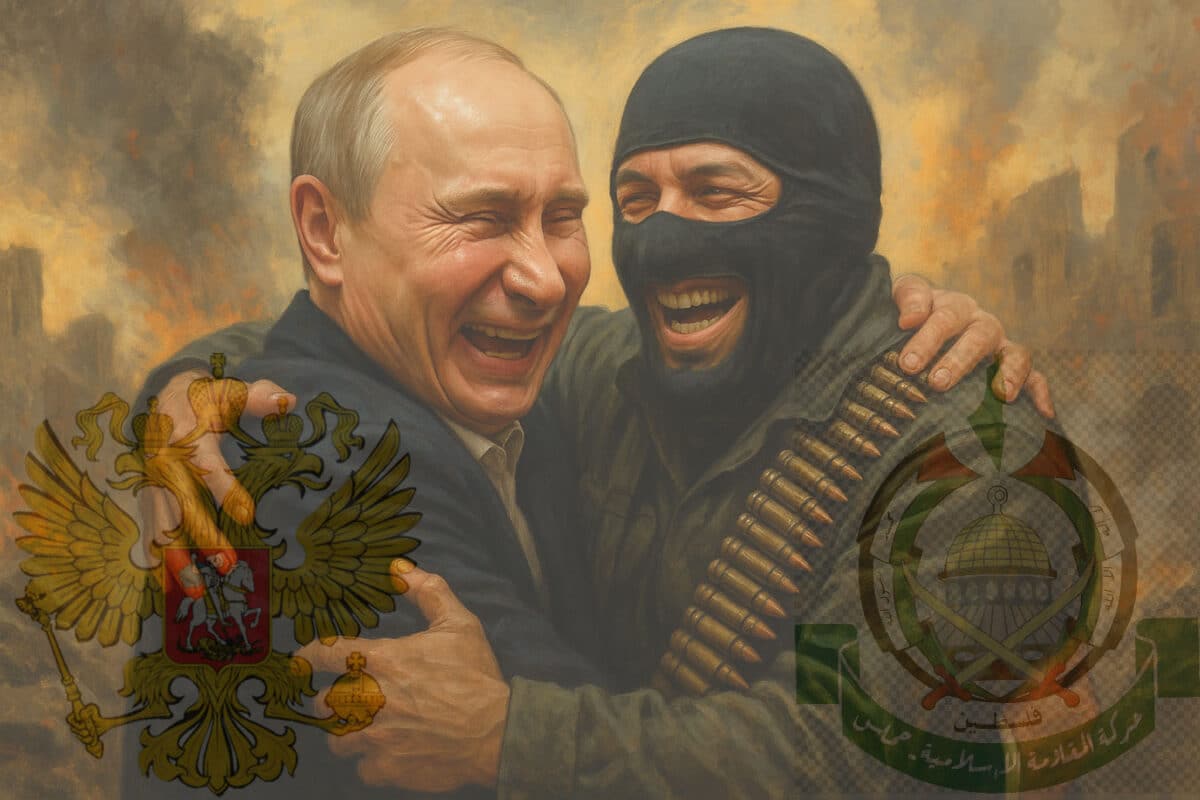
Europe and the Shadows of Hate: Why Anti-Semitism is Returning and What Russia and Hamas Have to Do with It

War is once again changing the face of Europe — and not just on the fronts. Where slogans of tolerance and human rights once echoed, the whisper of old hatred is growing louder. Anti-Semitism — the ancient virus of the continent — is awakening again, rising from the underground layers of history to the streets of Berlin, Paris, and Brussels.

Mass rallies, synagogue arson, attacks on Jews — these are no longer frames from the archives of the 1930s, but the chronicle of European news in 2025.

But the reasons for what is happening are far more complex than just a political dispute over Israel’s war with Hamas. It is a reflection of a global shift — how Russia, Iran, and their ideological partners use anti-Israeli and anti-Western rhetoric to ignite Europe from within.

When Anti-Semitism Became “Fashionable” Again

In recent months, the level of anti-Semitic incidents in Europe has increased manifold.

In France — attacks on Jewish schools and cemeteries.
In Germany — threats against rabbis and Israeli students.
In the UK, police record a rise in hate crimes of more than 500%.

But the danger is not only in the numbers.

It is about a new form of old evil — anti-Semitism under the guise of political activism.

Today, hatred is often disguised as “fighting imperialism” or “solidarity with the oppressed.”
Yesterday it was called fascism, today — “anti-colonialism.”
The essence has not changed.

Many experts note: anti-Semitism today is not always expressed in insults.

It can hide behind slogans, behind “the fight for Palestine’s freedom,” behind artificial narratives that are implanted through social networks and propaganda.

This is where the main danger of the new wave lies.

Russia and Hamas — Different Fronts of One Ideology

Europe and the Shadows of Hatred: Why Anti-Semitism is Returning and What Russia and Hamas Have to Do With It

In the Ukrainian context, the comparison of Russia and Hamas sounds particularly accurate.

Both structures operate on the same principle: terror as an argument.

Putin’s army destroys Ukrainian cities under the slogan of “liberation,” just as Hamas kills Israeli civilians, hiding behind “the fight for justice.”

This parallel is no accident.

Russia systematically builds ideological and informational ties with anti-Western forces in the Middle East.

Moscow justifies Hamas terror as a “reaction to Israeli aggression,” while in turn, it calls Russia’s war against Ukraine a “fight against Nazism.”

In fact, it is a common language of authoritarian regimes and extremist movements: everything is allowed if it can be called “resistance”.

Anti-Semitism as a Kremlin Tool

The Kremlin did not invent hatred — it learned to monetize it.

For years, Russian media structures have created pseudo-analysis where Israel and “Jewish influence” were presented as the cause of global injustice.

The same logic is used against Ukraine: “Western puppets,” “NATO accomplices,” “victims of Jewish capital.”

In essence, this is not just anti-Semitism, but a geopolitical technology.

It works on emotions, on fears, on the feeling of a “stolen identity.”

Radical Islamist propagandists operate in the same way, recruiting followers under the slogan of fighting “colonizers.”

These two streams — Russian imperialism and Middle Eastern fanaticism — merge into one: hatred of the West, Jews, and democracy.

Europe, Losing Its Immunity

Many European societies were not ready for this new form of old contagion.

After decades of peace and prosperity, control over the language of hatred has weakened.

Freedom of speech often becomes a cover for destructive narratives.

Social networks are filled with “anti-imperialist” blogs where Israel is called an “occupier” and Russia a “fighter against the West.”

Hundreds of such pages operate on the same servers, often funded from Moscow or Tehran.

Thus, anti-Semitism re-enters the mainstream — not through slogans of “beat the Jews,” but through words of “support Palestine.”

This makes it especially dangerous: a person can be a victim of propaganda without realizing that they are repeating the language of those who justify terror.

The Palestinian Narrative as a Mirror of Russian Aggression

When Hamas justifies attacks on Israel with slogans of “fighting occupation,” it is easy to recognize the Kremlin’s lexicon in these phrases: “denazification,” “liberation,” “historical territories.”

In both cases, violence is justified by a “higher goal.”

Authoritarian propagandists have learned to use the words “freedom” and “justice” as a smokescreen.

Russia justifies the killing of Ukrainians in the same way Hamas does Israelis.

The difference is only in scale: the methods are the same, the audiences different.

This is increasingly discussed in both Israel and Ukraine: terror, wherever it occurs, is always fueled by impunity.

The Ideology of Hatred and Western Fatigue

Modern Europe is tired of war.

But fatigue is the perfect ground for manipulation.

When people stop distinguishing shades, the slogan “for peace” can turn into a justification for terror.

In European universities, rallies “in support of Palestine” are held, where calls are made to “cleanse the land of Zionism.”

There is nothing humanitarian in these phrases — it is the language of hatred, only in a new wrapper.

Thus, anti-Semitism becomes acceptable again — if it is hidden under the guise of “justice.”

Ukraine, Israel, and the Moral Connection

Ukraine and Israel find themselves on the same side of reality, where terror is an ideology, and truth requires strength.

For Kyiv, it is obvious: when the West does not react to some manifestations of terror, it provokes others.

Unacknowledged evil grows faster than acknowledged.

Ukraine supports Israel in its fight against Hamas for a reason.

Both countries are targets of propaganda attacks, disinformation, and international pressure.

For both, the word “self-defense” has become not just a legal term, but a matter of survival.

How the Kremlin Plays on Anti-Semitic Sentiments

Russia actively implants anti-Semitic and anti-Israeli narratives in Western media.

Under the guise of “alternative viewpoints,” texts about “Jewish elites,” “Zionist control,” and “world conspiracy” are spread online.

These same theses were heard in the 1930s — only now, instead of newspapers, they are circulated by anonymous Telegram channels.

Often, anti-Semitism becomes a “byproduct” of pro-Russian propaganda.

Those who justify the war against Ukraine often use the same rhetorical constructions as anti-Semites: the search for an enemy, conspiracy theories, the cult of a “humiliated power.”

Why It Matters Now

Because history is knocking on Europe’s doors again.

Anti-Semitism is not just a problem for Jews. It is a litmus test of the state of society.

When hatred of Jews becomes the norm, it means the foundations of democracy are being destroyed.

Today’s cries in the squares “from the river to the sea” are not a slogan of freedom, but a warning.

And if Europe does not draw conclusions now, tomorrow this wave will engulf it itself.

What Can Stop the New Wave of Hatred

1. Strong government response.
States must qualify anti-Semitism as a threat to national security, not just as a hate crime.

2. Responsible media.
The media must stop equating the aggressor and the victim.
Terrorist organizations cannot be an “equal side of the conflict.”

3. Education and memory.
Europe cannot afford to forget where silence in the face of anti-Semitism has already led.
Every new case should be seen as an alarming signal, not as a “crowd excess.”

4. Solidarity of countries that know the price of terror.
Ukraine and Israel must remain allies — not only in politics but also in meanings.
Their experience of resisting terror is not two separate plots, but one line of defense of the civilized world.

Conclusion

Europe is once again at a crossroads.

On one side — fatigue, cynicism, false neutrality.
On the other — clarity: terror cannot be balanced, it must be stopped.

Russia and Hamas are two manifestations of one disease, which feeds on impunity and fear.

And while Europe seeks excuses for those who shoot at children, hatred continues to change flags, but not its essence.

Peace will begin where evil is no longer justified — under any slogans.

And if Europe wants to remain Europe, it will have to remember why it swore: never again.


Young musicians from Ashkelon and Rivne met again in Berlin: how the Israeli and Ukrainian cities became part of a single musical exchange - September 21, 2026 - Новости Израиля

From Iran to Deir ez-Zor: why the Syrian nuclear dossier has become relevant again – and where Russia fits into this story - September 21, 2026 - Новости Израиля

Ex-goalkeeper of ‘Maccabi Haifa’ Georgy Ermakov married Alexandra Mikolyuk from ‘The Bachelor’: Israel appeared twice in the history of this couple - September 20, 2026 - Новости Израиля

Fiber-optic drones for Iran: how Putin’s plan against the US reveals a new axis of threat in the Persian Gulf

The American-Iranian war could gain another dangerous layer: the Russian one. According to The Economist on May 7, 2026, the publication obtained a confidential document from Russia’s Main Intelligence Directorate, which suggests that Moscow offered Tehran thousands of fiber-optic drones and operator training for strikes against American forces in the Persian Gulf.

This is not just about delivering another batch of drones. The document described a military aid project to Iran, designed for a situation where the US might move to a ground operation against the Islamic Republic. For Israel, this story is important not only as an episode of the American-Iranian confrontation but also as a signal: Russia, Iran, and their military technologies are increasingly intertwined into a single system of pressure on the West, the Middle East, and Ukraine.

What exactly, according to The Economist, did Russia offer Iran

According to The Economist’s publication, the Russian plan provided for the transfer of 5,000 short-range drones to Iran. Separately, more long-range systems with satellite guidance were mentioned, but their quantity was not specified in the project.

The main feature of these drones is fiber-optic control. Such devices are connected to the operator not by a radio channel, but by a physical fiber-optic cable. This sharply reduces the effectiveness of electronic warfare means because conventional signal jamming almost does not work here.

In other words, it was about drones that are harder to suppress, intercept, and disorient with standard electronic warfare means. That is why such drones are especially dangerous against forces operating in confined spaces: landing ships, port infrastructure, temporary bases, columns of equipment, and forward units.

According to the publication, Putin personally offered Iran not only weapons but also training on how to use these systems against American soldiers. This already translates the story from the plane of ordinary arms export to the zone of direct military assistance to anti-American operations.

Why this is important for Israel

For the Israeli audience, there is an obvious connection here. Iran remains Israel’s main strategic adversary, and Russia increasingly acts not as a neutral player but as a country ready to strengthen those who fight against Western allies and US regional partners.

If Tehran receives technologies, experience, and training from Moscow, these solutions do not disappear after one conflict. They can be transferred to proxy structures, adapted to new theaters of war, and appear in the hands of groups that act against Israel or near its borders.

This makes the topic of fiber-optic drones not a narrow technical detail, but an element of the big picture of security in the Middle East.

Secret GRU project: islands, Kharg terminal, and attacks on landing ships

The Economist’s material states that the 10-page GRU project was prepared in the first weeks of the war when the scenario of an American ground invasion of Iran was considered. The document, according to the publication, included diagrams and a map of islands off the Iranian coast.

A special place was occupied by Kharg Island — Iran’s key oil terminal. According to the document, American forces might attempt to capture it, and the Russian side offered scenarios of counteraction.

One of the diagrams showed how operators trained by Russia could launch swarms of five to six drones from hidden positions. The targets of such attacks were named as American landing ships. This does not look like improvisation: the scheme implies operator training, understanding of the coastline, selection of launch points, and use of vulnerabilities during landing.

In the middle of this story, it is important to see not only military equipment but also political meaning. NAnews — Israel News | Nikk.Agency considers such plots precisely through the prism of the Iran-Russia-regional security link, because for Israel such plans mean an increase in threat not somewhere far away, but in a zone that directly affects the balance of power around the country.

Who they wanted to make drone operators

The block on recruiting operators is particularly indicative. According to The Economist, the GRU proposed looking for people among approximately 10,000 Iranian students studying at Russian universities.

The document also mentioned Tajiks and Syrian Alawites loyal to the overthrown regime of Bashar al-Assad. Such logic is understandable: Russia could use people already in its orbit, train them on its territory, and then transfer not only equipment but also a ready human resource to Iran.

This resembles not a classic state army, but a hybrid war infrastructure. Students, foreign loyalists, technical specialists, military instructors, closed training programs — all this forms a system where the line between ally, mercenary, and proxy operator becomes blurred.

New technological threat: why fiber-optic drones change the rules of the game

Ordinary FPV drones depend on radio communication. They can be jammed, intercepted, knocked off course, deprived of image or control. That is why electronic warfare has become one of the key elements of modern warfare.

A fiber-optic drone works differently. It drags a thin cable behind it, through which control and signal transmission occur. This limits range and maneuverability but provides a significant advantage: such a device is much harder to suppress with electronic means.

For close-range attacks, this can be critically dangerous. Especially if drones are launched in groups, from pre-prepared positions, at targets that are difficult to quickly move: ships, warehouses, equipment on the shore, command points, or infrastructure objects.

Ukrainian experience and Middle Eastern risk

Russia is actively studying drone warfare on the front against Ukraine. Every technological technique worked out on the Ukrainian front can then go further — to Iran, to allied regimes, to military proxies, or to the gray zones of the global arms market.

For Israel, this is an especially unpleasant scenario. Technologies that are used against Ukraine today may appear tomorrow in the hands of those who see Israel as a target. Iran has already proven that it can scale drone programs, transfer technologies to allies, and build an entire military doctrine around drones.

Therefore, The Economist’s report looks alarming not only because of a possible attack on American forces. It shows that Moscow is ready to help Iran precisely where it can cause maximum damage to the US and its partners.

What this says about Putin’s strategy

Putin’s Russia is increasingly less hiding that its interest is not stability, but the expansion of chaos. Supporting Iran at the moment of war with the US, if the described document indeed reflects Moscow’s real proposals, shows a willingness to use the Middle East as another front of pressure on the West.

This coincides with the general logic of Russian policy: in Ukraine — to destroy cities and infrastructure, in Europe — to destabilize security and politics, in the Middle East — to strengthen those who oppose the US, Israel, and the Western order.

Iran in this scheme is not an accidental partner. It has long been an enemy of Israel and Ukraine: for Israel — through the nuclear threat, missiles, and proxy groups; for Ukraine — through drones that Russia uses in strikes on civilian infrastructure. Now, according to The Economist, it may also be about the movement of technologies in the opposite direction: Russia offers Iran new means for war against Americans.

The final conclusion here is harsh but logical. If such plans existed on paper, then the military rapprochement between Moscow and Tehran has reached a level where each new technology can quickly become common. And for Israel, this means the need to view the Russian-Iranian link not as a diplomatic background, but as a direct security factor.


Young musicians from Ashkelon and Rivne met again in Berlin: how the Israeli and Ukrainian cities became part of a single musical exchange - September 21, 2026 - Новости Израиля

From Iran to Deir ez-Zor: why the Syrian nuclear dossier has become relevant again – and where Russia fits into this story - September 21, 2026 - Новости Израиля

Ex-goalkeeper of ‘Maccabi Haifa’ Georgy Ermakov married Alexandra Mikolyuk from ‘The Bachelor’: Israel appeared twice in the history of this couple - September 20, 2026 - Новости Израиля

“Shameful gathering of Jewish and Ukrainian nationalists”: in 1966, the first rally took place in Babyn Yar

What Happened and Why It’s a Turning Point

At the end of September 1966, Kyiv residents independently held a commemoration at Babyn Yar for the first time in a quarter of a century. September 24 — a small quiet action (about fifty people), September 29 — already hundreds. Thus began the city’s “lower” memory, returning names to the place where on September 29–30, 1941, the Nazis shot about 34,000 Jews in two days, and in total, about 100,000 people were killed in the ravine during the occupation. This was a turning point: memory initiated by citizens outpaced and forced changes in the official, impersonal version of history.

The story of the rally and its consequences was told on September 29, 2025, by the Ukrainian publication radiosvoboda (Ukr.) – there are many photos here.

Background: The Filled Ravine and the Kurenivka Disaster

1961: A Wave of Mud as “Babyn Yar’s Revenge”

The post-war years in Kyiv were marked by the systematic erasure of crime traces: the ravine was filled, a highway was laid nearby, and the old Jewish and Karaite cemeteries were destroyed for future construction.

On March 13, 1961, an earthen dam with liquid waste from a brick factory burst, and a four-meter wave of slurry hit Kurenivka. According to various estimates, 145 to 1,500 Kyiv residents died — the tragedy in popular memory was called “Babyn Yar’s Revenge.”

It was after these events that young Kyiv resident Emmanuel (Amik) Diamant first “saw” the Yar in the summer of 1961: a churned-up mess of earth and human bones. He began filming what was happening, creating unique testimonies of the state of the ravine in the early 1960s.

Personal Assembly Point: “I Am Responsible Only”

From Yevtushenko’s Line to Action

During the same period, Diamant heard a public reading by Yevgeny Yevtushenko — with the line “There are no monuments over Babyn Yar.” His response was harsh and honest:

“There was a lot of pathos… But Yevtushenko helped me understand the main thing: I am responsible only.”

This is the turning point: not waiting for someone’s permission, but returning memory through one’s own action.

How the First Outing Was Prepared

Canvas, Black Paint, and “Word of Mouth”

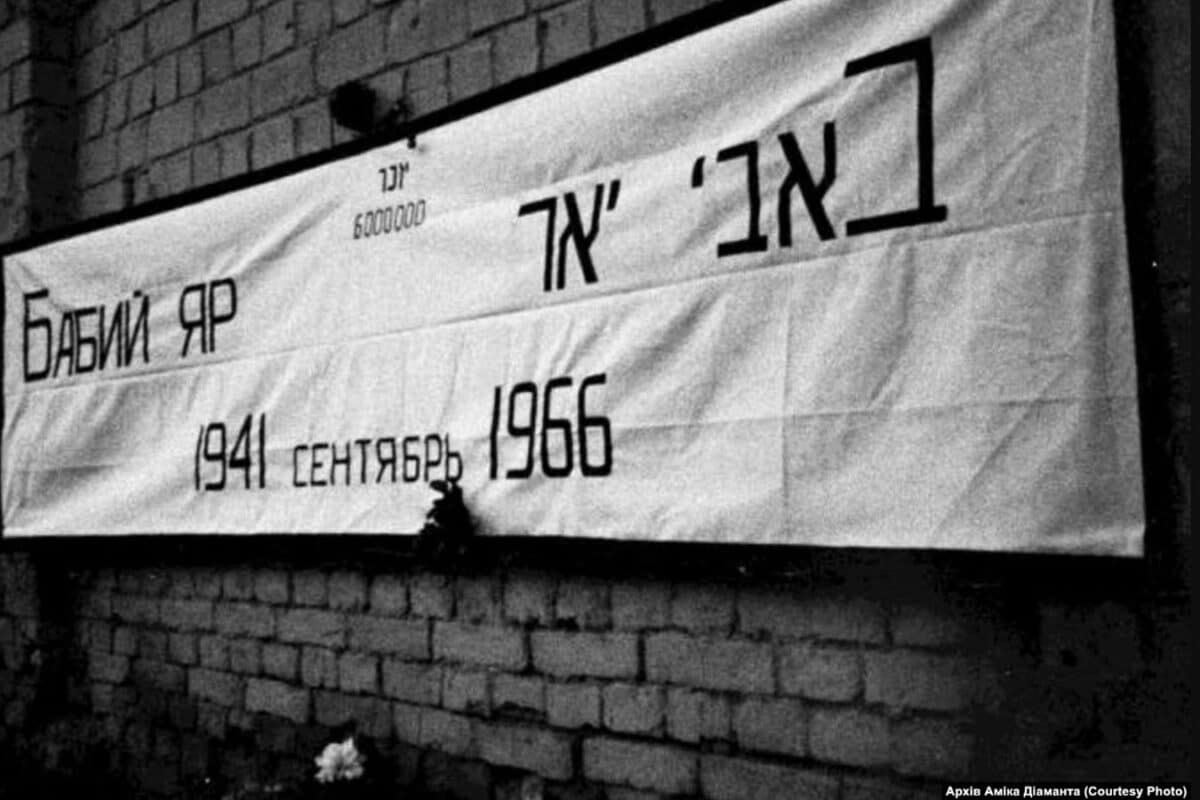
For the 25th anniversary of the tragedy, in the fall of 1966, Diamant decided to act. He bought white canvas and black paint, wrote a poster in Russian and Jewish languages (he barely knew Yiddish and Hebrew). The text was as direct and innocuously inevitable as possible:

“Babyn Yar. Remember the six million.”

“Shameful gathering of Jewish and Ukrainian nationalists”: the first rally at Babyn Yar took place in 1966

Invitations began literally “in queues and trolleybuses” — from person to person, without posters and announcements.

The motivation was articulated without equivocation: “The main motive was wounded national dignity.” It was unacceptable for Jewish pain to dissolve into the impersonal formula “victims of fascism.”

September 24, 1966, 17:00 — Silence as Action

About fifty people approached the wall of the destroyed Jewish cemetery. No slogans, no demands — just presence, candles, a poster. And — the sudden appearance of two cars with film crews: Kyiv’s “Ukrkinochronika” and Moscow’s “Nauchfilm”. Some people were frightened by the cameras and dispersed; at that moment, a stranger squeezed into the small remaining group and asked short questions:

— “Did you do this?”
— “Not me.”
— “Are you afraid?”
— “I am.”

The stranger turned out to be writer Viktor Nekrasov. He simply said, “We need to talk,” and left his address and phone number. Thus, a vector for the second date appeared — for the civil anniversary on September 29.

Footage That Survived Searches

Kyiv operator Eduard Timlin managed to hide 80 meters of film (about one and a half minutes) — and kept the reel until 1991. This gesture alone was enough to understand: memory “burns” both at the level of people and facts.

The Second Rally: Word and Solidarity

“Come, Nekrasov Will Be There”

September 29, 17:00. An oral invitation formula circulated around Kyiv: “Come, Nekrasov will be there”. The writer himself “sat on the phone,” calling acquaintances — even in Moscow; a note was passed to literary critic Ivan Dziuba. Hundreds of people headed to the ravine — for the first time in 25 years after the mass shootings of 1941. Documentary filming was now in the hands of Garik Zhurabovich. The simple focus-conspiracy technique: the film was not wound to the end, pieces were hidden in pockets — “in case of arrests.”

Dziuba’s Speech and Shouts in the Crowd

Nekrasov and Dziuba appeared — naturally creating a demand for words. There were no microphones, not everyone could hear, but the meaning was very clearly fixed.

Ivan Dziuba:Silence speaks only where everything has already been said. When nothing has been said yet, silence becomes an accomplice of falsehood and unfreedom.”

In several places, people climbed onto shoulders and shouted:

Jews should not be afraid! We need to talk about anti-Semitism!

Later, writer Vladimir Voinovich would express his shock at what he saw:

I saw for the first time an absolutely spontaneous rally, not controlled by Soviet power.”

Among those present that day was Dina Pronicheva, one of the few who survived September 29, 1941; she is known to readers as a heroine of the documentary novel Anatoly Kuznetsov’s “Babyn Yar”.

“Civilians,” but No Dispersal

Police and KGB were present in civilian clothes, observing, recording, but no forceful dispersal occurred. Many in the crowd noticed informants. After an hour and a half, Diamant left with his wife and young daughter, formulating the main point:

The main thing was achieved… We learned to be a nation from a ‘rabble.’ We learned to respect our graves.”

How the System Responded and What Happened Next

Stigma, Reprimands, “Preventive Measures”

The official formula used to stigmatize participants and the fact of the rallies was verbatim: “shameful gathering of Jewish and Ukrainian nationalists”. There were strict reprimands, dismissals, “preventive” conversations, film confiscations, and names were noted. But it was too late: annual September gatherings at Babyn Yar became a tradition.

Diamant’s Emigration and “Universal” Soviet Memory

In March 1971, Diamant was given 10 days to leave — he left the USSR and moved to Israel, taking with him surviving materials, including Zhurabovich’s footage from the second rally. The late Soviet decision on memorialization did not solve the problems: in 1976, a general monument “to the victims of fascism” was erected (without emphasis on Jewish victims), and in 1980, a park was created on the site of the filled ravine.

In independent Ukraine, the memory space consists of approximately 25 disparate signs — a long road to a coherent, honest conversation about the tragedy and its recipients.

Historical Framework and Facts (Collected in One Place)

  • 29–30.09.1941 — about 34,000 Jews shot in two days; during the occupation years — about 100,000 killed in the ravine.
  • 13.03.1961 — dam burst with liquid waste; wave up to 4 m, victims 145–1,500 (various estimates); event in city memory — “Babyn Yar’s Revenge“.
  • 24.09.1966, 17:00first silent rally (~50 people); poster: “Babyn Yar. Remember the six million”; film crews “Ukrkinochronika” and “Nauchfilm”; Eduard Timlin saves 80 m of film and keeps the reel until 1991.
  • 29.09.1966, 17:00second rally (hundreds of people); invitation formula in the city — “Come, Nekrasov will be there”; speeches by Viktor Nekrasov and Ivan Dziuba; documentary filming — Garik Zhurabovich; among those present — Dina Pronicheva; later assessment by Vladimir Voinovich on the spontaneity of the rally, “not controlled by the authorities”.
  • 1971Emmanuel (Amik) Diamant emigrates to Israel, taking surviving materials.
  • 1976 / 1980 — Soviet monument without mentioning Jews; park on the site of the filled ravine.
  • Independent Ukraine≈25 memorial signs, annual September actions.

Why This Is Important — for Ukraine and Israel (Today)

This story is not only about the past but also about a way to be a society. In Kyiv in 1966, without permits and microphones, people called the tragedy by its name, and the solidarity of Jewish and Ukrainian intellectuals became the norm, not the exception. For Israelis, this is part of the diaspora bridge: figures like Diamant ultimately connect their fate with Israel, without losing ties with Kyiv-Babyn Yar. And for all of us, it’s a reminder: where memory is precise and honest, it’s harder to ignite xenophobia and rewrite history.

FAQ

Why were there two rallies — on the 24th and 29th?

Because September 29, 1941 fell on Yom Kippur, and 25 years later, the “religious” date of memory according to the Jewish calendar fell on September 24, 1966; the second was the civil date of September 29. Both gatherings were about one thing: to return the place of the Jewish tragedy to the general historical memory of Kyiv.

What exactly was done on September 24?

A poster “Babyn Yar. Remember the six million” was attached to the wall of the destroyed Jewish cemetery, and they stood silently. It was a form of statement, not a rally “format”: to show that this is our grave and to name it.

What was said on September 29?

The key thought was from Ivan Dziuba’s speech: silence, while the truth is not spoken, is an accomplice of lies and unfreedom. In the crowd, there were calls “Jews should not be afraid! We need to talk about anti-Semitism!” — this was the meaning of the second action.

How did the authorities react?

The stigma of “shameful gathering of Jewish and Ukrainian nationalists”, reprimands, dismissals, “preventive measures”, film confiscations. But the annual September gatherings were no longer stopped: a tradition was formed.

Conclusions in Four Lines (for the Busy)

  1. September 1966 launched civil memory of Babyn Yar.
  2. Accuracy of names and dates is protection against future falsification.
  3. Solidarity of Jews and Ukrainians became a reality, not a slogan.
  4. The history of Babyn Yar is a bridge Kyiv ↔ Israel, part of a shared experience of dignity.


Young musicians from Ashkelon and Rivne met again in Berlin: how the Israeli and Ukrainian cities became part of a single musical exchange - September 21, 2026 - Новости Израиля

From Iran to Deir ez-Zor: why the Syrian nuclear dossier has become relevant again – and where Russia fits into this story - September 21, 2026 - Новости Израиля

Ex-goalkeeper of ‘Maccabi Haifa’ Georgy Ermakov married Alexandra Mikolyuk from ‘The Bachelor’: Israel appeared twice in the history of this couple - September 20, 2026 - Новости Израиля

Chief Rabbi of Ukraine Moshe Asman reminded on May 8: evil is not eternal if opposed by Ukraine, Israel, and memory

On May 8, 2026, the Chief Rabbi of Ukraine, Moshe Asman, published an address for the Day of Remembrance of the Victims and Victory in World War II. In his words, this date does not sound like a formal historical ritual, but as a living moral reference point — especially for Ukraine, Israel, and the Jewish people.

It is a day of mourning and gratitude at the same time.

Mourning — because Nazi evil destroyed millions of people, broke families, cities, communities, and entire generations. For Jews, May 8 holds special significance: six million Jews were killed just for being Jewish.

Gratitude — because victory over Nazism became possible at the cost of the enormous sacrifice of the peoples of the anti-Hitler coalition.

May 8: a memory that should not become an empty date

Moshe Asman reminded that on May 8, the world saw: even very strong evil is not eternal. Nazi Germany capitulated, and the ideology that wanted to erase humanity itself was defeated.

But this victory did not come by itself.

Behind it stood armies, peoples, families, soldiers, underground fighters, prisoners, rescuers, the dead, and the survivors. Behind it stood millions of fates, many of which were never fully told.

For the Israeli audience, this emphasis is especially important. Israel lives with the memory of the Holocaust not as a distant page of the past, but as part of national consciousness, security, and responsibility to future generations.

Jewish memory and the Ukrainian context

In the address of the Chief Rabbi of Ukraine, an important thought was expressed: the memory of World War II cannot be separated from the real contribution of those who fought against Nazism.

Ukraine made a huge contribution to this struggle. About 7 million Ukrainians fought against Nazism, and without this sacrifice, the victory over the Third Reich would have looked different.

The contribution of the Jewish people was also significant. More than a million Jews served in the armies of the allies: in the USA, Great Britain, Canada, Poland, the Red Army, and other forces that fought against Nazi Germany.

It is fundamentally important to remind today when different forces try to privatize victory, erase Ukraine’s contribution, obscure Jewish participation, and appoint themselves as the sole ‘right holders’ of historical memory.

Victory over Nazism does not belong to one state, one regime, or one political mythology. It was paid for with the blood of many peoples.

Why Moshe Asman’s words sound especially poignant in 2026

Today, Ukraine and Israel are once again living through a difficult war. Both societies know what missile strikes, funerals, anxiety, mobilization, and the struggle for the right to live without the dictate of terror and violence mean.

That is why Moshe Asman’s words about the ‘axis of evil’ sound not like a metaphor, but as a political and spiritual assessment of the time.

Ukraine is resisting Russian aggression. Israel continues to live under the threat of terrorist structures and their patrons. Iran remains an enemy of both Ukraine and Israel because its technologies, ideology, and allies work to strengthen war, pressure, and fear.

In such a context, the memory of victory over Nazism becomes not an archival topic, but a matter of today’s resilience.

NANews — Israel News | Nikk.Agency draws attention to this very meaning: on May 8, it is important not only to remember the past but also to understand how historical memory helps society recognize evil in the present — without substitutions, without foreign propaganda, and without attempts to rewrite the contribution of Ukraine and Jews to victory.

Evil can be strong, but that does not mean it will win

One of the key phrases in Moshe Asman’s address is the thought that evil can be strong and enduring, but it will not always be so.

This is not a comforting formula for a beautiful speech. It is a conclusion from history.

Nazi Germany also seemed powerful. Its army captured countries, its propaganda instilled fear, its ideology claimed eternity. But in the end, this system was broken.

For Ukraine, this thought today sounds like a reminder of the cost of resistance. For Israel — as a reminder of the need to stand against those who once again dream of destroying Jews, states, and the freedom of other peoples.

The memory of World War II should not turn into a decoration for parades or slogans. It requires honesty.

Ukraine, Israel, and the Jewish people: a common line of memory

In the words of the Chief Rabbi of Ukraine, there is an important bridge between the past and the present. He speaks not only of the dead but also of the living — of those who today must withstand a new historical test.

For the Jewish people, the memory of six million killed is not just a tragedy of the past. It is a warning that hatred, if not stopped in time, turns into a system of destruction.

For Ukraine, the memory of World War II is also a memory of the land that became one of the main battlefields, of cities, villages, Babi Yar, the front, occupation, resistance, and millions of people who went through the catastrophe.

Today, these meanings converge again.

Ukraine and Israel experience war differently, but both countries understand: evil rarely comes into the world with an honest name. It hides behind history, religion, ‘protection’, ‘security’, ‘tradition’, or ‘justice’. That is why memory must be precise.

Prayer for Ukraine and Israel

Moshe Asman concluded the address with words about the blessed memory of all the dead and a request to the Almighty to give Ukraine and Israel the strength to withstand and defeat the darkness in our time.

This is a strong formula for May 8, 2026.

Because it is not only about the past. It is about the right of peoples to live, remember, defend themselves, and not allow new aggressors to appropriate someone else’s sacrifice, someone else’s victory, and someone else’s history.

May the memory of the dead be blessed.

And may Ukraine and Israel find the strength to go through this time so that future generations can also say: evil was strong, but it did not become eternal.


Young musicians from Ashkelon and Rivne met again in Berlin: how the Israeli and Ukrainian cities became part of a single musical exchange - September 21, 2026 - Новости Израиля

From Iran to Deir ez-Zor: why the Syrian nuclear dossier has become relevant again – and where Russia fits into this story - September 21, 2026 - Новости Израиля

Ex-goalkeeper of ‘Maccabi Haifa’ Georgy Ermakov married Alexandra Mikolyuk from ‘The Bachelor’: Israel appeared twice in the history of this couple - September 20, 2026 - Новости Израиля

Officer of the Armed Forces of Ukraine “Hasid” received the international IPA award: what is known about the fighter and why he was recognized

International Police Association awarded a Ukrainian Armed Forces officer

The International Police Association (IPA), uniting law enforcement officers from more than 70 countries, awarded its medal to an officer of the Armed Forces of Ukraine with the call sign “Hasid”.

This was reported by the Federation of Jewish Communities of Ukraine (FJCU) and the publication JewishNews on November 22, 2025.
The IPA decision emphasizes that the award was given for high professionalism, courage, and a special contribution to the defense of Ukraine.

For the Jewish community, this decision was significant: for the first time in a long time, a representative of Ukraine with Jewish heritage receives an international professional award specifically as a combat officer of the active army.

Ukrainian Armed Forces officer 'Hasid' received the international IPA award: what is known about the fighter and why he was noted
Ukrainian Armed Forces officer ‘Hasid’ received the international IPA award: what is known about the fighter and why he was noted

Who is “Hasid”: collected facts from open sources

There is little information about “Hasid” in the public domain — he consciously maintains anonymity. However, over the past years, his name (or rather, call sign) has repeatedly appeared in Ukrainian media and social networks.

Instructor and intelligence officer of the Ukrainian Armed Forces

In a report by Informator it is stated:

  • he does not show his face, his name is not disclosed — this is stated directly;

  • serves as an instructor on the front line;

  • trains infantry, mechanized units, and intelligence personnel;

  • has been working since the beginning of the full-scale invasion, often in areas of active combat.

Commanders commenting on his work noted that thousands of servicemen have gone through his training — social networks mention the figure “more than 8,000 students”.

Jewish by origin and a person of faith

All Ukrainian and Jewish sources emphasize that “Hasid” is —

  • Jewish by nationality,

  • a person of religious views,

  • motivating fighters with spiritual values and philosophy that he himself shares.

One of the meanings he quotes: “defending Ukraine is also about the light that must overcome darkness”.

The phrase “about the light that must overcome darkness” is a direct part of the Hasidic tradition, where light is always seen as a force that naturally dispels darkness. Such an image is found in the teachings of Baal Shem Tov, the Maggid of Mezritch, and the Alter Rebbe and is one of the central Hasidic principles.

The image that society sees

In Ukrainian social networks, “Hasid” is described as:

  • a principled instructor,

  • a strict but fair commander,

  • an officer who combines professional training with a personal moral stance.

What remains unknown

Full name, rank, unit, locations — are not published.
Some hostile resources spread an unverified version of “service in the Israeli special forces”, but there is no confirmation of this. Ukrainian official sources have not made such statements.

What video materials about “Hasid” show: documentary sources

1. Video from January 3, 2023 (project “Finding Answers with Inna Zolotukhina”)

This is one of the earliest confirmed appearances of “Hasid” in the media — a report from a combat company training.

The video directly states:

  • “Hasid” trains Ukrainian fighters from various units from the first days of the war, and does so exclusively on a volunteer basis.

  • He introduces himself as:
    “I am Jewish by nationality and have extensive experience serving in special units of Ukraine and Israel”.

  • He emphasizes that he considers it his duty to pass on combat experience:
    “This is how I save their lives. And as Jews say: ‘Save a life — save the whole world’”.

In the same video, fighters of the “Black Raven” company talk about heavy battles in the Chernobyl zone, the importance of constant training, and how the instructor helps cope with combat stress:

  • “When you sit in a trench under fire for three days and don’t see the enemy — the instructor helps you learn to keep a cool head”.

  • “If you don’t train — you can lose vigilance. In war, mistakes cost lives”.

This video shows “Hasid” as a combat instructor who combines professional training with psychological support for fighters.

2. Video from August 31, 2025: “Who is Hasid?”

This is a later and more systematic video material that gathers information about him into a coherent portrait.

The video states:

  • “Hasid” personally trained over 8,000 elite Ukrainian fighters.

  • Has experience serving in special units of the National Guard of Ukraine.

  • Holds international certification in Israeli training centers.

  • Uses his own methods based on real combat experience.

  • Follows the principle:
    “Weapons are just a tool, it’s the person who fights”.

  • Considers his main reward the moment,
    when a soldier returns home safe and sound.

  • His faith in the Almighty is separately emphasized, which helps maintain inner resilience in wartime conditions.

This video shows “Hasid” as a systematic, recognizable, and one of the most effective Ukrainian instructors of the modern war.

What Russian propaganda press wrote about “Hasid”

Russian occupation media and related resources mentioned “Hasid” several times, but exclusively in a manipulative and speculative manner. The main thesis they promoted was the version that the Ukrainian Armed Forces instructor is allegedly a “former Israeli special forces operative”. Such statements appeared on several Russian sites after the release of Ukrainian video materials about the training of servicemen, where “Hasid” was featured.

Russian resources used the same video from the State Border Guard Service of Ukraine, interpreting it in a propagandistic manner, adding accusations, non-existent details, and attempts to present “Hasid” as a “foreign mercenary”. This is a typical tactic of Russian disinformation: distorting facts, imagining non-existent biographies, and forming the image of an “external enemy” to discredit Ukrainian volunteers, instructors, and officers.

What is the IPA and why does it award military personnel

The International Police Association is the oldest and largest professional organization of law enforcement officers in the world.

Founded in 1950, today it has representations in more than 70 countries.
The goal of the IPA is to promote international cooperation, law and order, professional exchange, and support for colleagues working in risky conditions.

Why the IPA awards

The IPA periodically awards

  • medals for bravery,

  • badges for service to society,

  • distinctions for contribution to safety and protection of citizens.

In peacetime, awards are more often received by the police — but during war, the association separately recognizes people who demonstrate a high level of professionalism in combat conditions, especially when it comes to protecting the population, training personnel, or saving lives.

Awarding the Ukrainian Armed Forces officer is precisely such a case.

Ukrainian Jews continue to defend their country

The story of “Hasid” is not only a personal recognition. It is a marker of a phenomenon that we at NAnovosti regularly write about:
the Jewish community of Ukraine is not a bystander in the war, but a participant.

  • Jewish military personnel serve in infantry, intelligence, and border troops.

  • Rabbis of the volunteer movement coordinate humanitarian and spiritual support on the front.

  • Thousands of Ukrainian Jews participate in the defense of the country as servicemen, medics, volunteers, engineers.

“Hasid” has become one of the symbols of this participation: a person who combines Jewish identity, professional military training, and real combat service.

His award is a reminder to the world:
Jews of Ukraine defend their homeland just like all other citizens of the country.


NAnovosti News of Israel Nikk.Agency November 24, 2025.


Young musicians from Ashkelon and Rivne met again in Berlin: how the Israeli and Ukrainian cities became part of a single musical exchange - September 21, 2026 - Новости Израиля

From Iran to Deir ez-Zor: why the Syrian nuclear dossier has become relevant again – and where Russia fits into this story - September 21, 2026 - Новости Израиля

Ex-goalkeeper of ‘Maccabi Haifa’ Georgy Ermakov married Alexandra Mikolyuk from ‘The Bachelor’: Israel appeared twice in the history of this couple - September 20, 2026 - Новости Израиля

“Polesie” is once again looking towards Haifa: the Ukrainian football club wants to bring Georgiy Ermakov back from Israel

Zhytomyr’s “Polissya” is preparing for the new season and, according to Ukrainian football sources, is looking for a strong goalkeeper who can immediately strengthen the team. An Israeli connection has appeared in this transfer story: the club is once again considering the option of Ukrainian goalkeeper Georgiy Ermakov, who is currently playing for Maccabi Haifa.

For the Israeli audience, this news is interesting not only because of the football geography. It shows how Ukrainian football continues to keep track of its players abroad, and Israel remains a notable point on the map of Ukrainian sports careers.

Why “Polissya” is looking for a new goalkeeper

According to the Telegram channel Inside UPL, “Polissya” wants to enter the new season with a stronger goalkeeping line. The Zhytomyr club has been trying for several years to establish itself among the ambitious projects of Ukrainian football, so the goalkeeper position becomes one of the key ones for them.

The first option for the club was Nazar Domchak.

He has become one of the sensations of the current season and is considered one of the most notable goalkeepers in the UPL at the moment. His game is highly rated by Ruslan Rotan, and there is already interest from European clubs around the player himself.

But this is where “Polissya” encountered difficulties. If a battle for Domchak has indeed begun, then the financial demands of “Karpaty” may be too high. Even for the ambitious Zhytomyr club, such a deal could be challenging.

Why the option with Georgiy Ermakov arose again

Against this background, “Polissya” returned to a candidate they had already considered last summer. We are talking about Georgiy Ermakov — a Ukrainian goalkeeper who is currently in the Maccabi Haifa system.

The deal did not take place then: the Israeli club did not want to sell the player.

Now the situation, according to sources, has moved again. “Polissya” has already made contact with the player himself. Ermakov, it is claimed, has indicated that he is ready to consider returning to Ukraine, but only under the condition of a strong personal contract.

This is the stage where negotiations are currently at.

What this means for Israel and Ukrainian football

Ermakov’s story is interesting because it connects several football directions at once: Ukraine, Israel, and the European transfer market. For Ukrainian clubs, players performing abroad often remain a clear and valuable option — they know the Ukrainian school, can adapt faster, and do not require a long period of cultural acclimatization.

But returning from Israel to Ukraine now is not just a sports question.

The player needs to assess the level of the championship, financial conditions, safety, prospects for playing practice, and role in the team. For a goalkeeper, this is especially important: if the club is looking for a “number one,” the contract can be attractive. If it’s just about competition, the decision becomes more difficult.

NANews — Israel News | Nikk.Agency notes that such transfer stories are important for the Russian-speaking audience in Israel. They show that sports connections between Ukraine and Israel continue to work even against the backdrop of war, migration, market changes, and new economic conditions in football.

Why “Maccabi” Haifa may not be in a hurry

For “Maccabi” Haifa, the question does not seem simple either. The Israeli club must understand whether Ermakov is needed in its own structure, whether there are plans for him, and what financial sense a possible transfer has.

If last summer the club did not want to sell the goalkeeper, it means that in Haifa they saw him as a resource or did not receive a suitable offer.

Now much will depend on the amount, the player’s own position, and “Polissya’s” readiness to make not just a request, but a real offer. In transfers of this level, a personal contract often becomes as important as the agreement between clubs.

At what stage is the transfer

So far, it is not about a completed deal. According to available information, “Polissya” is showing interest, contact with the player has already been made, but there is no final decision.

The key question is money.

Ermakov is ready to return to Ukraine only if there is a financially strong personal contract. This means that the Zhytomyr club needs to convince not only “Maccabi” Haifa but also the player himself.

For “Polissya,” such a transfer could look logical: a Ukrainian goalkeeper, experience abroad, understandable adaptation, potential strengthening of an important position. But for now, this is precisely a negotiation story, not an announced transfer.

Now the club needs to decide whether it is ready to invest in Ermakov or continue to look for alternatives in the Ukrainian and European markets. The goalkeeper position does not tolerate haste, but delaying it before the new season is risky.


Young musicians from Ashkelon and Rivne met again in Berlin: how the Israeli and Ukrainian cities became part of a single musical exchange - September 21, 2026 - Новости Израиля

From Iran to Deir ez-Zor: why the Syrian nuclear dossier has become relevant again – and where Russia fits into this story - September 21, 2026 - Новости Израиля

Ex-goalkeeper of ‘Maccabi Haifa’ Georgy Ermakov married Alexandra Mikolyuk from ‘The Bachelor’: Israel appeared twice in the history of this couple - September 20, 2026 - Новости Израиля

Jewish Soldiers in the Armed Forces of Ukraine: Why the War in Ukraine Has Not “Left the Front Pages” for Them – The Jerusalem Post

On January 15, 2026, the Israeli publication The Jerusalem Post published (Eng.) a report by journalist Michael Starr about Jewish servicemen who continue to fight as part of the Ukrainian army, while “the attention of the world audience increasingly shifts to other crises” – original.

The main idea of the material is simple and harsh: even if the media agenda changes, Russia’s war against Ukraine has not stopped for a single season, and the Jews of Ukraine remain among those who “hold the line” since 2022, going through winter after winter.

Drone reconnaissance commander from Nikolaev: “fight for your country”

One of the key figures in the report is Moshe Bizsemov, the commander of a small group of reconnaissance drones. He has been serving in the Ukrainian army since 2018 and witnessed the phase of battles often associated in Ukraine with the war in Donbas after 2014. Bizsemov is a resident of Nikolaev, a father of two, and was supposed to complete his service in April 2022, shortly after the full-scale invasion began.

However, circumstances unfolded differently. At the moment when his unit came under attack, Bizsemov was in the process of being discharged. Many of his soldiers were captured in Mariupol, and as noted in the material, seven had not been released at the time of publication. He extended his contract and remained in service. When asked about his motivation, the answer is extremely short: “fight for your country.”

The report also highlights another detail: Bizsemov was wounded at the beginning of the war and had grounds to leave the service with an honorable discharge. Instead, he continued working specifically in drone reconnaissance — where the price of a mistake is measured not in statistics but in human lives on the ground.

BMP driver and “the man who stopped”: the story of Andre Chernecki

The second figure is Andre Chernecki, a driver of an armored vehicle (BMP). The text states that he has been serving since March 22 (the year is not specified in the material) and has gone through some of the bloodiest episodes of the war, including Bakhmut. Chernecki fought there twice, with one rotation, according to him, lasting seven months.

The strongest fragment of the report is an episode that Chernecki recounts as an illustration of a choice made “inside the war.” Returning from the Bakhmut direction and already about a kilometer from a safe area, he noticed a Ukrainian soldier trapped by debris in a destroyed building. According to protocol, the armored vehicle should not stop: the risk is too high for the crew and equipment. Chernecki stopped.

He ran out, bandaged the wound, and then effectively amputated the destroyed limb that was holding the soldier under the rubble, after which his team loaded the wounded onto the armored vehicle. The material emphasizes: by this act, he put himself and his people at risk, but he believed that otherwise, the soldier would have been “left behind,” and then almost certainly forgotten.

Chernecki speaks about his Jewish identity directly and without embellishment. He did not hide that he was Jewish and perceived it as part of his service: “if you represent a people — you must keep the bar higher.” He notes that he was wounded three times and explains why he continues to fight: so that no one can say that Jews do not fight.

Not everyone is on the front line — and this is also part of the truth

The Jerusalem Post text does not romanticize. It states directly: as among other citizens of Ukraine, among Jews, there were those who did not go to fight — who hid at home, fearing mobilization, or tried to avoid conscription. One of the Jewish leaders admits regret about this part of reality, but other community representatives emphasize: there are many servicemen, it’s just difficult to name the exact number.

The reason lies in the structure of the community and society. Some are actively involved in Jewish life and are visible, while others live outside community frameworks, and even people who usually “keep their finger on the pulse” may not know about their service.

The cost of war: the dead, the wounded, returning and dying on position

The report lists specific cases of losses among Jewish fighters. One of them is Tzvi-Hirsch (Grisha) Zvergazda, a cook and father of two. He died in June in the Kherson direction. The article notes his dream — to open a kosher restaurant in Odessa and someday receive a Michelin star.

Around the same time, Andrey Korovsky, a 32-year-old Chabad school teacher, died. He was a drone operator, had previously returned to service after a combat wound, and died on the front from a heart attack. In this fragment, the “rear” side of the war is especially noticeable: even when a person does not die from a bullet or shrapnel, the war continues to wear down the body.

Another hero is Maksim Nelipa, a 44-year-old Ukrainian actor and TV presenter. The material states that he left television at the beginning of the invasion and went to fight, and in May he was killed in battle. A separate detail strengthens the Ukraine-Israel connection: according to the Federation of Jewish Communities of Ukraine, Nelipa’s son was at that time fighting as part of the Golani Brigade in Gaza and received news of his father’s death right on duty.

How many are there: assessment of losses and scale of participation

There is no official “Jewish statistics” for the Ukrainian army, and the report emphasizes that the numbers vary. But an estimate by Jewish representatives is provided: since 2022, the number of Jewish citizens of Ukraine who died in the war may range from 100 to 200 people, with dozens dying just last year. Against this background, another estimate is heard: now about twice as many Jews serve in the army as those who have already died.

This is not accounting and not a dispute over numbers. Rather, it is a marker that we are talking not about isolated stories, but about a noticeable layer of society that bears the same cost of war as the rest.

The role of communities: funerals, family assistance, chaplain on the front line

An important block of the report is about how Jewish structures in Ukraine take on what would be taken for granted in peacetime. The Federation of Jewish Communities of Ukraine (FJCU) reports that it helps organize Jewish funerals together with Chabad emissaries, supports families financially, and conducts prayers and Kaddish readings for the deceased.

The article also mentions Hungarian Jewish volunteer Binyamin Aser — an example of how the war attracts people to Ukraine from abroad, and the issue of a dignified burial becomes part of humanitarian work.

The work of military chaplain, Rabbi-Lieutenant Yakov Sinyakov, associated with FJCU, is described separately. He visits the trenches, brings soldiers sweets “the taste of home,” distributes books of psalms to those who ask, talks to recruits who see the front for the first time and do not always cope psychologically. Sinyakov has a master’s degree in psychology, and the material emphasizes that he knows how to “connect” with people not through slogans, but through human conversation.

His thought is also presented, explaining the moral complexity of war: some soldiers find it difficult to accept the very idea of killing, but in the “reality of evil,” he says, protecting family and country makes this choice inevitable.

Why this is important for Israel

The report includes a phrase of gratitude to Israel for accepting Ukrainian refugees at the beginning of the war. But the key meaning is broader: for the Israeli audience, Ukraine increasingly becomes an “external topic,” while for people on the front line, it is a matter of life and death, without pauses for changes in the news cycle.

The story of Jewish fighters of the Armed Forces of Ukraine is simultaneously about Ukraine and about Israel: about shared memory, about the reaction to violence, about family ties that ended up on both sides of the fronts and borders, and about how war tears apart “ordinary life” in the most unexpected places — from Nikolaev and Kherson to Holon and IDF bases.

That is why such texts are important not as an emotional gesture, but as a document of the time: names, facts, direct words of people who fight, bury, return after injuries, and go back to positions. In the Russian-speaking Israeli agenda, this layer of reality must remain visible — and this is exactly what NAnews — Israel News | Nikk.Agency works for.

Original from January 15, 2026, The Jerusalem Post (Eng.) report by journalist Michael Starr:

https://www.jpost.com/international/internationalrussia-ukraine-war/article-883460


Young musicians from Ashkelon and Rivne met again in Berlin: how the Israeli and Ukrainian cities became part of a single musical exchange - September 21, 2026 - Новости Израиля

From Iran to Deir ez-Zor: why the Syrian nuclear dossier has become relevant again – and where Russia fits into this story - September 21, 2026 - Новости Израиля

Ex-goalkeeper of ‘Maccabi Haifa’ Georgy Ermakov married Alexandra Mikolyuk from ‘The Bachelor’: Israel appeared twice in the history of this couple - September 20, 2026 - Новости Израиля

“Evenings of Humor in Israel – 2026”: Ukrainian comedians Oleksandr Stepanenko and Ivan Kukharchuk will perform in June in Netanya (9), Rishon LeZion (11), and Ashdod (13)

In June 2026, “Evenings of Humor” will be held in Israel featuring Ukrainian comedians Oleksandr Stepanenko and Ivan Kukharchuk — artists known to audiences from the Ukrainian project “League of Laughter.” The poster promises an hour and a half of live humor, popular acts, television stories, and comedic improvisation. The program will include a charity auction with valuable lots, and the collected funds will be donated to the needs of the Armed Forces of Ukraine.

For the Israeli Ukrainian and Russian-speaking audience, this event looks not just like another concert. After 2022, the Ukrainian stage has changed significantly: humor has become not only a way to distract but also a form of support for the country, the army, and people living in wartime conditions.

According to the published poster, performances will take place in three cities in Israel: Netanya, Rishon LeZion, and Ashdod. The description also states that the program will include a charity auction with valuable lots, and the collected funds will be donated to the needs of the Armed Forces of Ukraine.

Evenings of Humor in Israel: Who Will Perform and Where the Program Will Take Place

Organizers invite viewers for an hour and a half of sincere laughter and a positive atmosphere. The program includes favorite acts familiar from television performances, as well as live comedic improvisation.

A separate part of the evening is a charity auction. According to the poster, all collected funds will be donated to the needs of the Armed Forces of Ukraine. For many viewers in Israel, this makes the event not just entertaining but also socially important.

Performance Schedule

Date City Time Venue
June 9, 2026 Netanya 19:00 Heichal HaTarbut, Dormund Hall / Dortmund, 4 Raziel St.
June 11, 2026 Rishon LeZion 19:00 Beit HaAm, 3 Zadal St.
June 13, 2026 Ashdod 21:00 Monart Concert Hall, 8 Derech Eretz St.

Tickets are already available for sale.

"Evenings of Humor in Israel - 2026": Ukrainian comedians Oleksandr Stepanenko and Ivan Kukharchuk will perform in June in Netanya (9), Rishon LeZion (11), and Ashdod (13) Israel News
“Evenings of Humor in Israel – 2026”: Ukrainian comedians Oleksandr Stepanenko and Ivan Kukharchuk will perform in June in Netanya (9), Rishon LeZion (11), and Ashdod (13) Israel News

Who are Oleksandr Stepanenko and Ivan Kukharchuk

Oleksandr Stepanenko and Ivan Kukharchuk are Ukrainian comedians associated with the television project “League of Laughter.” This is one of the most recognizable comedic formats in Ukraine, where teams perform sketches, improvisations, and topical stage acts.

In the poster for the Israeli concerts, they are presented as frontmen of top teams of the “League of Laughter.” It states: Oleksandr Stepanenko — “30+”, Ivan Kukharchuk — “Resting Together.”

Both artists are connected to the Ukrainian comedy scene, television humor, and volunteer projects that emerged after the start of the full-scale war.

For NAnews — Israel News | Nikk.Agency, this story is interesting precisely at the intersection of culture, the Israeli Ukrainian community, and aid to Ukraine. In Israel, such evenings often become not only an entertainment event but also a meeting place for people for whom the Ukrainian theme remains personal.

How they helped Ukraine after 2022

After the start of the full-scale war, Ukrainian artists, comedians, and TV hosts began actively participating in charity concerts, volunteer gatherings, and public campaigns in support of the Armed Forces of Ukraine. Oleksandr Stepanenko and Ivan Kukharchuk also found themselves within this cultural-volunteer wave.

In July 2022, Ukrainian media reported that comedians from the “League of Laughter” held charity concerts and auctions to support the Armed Forces of Ukraine. Oleksandr Stepanenko from the “Resting Together” team participated in such events. The format was clear: humor, meeting with the audience, and collecting aid for the Ukrainian army.

Another example is charity sports and cultural events. In Ukrainian announcements after 2022, Stepanenko was mentioned among the participants of events in support of the Armed Forces of Ukraine, where artists, athletes, and public figures performed together.

Ivan Kukharchuk is associated with the “30+” team, whose concerts after 2022 were repeatedly presented as performances with fundraising for Ukrainian defenders. In regional announcements, the “30+” team was presented as a “League of Laughter” collective inviting viewers not only to humor but also to support the army.

“Volunteer Landing” as a New Role for Humor

It is worth noting separately the project “League of Laughter. Volunteer Landing.” After 2022, it became one of the symbols of how Ukrainian humor transitioned into a format of supporting the army and society.

In this special season, teams competed not just for victory but for the opportunity to fulfill a volunteer mission for the Armed Forces of Ukraine. In publications about the second season of “Volunteer Landing,” both Ivan Kukharchuk and Oleksandr Stepanenko were mentioned among the participants and coaches.

This shows that their participation in the comedic scene after the start of the war was not limited to ordinary concerts. They were part of a broader Ukrainian volunteer cultural environment.

Why this is important for Israel

For Israel, such concerts have a separate meaning. There is a large Ukrainian community living here, many immigrants from Ukraine, as well as people for whom the war against Ukraine is not a distant news story but part of family and personal reality.

An evening of humor in such a situation works in several directions at once. It gives people the opportunity to meet, hear live Ukrainian speech, support artists, and at the same time participate in helping Ukraine.

Moreover, the charity auction in support of the Armed Forces of Ukraine makes these performances not only a cultural but also a public event. This is an important signal: the Ukrainian theme in Israel remains alive, and support for Ukraine can be expressed not only through rallies, statements, and news but also through concerts, gatherings, community meetings, and cultural evenings.

Briefly for the reader

  • Oleksandr Stepanenko and Ivan Kukharchuk are Ukrainian comedians from the orbit of the “League of Laughter.”
  • After 2022, they participated in charity and volunteer formats related to supporting the Armed Forces of Ukraine.
  • In Israel, performances will take place in June 2026 in Netanya, Rishon LeZion, and Ashdod.
  • The program includes comedic acts, live improvisation, and a charity auction.
  • According to the poster, all funds collected at the auction will be donated to the needs of the Ukrainian army.

For Ukrainians, Israelis, and the Russian-speaking audience of Israel, this is not just an evening of laughter. It is another way to show that Ukraine remains in focus, and culture during wartime can be not only entertainment but also a form of solidarity.

Performance Schedule and Tickets

Date City Time Venue
June 9, 2026 Netanya 19:00 Heichal HaTarbut, Dormund Hall / Dortmund, 4 Raziel St.
June 11, 2026 Rishon LeZion 19:00 Beit HaAm, 3 Zadal St.
June 13, 2026 Ashdod 21:00 Monart Concert Hall, 8 Derech Eretz St.

Tickets are already available for sale.


Young musicians from Ashkelon and Rivne met again in Berlin: how the Israeli and Ukrainian cities became part of a single musical exchange - September 21, 2026 - Новости Израиля

From Iran to Deir ez-Zor: why the Syrian nuclear dossier has become relevant again – and where Russia fits into this story - September 21, 2026 - Новости Израиля

Ex-goalkeeper of ‘Maccabi Haifa’ Georgy Ermakov married Alexandra Mikolyuk from ‘The Bachelor’: Israel appeared twice in the history of this couple - September 20, 2026 - Новости Израиля

The Evian Conference of 1938: Lessons for Those Who Believe That Israel “Should Not” Help Ukraine

Those who claim that “Israel is not obliged to help Ukraine” and that “every country has its own interests” should remember the consequences of such thinking at the Evian Conference, held from July 5 to 16, 1938.

The fates of European Jews, whom the Third Reich had already deemed “subhumans,” were on the agenda.

In July 1938, U.S. President Roosevelt convened an international conference to promote and finance the emigration of “political refugees.”

But Hitler, before the ovens of Auschwitz began operating, offered the world community to take the Jews and watched with interest to see how it would end.

Representatives from 32 countries participated in the conference. These were countries from Western Europe (Hungary was the only representative from Eastern Europe), North and South America, as well as Australia and New Zealand. Additionally, 24 Jewish and international humanitarian organizations, including the Joint, the Jewish Agency, and the World Jewish Congress, sent their delegates to Evian.

The situation at the start of the conference was previously described by Chaim Weizmann:

“The world is divided into two parts – those places where Jews cannot live, and those where they cannot go.”

None of the countries participating in the Evian Conference were to be forced to increase their immigration quotas – it was solely about voluntary agreement to accept more Jewish refugees.

However, Switzerland, strictly maintaining neutrality, refused to host the conference, so it was held in France. Due to the annexation of Austria in March 1938, the number of potential Jewish victims of the Nazi regime significantly increased. Many Jews had already been expelled from Germany and Austria, and now Jews from Czechoslovakia were in danger.

The conference participants expressed sympathy for the suffering Jews but made no commitments. The U.S. did not want to increase immigration quotas due to anti-Semitic sentiments in Congress and fears of job competition. Britain could not accommodate refugees on its territory, and Eretz-Israel was excluded due to the Arab uprising.

Some countries stated they had already accepted as many as they could, while others refused due to the economic crisis and unemployment. As a result, only the Dominican Republic and Costa Rica agreed to accept refugees, although only about 500 people ended up in the Dominican Republic.

Israeli leaders of the time, Chaim Weizmann and David Ben-Gurion, were also against Jews entering Western countries. They hoped that restricting entry to other countries would force Britain to open Jewish emigration to Palestine.

The outcome of the conference quite suited Hitler, who sarcastically remarked:

“I hoped that the world, which feels such deep sympathy for these criminals [Jews], would at least be generous enough to turn this sympathy into practical help.”

The refusal to accept Jews was considered a grand victory for the German propaganda machine.

Golda Meir, who was at the forum, later described the events in her book “My Life”:

“I was there in the strange capacity of a ‘Jewish observer from Palestine’ and even sat not with the delegates but in the hall, although the refugees in question belonged to my people, to my family, and were not an unwanted number to be squeezed into a quota if at all possible.

It was a terrible thing – to sit in a luxurious hall and listen to the delegates of thirty-two countries explain in turn that they would like to accept a significant number of refugees but, unfortunately, are unable to do so.”

In an interview with journalists, Golda Meir added:

“I want to see only one thing before I die: that my people no longer need expressions of sympathy.”

The Evian Conference, which took place in July 1938, had serious consequences for the Jewish population of Europe. Not wanting to exacerbate their internal problems and fearing confrontation with the Nazi regime, the civilized international community failed to save millions of people, only postponing a world war indefinitely. Less than six months after the conference, Kristallnacht occurred, resulting in many Jews being killed, others arrested, and sent to concentration camps.

The historical lesson that can be drawn from the events of the Evian Conference should be taken into account by NATO in 2023. It is especially important to understand that the desire to avoid expanding the conflict when war is already underway can lead to a global conflict. NATO is currently providing material and tactical assistance to Ukraine but is not opening a second front against Russia.

Russian experts gleefully noted that the NATO summit communiqué paid little attention to Ukraine, with no clear promise of further material and financial support. They question whether only Ukraine has been “abandoned” or if it faces an even harsher fate in a world war.

Those who claim that Israel is not obliged to help Ukraine and that every country has its own interests should remember the consequences of such thinking at the Evian Conference. The Netherlands, London, France, Belgium, the USA, and other countries suffered damage from Nazi Germany.

This conference was recognized as a shameful page in Western history and serves as a lesson that by rejecting people in distress, states bring trouble upon themselves.

However, the Israeli government has not yet learned the lessons from the history of its people.

Leave a COMMENT

Read other News from Israel and the world on the channels “NiKK”
Nikk.Agency on Telegram, Facebook and Google News

Evian Conference – Material from Wikipedia — the free encyclopedia


Young musicians from Ashkelon and Rivne met again in Berlin: how the Israeli and Ukrainian cities became part of a single musical exchange - September 21, 2026 - Новости Израиля

From Iran to Deir ez-Zor: why the Syrian nuclear dossier has become relevant again – and where Russia fits into this story - September 21, 2026 - Новости Израиля

Ex-goalkeeper of ‘Maccabi Haifa’ Georgy Ermakov married Alexandra Mikolyuk from ‘The Bachelor’: Israel appeared twice in the history of this couple - September 20, 2026 - Новости Израиля

Israeli businessman convicted in the US for aircraft parts for Russia requests transfer to Israeli prison

Israeli businessman Gal Haimovich, convicted in the US for illegal supply of aviation parts to Russia, wants to serve the remaining term not in an American federal prison, but in Israel.

He has already filed a petition in the Central District Court of Lod.

At first glance, this is a common legal procedure: an Israeli citizen asks to be transferred to his homeland to continue serving his sentence. But Haimovich’s case is too sensitive to be seen only as a matter of prison logistics.

Behind it lies another story — sanctions against Russia, the war in Ukraine, the supply of dual-use components, American export control, and an Israeli citizen caught in an international scheme.

Why this case is important not only for the USA

Haimovich is 50 years old. Early last year, an American court sentenced him to two years in prison and another three years of supervision after release.

The basis — conspiracy to illegally supply aviation parts and avionics from American manufacturers and suppliers to Russia.

This is not a story about an accidental mistake in an invoice.

According to the case materials, Haimovich admitted to participating in a scheme where American companies were given false information about the final destination of goods. Documents might list some countries, but the real destination, according to the American side, was Russia.

And this is what makes the case politically and legally heavy.

After Russia’s full-scale invasion of Ukraine, aviation parts, electronics, avionics, and dual-use components became not just goods for Western countries. They turned into part of the sanctions front.

What exactly did Haimovich admit

As part of a plea agreement, Haimovich agreed that the scheme involved deceiving American suppliers and false information in export documents submitted to US authorities.

The essence of the accusation was simple: goods of American origin could not be sent to Russia bypassing export restrictions, but this is exactly what, according to the investigation, was happening.

An especially important detail: among the supplied components were aviation parts and avionics, including elements that can be used in missile technologies.

For the Israeli audience, this sounds extremely clear.

When it comes to dual-use technologies, the line between the civilian market and the military sphere can be very thin. Israel itself lives in a reality where logistics, electronics, aviation, and security are constantly interconnected.

How the supply scheme to Russia worked

According to the case materials, Haimovich owned an international freight forwarding company. It was part of a group of structures operating in different countries, including the USA and Israel.

Through these companies, he acted as a trusted forwarder for individuals and organizations who wanted to send goods to Russia, violating American export control rules.

The period is especially important: March 2022 — May 2023.

That is, this happened after the start of Russia’s major war against Ukraine. After the US and other Western countries imposed additional restrictions against Moscow. Already then, bypassing sanctions became not a gray commercial zone, but a direct risk of criminal prosecution.

According to the American side, Haimovich helped export aviation parts and avionics from the USA through intermediary carriers in the interests of Russian customers.

One of the stories concerns the airline S7 Airlines.

In August 2022, Haimovich, as claimed in the case, was hired to deliver an aviation component to Russia. At the same time, the US supplier was given false information: as if the part was intended for the Maldives.

On paper — the Maldives.

In reality, according to the investigation, — a Russian customer.

This is often how bypassing sanctions looks: not a direct route, not an open contract with a Russian structure, but a chain of countries, companies, carriers, and documents, where the main meaning is hidden behind formalities.

More than 160 deliveries and two million dollars

American materials indicate that from April 2022 to April 2023, Haimovich organized more than 160 deliveries to companies in the Maldives and the United Arab Emirates.

These companies, according to the investigation, participated in the further illegal transshipment of goods to Russia.

The scale here is crucial. This is not one episode that can be explained by negligence, misunderstanding, or an old contract. It was about dozens and hundreds of operations built during a period when the rules were already clear to all market participants.

Haimovich also admitted that he billed Russian clients for the illegal export of aviation parts and avionics from the USA to Russia.

Among the clients was the airline “Siberia,” operating under the brand S7 Airlines.

The invoice amounts exceeded two million dollars. As a result, Haimovich agreed to the confiscation of 2,024,435 dollars, as well as the confiscation of various aviation parts and components.

For readers of NANews — Israel News | Nikk.Agency in this case, the Israeli passport of the figure is not the only important thing. More important is something else: after 2022, business with Russia in sensitive technological areas ceased to be ordinary commerce. Especially if it concerns goods that can support Russian aviation or military chains.

Why he asks to be transferred to Israel

Now Haimovich asks to be allowed to serve the remaining part of the term in an Israeli prison. In his statement, he claims that as an Israeli citizen, he has the right to such a transfer.

This does not mean release.

If the court agrees, it will only be about changing the country of serving the sentence. The American sentence does not disappear, and the criminal story itself does not become less serious.

But symbolically, such a step will be noticeable.

An Israeli citizen, convicted in the USA for participating in a supply scheme to Russia after the start of the full-scale war, may return to Israel not as a businessman, but as a prisoner continuing to serve his term.

What the court in Lod must decide

The Central District Court of Lod must consider the petition in the coming days.

The question before the court is not only technical. It is necessary to assess whether there are legal grounds for the transfer, how it correlates with international obligations, and whether the decision creates problems in relations with the American side.

Israel finds itself in a difficult position here.

On the one hand, the state must protect the rights of its citizens, even if they are convicted abroad. On the other hand, the case is related to the violation of US export control, Russian customers, and the war against Ukraine.

And this is no longer just a private story of one entrepreneur.

This is a reminder for the entire Israeli business: after 2022, working with Russian structures, especially in aviation, electronics, logistics, and dual-use technologies, can end not only with a loss of money but also with a criminal case in another country.

There is no final decision yet.

But Haimovich’s request itself shows that the consequences of such schemes do not end with a sentence. They continue in courts, in diplomacy, in sanctions policy, and in the reputation of the country whose citizen is convicted.


Young musicians from Ashkelon and Rivne met again in Berlin: how the Israeli and Ukrainian cities became part of a single musical exchange - September 21, 2026 - Новости Израиля

From Iran to Deir ez-Zor: why the Syrian nuclear dossier has become relevant again – and where Russia fits into this story - September 21, 2026 - Новости Израиля

Ex-goalkeeper of ‘Maccabi Haifa’ Georgy Ermakov married Alexandra Mikolyuk from ‘The Bachelor’: Israel appeared twice in the history of this couple - September 20, 2026 - Новости Израиля

Jews from Ukraine: Mila Kunis

Today we are talking about a Hollywood star – Mile Markovna Kunis! — New section 🔯 — Jews from Ukraine 🇺🇦

📍 Birth and emigration

  • Born August 14, 1983 in Chernivtsi, Ukraine 🇺🇦.
  • At the age of 7, she emigrated with her family to Los Angeles, USA 🇺🇸.

🕯 Tragic family story

Many of Mila’s relatives died during the Holocaust. The actress has repeatedly mentioned anti-Semitism in the Soviet Union:

“We were brought up like this: you’re a Jew, just don’t tell anyone about it. That’s why we moved to the US.”

🕎 Judaism and Kabbalah

The Jewish religion plays an important role in the life of Mila and her family.

“We celebrate Yom Kippur and Hanukkah, although not always according to all the rules. I love our religion. I go to synagogue not out of obligation, but because it is important to me.”

Mila and her family light Shabbat candles, read prayers, and her children know blessings in Hebrew.

She also emphasizes the importance of family traditions:

“On Fridays, we get together as a family, look into each other’s eyes, say “I love you” and share the events of the week. This time strengthens our connection. No matter where we are, we always find a moment for it.”

🧬 Jewish roots

A genealogical DNA test showed that Mila is ethnically 98% Ashkenazi Jewish.

“I’m quite Jewish, but in New York I’m becoming super Jewish!”

🤝 Marriage to Ashton Kutcher

Mila’s husband, actor Ashton Kutcher, although not Jewish, shares her spiritual interests:

“He speaks and reads Hebrew and has read the Torah a million times. He taught me something I didn’t know myself.”

Ashton visited Israel more than once, including with Mila. In 2013, they came to Safed for the funeral of Kabbalist Philip Berg.

“Israel is dear to my heart. For me, it’s like going back to the roots of creativity, which is inspiring on all levels.”


🇺🇦 Help to Ukraine

The full-scale war with Russia strengthened Mila’s Ukrainian identity.

“I have never been more proud of my origins than I am now. I’m proud to be Ukrainian.”

💪 Charity

  • Mila and Ashton collected more than $35 million to help Ukrainian displaced people, donating 3 million of their own funds for this.
  • At the Oscar ceremony, the actress announced a minute of silence in memory of those killed in Ukraine.

👦🏻 Meet Vladimir Zelensky

Mila has known Vladimir Zelensky since 2016, when she discussed with him the rights to a remake of the series “Servant of the People”.

“When I saw that Ukraine had a new Jewish president, I thought: “Mazal tov!” This is a familiar surname!” Later I found correspondence with him.”

Mila and Ashton met with Zelensky and his wife Elena several times, including in New York, where they discussed cooperation between Ukraine and the United States in the film industry.


🏆 Achievements of Mila Kunis

  • In 2022 entered the list 100 most influential people in the world according to version Timealong with Vladimir Zelensky.
  • Took 1st place in the ranking “100 Sexiest Women in the World” (FHM) and 4th place among the most beautiful women (Maxim).
  • Recognized Esquire the sexiest woman on the planet.

🎬 Selected films of Mila Kunis

  1. Black swan (2010)
  2. Sex buddies (2011)
  3. Third wheel (2012)
  4. Oz the Great and Powerful (2013)

Mila Kunis: the pride of the Jews of Ukraine

Mila Kunis is not only one of the most successful actresses in Hollywood, but also a shining example of a Jew of Ukrainian origin who maintains a connection with culture, religion and his native land. Her contributions to Ukraine and respect for Jewish tradition serve as an inspiration to millions.

This article was prepared specifically for the site NAnewswhere you will find even more interesting stories about prominent Ukrainian Jews, such as Mila Kunis.

Veda section @davidkrutonog — Jew from Ukraine and founder of a marketing agency tlv.agency

Leave a comment in Telegram channel NAnews ↓ — Israel News


Young musicians from Ashkelon and Rivne met again in Berlin: how the Israeli and Ukrainian cities became part of a single musical exchange - September 21, 2026 - Новости Израиля

From Iran to Deir ez-Zor: why the Syrian nuclear dossier has become relevant again – and where Russia fits into this story - September 21, 2026 - Новости Израиля

Ex-goalkeeper of ‘Maccabi Haifa’ Georgy Ermakov married Alexandra Mikolyuk from ‘The Bachelor’: Israel appeared twice in the history of this couple - September 20, 2026 - Новости Израиля

In Ukraine, the ‘Jewish Song Contest for Girls and Women’ will take place – May 2026

In Ukraine, a Jewish song contest for girls and women has been announced

In Ukraine, the “Jewish Song Contest for Girls and Women” (originally in Ukrainian «Конкурс єврейської пісні для дівчат і жінок») has started — a musical initiative for girls, young women, and women associated with the Kyiv Jewish community.

The contest poster lists the organizers: “Єврейська громада / Jewish Community” at the Brodsky Synagogue in Kyiv and “Shaarei Nashim” — a women’s Jewish organization Chabad Lubavitch. The Brodsky Synagogue is located at: Kyiv, Shota Rustaveli St., 13.

The contest announcement was also spread by the Lyceum “Mitzva-613” — a private Jewish lyceum and kindergarten operating in Anatevka, in the village of Hnatovka, Kyiv region.

Registration is open until May 15, 2026. Participants are invited to apply, showcase their voice, become a contestant, and compete for a prize. The poster prominently features the phrase: “Win $200 for a song!”

The contest is designed for two age categories: 7–16 years and 16+.

There are three prize places for the winners.

A Jewish Song Contest for Girls and Women will be held in Ukraine - May 2026 Israel News
A Jewish Song Contest for Girls and Women will be held in Ukraine – May 2026 Israel News

Who is behind the contest

In this story, it is important to correctly understand which organizations are mentioned in the announcement and what role they play.

Єврейська громада / Jewish Community

Jewish Community / Jewish Community — the Kyiv Jewish community associated with the Brodsky Synagogue in the center of Kyiv. It is one of the notable community structures of the capital, around which religious, cultural, educational, and social initiatives take place.

This community framework is indicated on the contest poster.

Brodsky Synagogue

Brodsky Synagogue — the central synagogue of Kyiv located at Shota Rustaveli St., 13. It is an important place of Jewish life in the Ukrainian capital.

Here, prayers, holidays, community meetings, educational and cultural events take place. For many Jews in Kyiv, the Brodsky Synagogue remains not only a religious center but also a point of connection with the community.

Shaarei Nashim

Shaarei Nashim” — a women’s Jewish organization Chabad Lubavitch. In the context of the contest, its role is especially important because the event itself is aimed specifically at girls, young women, and women.

This is not just a music contest. It is part of women’s Jewish community activity, where there is room for culture, voice, stage, tradition, and women’s participation in community life.

Lyceum “Mitzva-613”

Lyceum “Mitzva-613” — a private Jewish lyceum and kindergarten in Anatevka, the village of Hnatovka, Kyiv region. The educational institution works with children from Jewish families and combines regular education with Jewish tradition, upbringing, and community environment.

In this story, the lyceum is important as an educational structure that spread the contest announcement and is connected with Jewish life near Kyiv.

Anatevka

Anatevka — a Jewish humanitarian and educational center near Kyiv. It is located in the village of Hnatovka, Kyiv region, and is associated with the initiative of the Chief Rabbi of Ukraine Moshe Reuven Asman.

Anatevka was created after the start of Russian aggression against Ukraine in 2014 as a place to help displaced persons. Over time, it has become not only a space for families who survived the war to live but also a place where a school, kindergarten, community projects, and Jewish infrastructure operate.

The name Anatevka refers to the Jewish shtetl from the stories of Sholem Aleichem about Tevye the Dairyman. Therefore, for the Ukrainian Jewish community, it is not just a location but a symbol of life continuation after exile, war, and loss.

Moshe Reuven Asman

Moshe Reuven Asman — the Chief Rabbi of Ukraine, associated with the Anatevka project. His role in this story is manifested through the support of community, humanitarian, and educational infrastructure, especially after the start of Russian aggression against Ukraine.

Anatevka has become one of the examples of how the Jewish community in Ukraine not only helps people in crisis periods but also creates conditions for normal life, education, and preservation of tradition.

Why the contest is important right now

The Jewish song contest for girls and women is a small event in scale but very indicative in meaning.

Against the backdrop of war, such initiatives are especially noticeable. Ukraine has been living under the pressure of Russian aggression for many years, and the Jewish communities of the country are going through this time together with all of Ukraine.

The Jews of Ukraine are not standing aside from what is happening.

They serve in the Armed Forces of Ukraine, volunteer, help displaced persons, support the army, collect humanitarian aid, work with international partners, and explain to the world what is really happening in Ukraine.

But community life cannot be reduced only to war.

Even during alarms, evacuations, losses, and constant tension, Jewish organizations continue to teach children, hold cultural events, support women, preserve songs, language, traditions, holidays, and the connection of generations.

That is why the Jewish song contest is significant. It shows that Jewish life in Ukraine is not on pause.

Song as part of a living tradition

A Jewish song is not just music.

It contains family memory, language, prayer, joy of holidays, shtetl culture, women’s voice, and the connection between generations.

For girls and women, participating in such a contest can become not just a performance on stage. It is a way to feel part of the community, hear their own voice, and touch tradition not through a textbook but through live performance.

In this sense, the contest unites several directions at once: Kyiv, Brodsky Synagogue, the women’s organization “Shaarei Nashim”, Lyceum “Mitzva-613”, Anatevka, and modern Jewish life in Ukraine.

In the middle of this story, NAnovosti — Israel News | Nikk.Agency sees not just a local announcement, but an important sign: Jewish Ukraine continues to live, learn, help, sing, and raise new generations even during the war.

Jewish communities of Ukraine during Russian aggression

Russian aggression has changed the life of all Ukraine, and Jewish communities are no exception. After 2014, and especially after the full-scale invasion in 2022, they faced several tasks at once: security, evacuation, helping the elderly, supporting families, educating children, humanitarian work, and preserving community life.

Many Ukrainian Jews defend the country with weapons in hand. Others help the army, collect aid, support refugees, work in volunteer projects, engage in diplomatic and informational support for Ukraine abroad.

This is a very important part of reality.

But equally important is another: Jewish communities in Ukraine continue to live not only in defense mode. They maintain the ability for cultural development. They hold holidays, support schools, organize women’s projects, develop children’s programs, preserve memory, and give people the opportunity to feel part of a large Jewish history.

The Jewish song contest for girls and women is precisely about this.

It does not cancel the war, does not pretend that everything is normal, and does not replace humanitarian work. But it shows that even in difficult times, the community has room for culture, voice, stage, childhood, and women’s participation.

Ukraine, Israel, and the Jewish connection

For the Israeli audience, this story also has special significance. Jewish life in Ukraine is not only the past, the Holocaust, old shtetls, and family memory. It is also today’s schools, synagogues, children, community centers, volunteers, rabbis, teachers, women who continue to build life here and now.

Ukraine occupies an important place in Jewish history. Generations of Jews lived here, Hasidic centers arose here, Yiddish, Hebrew, prayers, songs, and family stories were heard here. Today, during the Russian war against Ukraine, this connection has not disappeared.

It has become different — heavier, more responsible, but alive.

When a Jewish song contest for girls, young women, and women is announced in Kyiv and Anatevka, it looks like a small news item. But behind it is a big picture: the community not only survives but continues to pass on culture.

What is important to remember

«Конкурс єврейської пісні для дівчат і жінок» — is a community musical initiative in Ukraine for girls, young women, and women.

The organizers listed on the poster are “Єврейська громада / Jewish Community” at the Brodsky Synagogue in Kyiv and “Shaarei Nashim” — a women’s Jewish organization Chabad Lubavitch.

The Brodsky Synagogue is located at: Kyiv, Shota Rustaveli St., 13.

The contest announcement was also spread by the Lyceum “Mitzva-613” — a Jewish lyceum and kindergarten in Anatevka, the village of Hnatovka, Kyiv region.

Registration is open until May 15, 2026.

Participant categories: 7–16 years and 16+.

Conclusion

The story of the Jewish song contest shows how Jewish communities in Ukraine live during Russian aggression.

They are not separate from the country. They, together with all of Ukraine, fight back, serve in the Armed Forces of Ukraine, volunteer, help displaced persons, support the army, work on the international stage, and tell the world the truth about the war.

But at the same time, they maintain not only the ability to survive but also the ability to live.

Jewish communities in Ukraine continue to teach children, support women, conduct cultural initiatives, preserve tradition, sing, celebrate, build educational projects, and pass on memory to the next generations.

The Jewish song contest for girls and women is exactly such an example. It does not have loud politics, but it has what often turns out to be stronger than slogans: voice, culture, community, and life that continues even during the war.


Young musicians from Ashkelon and Rivne met again in Berlin: how the Israeli and Ukrainian cities became part of a single musical exchange - September 21, 2026 - Новости Израиля

From Iran to Deir ez-Zor: why the Syrian nuclear dossier has become relevant again – and where Russia fits into this story - September 21, 2026 - Новости Израиля

Ex-goalkeeper of ‘Maccabi Haifa’ Georgy Ermakov married Alexandra Mikolyuk from ‘The Bachelor’: Israel appeared twice in the history of this couple - September 20, 2026 - Новости Израиля

On December 11, Ukraine celebrates the Day of Remembrance of Crimean Crimeans and Jews of Crimea – victims of Nazism.

In 1939, according to the census, 65,452 Jews lived in Crimea, of which more than 7 thousand were Crimeans. According to historical estimates, about 40 thousand Jews and Crimeans became victims of the Nazis in Crimea. After the Nazis were expelled from Crimea, only 499 Jews and Crimeans who lived here before the war remained alive.

On December 11, Ukraine celebrates the Day of Remembrance of the Jews and Krymchaks of Crimea, exterminated during the years of Nazi occupation.

This date is important not only for preserving the memory of the tragic pages of history, but also as a reminder of the treachery, manipulation and betrayal that Russia exhibits in the modern context.

In 2004, the Supreme Council of the Autonomous Republic of Crimea (Ukraine), in honor of the victims of Nazism, proclaimed December 11 as the Day of Remembrance of Jews and Crimeans who died during the Second World War.

Let us recall that on July 1, 2021, the Verkhovna Rada of Ukraine adopted Law No. 1616-IX “On Indigenous Peoples of Ukraine”. The law specifies that The indigenous peoples of Ukraine, which formed on the territory of the Crimean Peninsula, are the Crimean Tatars, Karaites, Krymchaks. On July 21 of the same year, this law was signed by Ukrainian President Vladimir Zelensky.

The history of the tragedy: Jews and Krymchaks of Crimea under the yoke of Nazism

In 1939, according to the census, 65,452 Jews lived in Crimea, of which more than 7 thousand were Crimeans. Krymchaks are a separate ethnolinguistic community of the Jewish population, whose representatives speak the Crimean Tatar language and are one of the indigenous peoples of Crimea.

The Nazis destroyed about 80% of the Krymchaks, and the destruction of the older generation deprived the community of its cultural heritage, because it preserved traditions, language and culture.

According to historical estimates, about 40 thousand Jews and Crimeans became victims of the Nazis in Crimea. After the Nazis were expelled from Crimea, only 499 Jews and Crimeans who lived here before the war remained alive.

Righteous Among the Nations

Despite the horrors of the war, 68 residents of Crimea were awarded the title of Righteous Among the Nations for saving Jews and Crimeans. Their feat is a reminder that even in the darkest of times, humanity can prevail.


Karaites and their unique fate

The Karaites are another indigenous people of Crimea who, although they have religious ties to Judaism, escaped genocide. This was made possible thanks to their efforts to prove, that they are Karaites, not Jews.

The Nazis’ rise to power in Germany and the introduction of anti-Jewish legislation prompted the German Karaite community, represented by eighteen former officers of the army of General Peter Wrangel, to apply to the Ministry of the Interior of the Third Reich to not recognize them as Jews. On January 5, 1939, the Reich Genealogical Research Agency accepted that Karaites do not belong to the Jewish religious community. During World War II, the Karaites, as a rule, were not persecuted by the Nazi authorities in the occupied territories.

After the attack on the USSR, the issue of Karaites was again discussed in German departments. The reason for this was a request sent to the Main Directorate of Reich Security (RSHA) from the commander of Einsatzgruppe “D” of the SD security police, which was preparing for the destruction of the Crimean Jewish community, about what policy should be implemented regarding the Karaites of Crimea. Berlin sent an explanation that the Karaites should not be destroyed. The issue of the Karaites in the occupied part of the USSR was discussed later, both in the RSHA and in the Ministry of the Occupied Eastern Territories.

Interesting fact:

Karaites practice a unique form of Judaism, rejecting the Talmud and basing themselves solely on the Tanakh.

People Number before the war Victims of Nazism (%) Current population in Ukraine
Jews 65,452 40% about 1,000
Krymchaks 7,000 80% about 500
Karaites 1,200 minimum 671 (in Crimea)

Russia: from manipulation in the past to betrayal in the present

Throughout its history, Russia has skillfully used tragedies and conflicts to its advantage.

  1. Distortion of history:

    Russian propaganda sometimes rejects the role of Jews and Crimeans as indigenous peoples, downplaying the significance of their tragedies.

  2. Modern politics in Crimea:

    Since the annexation of Crimea in 2014, Russia has not recognized the rights of indigenous peoples to autonomy. Ukraine’s law on indigenous peoples has angered the Kremlin, further highlighting Russia’s desire to suppress the identity of small peoples.

  3. Multi-vector manipulations:

    As during the Second World War, Russia today is playing on several fronts at once, posing as a peacemaker, but in reality pursuing only its geopolitical interests.


Lessons for Israel and Ukraine

This story should serve as a warning to Israel and Ukraine about the need to cooperate and confront common threats.

What does this tragedy teach Israel?

  1. Don’t trust Russia:

    As history has shown, Russia easily betrays its “alliances” for the sake of strategic gain.

  2. Focus on autonomy:

    It is important for Israel to rely on its own strengths to protect its interests, as well as strengthen its alliance with trusted partners such as the United States and the EU.

  3. Memory as a unification tool:

    Joint preservation of the memory of the victims of Nazism is an important bridge between the Jewish and Ukrainian peoples.


Why is it important to remember?

The Day of Remembrance of Crimean Jews and Krymchaks reminds us of the terrible pages of history that must not be forgotten. This is not only an act of respect for the victims, but also an important reminder of how quickly deceit and manipulation can lead to tragedy.

On the website NAnews – Israel News we tell how the unity of Israel and Ukraine, based on mutual understanding and common values, can confront the challenges of the modern world.


The memory of the past is our duty to the future. Only through joint efforts can we protect the rights of peoples, prevent new tragedies and fight for a peaceful future.

Leave a comment on Telegram – channel NAnews ↓ — Israel News


Young musicians from Ashkelon and Rivne met again in Berlin: how the Israeli and Ukrainian cities became part of a single musical exchange - September 21, 2026 - Новости Израиля

From Iran to Deir ez-Zor: why the Syrian nuclear dossier has become relevant again – and where Russia fits into this story - September 21, 2026 - Новости Израиля

Ex-goalkeeper of ‘Maccabi Haifa’ Georgy Ermakov married Alexandra Mikolyuk from ‘The Bachelor’: Israel appeared twice in the history of this couple - September 20, 2026 - Новости Израиля

“Iron Swords” in Ukrainian: why Michael Bar-Zohar’s book about Israel’s war with Hamas was released in Ukraine at the most precise moment

The Ukrainian edition of Michael Bar-Zohar’s book about Israel’s war with Hamas appeared not just in time, but almost symbolically accurately. Against the backdrop of a new round of war with Iran, proxy warfare, and Israel’s right to self-defense, this book becomes not only a chronicle of October 7 but also a tool for explaining the entire logic of the conflict to the Ukrainian reader.

In Ukraine, a book by the famous Israeli historian Michael Bar-Zohar “Iron Swords, Wounded Hearts. Israel’s Fateful War with Hamas” (Ukr. – “Залізні мечі, зранені серця. Доленосна війна Ізраїлю з ХАМАСом”) was published. The Ukrainian edition was published in 2025 by the publishing house “Nash Format”, is part of the series “Jewish Library”, has 272 pages, hardcover.

The book is already available in Ukrainian on the publisher’s website – https://nashformat.ua/products/zalizni-mechi-zraneni-sertsya.-dolenosna-vijna-izrailyu-z-hamasom-709830

'Iron Swords' in Ukrainian: why Michael Bar-Zohar's book about Israel's war with Hamas was released in Ukraine at the most precise moment
‘Iron Swords’ in Ukrainian: why Michael Bar-Zohar’s book about Israel’s war with Hamas was released in Ukraine at the most precise moment

The annotation states that Bar-Zohar began writing it already on October 8, 2023, the day after the Hamas attack, to capture what was happening before reality was distorted by fanaticism and propaganda.

And this is precisely what makes the Ukrainian release of the book important not only for the book market. Before us is not an ordinary translated novelty and not another volume about the Middle East for a narrow audience. Before us is an attempt to transfer to the Ukrainian language the Israeli internal view of the catastrophe of October 7, 2023 — with pain, with names, with awareness of the scale of the failure, with the question of the price of illusions, and with the understanding that the war with Hamas was never just a war with Hamas.

Why this book is not just about October 7

On the publisher’s page, the book is described in several dimensions:

“October 7, 2023, became one of the most tragic dates in Israel’s history. The barbaric attack by Hamas on border settlements and a peaceful rave party brought mass killings, destruction, and hostage-taking. The world saw horrifying footage of terrorist crimes and at the same time — waves of support for Hamas in foreign capitals. Already on October 8, writer and historian Michael Bar-Zohar began writing this book to capture the truth, not yet distorted by blind fanaticism and propaganda.

The author describes the heroism of ordinary Israelis, weaving in the personal tragedies of hostages; analyzes the prerequisites for the catastrophic failure of the security forces that made the attack possible; evaluates the actions of the Israel Defense Forces in response — the ‘Iron Swords’ operation. The advantage of the book is a deep study of the historical context of Arab-Israeli relations to explain the causes and scale of the conflict.

This is not just a document or chronicle. It is simultaneously an emotional report and a scientific study — about pain and determination, about the search for truth amid a sea of fakes, about a people fighting for their survival.”

That is, Bar-Zohar is not just writing a chronicle of the tragedy. He is essentially engaged in a more complex task: restoring cause-and-effect relationships where international discussion quickly began to blur them. In the first days after October 7, the world saw not only footage of massacres and kidnappings but also a wave of attempts to immediately fit the Israeli tragedy into already prepared ideological schemes. It is against this, if the book’s description is to be believed, that the author hurried to speak with the text — as a person who understands that in the modern war for memory and legitimacy, a delayed explanation almost always loses.

In this sense, the book is important even today, when the conversation about Israel’s security has once again expanded far beyond the Gaza Strip. After October 7, many wanted to present what was happening as a local flare-up, as another round of the old Palestinian-Israeli confrontation. But as events developed, it became increasingly clear: it is about a broader system of threats, where Hamas is just one of the elements.

Why the Ukrainian edition sounds stronger than an ordinary book news

The series “Jewish Library”, in which the book was released, has long been a notable project. On the store’s page, it is described as a cycle of modern books about the history, politics, science, military affairs, and leadership of modern Israel; among the authors are Michael Bar-Zohar, Nissim Mishal, Ronen Bergman, and others. Special emphasis is placed on topics such as “Mossad”, secret operations, the role of women in intelligence, and the practice of targeted killings as a tool of state defense.

But the history of the series is broader than a specific store display. In publications by the Jewish Confederation of Ukraine, the series is directly named as a project that started at the initiative of the JCU, and its distinctive feature has been the first Ukrainian translations of world bestsellers about Israel and outstanding Jews.

At the end of 2024, JCU President Boris Lozhkin said that the series selects precisely those books about Israel and the Jewish world that have become world bestsellers but have not previously been published in Ukrainian.

Boris Lozhkin is a Ukrainian businessman, investor, and public figure. According to the Jewish Confederation of Ukraine itself, he has been its president since 2018; there he is described as an entrepreneur, philanthropist, and author. Previously, he was the head of the Administration of the President of Ukraine under Petro Poroshenko from 2014 to 2016.

JCU is the Jewish Confederation of Ukraine. Simply put, it is not a state body but a large public association of Jewish organizations in Ukraine. On Lozhkin’s website and the confederation itself, it is stated that the JCU unites independent social, charitable, and religious Jewish organizations.

This changes the perspective on the release of ‘Iron Swords’. Before us is not just a translation of a book by a famous author. Before us is part of a larger process: systematically opening Israeli historical, political, and military experience to the Ukrainian reader in their own language. And for a country that itself lives in war, this has a completely different weight than for the academic book market in peaceful Europe.

It is important to say directly: Ukrainians read books about Israel today not out of curiosity about a ‘foreign region’. They read them as texts about a state that has lived under the threat of rockets for decades, faces terror, debates the cost of intelligence failures, experiences the shock of losing citizens, and is simultaneously forced to repeatedly prove its right to defend itself. In this context, the Ukrainian translation of the book about October 7 is not a cultural courtesy towards Israel. It is a conversation in a language that is almost painfully familiar.

That is why NANovosti — Israel News | Nikk.Agency sees in this publication not only a literary event but also an important element of the overall Ukrainian-Israeli dialogue. Because both countries, each in their own way, have long lived in the same nerve: how not to let the enemy steal not only territory and lives but also the very logic of what is happening.

What Boris Lozhkin’s post adds and why it is important

Boris Lozhkin in the presentation of the book for Ukrainian readers writes that Israel’s operation ‘Iron Swords’ was a direct response to the terrorist attack on October 7, 2023, by Hamas, and the current operation against Iran can be considered its logical continuation. This is a strong formulation because it gathers the war into a single chain: the Hamas attack, the Israeli response, and then the move to the source of a broader threat — the Iranian center of the proxy system.

This is no longer a publisher’s annotation. This is a political explanation of the book.

If you look closely at Lozhkin’s text, he does several important things at once. First, he places Bar-Zohar’s book in the current strategic framework. Not as evidence of a completed stage, but as a document that helps explain the current moment. Second, he emphasizes that Bar-Zohar began writing immediately after the attack precisely because it was necessary to counter the wave of disinformation about the causes of the war and Israel’s motives. And third, Lozhkin specifically translates the emotional meaning of the book into the Ukrainian experience: he writes that this is a book about the pain of loss, the right to freedom, and the value of every life — things that are extremely understandable to Ukrainians.

And this is perhaps one of the most accurate thoughts in this whole story.

Because the book about October 7, translated into Ukrainian, really begins to work not only as a story about Israel. It becomes a mirror. For a Ukrainian, it reads not only as the Middle East but also as their own experience: the suddenness of a major blow, the monstrosity of violence against civilians, the weakness of previous illusions, the cost of an underestimated threat, and the daily struggle to prevent the world from getting tired, distancing itself, or turning the plot upside down.

Why this book is especially important for the Israeli audience in Ukraine and Israel

For Israelis, for Jews of Ukraine, for the Israeli audience that follows the topic of October 7 in its international reflection, the release of this book in Ukraine is important for another reason. It shows that the Ukrainian space not only sympathizes with Israeli pain but also tries to understand it from within, through an Israeli source, and not through third-party retellings.

This is not a trifle.

Too often, stories about Israel outside the country begin to live a separate life: someone removes the context from them, someone blurs the subjectivity of the victims, someone turns terror into an abstraction, and self-defense into a problem. Bar-Zohar, judging by the book’s description, is trying to go against this. He writes about ordinary Israelis, about hostages, about the catastrophic failure of the security forces, and about the military response of the IDF, while simultaneously returning the historical context of Arab-Israeli relations.

And this is especially important now, when the discussion about Israel’s war again rests not only on Gaza but also on Iran, Hezbollah, the proxy network, and the general question: can we still pretend that each new flare-up exists separately from the previous one.

Therefore, the Ukrainian release of the book ‘Iron Swords, Wounded Hearts’ looks so precise right now. Because it coincided not just with interest in the topic of Israel, but with a moment when the very meaning of October 7 again requires protection and explanation. The book becomes a way to fix: the Hamas attack was not a random autonomous flare-up, and the Israeli response cannot be honestly discussed without talking about the broader architecture of the threat.

And there is another important layer in this. For Ukraine, which itself lives under the pressure of Russian disinformation and constant attempts to erase the original causes of the war, such a book is not a foreign plot, but a very understandable experience of resisting semantic blurring. For Israel, it is a sign that its tragedy and its right to self-defense in Ukraine are not just observed but are being seriously, attentively, and in their own language, understood.

In the end, we are indeed not just looking at a book novelty.

This is a cultural gesture. A political signal. And, if you will, another quiet but very important bridge between Ukraine and Israel — a bridge built not on slogans, but on memory, pain, facts, and an attempt to preserve the truth about the war before it is completely blurred by foreign versions.

How to buy the book

The book is already available in Ukrainian on the publisher’s website – https://nashformat.ua/products/zalizni-mechi-zraneni-sertsya.-dolenosna-vijna-izrailyu-z-hamasom-709830


Young musicians from Ashkelon and Rivne met again in Berlin: how the Israeli and Ukrainian cities became part of a single musical exchange - September 21, 2026 - Новости Израиля

From Iran to Deir ez-Zor: why the Syrian nuclear dossier has become relevant again – and where Russia fits into this story - September 21, 2026 - Новости Израиля

Ex-goalkeeper of ‘Maccabi Haifa’ Georgy Ermakov married Alexandra Mikolyuk from ‘The Bachelor’: Israel appeared twice in the history of this couple - September 20, 2026 - Новости Израиля

Volker said the main thing: Ukraine has already changed the war, and the US should learn from it

Former US Special Representative for Ukraine Kurt Volker stated that the Ukrainian experience of modern warfare needs to be integrated into the current defense model of the United States. It’s not just about helping Kyiv, but a broader issue: the battlefield has changed faster than Western armies have managed to adjust their doctrines, budgets, and industry.

Why the Ukrainian experience has become a matter of Western security

In an interview with Ukrinform, Volker emphasized that the US, the American defense industry, and many Western countries do not fully realize how important what Ukraine is doing has become for them. According to him, weapons that were considered key three years ago, including HIMARS, ATACMS, and artillery, no longer play the same role as in the early stages of the large war.

This does not mean that such systems have become unnecessary. They remain important, especially against large targets, command posts, warehouses, logistics, and distant objects.

But the war no longer looks like a confrontation of only expensive missiles, heavy artillery, and classic armored operations. Drones, mobile groups, electronic warfare, quick cheap solutions, and the ability to adapt literally within weeks have come to the forefront.

The main lesson from Ukraine — the cost of a shot has become a strategic factor

Volker drew attention to a problem well understood in Israel: you cannot endlessly respond with a million-dollar missile to a threat that costs tens of times less. American systems may be among the best in the world, but they are extremely expensive, and their stocks are not infinite.

That is why the Ukrainian war has become a laboratory for new defense. Ukraine was forced to seek solutions not in ideal conditions, but under constant Russian strikes, including with the use of Iranian Shahed.

Such a school of war is harsh, but it has yielded results. Kyiv has learned to build a layered defense where expensive systems are not spent on every cheap target but are complemented by more affordable interception means, drones, mobile fire groups, and technological solutions on the ground.

Israeli context: Patriot, Iran, and the problem of expensive defense

For the Israeli audience, Volker’s words sound especially clear. During the recent conflict with Iran, the cost of interception became not a theory but a question of the sustainability of the entire defense model. According to Ukrinform, citing CSIS estimates, the US had about 2330 Patriot interceptor missiles before the war against Iran, and then could use from 1060 to 1430 such missiles; the cost of one missile was estimated at about 3.9 million dollars, and the time to replenish stocks from the manufacturer was up to 42 months.

This is the very trap of expensive defense.

If the opponent launches a relatively cheap drone, and the defending side is forced to use a million-dollar missile against it, even a successful interception does not always mean a strategic victory. On the contrary, the opponent can achieve the depletion of the budget, stocks, and production capabilities.

In Israel, this logic has been understood for a long time, but the events of recent years have shown: even a developed air defense system needs constant updating. You cannot build security only on super-expensive interceptors when the opponent bets on mass, cheapness, and attrition.

That is why in the middle of this discussion it is important to see not only the American or Ukrainian but also the Middle Eastern context. For readers of NAnews — Israel News | Nikk.Agency this topic is directly related to the question of how Israel, Ukraine, and the West should together respond to the same threat: the Russian-Iranian model of war, where drones, missiles, and propaganda work as a single pressure system.

Ukraine did not replace Patriot — it showed what it needs to be complemented with

Volker specifically emphasized that it is not about abandoning Patriot or other expensive systems. They are still needed, especially against ballistic missiles and complex air threats.

But if you rely only on them, the current defense model will be difficult to maintain in the long term. The Ukrainian experience shows a different approach: expensive means should be part of the system, not the only response to every threat.

This is especially important for countries living next to aggressive regimes. Israel faces Iran and its proxies. Ukraine faces Russia, which uses Iranian technologies and its own mass strike means. The US and Europe are forced to look at both theaters simultaneously and understand: the future war will not wait for industry to replenish stocks over years.

What exactly the West should take from Ukraine

Ukraine has effectively revolutionized the approach to war not because it had more resources, but because resources were lacking. This forced the creation of cheap drones, new ways to combat UAVs, flexible production schemes, and fast technology implementation lines.

Volker is talking about exactly this: Ukrainian solutions need not just be studied in reports but integrated into the defense models of the US and allies.

New defense must be faster than industrial bureaucracy

The classic Western defense system often works for years: tenders, tests, certification, contracts, production, supplies. In peacetime, such a model seems reliable.

In war, it can be late.

The Ukrainian model was born in a different logic: a threat was discovered, a temporary solution was found, tested on the front, improved, scaled. Yes, such a system does not always look perfect from the point of view of paperwork. But it provides what is especially valuable in modern warfare — speed.

For the US, this means the need to reconsider not only arsenals but also the mindset itself. You cannot only purchase the most expensive systems and think they will solve all tasks. Cheap interceptors, mass drones, swarm protection, flexible electronics, fast modernization, and production that can respond not in years but in months are needed.

Why this is important for Ukraine, Israel, and the entire West

Volker’s conclusion sounds extremely practical: the Ukrainian experience has already become part of Western security, even if the West itself has not fully recognized it yet.

Ukraine today is not just receiving help. It is producing knowledge that allies need. It shows how to fight against an army that relies on mass, terror, missiles, drones, and a willingness to expend people without count.

For Israel, there is also an important signal here. The war with Iran and its allies cannot be considered separately from Russia’s war against Ukraine. These regimes exchange technologies, political lessons, and methods of pressure. This means democratic countries must also exchange not only statements of support but real defense solutions.

Volker’s words are important for this very reason. He is not talking about symbolic gratitude to Ukraine, but about the need to restructure Western defense taking into account Ukrainian practice. In the new war, the winner is not only the one with the most expensive missile but the one who can respond quickly, massively, and intelligently to a cheap but dangerous threat.


Young musicians from Ashkelon and Rivne met again in Berlin: how the Israeli and Ukrainian cities became part of a single musical exchange - September 21, 2026 - Новости Израиля

From Iran to Deir ez-Zor: why the Syrian nuclear dossier has become relevant again – and where Russia fits into this story - September 21, 2026 - Новости Израиля

Ex-goalkeeper of ‘Maccabi Haifa’ Georgy Ermakov married Alexandra Mikolyuk from ‘The Bachelor’: Israel appeared twice in the history of this couple - September 20, 2026 - Новости Израиля

Tragedy in Odessa on May 2, 2014. ECHR: “Ukraine is obliged to pay compensation, but the violence was provoked by Russia”

The European Court of Human Rights (ECHR) made a decision on March 13, 2025 regarding the tragic events in Odessa on May 2, 2014.

The court noted that the Ukrainian authorities committed certain violations and must pay compensation. At the same time, it emphasized that the events were largely caused by Russian propaganda.

The tragic events in Odessa and the ECHR decision

On May 2, 2014, a tragedy occurred in Odessa, resulting in the deaths of 47 people. Clashes between pro-Russian and pro-Ukrainian activists led to violence, which later resulted in a fire at the Trade Unions House. The European Court of Human Rights (ECHR) recognized that the tragedy was a consequence of Russia’s intervention, which actively incited violence through its propaganda and information manipulation.

The court ordered Ukraine to pay compensation to the families of the victims and the injured, pointing to Russia’s responsibility for inciting violence.

Russia’s role in the tragedy and its consequences

The court emphasized that Russia bears primary responsibility for inciting violence in Odessa. Pro-Russian forces and Russian media actively spread false and provocative messages aimed at intensifying conflicts between pro-Ukrainian and pro-Russian activists. Russia used these events as part of its hybrid war, trying to destabilize the situation in Ukraine.

The ECHR noted that Russian propaganda and disinformation played a key role in these tragic events, leading to numerous victims.

“Russia bears primary responsibility for inciting violence in Odessa, which resulted from active intervention and propaganda.”

These events, which occurred more than ten years ago, were only the first stage in the hybrid war that Russia continued to wage against Ukraine.

Putin’s Russia uses events for its propaganda and manipulation

After the tragedy in Odessa, Russian propaganda tried to present the events as “evidence of threats” to certain groups in Ukraine, such as Jews, and accuse the Ukrainian authorities of organizing pogroms. False reports of “Jewish pogroms” and “evacuations” spread in Russian and pro-Russian media, fueling an atmosphere of fear and panic.

“Russian propaganda used the tragedy as a tool of information warfare, attempting to create a false sense of threat.”

However, despite Russia’s manipulations and attempts to distort the facts, the ECHR made a fair and just decision, pointing to Russia’s responsibility for inciting violence and trying to destabilize Ukraine through information warfare.

The circumstances of the tragedy and the role of Ukrainian authorities

The ECHR also noted that Ukrainian law enforcement agencies made serious violations. Odessa police did little to prevent the attack on pro-Ukrainian activists using firearms, ignoring warnings about possible riots.

It was also established that fire trucks were delayed by 40 minutes, and the police did not intervene to help evacuate people. Many of the potential perpetrators of the tragedy, including high-ranking police officers, fled to Russia to avoid responsibility.

Who filed the lawsuit and what compensation will the victims receive

Lawsuits were filed with the European Court by the relatives of 25 victims and three survivors of the fire at the Trade Unions House. Among the plaintiffs were relatives of pro-Ukrainian activists who were killed by gunshot wounds, as well as families of those who were accidentally killed during the shooting. Pro-Russian activists’ families, who lost loved ones in the fire, also participated in the case. The court’s decision said that all applicants claimed that Ukraine could have prevented the tragedy and accused the authorities of inaction.

“The court ruled that Ukraine must pay compensation of 15,000 euros to the families of the deceased and 12,000 euros to three injured people who survived but sustained serious burns.”

The highest compensation, 17,000 euros, will be received by the daughter of Mikhail Vyacheslavov, who died in the fire, as she was unable to obtain her father’s body for burial for a long time.

The Jewish community of Odessa in the context of Russian propaganda

After the tragedy, Russian media actively spread false rumors about the preparation of the evacuation of Jews from Odessa and the threat of pogroms. Russian propaganda tried to create a false sense of danger for the Jewish community, which exacerbated the already tense atmosphere in the city. However, the community itself denied these rumors, stating that there was no real threat. These disinformation campaigns were part of Russia’s overall plan to incite hostility and disrupt ties between different ethnic and political groups in Ukraine.

Messages in Russian media about this alarm immediately took on a sensationalist character.

“Buses and armed guards: Odessa Jews are ready for evacuation,” shouted the headline on the Russia Today informational site, which spreads Russian propaganda in English. “Odessa again awaits Jewish pogroms,” read the headline on another news site, UralPress.

These messages appeared after Israel’s Jerusalem Post on May 5 published an article stating that the chief rabbi of Odessa and southern Ukraine, Abraham Wolf, who leads the “Chabad-Odessa” educational complex, had prepared 70 buses for the evacuation of the Jewish community following the events of May 2.

Conclusion

The tragedy in Odessa on May 2, 2014, was a consequence of Russia’s active actions, using its propaganda and interference to create tension and violence in Ukraine. The ECHR made a fair decision, pointing to Russia’s guilt in inciting violence and obliging Ukraine to pay compensation. Russian propaganda and informational manipulation could not change the truth, and justice prevailed. These events were only part of the broader hybrid war that Russia continued to wage against Ukraine, which eventually grew into a full-scale invasion in 2022.

The tragedy in Odessa on May 2, 2014, and the events surrounding it serve as an important reminder of how Russian propaganda can manipulate public opinion, even in countries far from Ukraine. NAnews – News of Israel, like other media, must be particularly careful about sources of information that can be used for disinformation. Russian propaganda continues to affect the global community, including Israelis, creating false narratives and distorting facts. It is important to filter sources and not succumb to manipulations to avoid falling under the influence of destructive information campaigns.


Young musicians from Ashkelon and Rivne met again in Berlin: how the Israeli and Ukrainian cities became part of a single musical exchange - September 21, 2026 - Новости Израиля

From Iran to Deir ez-Zor: why the Syrian nuclear dossier has become relevant again – and where Russia fits into this story - September 21, 2026 - Новости Израиля

Ex-goalkeeper of ‘Maccabi Haifa’ Georgy Ermakov married Alexandra Mikolyuk from ‘The Bachelor’: Israel appeared twice in the history of this couple - September 20, 2026 - Новости Израиля