The end of the Orban era: Hungary has chosen Magyar and is changing the balance in Europe

Hungary has undergone a political upheaval that seemed almost impossible not long ago. In the parliamentary elections on April 12, 2026, the Tisza party led by Peter Magyar defeated Viktor Orban, ending his 16-year tenure in power. With nearly 80% turnout, a record for post-communist Hungary, Orban conceded defeat, and his opponent achieved a result sufficient for a constitutional majority.

For Europe, this is not just a change of name in the prime minister’s office. It is a blow to the model of ‘illiberal democracy’ that Orban had been selling for years as an alternative to Brussels Europe. For Ukraine, it is a chance for a more predictable Hungary within the EU and NATO. And for Israel, it is a reason to soberly assess who was truly a reliable partner and who merely skillfully combined demonstrative friendship with Jerusalem, close ties with Moscow, and, as revealed by The Washington Post, a willingness to assist Iran at a sensitive moment.

What happened in Hungary

Magyar received a mandate to dismantle Orban’s system

Peter Magyar’s victory was not symbolic but crushing. According to Reuters, AP, and other major Western media, his Tisza secured a two-thirds majority in parliament, which means the ability to change key laws and rewrite the rules on which Orban built his system of control over the state, courts, and public space. Some reports mention a result of 138 seats for Tisza in the 199-seat parliament — above the threshold needed for constitutional changes.

This is the real sensation. Orban not only lost another electoral cycle. He lost the architecture of untouchability that had kept him in the status of an almost irreplaceable leader for many years. Just yesterday, his model was considered stable, and today in Budapest, they are talking about dismantling the system, restoring the rule of law, and unfreezing European funds that were blocked due to EU concerns about the state of democracy in Hungary.

Why Hungarians opted for this change of power

The key role was played not by abstract debates about political theory but by very down-to-earth issues: economic stagnation, inflation, fatigue from corruption, degradation of public services, and general irritation that the government had been living in its own reality for too long. Reuters and AP note that it was everyday problems — healthcare, transport, prices, quality of governance — that became the language through which Magyar managed to reach the voter.

Hungarian society showed what many no longer expected from it: political maturity and the ability to mobilize without chaos. Orban conceded defeat on election night and stated that he would serve the country from the opposition. For a state that had been cited for years as a story of ‘creeping irreplaceability,’ this is indeed a significant event.

Why this is important for Europe and Ukraine

In Brussels, it’s not the tone that changes, but the balance

Orban was one of the most problematic EU partners on the Ukrainian front. Reuters directly calls him a key opponent of the European Union’s efforts to support Ukraine in the war against the Russian invasion. The Washington Post separately wrote about blocking a 90-billion-euro European loan for Kyiv. Against this backdrop, Magyar’s victory changes not only Hungarian domestic politics but also the balance of power within the European Union itself.

Magyar built his campaign as pro-European and anti-corruption, promised to restore relations with the EU and NATO, return Hungary’s frozen funds, and turn the country away from Orban’s conflict with Brussels to a more working format of cooperation. Among his first foreign policy priorities, Western media name Brussels and Warsaw. The signal is easily read: the new Hungary wants to be part of the European decision-making center again, not a constant internal saboteur.

That’s why НАновости — Israel News Hungary | Nikk.Agency view this vote not as an ordinary internal political reshuffle in Budapest, but as a turn that can affect both European aid to Ukraine and the overall climate within the EU, where Orban’s Hungary played the role of a convenient brake for decisions unpleasant to the Kremlin for too long.

For Kyiv, this is indeed good news

Volodymyr Zelensky has already congratulated the winner, and European leaders perceived the election outcome as a democratic breakthrough and a chance to reset Hungary’s relations with the European Union. For Ukraine, this is especially important because Budapest under Orban regularly turned into a source of blockages, scandals, and nervousness within the Western camp. Now Kyiv has a chance to work not with a politician who balanced between Brussels and Moscow for years, but with a leader promising a more transparent and European line.

Of course, an instant idyll should not be expected. Even a Ukraine-friendly Budapest will not solve all the EU’s problems with one move. But the disappearance within the union of such a strong and experienced lobbyist of Orban’s line is already a strategic relief for Europe and, indirectly, for Israel, which is also interested in a more stable and less pro-Russian contour of European policy.

What this means for Israel

Orban was convenient but not unconditionally reliable partner

The Israeli view of this story should not be superficial. Yes, Orban publicly supported Israel on a number of international issues and demonstrated closeness to Benjamin Netanyahu. The Washington Post writes that Netanyahu publicly supported Orban on the eve of the elections, and the Hungarian authorities in recent years have repeatedly met the Israeli position on the international stage. But the same material also reminds of another: after the pager attack, the Hungarian side, according to the publication, offered assistance to Iran — the main sponsor of Hezbollah.

And this is where the most important part begins. Orban’s Hungary tried to simultaneously befriend Israel, maintain special relations with Russia, remain a comfortable platform for national-conservative Europe, and not burn bridges with those working against Israeli security. Such multi-vectorism might have seemed convenient in short-term tactics, but in the long run, it made Budapest a partner with a double bottom.

Therefore, Orban’s defeat for Israel is not necessarily bad news. On the contrary, in the strategic perspective, Hungary, which returns to European institutions, the rule of law, and a more predictable foreign policy, looks much more worthy and reliable than Hungary, which tried to sit on several chairs at once — from Jerusalem to Moscow.

Magyar’s victory does not guarantee miracles and does not erase the entire Orban trace in courts, media, and state companies overnight. But it has already become a rare example of how a society, tired of the prolonged ‘strong hand,’ still finds the strength to peacefully change power. For Hungary, this is a chance to return to political Europe. For Ukraine, a chance for a less toxic Hungary within the EU. And for Israel, a reminder of a simple thing: the best ally is not the one who speaks the right words louder, but the one whose real connections and actions do not undermine regional security.


Ukraine is looking for workers, Israel shows a model: migrants cover only 0.1% of market needs - June 5, 2026 - Новости Израиля

Trump promises a finale with Iran: deadline, Pakistan, and a deal that is not yet in place - June 5, 2026 - Новости Израиля

The Kishinev pogrom: In 1903, the central authorities in Russia wanted Jewish blood to be shed, and that is exactly what happened. - June 5, 2026 - Новости Израиля

Hair Health Center ‘Abramsky’ in Haifa: when itching, hair loss, and ‘thinning part’ stop being trivial

There are problems that people try to “endure” for a long time.
Hair on the brush. Scalp itch. The feeling that the ponytail has become thinner. The parting has widened. And also — the eternal “maybe it’s seasonal.” In Israel, this sounds especially familiar: heat, sun, humidity, stress, abrupt changes in care and water — all this affects the scalp and follicles.

Therefore, many at some point stop googling another “shampoo for everything” and look for a place where they first deal with the cause, and only then offer a plan. In Haifa, such an address for many becomes the “Abramsky” Hair Health Center — the Russian-language main page is here: https://hair-health-center.nikk.co.il/ru/

Why “just hair loss” often turns out to be a system of causes

The most common pain is the feeling of losing control.
Yesterday everything was fine, and today hair remains in the shower drain, on the pillow, on clothes. People start taking typical steps: changing shampoos, buying vitamins, trying masks, canceling coloring, enduring itching. Sometimes it gets easier, but often — not for long.

The problem is that hair loss and thinning often go hand in hand with scalp irritation: inflammation, increased oiliness, dryness, flaking. And until the scalp is put in order, any “length remedies” only provide a cosmetic effect.

If it’s more convenient for you to read in Hebrew — the center’s main page is here: https://hair-health-center.nikk.co.il/

The pains that people most often come with — and what is done about them

1) “Hair falls out a lot, especially after stress/illness/childbirth”
This is a story where a person tries to understand: is it temporary, or is the process becoming entrenched. The center focuses on diagnosing the scalp and follicle condition — to separate “waves” of hair loss from situations where intervention is needed.

2) “Itching, burning, discomfort — and it seems that the scalp is living its own life”
This is not a symptom that should be suppressed by endlessly changing shampoos. When itching is associated with inflammation or imbalance of the scalp, it is more important to understand the trigger and calm the hair growth environment. Material on the topic (for those who want to delve deeper): https://hair-health-center.nikk.co.il/ru/zud-vospalenie-i-diskomfort/

3) “The parting is widening, the hair has become thin and brittle”
Brittleness rarely appears in one day. More often it is an accumulation of factors: heat styling, coloring, sun, humidity, stress, sometimes — internal causes. In such cases, the plan is usually built to work simultaneously with the scalp and the quality of the hair along the length.

By the way, NANews — Israel News | Nikk.Agency often writes about how “small” symptoms in Israeli reality quickly turn into a permanent problem if delayed — with hair, it works exactly the same.

How the center builds its approach: fewer promises — more stages

In Haifa, Check-Post:
In Haifa, Check-Post: “Abramsky” Hair Health Center — scalp diagnostics, help with hair loss, alopecia, itching, and thinning. Schedule: Sun–Thu 9:00–19:00, Fri/holiday eve 9:00–14:00. 055-939-7729.

People are not irritated by the procedures themselves. It’s the chaos that irritates.
When there is no understanding: what is happening, why, how long it will take, and how to assess progress.

Abramsky’s logic is clear:
first diagnosis, then individual protocol, then dynamics — and adjustments based on the reaction of the scalp and hair. Not “the same for everyone,” but tailored to the specific picture.

If you want to follow updates, analysis of typical cases, and short explanations — the center maintains a Facebook page: https://www.facebook.com/profile.php?id=61583975616191 (it’s convenient to view publications and news there, especially for the Russian-speaking audience).

Geography: who finds it convenient to get there

The center is located in Haifa, in the Check-Post area — a place that is easy to reach for city residents and those coming from Kiryat, Nesher, Tirat Carmel, and the entire North.

Address: שד’ ההסתדרות 44, צ’ק פוסט, חיפה.
If you need a map/route immediately on your phone, use the Google link: https://share.google/ZQvv9ENHX3H1rWwqh

Schedule and contact

Schedule, which is important to know in advance, so as not to travel “in vain”:

  • Sun–Thu: 9:00–19:00

  • Fri and pre-holiday days: 9:00–14:00

Phone for appointments/inquiries: 055-939-7729.

If you want “quick answers” without unnecessary noise

Sometimes it’s easier for a person to watch a short video than to read long explanations. For this, there is the center’s YouTube channel: https://www.youtube.com/@HairHealthHaifa — there you can gather a basic understanding of what is considered normal and what is a reason for diagnosis.

And if you prefer a more business-like format (professional presentation, updates, expert notes) — there is LinkedIn: https://www.linkedin.com/in/hairhealthhaifa/

For those who are used to receiving news briefly and to the point, there is also X (Twitter): https://x.com/HairHealthHaifa — convenient when you need literally 2–3 thoughts without “sheets.”

What can be done today while you are thinking about a visit

Without magic and without “guarantees”:

  1. stop endlessly changing shampoos “at random” every 5 days;

  2. do not scratch the scalp “to blood” and do not exacerbate irritation with scrubs/alcohol-based products;

  3. record: when it started, what changed (stress, illness, coloring, diet, medications);

  4. and come for a diagnosis, so as not to guess.

Because the most expensive mistake with hair problems is not the cost of the procedure.
The most expensive mistake is lost months in the “it will pass by itself” mode.


Ukraine is looking for workers, Israel shows a model: migrants cover only 0.1% of market needs - June 5, 2026 - Новости Израиля

Trump promises a finale with Iran: deadline, Pakistan, and a deal that is not yet in place - June 5, 2026 - Новости Израиля

The Kishinev pogrom: In 1903, the central authorities in Russia wanted Jewish blood to be shed, and that is exactly what happened. - June 5, 2026 - Новости Израиля

Trump announced ‘successful’ talks with Iran, but the main question for Israel remained unanswered

On March 23, 2026, Donald Trump stated that the US and Iran have been conducting “very good and productive” negotiations for two days, and that is why Washington is delaying strikes on Iranian power plants and energy infrastructure for five days. Formally, this appeared as a diplomatic turn. But within a few hours, it became clear: the story is far less straightforward than the White House tried to present.

The problem is that Tehran almost immediately publicly cut off this version. Iranian sources, including Fars and the country’s Foreign Ministry, stated that there are no direct or indirect negotiations with the US, and Trump himself, according to their version, simply backed down after harsh Iranian threats to regional infrastructure and shipping. As a result, two incompatible narratives simultaneously exist in the Middle East: the American one about “productive contacts,” and the Iranian one about bluffing and psychological games.

For the Israeli audience, this is not ordinary diplomatic noise. Israel views such signals not as media skirmishes, but as a test of Washington’s real intentions: whether it is a temporary pause before new pressure on Iran or the beginning of a deal where the region’s security is once again attempted to be exchanged for partial stabilization of the oil market.

Trump showed a pause, but did not show an agreement.

The essence of the American signal is clear. Trump announced that he gave the Pentagon the command to delay strikes on Iranian energy for five days if current contacts develop successfully. AP clarifies: the US president was not talking about a full-fledged agreement, but about indirect communication with some “respected” Iranian leader. Reuters, meanwhile, emphasizes: the market instantly perceived this as news of de-escalation, not as a confirmed peace mechanism.

This is where the main inconsistency begins. If the negotiations are indeed so substantive, why does Iran demonstratively deny them? If there are no negotiations in the declared form, then Trump’s statement becomes part of a political maneuver — for the external audience, for the markets, and for his own American voters. So far, the facts rather confirm the latter: the tone has sharply softened, but no transparent deal structure has been shown.

Why this is important right now

The whole story unfolds against the backdrop of the struggle around the Strait of Hormuz — a key artery of global energy. AP, Reuters, and other major publications note that the issue of shipping and threats to energy infrastructure has become central in this crisis, and any change in US rhetoric immediately affects oil, gas, and global expectations. So it’s long been not just about a military episode, but about a conflict that directly impacts prices, logistics, and the stability of US allies, including Israel and Gulf countries.

What Israel should hear in this story

Israel is not concerned about the mere fact of Washington talking to Tehran. Israel is concerned about the price of a possible conversation. If the American line boils down to a simple exchange of “Hormuz open — strikes delayed,” it will mean that Iran has gained time, space, and a political respite without a clear and publicly confirmed dismantling of its nuclear and missile problem. Even AP, retelling Trump’s position, only writes about his hope to achieve the cessation of the nuclear program and the transfer of enriched uranium. But Trump’s hope is not yet Iran’s commitment.

According to the Jerusalem Post, the Americans are allegedly in contact through the speaker of the Iranian parliament, Mohammad Bagher Ghalibaf. This is an important detail, but precisely as a report from the Israeli press, not as a fact confirmed by all parties. In such conditions, in Jerusalem and more broadly in the Israeli expert field, they will inevitably look at what is happening with caution: is the scheme repeating where Iran sells partial de-escalation as a strategic concession, and in return receives a weakening of pressure.

And here Nikk.Agency — Israel News | Nikk.Agency sees the main fork of the moment. For Israel, the question is not whether Trump likes the word “deal.” The question is whether this deal will be backed by a real limitation of Iran’s potential — or whether the region is once again being offered to calm down for a while, while Tehran gains diplomatic and economic points. In the Middle East, such pauses are rarely neutral.

Why the Iranian denial sounds so harsh

The Iranian side did not just say “no.” It tried to turn the plot itself, presenting the case as if it was not Tehran looking for a way out, but Washington blinked first after threats to the region’s energy and infrastructure. This is an important point: even if intermediaries are indeed working, Tehran clearly does not want to pay a political price for the image of the conceding side. This means that the space for a real, quick, and transparent deal remains very limited.

Markets rejoiced faster than diplomats

The fastest reaction came not from diplomacy, but from the exchanges. After Trump’s statement, Brent oil fell by about 13%, and global markets went up. This is a very telling detail: the markets reacted not to a signed agreement, but to the mere fact of delaying the strike and the chance that the White House would at least temporarily remove a new energy shock from the agenda.

But for Israel, such a reaction should not be a reason for complacency. The market loves breaks. The region, however, needs answers to completely different questions: is the path to long-term settlement open, will Iran’s nuclear component be limited, is there control over the missile program, and will the conversation about Hormuz not turn into another screen behind which the war simply changes form. So far, there is no clear “yes” to these questions. And so, the story of March 23 is more of a pause with a loud headline than a real diplomatic breakthrough.


Ukraine is looking for workers, Israel shows a model: migrants cover only 0.1% of market needs - June 5, 2026 - Новости Израиля

Trump promises a finale with Iran: deadline, Pakistan, and a deal that is not yet in place - June 5, 2026 - Новости Израиля

The Kishinev pogrom: In 1903, the central authorities in Russia wanted Jewish blood to be shed, and that is exactly what happened. - June 5, 2026 - Новости Израиля

“Only the dead will see the end of the war”: from Ukraine to the Middle East: – why Ukrainian General Zaluzhny warns of a big war — and why this signal will be heard especially acutely in Israel

The war in Ukraine and the war in the Middle East increasingly sound not like two separate crises, but as parts of one dangerous era. This is how Valeriy Zaluzhny formulates the problem in the article “Only the Dead Will See the End of War” in his new column for NV, published on March 22, 2026: the former Commander-in-Chief of the Armed Forces of Ukraine, now the Ambassador of Ukraine to the United Kingdom, writes that the world has already reached a point where local wars can either merge into a global confrontation or bring the international system to a state almost indistinguishable from a world war in terms of tension and consequences.

For the Israeli audience, this thesis does not sound like an abstract theory. Israel lives in a reality where regional war has long ceased to be just a regional topic. Ukraine also knows this state too well: one front, one aggressor, one line of attack — and the consequences spread far beyond the borders of the map.

Why Zaluzhny places Ukraine and the Middle East side by side

It’s not about the coincidence of plots, but about the coincidence of mechanics

Zaluzhny writes not that the war in Ukraine and the combat conflicts in the Middle East are identical. His thought is harsher and more important: both wars became possible in a world lacking political will, responsibility, and readiness to make big, unpleasant, but necessary decisions. According to his logic, international platforms continue to discuss threats, but are increasingly failing at what they were created for — developing solutions that stop the expansion of war.

This is a key point. Not the absence of conversations. There are plenty of conversations. Not the absence of conferences. There are enough conferences too. The problem is different: the global system reacts as if it can still stretch, wait, postpone, hope for someone else’s caution. History, according to Zaluzhny, usually punishes precisely for this.

For the Israeli reader, there is nothing foreign here. Israeli society has long perceived security not as a beautiful formula, but as a daily practice of survival. Therefore, Zaluzhny’s warning is read in Israel especially directly: when aggression is not stopped in time in one place, it almost inevitably changes the balance in another.

The war in Europe has already changed the rules far beyond Europe

One of Zaluzhny’s main conclusions is that Russia’s war against Ukraine destroys not only Ukrainian cities and lives. It erodes the very notion of international law as a system that actually works, not just exists in texts, reports, and statements. In his logic, the disruption of balance in one region creates the temptation to break the balance in others.

This is where the Ukrainian plot begins to directly intersect with the Middle Eastern one. If the world shows that forceful pressure, revanchism, terror, or war of attrition can remain without a clear global response for a long time, this is perceived not only in Moscow. It is perceived by everyone who tests the boundaries of the permissible.

In the middle of this conversation, it becomes clear why such a topic is important not only to Kyiv or London but also to the Israeli media space. NAnews — News of Israel | Nikk.Agency in this context speaks not just about two wars, but about a single logic of an era in which the weakness of international reaction quickly turns into a new round of violence — first local, then regional, and then almost without geography.

Why his historical comparison should be taken seriously

Zaluzhny returns the conversation to the 20th century not for effect

In his column, he reminds of an old, unpleasant thing: any war has not only an immediate result — victory, defeat, truce — but also a long shadow of consequences. It is this shadow that often becomes the ground for the next war. As an example, he refers to the outcomes of the First World War and how the decisions after 1918 eventually created conditions for a new catastrophe in Europe.

This is an important turn of thought. Zaluzhny essentially warns not only about how wars end but also about how dangerous it is to end them incorrectly. Not to press the source of the threat. Not to create a sustainable post-war order. Not to think a generation ahead.

For Israel, this is read especially clearly. Here they understand too well the price of illusions, the price of underestimating the enemy, and the price of international recipes that sound beautiful on a forum panel but fall apart at the first real blow.

Russia in his interpretation is not just a participant in the war, but a revanchist center of pressure

Another important line in Zaluzhny’s text concerns Russia. He describes current Russian policy as an attempt at forceful revenge after the defeat in the Cold War and the collapse of the Soviet empire. It is essentially about the desire to regain a dominant role in Europe and maintain or expand influence in other regions, including the Middle East.

For the Israeli audience, this is especially significant because the Middle East has long lived not only in the mode of local conflicts. It is a space where the interests of Iran, Russia, the USA, Turkey, Gulf countries, proxy structures, and global players intersect. Therefore, Zaluzhny’s view is important not as a Ukrainian comment “about us,” but as a warning: the same geopolitical weakness allows different centers of power to test the world for strength on several fronts at once.

And here his formula sounds without unnecessary rhetoric. If global-level decisions are not made in time, the world does not necessarily receive one formally declared world war. It can receive dozens of interconnected conflicts that, in their cumulative destructiveness, will work like one.

Why it is important for the Israeli reader to understand who Zaluzhny is

He is not just a commentator and not another former general

For the Israeli reader, Valeriy Zaluzhny is a figure to be perceived in two capacities at once. On one hand, he is the former Commander-in-Chief of the Armed Forces of Ukraine during one of the most difficult periods of full-scale war. On the other hand, since May 2024, he officially represents Ukraine in London as the Extraordinary and Plenipotentiary Ambassador to the United Kingdom. That is, today he is a person who is simultaneously connected with military practice and the diplomatic level of decision-making.

His words are therefore weighty not only as the opinion of a popular military man. This is the position of a person who has seen the war from the inside, commanded the army, and now works in one of the key capitals of the Western world, where security, supplies, alliances, and post-war order are discussed.

To Israeli society, such a figure is understandable. Here they know how to distinguish cabinet analytics from the words of a person who has experienced real command under fire. That is why Zaluzhny’s warning about the risk of a large global confrontation is perceived not as a journalistic exaggeration, but as a serious signal.

What exactly he wants to convey

The main idea of his article boils down to a simple, unpleasant conclusion: the world needs not another round of comfortable discussions, but decisions capable of stopping the spread of war. For Ukraine, this is a question of the future of children and the very right to a safe world. For Israel — too. The only difference is in geography. The meaning, alas, is the same.

When such words come from a person who first commanded an army and then found himself in diplomacy, it is difficult to dismiss them as emotions. This is no longer just a Ukrainian warning. This is a warning of the era.


Ukraine is looking for workers, Israel shows a model: migrants cover only 0.1% of market needs - June 5, 2026 - Новости Израиля

Trump promises a finale with Iran: deadline, Pakistan, and a deal that is not yet in place - June 5, 2026 - Новости Израиля

The Kishinev pogrom: In 1903, the central authorities in Russia wanted Jewish blood to be shed, and that is exactly what happened. - June 5, 2026 - Новости Израиля

Ukraine prepares missiles for strikes on Moscow – FP

Украина на фоне нехватки западного дальнобойного оружия все быстрее переводит войну в режим собственной инженерии. Речь уже не только о дронах, которые бьют по объектам в глубине России, но и о ракетных системах, которые, по оценкам Foreign Policy от 19 марта 2026 и заявлениям разработчиков, в перспективе способны достать до Москвы.

Для израильской аудитории эта тема звучит особенно внимательно. Когда страна, ведущая затяжную войну, начинает строить собственный арсенал дальнего удара, это уже не просто вопрос фронта. Это вопрос стратегической автономии, темпов военного производства и того, как быстро оборонная промышленность умеет превращать дефицит поставок в новые решения.

Почему тема ударов по Москве перестала быть чистой теорией

Как пишет Foreign Policy, украинские беспилотники уже давно наносят удары на сотни и даже тысячи километров от линии фронта. Под удар попадают энергетическая инфраструктура, склады, аэродромы и другие объекты в российском тылу. Но дроны, даже массовые и дальнобойные, не закрывают весь спектр задач, особенно когда речь идет о более тяжелом боезаряде, точности и скорости подлета.

Именно поэтому Украина, по данным издания, усиливает ставку на собственные ракетные разработки. В материале упоминаются как баллистические, так и крылатые системы. Среди них названы «Сапсан» и крылатая ракета «Фламинго», которой приписывают дальность до 3000 километров и боевую часть массой более тонны. Отдельно подчеркивается использование спутниковой навигации с защитой от помех, что должно повышать устойчивость к противодействию ПВО.

Что именно утверждает Foreign Policy

Ключевой вывод публикации звучит так: новое украинское дальнобойное оружие может не переломить войну одномоментно, но способно заметно изменить баланс давления. Если у Киева появляется арсенал, который теоретически позволяет поражать цели в любой точке России, это уже не только тактический, но и политический фактор.

В том же контексте Foreign Policy выделяет украинскую компанию Fire Point. Издание описывает ее как пример того, как локальный оборонный стартап за короткий срок вырос в крупного производителя: выпуск беспилотников увеличился с сотен единиц в 2023 году до десятков тысяч в 2024-м, а теперь компания наращивает и ракетное направление.

Fire Point, FP-7 и ставка на быстрый военный цикл

По данным публикации, Fire Point работает сразу над баллистическими ракетами разной дальности. В тексте названы модели FP-7 и FP-9. Причем именно о них говорится наиболее жестко: как утверждает сама компания, к концу лета эти ракеты смогут достигать Москвы. Это важная формулировка, и ее стоит читать аккуратно: речь пока идет о заявлении производителя, а не о подтвержденной боевой статистике.

Тем не менее сам вектор понятен. Украинские инженеры, по описанию Foreign Policy, делают ставку на ускоренный цикл разработки и производства. Используются более доступные технологические решения, собственные исследования и подход, при котором систему стараются не доводить годами до идеального лабораторного состояния, а быстрее адаптировать к условиям реальной войны.

Почему это важно не только для Украины

На этом фоне для читателей НАновости — Новости Израиля | Nikk.Agency история выглядит шире, чем просто очередная военная новость из Восточной Европы. Это пример того, как страна под постоянным ударом пытается сократить зависимость от внешних поставок и получить свободу в выборе целей, темпов производства и типа ответных действий.

Отдельно подчеркивается и вопрос цены. По оценкам, приведенным в материале, украинские системы обходятся дешевле западных аналогов, а значит, их проще масштабировать. В современной войне это критично: единичный дорогой комплекс может быть технологически впечатляющим, но именно серийность часто определяет, что реально меняется на поле боя, а что остается демонстрацией возможностей.

Что известно о новой украинской баллистике уже сейчас

В качестве одного из ориентиров публикация напоминает о 27 февраля, когда было обнародовано видео запуска новой украинской баллистической ракеты FP-7. Этот эпизод стал важным сигналом: проект существует не только на уровне заявлений или закрытых обсуждений, а уже выходит в публичное поле.

Эксперты, комментировавшие эту тему, обратили внимание на характерный подход разработчиков. По их мнению, Fire Point могла сознательно пойти по пути упрощения ряда решений, чтобы ускорить внедрение ракеты в условиях войны против России. Такой подход выглядит логичным: в ситуации постоянного давления и ограниченных ресурсов ставка часто делается не на технологическую избыточность, а на скорость, воспроизводимость и практичность.

Что говорил сооснователь компании

Ранее сооснователь украинской оружейной компании Fire Point Денис Штилерман сообщал о подготовке к завершению кодификации новой баллистической ракеты FP-7. Само по себе это еще не означает немедленного массового развертывания, но показывает, что проект движется не в формате концепта, а в логике выхода к формальному допуску и дальнейшему серийному применению.

И здесь возникает главный вывод. Украина, судя по этой информации, больше не ограничивается ролью получателя внешнего оружия и все заметнее превращается в страну, которая строит собственную дальнобойную ракетную архитектуру. Насколько быстро это даст реальный военный эффект, покажет время. Но уже сейчас видно другое: тема ударов по Москве больше не выглядит фантазией из заголовков. Она постепенно превращается в часть новой военной реальности, за которой в Израиле тоже будут следить очень внимательно.


Ukraine is looking for workers, Israel shows a model: migrants cover only 0.1% of market needs - June 5, 2026 - Новости Израиля

Trump promises a finale with Iran: deadline, Pakistan, and a deal that is not yet in place - June 5, 2026 - Новости Израиля

The Kishinev pogrom: In 1903, the central authorities in Russia wanted Jewish blood to be shed, and that is exactly what happened. - June 5, 2026 - Новости Израиля

Since 1976, the Ukrainian mosaic icon of the “Zarvanitsky Mother of God” in Nazareth has occupied one of the central places in the Basilica of the Annunciation – how did this happen?

Entering the churchyard of the Basilica of the Annunciation in Nazareth, you immediately notice the beautiful mosaic depicting Ukrainian Zarvanitsky Mother of Godlocated directly opposite the main entrance to the temple.

It is surprising that this image ended up in such an important place, among the mosaics of other countries – as if the Virgin Mary, revered in Ukraine, suddenly found itself among all the great icons of the world.

What is she doing here, how did she appear?

Basilica of the Annunciation (Hebrew: כנסיית הבשורה, Arabic: كنيسة البشارة, Greek: Εκκλησία του Ευαγγελισμού της Θεοτόκου) – this Catholic church was built over the site of the Annunciation – Christian tradition (Roman Catholic) claims that it was in this place (Joseph’s house) that the Archangel Gabriel informed the Virgin Mary that she would “conceive in her womb and give birth to Jesus Christ.”

Not to be confused with Church of the Annunciation over the source of the Blessed Virgin Mary in Nazareth, also known as the Greek Orthodox Church of the Archangel Gabriel over the Spring of the Blessed Virgin Mary.

The largest Christian church in the Middle East. It has the honorary status of “minor basilica”, awarded to it in 1964 by Pope Paul VI. Place of Christian pilgrimage. The monks of the Franciscan order serve in the basilica.

The first mention of a church on this site dates back to 570, and the building was an altar in the Grotto of the Annunciation. More about long history of the church (for those interested) on Wikipedia.

The construction of the new basilica building, which still exists today, was completed in 1969 and the Basilica was consecrated on March 23, 1969.

The initiative arose after the Basilica of the Annunciation, built in modern style in 1969, opened its doors to mosaic icons from around the world.

The walls of the main hall of the upper part of the temple are decorated with images of the most important temples of the Virgin Mary in the world. But because the internal space of the basilica is obviously limited, we see only 17 images there, illustrating the reading of the Blessed Virgin Mary in the world.

Other (more than 50) images of different peoples and countries create a wonderful wreath in the outer gallery, surrounding the Nazarene Temple in a semicircle.

Noteworthy is the peculiarity of conveying the image of the Virgin Mary as it is perceived by artists of different nations and races.

The idea to create mosaic icon of the Zarvanitsky Mother of God belongs to representatives of the Ukrainian Greek Catholic Church (UGCC).

Every country (Catholic churches – ed.) were invited to present their unique image of the Virgin MaryAnd Ukraine (UGCC), chose the Zarvanitsky Mother of Godwhich is one of the most revered shrines of the Ukrainian people (from Greek Catholics -ed.).

As a result of the pseudo-council in Lviv in March 1946 The Ukrainian Greek Catholic Church was liquidated on the territory of the USSR. A significant part of its property was transferred to the Russian Orthodox Church, and believers and clergy were forcibly forced to renounce their church. The UGCC was legalized in Ukraine in 1989.

Entering the church yard to the main entrance to the Basilica, a beautiful mosaic of the Ukrainian Zarvanytsia Mother of God immediately catches your eye, to the right of the entrance.

We see a copy Zarvanitskaya Mother of Godframed by carefully selected Ukrainian landscapes, among images of two of the greatest Ukrainian churches: Kyiv St. Sophia and Lviv St. George.

Icon of the Zarvanitsa Mother of Godin question, represents an important religious symbol for Ukraine. It is located in Zarvanytsia (Ternopil region), on the territory of the holy complex of the same name, which is one of the main Christian pilgrimage sites in Ukraine. Dates from the middle of the 17th century. According to legend, there was also an image from the 13th century.

On both sides of the icon are two pairs of pilgrims in Poltava and Hutsul folk clothes – representatives of the Eastern and Western lands of Ukraine in bow to the Most Holy Zarvanitskaya Mother of God.

Above the mosaic picture we read the inscription: “For all generations will call me blessed” (Luke 1:48), and under the image there is a pleading call: “Most Holy Mother of God, pray for Your Ukrainian people”. The origin of the icon is explained below in Latin: “Miracle-working Mother of God – Zarvanitsa – Ukraine”.

This one is wonderful The image of the Zarvanitsky Mother of God belongs to creativity sisters (religious institute – ed.) Vasily Chikalo (Vasiliya Chykalo – Ukrainian) (d. 2012), “Servants of the Immaculate Virgin Mary” (auto), natives of Podolia (Ukraine), who then lived in Poland.

The initiator and sponsor of this project, which was completed in the summer of 1976when Vasily Chikalo was in the Main House of the “Servant Sisters” in Rome, there was a father of holy memory (religious institute – ed.) Vasily Turkovid, priest of the Ukrainian Catholic Church in New Ulm in Germany.

He, together with the then “Proto-Archimandrite of the Basilian Order, Fr. Isidore Patril“, CHSVV (The Order of St. Basil the Great (lat. Ordo Sancti Basilii Magni), also ChSVV, the Basilian Order of St. Josaphat, the Basilian Fathers – one of the main monastic orders of the Ukrainian Greek Catholic Church.), made great efforts to obtain this place of honor for Zarvanitsky Mother of God in Nazareth.

According to their instructions, Sister Servant Vasily Chikalo painted the image, and the mosaic itself was executed by a specialized Italian company in Milan under the careful supervision of Fr. Isidora Patrila.

What a story!

….

Read on WhatsApp – channel NAnews ↓ — Israel News

Read on Telegram – channel NAnews ↓ — Israel News


Ukraine is looking for workers, Israel shows a model: migrants cover only 0.1% of market needs - June 5, 2026 - Новости Израиля

Trump promises a finale with Iran: deadline, Pakistan, and a deal that is not yet in place - June 5, 2026 - Новости Израиля

The Kishinev pogrom: In 1903, the central authorities in Russia wanted Jewish blood to be shed, and that is exactly what happened. - June 5, 2026 - Новости Израиля

“Secret cargo” from Russia to Iran: why the IDF strike on the Caspian became more than just a new attack

On the evening of March 18, 2026, Israel for the first time in the current war confirmed a strike on targets in northern Iran — on Iranian naval facilities in Bandar Anzali on the Caspian Sea coast. The IDF separately emphasized that the operation was carried out by the Air Force based on intelligence from Naval Intelligence and military intelligence, and the strike itself marked the first entry of this war into the Caspian direction.

For the Israeli audience, this is not exotic geography or a secondary episode. The Caspian has long been considered almost a rear zone for the Moscow–Tehran connection. That is why the very fact of the strike on Bandar Anzali looks like a signal: Israel has begun to hit not only the launch sites, bases, and industry of Iran, but also the routes through which the regime receives external support.

Why the Caspian suddenly stopped being a distant rear

Bandar Anzali is not just a port, but a working corridor between Tehran and Moscow

Israeli sources directly call Bandar Anzali a key node of the Caspian route between Iran and Russia. According to their data, after Russia’s invasion of Ukraine, the Caspian became an important corridor for military supplies: ships between the Iranian ports of Anzali and Amirabad and Russian Astrakhan regularly turned off tracking systems and ferried cargo, and the route itself was used for the transfer of drones, ammunition, and other military supplies.

This is important also because now, judging by reports from the Western press, the flow works not only from Iran to Russia, as before, but also in the opposite direction. The Wall Street Journal wrote that Moscow expanded intelligence sharing with Tehran, transmits satellite data and components for the refinement of Shahed, and also shares the practice of their use obtained in the war against Ukraine. The Kremlin publicly denies this and calls such publications fake, but the dispute itself already shows how sensitive this supply line has become.

What is known about the cargo itself — and what remains in the gray zone

The publicly confirmed fact at the moment is one: Israel struck Iranian naval targets in Bandar Anzali, and this port is connected with the military exchange route between Iran and Russia. The detailed composition of the specific cargo has not been officially disclosed by the IDF or in open confirmed reports. Therefore, formulations about the ‘secret cargo’ and the exact set of components should be perceived as a version circulating in regional media, rather than as an already proven official investigation result.

But even without this detail, the meaning of the operation is quite clear. If the strike is not on a random boat somewhere on the shore, but on the Caspian node of the Iranian fleet, through which a sensitive communication route with Russia passes, then the target becomes the logistics of the war itself. Not a picture. Not a symbol. The supply channel.

Why this is important specifically for Israel

The strike hit the line where the Iranian threat and Russian war experience converge

Here begins the most unpleasant for Tehran — and the most indicative for Israel. According to publications referenced by Reuters and Israeli publications, Russia not only supports Iran politically. It is about satellite information, improving communication, navigation, and targeting for drones, as well as transferring tactical experience of mass drone use. That is, in fact, about transferring Ukrainian military experience to the Middle Eastern theater.

And this already directly concerns Israel. Because it is not about distant technical exchange somewhere on paper, but about technologies and methods that can increase the effectiveness of Iranian strikes on American targets in the region, on the countries of the Persian Gulf, and on Israel itself. In such logic, the Caspian ceases to be a ‘foreign sea’ and becomes another part of the front.

It is at this point that the broader meaning becomes clear, which has already been repeatedly noted by Nikk.Agency — Israel News | Nikk.Agency: Israel’s war with Iran has long not been limited to a missile duel and strikes on nuclear or military infrastructure. It increasingly rests on the network of external support for Iran — from satellite data and drone refinements to sea routes that connect Tehran with Moscow.

The geography of the war has changed — and this is bad news for Tehran

The Times of Israel and Israel Hayom directly note: the strike on Bandar Anzali expanded the maritime theater of war beyond the Persian Gulf and the Strait of Hormuz. And this is perhaps the main outcome of the whole story. Until now, Iranian logistics on the Caspian looked relatively protected because it was far from the usual map of the Israeli-Iranian confrontation. Now this is no longer the case.

For Iran, this means that there are fewer and fewer safe internal routes. For Russia, that participation in fueling the Iranian military machine no longer looks like something remote and unpunished. And for Israel, this is essentially a new stage of the war: a strike not only on the enemy’s weapons but also on the nerves of the system that collects, transports, updates, and returns this weapon to battle.


Ukraine is looking for workers, Israel shows a model: migrants cover only 0.1% of market needs - June 5, 2026 - Новости Израиля

Trump promises a finale with Iran: deadline, Pakistan, and a deal that is not yet in place - June 5, 2026 - Новости Израиля

The Kishinev pogrom: In 1903, the central authorities in Russia wanted Jewish blood to be shed, and that is exactly what happened. - June 5, 2026 - Новости Израиля

Russian-speaking lawyer in Haifa and Tel Aviv: why it is valued in Israel

In Israel, language in legal matters is not just a means of communication. It is a tool for protection. For Russian-speaking immigrants, entrepreneurs, and families, choosing a lawyer who is fluent in both Russian and Hebrew often becomes a decisive factor in the outcome of a case.

When a person faces a court, ministry, Ministry of Internal Affairs, or another state structure, they are dealing with a system where there are no “approximate formulations.” Any inaccuracy, misunderstood word, or incorrectly prepared document can lead to refusal, delays in the process, or financial losses.

That is why the official website of Ariel Katsman’s law office — https://katsmanlaw.co.il/ — is important not as a showcase, but as a working tool for clients who need legal assistance in Russian and Hebrew in Tel Aviv, Haifa, and northern Israel.

Russian-speaking lawyer in Haifa and Tel Aviv: why it is valued in Israel

Why “lawyer in Russian” is not just language knowledge

In Israel, you can find specialists who formally speak Russian. But legal support is not a casual conversation. A Russian-speaking lawyer is a specialist who understands how the client thinks, from which system of coordinates they came, and what mistakes immigrants most often make.

It is about the ability to explain complex legal processes in simple, understandable language, without distorting the meaning. This is especially important in family disputes, labor conflicts, repatriation issues, and criminal cases, where the cost of a mistake can be too high.

Israeli legal system: where problems most often arise

Israeli law combines elements of the British system, local legislation, and case law. All key processes — courts, Ministry of Internal Affairs, ministries, notarial actions — are conducted exclusively in Hebrew.

For a Russian-speaking client, this means dependence on the quality of translation and interpretation. A Russian-speaking lawyer completely removes this risk, as they work directly with documents, courts, and agencies, not through intermediaries.

Geography of work: Tel Aviv, Haifa, and Krayot

Ariel Katsman’s law office practices in Tel Aviv and Haifa, and also works with clients in Krayot — Kiryat Ata, Kiryat Bialik, Kiryat Motzkin, Kiryat Yam, Kiryat Haim, as well as in Nesher and Tirat Carmel.

Such geographical coverage is important not only for client convenience. It allows for prompt participation in court hearings, meetings with government representatives, and accompanying transactions or processes on-site.

Transparency of work and confidentiality

Legal issues are always associated with personal data, documents, and sensitive information. Therefore, it is fundamentally important to understand how the law office works with confidential information.

A detailed privacy policy is available on the page https://katsmanlaw.co.il/privacy-policy. This section is especially important for clients who provide the lawyer with documents related to family status, business, or immigration issues.

Legal services: when a comprehensive approach is needed

In Israel, one legal problem rarely exists in isolation. A family dispute may affect real estate issues, and a labor conflict may affect immigration status. Therefore, it is important that the law office provides a wide and structured range of services.

The full list of areas of work is available on the page https://katsmanlaw.co.il/perechen-uslug. This section allows the client to immediately understand whether the lawyer can accompany the case entirely, without transferring it to other specialists.

Notarial services: a formality on which the result depends

In Israel, notarial actions play a key role in matters of powers of attorney, translations, real estate transactions, and official statements. An error at this stage can render the document invalid.

The description of notarial services is posted on the page https://katsmanlaw.co.il/perechen-uslug/notarialnye-uslugi. This section is especially important for immigrants who are processing documents for Israeli and foreign authorities.

Labor conflicts: one of the most common problems

Labor disputes between employer and employee are one of the most common categories of cases in Israel. New immigrants, who are not fully familiar with local labor legislation, especially often face them.

The practice of labor conflicts is described in detail here: https://katsmanlaw.co.il/perechen-uslug/trudovye-konflikty. This section helps to understand in which situations it is worth contacting a lawyer and what rights the employee or employer has.

Family law: when emotions interfere with protecting interests

Family cases in Israel are one of the most complex and sensitive categories. Divorces, property division, alimony, child custody, and inheritance disputes are often accompanied by strong emotional tension, which prevents people from soberly assessing the legal consequences of their decisions.

A detailed description of the practice in the field of family law is posted on the page https://katsmanlaw.co.il/perechen-uslug/semejnoe-pravo-a. This section is especially important for Russian-speaking clients who are encountering the Israeli judicial system for the first time and do not always understand the difference between religious and civil courts.

Real estate in Israel: transactions where there are no trifles

Buying or selling real estate in Israel is always a legally complex process. It is not only about the purchase and sale agreement but also about checking property rights, taxes, obligations to the developer or third parties.

The practice of accompanying real estate transactions is described in detail here: https://katsmanlaw.co.il/perechen-uslug/nedvizhimost. For immigrants, this section is especially valuable, as errors in documents can lead to serious financial losses or legal disputes.

Repatriation, citizenship, and residency status

Immigration issues are one of the key reasons why Russian-speaking clients turn to a lawyer in Israel. Errors in submitting documents, incomplete data, or incorrectly chosen strategy can lead to refusals and long delays.

Repatriation, citizenship, and status issues are detailed on the page https://katsmanlaw.co.il/perechen-uslug/repatriaciya-grazhdanstvo-stupro-status-na-zhitelstvo-v-izraile. This section helps to understand in which cases it is worth seeking legal support rather than trying to solve the issue independently.

Criminal and military law: when the cost of a mistake is maximal

Criminal and military cases in Israel require special experience and caution. Even a seemingly minor violation can have serious consequences — from fines to restriction of freedom.

The description of practice in the field of criminal and military law is available at https://katsmanlaw.co.il/perechen-uslug/ugolovnoe-i-voennoe-pravo. This section is especially important for clients who are serving or have become involved in a criminal process for the first time.

Civil law and compensations

Civil disputes and compensation issues are another common category of cases. It is about recovering damages, road traffic accidents, insurance disputes, and liability of parties.

Civil law practice is presented on the page https://katsmanlaw.co.il/perechen-uslug/grazhdanskoe-pravo, and compensation and traffic accident issues are detailed here: https://katsmanlaw.co.il/perechen-uslug/vzyskanie-ushherba-voprosy-kompensacij-dorozhnotranspornye-avarii. These sections help clients understand when and to what extent they are entitled to compensation.

Licenses and professional status of a lawyer

In Israel, having a license and official lawyer status is not a formality but a mandatory condition for legal practice. The client has the right to check in advance with whom they are working.

Information about licenses is posted on the page https://katsmanlaw.co.il/nashi_litsenzii, as well as in the Hebrew version of the site: https://katsmanlaw.co.il/he/our-licenses. This is an important indicator of transparency and trust.

Exclusive services and solutions for clients

In addition to standard legal services, the office offers additional solutions aimed at complex and non-standard situations.

Exclusive advantages for clients are described here: https://katsmanlaw.co.il/nashi-eksklyuzivnyye-preimushchestva. Separate services for business clients are highlighted: https://katsmanlaw.co.il/eksklyuzivnyye-uslugi-dlya-biznes-kliyentov, as well as solutions related to visa status: https://katsmanlaw.co.il/eksklyuzivnyye-uslugi-v-oblasti-vizovogo-statusa.

Won cases as an indicator of practice

For many clients, not only the list of services is important but also the real results of the lawyer’s work. Won cases allow assessing practical experience.

The general list of cases is available at https://katsmanlaw.co.il/vyigrannye-dela. Separate cases on business conflicts, debtor protection, real estate, family law, residency status, as well as criminal and transport law are presented.

Client reviews and feedback

Client reviews are another important guide when choosing a lawyer. They allow understanding how communication and case support are structured.

Reviews in Russian are posted here: https://katsmanlaw.co.il/otzyvy, and reviews in Hebrew are on the page https://katsmanlaw.co.il/he/reviews-about-us.

Conclusion: why a Russian-speaking lawyer is truly valued

A Russian-speaking lawyer in Israel is not a marketing slogan but a practical advantage. It is precise formulations, understandable explanations, competent strategy, and the absence of language risks.

That is why the lawyer in Russian and Hebrew, Ariel Katsman, is in demand in Tel Aviv, Haifa, and Krayot. When language ceases to be a barrier, legal protection becomes effective.


Ukraine is looking for workers, Israel shows a model: migrants cover only 0.1% of market needs - June 5, 2026 - Новости Израиля

Trump promises a finale with Iran: deadline, Pakistan, and a deal that is not yet in place - June 5, 2026 - Новости Израиля

The Kishinev pogrom: In 1903, the central authorities in Russia wanted Jewish blood to be shed, and that is exactly what happened. - June 5, 2026 - Новости Израиля

Jews from Ukraine: Yevhen “Benya” Yatsyna, the youngest Ukrainian “cyborg” who died in January 2015 defending Donetsk airport

In Ukraine, January 20 is observed as the Day of Remembrance for the Defenders of Donetsk Airport. It marks the anniversary of the end of the battles for the airfield. The events of those days became an important milestone in the modern history of the country. The battles for the Donetsk Airport lasted from May 26, 2014, to January 22, 2015 — 242 days of fierce resistance by Ukrainian warriors against Russian occupation forces.

For many, this is not a “commemorative date” or a formality. Donetsk Airport became one of the first symbols of Russian aggression against Ukraine — long before the full-scale invasion. It was there that what would be repeated over and over again first manifested in a concentrated form: when the enemy cannot break the defense in direct combat, they try to destroy the point of resistance itself along with the people, turning the building into a mass grave.

On this day, all the “cyborgs” — the defenders of the airport — are remembered. But in the section “Jews from Ukraine“, it is impossible to overlook the name Yevhen Yatsyna, call sign “Benya” — the youngest cyborg warrior who died in January 2015 in the new terminal of Donetsk Airport.

More about the defense of Donetsk Airport – “People endured, concrete did not”: in Ukraine, January 20 is the Day of Remembrance for the Defenders of Donetsk Airport

Who is Yevhen Yatsyna and why his call sign is especially resonant

Yevhen was born on January 25, 1989. A native of Kyiv, Pechersk. He studied at the Kyiv National Linguistic University, in the Faculty of Economics. Friends remembered him as a star of the university KVN and a “one-man band” — bright, lively, very sociable.

The nickname “Benya” was part of his life even before the front, and later became his call sign. And in this detail, there is an important intonation for the Jewish community: Yevhen greeted friends with the word “shalom”, responded to “Benya”, and this manner of communication was remembered by many more strongly than any official biographies. It was later reported that Yevhen’s mother was Jewish, and he himself had visited Israel and been to Jerusalem.

These strokes are important not for “origin for the sake of origin”. They show that the Jewish line in Yevhen’s history is not a decorative signature at the end, but part of his living language, habits, and connections.

The Defense of Donetsk Airport: Why It Became a Symbol

The defense of the airport lasted for months. The new terminal was turning into ruins right during the battles — under shelling, assaults, explosions. There, the war was fought not on a map, but on stairs, corridors, breaches in walls. People held positions in conditions where every day could be the last.

The word “cyborgs” appeared as an attempt to explain what seemed impossible: Ukrainian soldiers held on so persistently that even the enemy called them “not human”. And this is an important point for understanding the modern war: the Russian side from the very beginning acted on the logic of destruction, not “negotiations” or “disputes”.

Then, in 2015, the terminal was blown up, and part of the defenders ended up under the rubble. Today, in the years of full-scale war, the same principle works throughout the country: strikes on cities, energy, residential buildings — to destroy not only the defense but also the ability of society to live.

The Last Connection and Days That Ended in the Terminal

The last time Yevhen, a soldier of the 81st Brigade of the 90th Separate Airmobile Battalion, made contact was on January 18, 2015. He was definitely in the new terminal of Donetsk Airport that day.

According to his comrades, on January 19, he was wounded (a torn wound on the cheek) and concussed.
On the evening of January 20, Yevhen was caught under the collapse of the airport building after an explosion. His comrades pulled him out from under the rubble. According to them, he had fractures in both legs and a severe spinal injury — he could no longer move. He had a tag with his surname and individual code.

He did not live to see his 26th birthday — January 25 was just a few days away.

Different testimonies record different dates of death — January 19, 20, or 21. But the meaning is the same: Yevhen died in the last days of the defense of the new terminal, at the very point where the war led to the literal collapse of the building on people.

“To Georgiy Borisovich, shalom…”: Words of Georgiy Tuka

Volunteer Georgiy Tuka remembered Yevhen briefly and as one speaks of a close person — without unnecessary “literature”:

“Zhenya. Zhenya Yatsyna. Call sign ‘Benya’. A native of Kyiv. Pechersk. 25 years old. I met Zhenya back when the battalion was stationed in Zhytomyr. Zhenya had the opportunity to ‘dodge’ the draft, but as a man, as a citizen, he did not do this, and honestly went to fulfill his duty. Zhenya was the youngest fighter in the battalion. Without exaggeration, everyone’s favorite. The funniest, most sociable, most contactable. Every time our phone conversation started with the words: To Georgiy Borisovich, shalom!… Still a lump in the throat…”

This quote holds what is often lacking in official memory: voice, habit, life. Not a “hero’s portrait”, but a person who is truly missed.

“Jerusalem Thread”: A Story from His Mother

Yevhen’s mother, Svetlana, said that her son died due to closed fractures of the legs. And she recalled a detail that really brings a lump to many throats:

Once she brought a Jerusalem thread from Israel. When Zhenya came from Zhytomyr, she secretly sewed this thread into his uniform — into pockets, cuffs, “everywhere”. She did it quietly because her son considered such things “nonsense”.

But before leaving for Vodiane, Yevhen put on Pavlo Tuka’s pants — his own were dirty. And later, when the mother found out about this, she said: “Well, now it’s clear why it was the legs — there were no mother’s threads on the pants.”

This story is not about mysticism or “amulets”. It’s about a mother’s attempt to keep her son alive by any means, even the most inconspicuous. And about how war breaks such attempts mercilessly and routinely.

Help from Friends and What They Didn’t Have Time to Deliver

After Yevhen went to the army, friends collected over 40,000 hryvnias on social networks for a thermal imager, thermal underwear, and protective equipment. But they didn’t have time to deliver it to him.

This detail very accurately shows how Ukraine lived in the early years of the war: the front was held not only on orders and headquarters but also on horizontal support — when people collected money “from the world by a thread” to protect a specific fighter. Sometimes they made it. Sometimes — not.

Kyiv Bids Farewell to “Benya”: Funeral, Community Memory, “Wall of Memory” and State Award

After the death of Yevhen Yatsyna (“Benya”), his body was delivered to Dnipropetrovsk and then transported to Kyiv. The funeral took place on February 20, 2015 at Berkovets Cemetery — in the part associated with the relocation of burials from the destroyed Lukyanivka Jewish Cemetery. This place itself became symbolic: Kyiv buried its defender where the city had once tried to preserve Jewish memory, which was being destroyed.

The farewell took place at the Pechersk Military Hospital, followed by a military ceremony and burial. It was reported that the Chief Rabbi of Kyiv and Ukraine Moshe-Reuven Asman participated in the ceremony — an important detail for understanding how the Jewish community perceived this loss: not as a “foreign war”, but as their personal pain.

In the same 2015, at the Central Brodsky Synagogue in Kyiv, Yevhen’s mother was awarded the “Pride of the Community” award — “for the hero son”. For the section “Jews from Ukraine”, this is not a formality or a “religious touch”. It is a marker that the community recognized Yevhen as one of their own — and saw him off as they would their sons.

Memory That Doesn’t End with the Funeral: University and School

The memory of “Benya” was also preserved in the places where he lived before the war — in educational institutions.

On October 11, 2015, at the Kyiv National Linguistic University, a memorial plaque was unveiled in memory of graduate Yevhen Yatsyna by the efforts of students. This is an important moment: the memory was not “imposed from above”, it was made by the young — those who believed that the name should remain within the university walls.

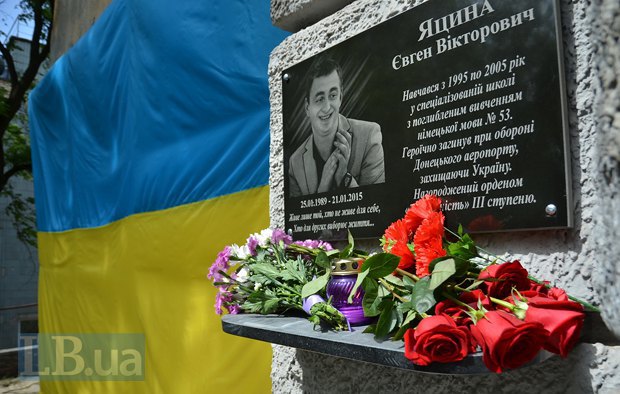
Separately, there is the story with the school. In Kyiv, in the city center, at School No. 53, where Yevhen studied from 1995 to 2005, a memorial plaque was opened for the fallen “cyborg”. His mother said that a “very positive photograph” was chosen for the plaque — the one that best reflected her son’s character: he was cheerful, lively, contactable. The idea came from friends and classmates — the memory was made by people who knew him not by biography, but by school corridors and common conversations.

“Benya” — the youngest “cyborg”: the Jewish story of Yevhen Yatsyna in the memory of Donetsk Airport

“Wall of Memory of Those Who Fell for Ukraine”: Portrait and Exact Location

Another point of Kyiv’s memory is the memorial “Wall of Memory of Those Who Fell for Ukraine”, open to the urban space. This place is arranged so that a person can come and find a specific face — not “in the general list”, but nearby, at arm’s length.

Yevhen Yatsyna’s portrait on the “Wall of Memory” is placed with precise marking: section 5, row 3, place 38. This precision turns memory into action: you can come and stop right at his portrait.

In recent years, the “Wall of Memory” has also become part of the public diplomacy of memory: Volodymyr Zelensky often brings foreign guests there to show the cost of Russian aggression not in the language of statistics, but with the faces of the fallen.

Order “For Courage” III Degree: Fixing the Feat at the State Level

The feat of Yevhen Yatsyna is also enshrined in a state document. He was awarded the Order “For Courage” III Degree (posthumously).

The basis is Presidential Decree of Ukraine No. 270/2015 of May 15, 2015. The decree states that the award is given “for personal courage and high professionalism shown in the defense of the state sovereignty and territorial integrity of Ukraine, loyalty to the military oath”.

Together, these elements — the funeral in Kyiv, community participation, memorial plaques, portrait on the “Wall of Memory”, and state order — form a coherent line: Yevhen Yatsyna did not dissolve in the war as “one of”. He remained a name, a face, and a story — for Ukraine and for the Jewish community, which shared this loss as their own.

Knesset and Words About the Contribution of Jews from Ukraine

On December 23, 2015, during a speech in the Knesset, President of Ukraine Petro Poroshenko said a phrase that still sounds like a political and human testimony:

“In confronting external aggression, our country has revived its army. And in this army, citizens of Ukraine of different nationalities are fighting. And we are proud of the contribution that Jews make to the defense of the country. I cannot but recall the glorious cyborg warrior who died in January this year at Donetsk Airport, Yevhen Yatsyna with the call sign ‘Benya’. We are proud of his feat. Posthumously, he was awarded the state order ‘For Courage’.”

This is not just a “mention of a name”. It is a public acknowledgment that the Jewish community of Ukraine is not an observer and not a “separate topic”, but part of the resistance to Russian aggression.

And this is especially important now, when Russia continues the war and continues to try to blur responsibility, substitute cause-and-effect relationships, and play the card of societal division. Stories of such people break this propaganda because they are very simple and very direct: a citizen of Ukraine went to defend the country, died, and he is remembered — by the state, the university, and the community.

Why the Story of “Benya” Sounds Sharper Today Than Ten Years Ago

Donetsk Airport was one of the first places where the war showed its true face. Back then, many still hoped that “everything would end soon”. Today, after the full-scale invasion, it has become clear: Russian aggression is a long-term project of destruction, exhaustion, terror in the rear, and an attempt to erase identity.

Against this background, the story of Yevhen Yatsyna looks not like an “episode of the past”, but as a point from which much began. It shows that resistance in Ukraine was initially nationwide — including with the participation of the Jewish community, which provided the country with warriors, volunteers, doctors, support for the families of the fallen, and public memory.

And in the end, there remains a simple formula that sounds especially honest in the section “Jews from Ukraine“:

Memory is us with you. As long as we name names and tell stories in living words, the war cannot turn people into impersonal numbers. NAnews — Israel News | Nikk.Agency.


Ukraine is looking for workers, Israel shows a model: migrants cover only 0.1% of market needs - June 5, 2026 - Новости Израиля

Trump promises a finale with Iran: deadline, Pakistan, and a deal that is not yet in place - June 5, 2026 - Новости Израиля

The Kishinev pogrom: In 1903, the central authorities in Russia wanted Jewish blood to be shed, and that is exactly what happened. - June 5, 2026 - Новости Израиля

The little man inside the big occupation: Russian archaeologist Butyagin will be extradited to Ukraine on charges of illegal excavations in annexed Crimea and looting of historical artifacts

A Polish court has deemed the extradition of Russian archaeologist Alexander Butyagin to Ukraine permissible. Full story: Myrmekion, excavations in annexed Crimea, Article 298 of the Criminal Code of Ukraine, damage exceeding 200 million UAH, the debate over sanctions, and why this case is significant far beyond archaeology.

The story of Alexander Butyagin is already being reduced to a convenient formula: “a scientist is being persecuted for science.” But if you trace the entire chain from the beginning, a completely different picture emerges. Before 2014, the Russian archaeologist worked in Ukrainian Crimea under one legal framework, after 2014 — under another. It is precisely on this rupture that both the Ukrainian accusation and the Polish extradition procedure are built today, as well as the broader debate about whether it is possible to continue excavating, publishing findings, and pretending that politics has nothing to do with it under occupation.

On March 18, 2026, the Warsaw District Court deemed the extradition of Russian archaeologist Alexander Butyagin to Ukraine legally permissible. This does not mean immediate transfer: the defense has already announced an appeal, and after the court decision comes into force, the final decision on the Polish procedure is made by the Minister of Justice. But the meaning of the step itself is already clear: the Polish court did not see insurmountable obstacles to extradition at this stage.

Butyagin is not a random figure. He is an employee of the Russian State Hermitage Museum, head of the sector of ancient archaeology of the Northern Black Sea region, and since 1999 has led the Myrmekion archaeological expedition in Kerch. The settlement of Myrmekion itself is an ancient Greek colony founded in the first half of the 6th century BC, one of the significant archaeological sites of eastern Crimea.

Myrmekion (Greek Μυρμήκιον) — founded by Ionian Greeks in the mid-6th century BC on the shore of the Kerch Strait, an ancient city that was part of the Bosporan Kingdom. It was located east of Panticapaeum (modern Quarantine Cape within Kerch). It is a cultural heritage monument of Ukraine of national significance (protection No. 010015-N).The area of the settlement is over 6 hectares.

What exactly happened and why this case did not start in Poland

A small man within a large occupation: Russian archaeologist Butyagin will be extradited to Ukraine on charges of illegal excavations in annexed Crimea and looting of historical artifacts

Butyagin’s story did not begin with his arrest in Warsaw, but with excavations in Crimea. And here it is important to immediately remove the confusion often used in polemics. The fact that he is a Russian archaeologist and an employee of the Hermitage did not automatically make his work in Crimea illegal until 2014. Ukrainian legislation allowed archaeological research with Ukrainian permits and an “open sheet,” and Butyagin himself claimed in interviews that before the annexation, permits for the expedition were obtained in Kyiv through the museum’s management. So, at the starting point, it was not about a “self-willed outsider,” but about a Russian expedition operating within the Ukrainian legal framework.

After the annexation of Crimea in 2014, this logic broke down.

For Russia, the peninsula became “its territory,” for Ukraine, the EU, and international organizations — an occupied Ukrainian territory. Excavations continued, but Ukrainian permits were no longer available. This is where the main legal knot of the case arose: not in the mere fact that a Russian archaeologist works in Crimea, but in the fact that after 2014, according to Kyiv, he continued to do so without the consent of the state, which international law continues to consider the sovereign of the peninsula.

Ukrainian law enforcement officials informed Butyagin of suspicion in absentia in 2024. According to materials cited by human rights and media sources, he is accused of illegal work at the archaeological heritage site Myrmekion and partial damage to the monument. The Ukrainian side estimates the damage at more than 200 million UAH. In November 2024, he was put on the wanted list, and then the case reached the international level.

In early December 2025, Butyagin was detained in Poland while traveling through Warsaw during a European lecture tour; different publications mention the date December 4, and the detention was widely reported publicly on December 11. Ukraine officially sent an extradition request on December 23. On January 13, the Polish prosecutor’s office supported the Ukrainian position, in January the court extended his detention, and on March 3, the arrest was extended until June 1. On March 18, the court deemed the extradition permissible.

This entire path is important: it is not a one-time political statement, but an already formalized European procedure.

A separate episode that amplified the case in the public space is related to a 2022 discovery. According to Ukrainian sources cited by human rights activists, Butyagin’s expedition discovered 30 gold coins, 26 of which bore the name of Alexander the Great, and 4 from the time of Philip III Arrhidaeus. For the Russian museum and archaeological community, this was presented as a major scientific discovery. For Kyiv, it was yet another proof that excavations are being conducted on occupied territory and valuable artifacts are being removed outside the Ukrainian permit regime.

Under which articles he is accused and what is wrong with the formula “up to 10 years”

According to publicly available materials that can now be verified, Butyagin is charged in Ukraine under part 4 of Article 298 of the Criminal Code of Ukraine. This provision is related to illegal actions concerning cultural heritage objects if they are committed with the aim of searching for movable items of archaeological origin. The current public version of the article specifies a punishment of 2 to 5 years of imprisonment with a possible prohibition on holding certain positions or engaging in certain activities.

If you break down the provision a bit more precisely, Article 298 is structured as follows: part 1 concerns illegal archaeological and other earthworks at an archaeological heritage site; parts 2 and 3 — intentional destruction, damage, or harm to cultural heritage objects, including monuments of national significance; and part 4 increases responsibility if actions under parts 2 or 3 were committed specifically for the purpose of searching for movable items from archaeological heritage. This construction explains why Butyagin’s case is presented not as a dispute over paperwork, but as a criminal plot about damaging the object and searching for artifacts.

At the same time, some publications indeed featured the formula that Butyagin faces “up to 10 years.”

Such a figure appeared in some early media retellings and Russian publications. But later, both Polish prosecutorial spokesman Piotr Skiba and Ukrainian human rights sources spoke specifically about the risk of up to five years, which coincides with the open text of part 4 of Article 298 of the Criminal Code of Ukraine.

The same applies to the word “plundering.” In journalism, it sounds strong, but legally it is more accurate to write this way: Ukraine accuses Butyagin of illegal excavations, damage to the monument, and illegal handling of finds discovered during these works. Reuters in December 2025 wrote about Ukrainian accusations of unauthorized excavation and plundering historical artifacts.

There is also another important nuance.

The Russian side and some of Butyagin’s colleagues insist that the finds were not taken from Crimea to St. Petersburg but remained on the balance of the Eastern Crimean Museum-Reserve. This does not negate the Ukrainian accusation because for Kyiv the problem begins earlier — already in the very fact of excavations on occupied territory without its permission. But as a defense argument, this thesis will clearly continue to be used.

It is at this point that it becomes clear why the plot ceased to be narrowly specialized. For NAnovosti — News of Israel | Nikk.Agency, the importance here is not only the fate of one scientist but the precedent itself: Europe is showing for the first time so specifically that cultural heritage in Crimea is not a “gray area outside politics,” but part of the big question of sovereignty, occupation, and future responsibility.

Why this case is more than the case of one archaeologist

The most convenient version for Moscow is the formula “a scientist is being persecuted for science.” It is emotional and therefore catchy. But from the perspective of the international framework, the problem looks different. The EU in 2025 officially extended restrictive measures related to the illegal annexation of Crimea, directly calling it illegal annexation. And UNESCO’s recommendation on international principles of archaeological excavations speaks even more harshly: a state occupying the territory of another state must refrain from conducting archaeological excavations on occupied territory.

This does not mean that Butyagin’s guilt has already been proven on the merits. But it directly follows another: the thesis “we were just doing science” does not automatically remove the legal problem. If the territory is considered occupied, archaeology there ceases to be just science. It becomes an action within the regime of control over someone else’s heritage, and sometimes — an instrument of its reformation. That is why Butyagin’s case is so painful for the museum and academic community: it undermines the familiar formula “we are outside politics.”

And here the important question we have already discussed arises: how could a Russian archaeologist even dig in Ukrainian Crimea?

The answer shows where the boundary between the old and new reality lies. Before 2014, he could work there within the framework of Ukrainian law. After 2014 — no longer, if there was no permission from Kyiv. Therefore, the criminal conflict did not begin with Butyagin’s biography itself and not with his nationality, but with the continuation of work under occupation conditions.

If the appeal in Poland does not change the situation, the case will move further along the Polish extradition procedure to the Minister of Justice. If extradition fails for some reason, some human rights lawyers allow for another scenario: transferring materials to the Polish side for possible prosecution already in Poland. This is not yet the main path and not a decision made, but as a legal option, it is being discussed.

A small man within a large occupation — but this does not negate responsibility

On a personal level, Butyagin may not look like the architect of war or an official of the occupation administration, but as a narrow specialist who has been engaged in one monument for many years. There is human drama in this. He indeed excavated Myrmekion for decades, lived with this object, and, judging by his own explanations, considered continuing work after 2014 “necessary and right” in relation to the monument itself. That is why the case is so easily sold to the public as a story about a “small man” caught in the gears of geopolitics.

But here lies an unpleasant boundary.

Occupation is sustained not only by generals, tanks, and flags. It is also sustained by people who make it everyday: administrators, museum workers, teachers, restorers, archaeologists. Not all of them are equal in the scale of guilt. Not all of them are the main ones.

But this does not mean that they do not bear responsibility. If a person continues to work on occupied territory as if international law has already been abolished, they sooner or later face the fact that the legal bill still comes. This framework is confirmed by both the EU’s position on Crimea and UNESCO’s norm on excavations on occupied territory.

Therefore, the most accurate formula here is probably this. Yes, Butyagin is not the main figure of the Russian occupation of Crimea. Yes, on a human level, he may be a “small man” within a large state machine. But the illegality of the occupation itself does not disappear because of this. And those who continued to work there after 2014 should have understood: the immunity of the word “science” is not eternal. This is perhaps the main meaning of the whole story.

That is why Ukraine, in general principle, looks stronger here.

Not because any Russian scientist is automatically guilty, but because you cannot first seize territory, then declare it yours, and then conduct excavations, formalize findings, and say that it is just academic routine. But now it is important for Kyiv not to fall into propaganda and to bring the case purely legally: with proven episodes, a clear causal link, and a careful procedural basis. Only then will Butyagin’s story become a real international precedent, not just a loud headline for a few days.

Why the argument “what about the Golan?” does not save Butyagin

One of the most predictable comments under such an article will sound like this: if Russian excavations in Crimea are a violation, then why are “Israeli works on the Golan supposedly permissible”? It is better to answer this question honestly, not with a slogan.

According to the UN and EU position, the Golan Heights are not recognized as Israeli territory: the UN Security Council in resolution 497 declared the extension of Israeli law to the Golan “null and void,” and UN structures in 2025–2026 continue to use the formula occupied Syrian Golan. The EU also explicitly states that it does not recognize Israeli sovereignty over the Golan. Meanwhile, the US has recognized the Golan as part of Israel since 2019.

That is, the status of the Golan in international politics is disputed, not “closed once and for all.”

But this does not mean that Crimea and the Golan are the same case. On Crimea, the EU’s position is much stricter and more unequivocal: Brussels directly calls it illegally annexed by Russia Ukrainian territory and for this reason extends a separate sanctions regime. There is no Western recognition of Russian sovereignty over Crimea (even Iran has not recognized it). Therefore, in the European legal logic, Butyagin falls not into a “gray zone of disputed territory,” but into a case about activities on territory that Europe continues to consider Ukrainian and illegally annexed by Russia.

There is also another difference that proponents of such a comparison usually prefer to remain silent about.

Israel’s control over the Golan arose after the 1967 war and has been discussed for decades within the framework of the security of northern Israel, Syrian shelling, and subsequent international negotiations. Before 1967, Syrian artillery and sniper fire was conducted from the heights on Israeli areas below, and during the war itself, Syria continued shelling northern Israeli villages. This does not make the international legal dispute over the Golan disappear, but it shows: the historical context here is different. Crimea “joined” Russia not through a security negotiation framework, but through the 2014 annexation, which the EU officially qualifies as a violation of international law.

That is why the argument “whose then are the Golan?” is weak for Butyagin’s case.

Even if someone considers Israeli actions on the Golan legal, and someone does not, this does not automatically make Russian excavations in Crimea legal. International law does not work on the principle “if it is disputed in one place, then it is allowed in another.” For this article, a strong formula is this: the question of the Golan does not cancel the question of Crimea, but only shows that territorial disputes differ in origin, international support, and legal consequences. And in the case of Crimea, the European position today is much more straightforward and strict than Butyagin’s defenders try to present.


Ukraine is looking for workers, Israel shows a model: migrants cover only 0.1% of market needs - June 5, 2026 - Новости Израиля

Trump promises a finale with Iran: deadline, Pakistan, and a deal that is not yet in place - June 5, 2026 - Новости Израиля

The Kishinev pogrom: In 1903, the central authorities in Russia wanted Jewish blood to be shed, and that is exactly what happened. - June 5, 2026 - Новости Израиля

Putin dictates: why Iran suddenly called Ukraine a ‘target’ and what this threatens for Israel

Ukraine has officially found itself on the list of countries that the Iranian regime considers as potential targets for strikes. This is no longer leaks or propaganda — the statement came from a representative of the Iranian parliamentary commission on national security.

The change in rhetoric seems abrupt. Not long ago, Tehran tried to deny direct involvement in the war against Ukraine through arms supplies to Russia. Now — direct threats.

And for Israel, this is also a signal.

Why Iran has moved to open pressure

From covert participation to direct statements

The head of Iran’s national security commission, Ebrahim Azizi, stated that the entire territory of Ukraine can be considered a ‘legitimate target.’ Formally, this is presented through a reference to international law, but in essence, it is about political blackmail.

In fact, Iran is publicly marking Ukraine as an adversary for the first time.

What triggered this

The key factor is Ukraine’s involvement in helping Middle Eastern countries intercept Iranian drones.

Before this, Kyiv avoided direct conflict with Tehran. The logic was simple: the war with Russia already requires maximum concentration of resources. But after the inclusion of Ukrainian air defense specialists in regional processes, the situation changed.

Ukraine has effectively found itself in the same framework as Israel and the USA.

Where is Moscow’s role here

Iran is part of a broader axis

Today, Iran is not acting on its own. It is integrated into a partnership with Moscow and Beijing.

Iranian Shahed drones have become one of the key tools for strikes on Ukraine. Production has been scaled up, deliveries are regular, and the technological base is a hybrid of Soviet, Western, and domestic solutions.

And it’s important to understand: such statements from Tehran do not arise in a vacuum.

In the context of how NAnews — Israel News | Nikk.Agency views the developments, it is clear that the intensification of Iran’s rhetoric coincides with the Kremlin’s interests — to expand the conflict and blur the focus of the war in Ukraine.

Why this happened right now

Several factors coincided at once:

– escalation in the Middle East
– increased tension between Israel and Iran
– signals of reduced US aid to Ukraine
– reports of close contacts and coordination between Moscow and Tehran

This creates a sense of controlled escalation.

How real is the threat of strikes

The range already allows

Iran has not only drones but also ballistic missiles.

Tactical — up to 300 km. Medium-range — up to 2000–3000 km. This means that theoretically, the entire territory of Ukraine is within reach.

An additional factor is the testing of two-stage missiles, which increases range and power.

How this might look in practice

Large-scale independent strikes by Iran on Ukraine seem unlikely.

But another scenario is more realistic:

– synchronized attacks with Russia
– targeted demonstrative strikes
– using missiles as a political signal

This will not change the situation on the front, but it will increase pressure.

Risk of sabotage

A separate direction is sabotage activity.

Iran is already using such tactics in countries where American bases are located. If this model is transferred to Ukraine, an additional threat arises.

This is a matter not only for the army but also for special services.

Why this is important for Israel

A unified line of conflict is now forming.

Iran against Israel — and simultaneously against Ukraine.

If Ukraine helps shoot down Iranian drones in the Middle East, and Iran in response declares it a ‘target,’ this is no longer two separate conflicts.

This is one connected system.

And the main question here is not even whether there will be real strikes.

But whether Iran is ready to act according to a scenario beneficial to Moscow — including expanding the war beyond the region.


Ukraine is looking for workers, Israel shows a model: migrants cover only 0.1% of market needs - June 5, 2026 - Новости Израиля

Trump promises a finale with Iran: deadline, Pakistan, and a deal that is not yet in place - June 5, 2026 - Новости Израиля

The Kishinev pogrom: In 1903, the central authorities in Russia wanted Jewish blood to be shed, and that is exactly what happened. - June 5, 2026 - Новости Израиля

Shock wave therapy in Israel: what pains does SWT treat and how does it work

Chronic pain is one of the main reasons people seek medical attention in Israel. Pain in the heel, knee, shoulder, or tendons can last for months or even years, limiting mobility and reducing quality of life. One of the most effective non-drug treatments for such conditions today is shockwave therapy.

In Israel, this method is actively used at the David Sendler Pain Treatment Clinic. Detailed information about the clinic’s approach, treatment directions, and appointment possibilities is available on the official website:
https://uvt.nikk.co.il/.
This is where patients can get an initial understanding of the method and therapy possibilities.

Treatment Geography: Where Shockwave Therapy is Conducted in Israel

The David Sendler Pain Treatment Clinic works with patients throughout Israel, providing access to shockwave therapy in different regions of the country. The reception geography is structured so that patients can receive treatment as close to their place of residence as possible, without the need for long trips.

The main region of the clinic’s work is Haifa and the Krayot agglomeration. This area includes Kiryat Ata, Kiryat Bialik, Kiryat Motzkin, Kiryat Yam, and Kiryat Haim. Here, patients with chronic pain in the heel, knee, shoulder, and tendons, who require a regular course of ESWT, are most often treated.

Special attention is given to patients from Nesher and Tirat Carmel. For residents of these cities, treatment is convenient as it does not require long commutes, and the clinic’s work format allows for an individual visit schedule considering the patient’s availability.

The clinic also accepts patients from Acre and Nahariya. In these cities, people often seek help for pain associated with prolonged stress, working on their feet, and the consequences of old injuries. Shockwave therapy in such cases is considered a way to reduce pain and restore mobility without surgery.

Residents of Afula and Yokneam often turn to the clinic with chronic pain syndromes of the musculoskeletal system. For this category of patients, comprehensive treatment is important, where ESWT is combined with recommendations on loads and lifestyle.

In the central regions of Israel, the clinic works with patients from Petah Tikva, Netanya, Hadera, and Kfar Saba. Here, shockwave therapy is often used for prolonged pain that did not yield results with standard medication or physiotherapy.

For patients with limited mobility or severe pain syndrome, a home demonstration of the procedure is possible — by prior arrangement. This format is especially convenient at the stage of initial acquaintance with the method and assessing the body’s reaction to therapy.

Regardless of the city of residence, each patient undergoes an individual assessment of their condition, after which the optimal course of shockwave therapy is selected, taking into account the diagnosis, duration of pain, and overall level of physical activity.

Shockwave Therapy in Israel: What Pains ESWT Treats and How It Works

What is Shockwave Therapy and What is Its Essence

Shockwave therapy (ESWT) is a method of affecting tissues using high-energy acoustic waves. These impulses penetrate deep into the tissues and stimulate natural recovery processes without damaging healthy structures.

A detailed description of the technology, indications, and principles of ESWT devices is presented on the page
https://uvt.nikk.co.il/ubt/.
It explains in detail why the shockwave triggers regeneration and reduces chronic inflammation.

A separate material is dedicated to the specific pain syndromes where the method is applied and which areas are treatable.
This information is collected on the page
https://uvt.nikk.co.il/gde-udarno/,
where the most common clinical cases are described.

For patients who find it more convenient to receive information in English, a full English version of the site is provided:
https://uvt.nikk.co.il/en/.
It is especially useful for new immigrants and foreign patients.

There is also a separate English section that explains in detail where exactly shockwave therapy is applied and in which conditions it is most effective:
https://uvt.nikk.co.il/en/where-shockwave/.

Heel Pain and Heel Spur

Heel pain is one of the most common reasons for visiting a pain clinic. Complaints about sharp pain during the first steps in the morning or after prolonged sitting are especially characteristic. Most often, it is about plantar fasciitis or a heel spur.

On the page
https://uvt.nikk.co.il/bolit-pjatka/
the causes of heel pain, typical symptoms, and treatment approaches using ESWT are thoroughly analyzed.

A separate material is dedicated specifically to the heel spur and its treatment features in Israel.
It is available at
https://uvt.nikk.co.il/pjatochnaja-bol-i-pjatochnaja-shpora-v-izraile/,
where it is explained in detail why ESWT often allows avoiding surgeries.

Practical issues of assistance with heel pain while walking are covered on the page
https://uvt.nikk.co.il/pomoshh-pri-boli-v-pjatke-pri-hodbe-uvt/.
Real treatment scenarios and patient expectations are considered there.

For English-speaking patients, similar information is presented on the page
https://uvt.nikk.co.il/en/heel-pain-when-stepping/,
where the causes of heel pain and therapy possibilities are described.

A separate English material on heel spur and chronic heel pain is available at
https://uvt.nikk.co.il/en/heel-pain-and-heel-spurs/.

A practical guide for patients experiencing pain while walking is posted on the page
https://uvt.nikk.co.il/en/help-with-heel-pain-when-walking-eswt/.

Knee Pain

The knee joint experiences significant stress daily. Knee pain can be associated with overloads, microtraumas, age-related changes, or the consequences of old injuries.

On the page
https://uvt.nikk.co.il/bol-v-kolene/
the main causes of knee pain are thoroughly examined, and it is explained in which cases ESWT can be an effective solution.

For the English-speaking audience, similar material is available here:
https://uvt.nikk.co.il/en/knee-pain-why/.

Shoulder Pain

The shoulder joint is highly mobile, but for this reason, it often suffers from overloads and inflammatory processes. Chronic shoulder pain can limit movement and interfere with daily activities.

The causes of shoulder pain and treatment options are described on the page
https://uvt.nikk.co.il/bolit-plecho/,
where the role of shockwave therapy is separately considered.

Additional material on chronic shoulder pain is available at
https://uvt.nikk.co.il/bol-v-pleche/.

For patients who prefer English, the information is posted on the page
https://uvt.nikk.co.il/en/shoulder-pain/.

An analytical material on the causes of shoulder pain and treatment options is available here:
https://uvt.nikk.co.il/en/shoulder-pain-why/.

Pain in the Achilles Tendon

The Achilles tendon is one of the most stressed structures of the musculoskeletal system. Chronic pain in this area is often found in people with an active lifestyle.

A detailed analysis of the problem is presented on the page
https://uvt.nikk.co.il/bol-v-ahillovom/,
where symptoms and treatment possibilities using ESWT are described.

The English version of the material is available at
https://uvt.nikk.co.il/en/achilles-tendon/.

Clinic Geography and Treatment Organization

The David Sendler Pain Treatment Clinic accepts patients in different cities of Israel. Information about treatment in Haifa is available on the page
https://uvt.nikk.co.il/klinika-boli-v-hajfe/,
where the reception conditions and therapy possibilities are described.

Patients from Petah Tikva can learn about the clinic’s work features via the link
https://uvt.nikk.co.il/klinika-boli-v-petah-tikve/.

A separate page for residents of Netanya is located here:
https://uvt.nikk.co.il/klinika-boli-v-netanii/.

Information for patients from Hadera is available on the page
https://uvt.nikk.co.il/klinika-boli-v-hadere/.

For residents of Kfar Saba, a separate section is created:
https://uvt.nikk.co.il/klinika-boli-v-kfar-save/.

Confidentiality and Authorship

The clinic pays special attention to protecting patients’ personal data. A detailed privacy policy is published on the page
https://uvt.nikk.co.il/privacy-policy/.

Medical and informational materials on the site are published by the clinic’s official team.
Information about the author is available here:
https://uvt.nikk.co.il/author/admins56ni9mns4/.

All articles on health and medicine are collected in the corresponding section:
https://uvt.nikk.co.il/category/medicina-i-zdorove/.

Contacts and Working Hours

David Sendler Pain Treatment Clinic
Phone: 055-951-4135
Contact via website: 24/7
Home visit by agreement

Working hours:
Sunday–Thursday: 10:00–19:00
Friday and pre-holiday days: 09:00–14:00
Saturday: closed


Ukraine is looking for workers, Israel shows a model: migrants cover only 0.1% of market needs - June 5, 2026 - Новости Израиля

Trump promises a finale with Iran: deadline, Pakistan, and a deal that is not yet in place - June 5, 2026 - Новости Израиля

The Kishinev pogrom: In 1903, the central authorities in Russia wanted Jewish blood to be shed, and that is exactly what happened. - June 5, 2026 - Новости Израиля

Mordechai Kreuser: an Israeli citizen who has been feeding internally displaced people free kosher meals in Ukraine for 3 years – video

“This is my way of saying thank you to G-d that we have food and shelter,” – says Mordechai.

The story of Mordechai Kreuser is a shining example of human solidarity and selflessness. An Israeli citizen who came to Transcarpathia to revive the Jewish community became a savior for thousands of Ukrainian immigrants.

For the third year now, he has been providing them with free kosher meals, bringing light during the difficult times of war.

A report about Mordechai Kreuzer showed Ukrainian TV channel ICTV .

Mordechai Kreuser came to Mukachevo in 2022 with an ambitious goal: to open a kosher restaurant and breathe new life into the Jewish community. However, Russian aggression changed his plans.

When the war began, Mordechai used his funds to set up charity canteens in Mukachevo, Ivano-Frankivsk and Chernigov.

At the beginning of 2022, about 500 people came to the dining room in the Mukachevo synagogue four times a week, now – 250.

“This is my way of saying thank you to G-d that we have something to eat and a place to sleep. I came here for a different purpose and found myself among hundreds of thousands of people fleeing the war and becoming its victims. I feed the hungry and this is my way to help them.” – says Mordecai.


Help with numbers

At their peak, Kreuser’s canteens fed up to 500 people daily.

City Number of people (2022) Number of people (2024)
Mukachevo 500 250
Ivano-Frankivsk ~300 ~150
Chernigov ~200 ~100

Over time, the number of visitors has declined due to fewer migrants, but the need for hot meals remains high.


Why kosher food?

Kosher dishes are not only a tradition, but also a sign of respect for every person, regardless of their faith.

Features of Mordecai’s cuisine:

  • Suitable for people of all religions.
  • Meets strict kosher standards.
  • It is being prepared with the participation of volunteers, including displaced people.

Volunteer work

The Kreuzer canteen is staffed by four women who are themselves displaced people.


Stories that touch the heart

One of the visitors to the canteen was Nadezhda from Mariupol, who spent 40 days under occupation without food or water. As a result, she lost her sight and hearing.

“These people cook with warmth and kindness. Here I felt that I could live again,” — Nadezhda shares.


Problems and challenges

Today, charity canteens in Ivano-Frankivsk and Chernigov have closed due to lack of funds. However, Mordecai continues to seek support.

“I had a calling from my heart. I cannot remain indifferent, even if the funds are not enough.” – he says.

Kreuzer appeals to wealthy people with a request to open their hearts and support those who are in trouble.


The role of the initiative for relations between Israel and Ukraine

The Mordechai project is not only humanitarian aid, but also an important symbol of cooperation between the Jewish and Ukrainian peoples.

Our website NAnews – Israel News continues to tell stories that unite Israel and Ukraine.


Conclusion

Mordechai Kreuser’s initiative demonstrates the power of the human spirit and the potential for uniting peoples. His story is an example of how you can overcome boundaries while supporting those who need it most.

“The war will pass, but the memory of good deeds will remain,” – Mordechai is sure.

Let’s support such initiatives together and make the world a better place.

…..

Read on WhatsApp – channel NAnews ↓ — Israel News

Read on Telegram – channel NAnews ↓ — Israel News


Ukraine is looking for workers, Israel shows a model: migrants cover only 0.1% of market needs - June 5, 2026 - Новости Израиля

Trump promises a finale with Iran: deadline, Pakistan, and a deal that is not yet in place - June 5, 2026 - Новости Израиля

The Kishinev pogrom: In 1903, the central authorities in Russia wanted Jewish blood to be shed, and that is exactly what happened. - June 5, 2026 - Новости Израиля

The Chief Rabbis of Israel congratulated Moshe Asman on his 60th birthday: words about the Torah, mercy, and service to people – video

On March 16, 2026, the Chief Rabbi of Ukraine, Moshe Reuven Asman, published words of gratitude (in Ukrainian) to the Chief Rabbis of Israel, who congratulated him on his 60th birthday. This refers to the Sephardic Chief Rabbi of Israel, Rabbi David Yosef, and the Ashkenazi Chief Rabbi of Israel, Rabbi Kalman Bar.

Moshe Asman himself wrote briefly and very personally: he sincerely thanked both rabbis for their congratulations. But the content of the video messages themselves turned out to be much broader than a formal anniversary gesture. In these words, there is recognition of many years of work, respect for his path, and an assessment of what he has done for Jewish life in Ukraine during years of peace, crisis, and war.

Chief Rabbis of Israel congratulated Moshe Asman on his 60th birthday: words about Torah, mercy, and service to people

March 14, 2026, Moshe Reuven Asman turned 60 years old. A few days before that, a festive celebration of the anniversary took place in Kyiv. Asman later wrote that for him it was a “very bright evening” and a rare opportunity to gather many good people who today work and serve to ensure that Ukraine stands firm — each in their own place.

When at one event, the head of the Office of the President of Ukraine Kyrylo Budanov, Deputy Head of the Office of the President Iryna Mudra, Acting U.S. Chargé d’Affaires in Ukraine Julie Davis, Ambassador of Israel to Ukraine Michael Brodsky, representatives of the Ukrainian Air Force Command, National Guard, Territorial Defense Forces, Medical Forces, Military Chaplaincy, the “Azov” Corps, as well as hierarchs of Ukrainian churches, diplomats, public figures, and rabbis are present, it is no longer a private date.

What Rabbi David Yosef said

The first video featured a congratulation from Rabbi David Yosef. His address was short but very precise in tone. He called Moshe Asman his outstanding friend, a person who builds the world of Torah, and specifically emphasized his role as the Chief Rabbi of Ukraine.

The congratulation included a wish to continue “spreading the Torah, magnifying it, and strengthening it.” At the same time, Rabbi David Yosef emphasized not only the spiritual mission but also that this work continues “in these difficult days.” This emphasis is especially important because it directly links the congratulation not to an abstract date but to the reality in which the Jewish communities of Ukraine live.

He wished Moshe Aman health, longevity, joy, and new strength to go “from strength to strength.” In religious language, this formula is not just a polite congratulation. It is an acknowledgment that there is still a path ahead, still a task, still a service.

A congratulation that turned into a characterization of a whole life

The second address, delivered by Rabbi Kalman Bar, was much more detailed. It included warmth, humor, a deep religious reference, and a very personal characterization of the jubilarian himself.

Rabbi Bar began with an almost familial tone: he admitted that at first, he even thought the news of the 60th birthday was a joke because Moshe Asman, in his words, looks much younger. But after this light introduction, he moved on to the main point: the meaning of age, the significance of the years lived, and what exactly fills this life.

He recalled a Talmudic saying that reaching the age of 60 is a special milestone. But then he offered a broader meaning: not just gratitude for the years lived, but a testimony that the person was not “cut off” from his people, but on the contrary, acted for them all his life.

It was here that the congratulation ceased to be an ordinary anniversary speech. Rabbi Kalman Bar essentially defined how he sees Moshe Asman’s life: as constant service to others, as a search for new ways to help, as a practice of mercy not in words but in action.

Not just charity, but a constant search for how else to help

One of the main thoughts expressed in the congratulation concerns the very concept of chesed — mercy, kindness, helping one’s neighbor. Rabbi Bar specifically emphasized that true chesed is not only a response to an already voiced request. A truly high level is constantly thinking about what else can be done for another person.

In this context, he mentioned helping refugees, food, and spreading the Torah. That is, it was not about one direction of work, but about a whole way of life in which spiritual service is not separated from practical help to people.

Such a description is especially important in the Ukrainian context of recent years. The Jewish communities of Ukraine have experienced evacuations, humanitarian crises, and the need to literally rebuild the system of assistance in wartime conditions. Therefore, the words that Moshe Asman “thinks all his life about what else can be done for others” sound not like ritual praise but as a very concrete characteristic.

At this point, NAnews — Israel News | Nikk.Agency sees the main meaning of these congratulations: Israeli religious leaders speak of the Chief Rabbi of Ukraine not only as a spiritual authority but also as a man of action who managed to combine Torah, public service, and real help to people in difficult historical times.

Why these words are important for Israel and Ukraine

Such congratulations are significant not only for Moshe Asman’s personal biography. They also show something else: how closely religious, public, and human bridges are connected today between Israel and Jewish life in Ukraine.

When the Chief Rabbis of Israel specifically note not only knowledge, status, or position but precisely help to refugees, good deeds, devotion to the people of Israel, and many years of service to the community, it means recognizing the role of Ukrainian Jewry as part of the common Jewish space.

For the Israeli audience, this is also an important signal. In recent years, Ukraine is increasingly perceived through the prism of war, destruction, and geopolitics. But behind this, it is easy to lose sight of the people who continue to hold communities together, help families, maintain religious life, and prevent the Jewish presence from disappearing even in extraordinary conditions.

That is why the congratulation addressed to Moshe Asman goes beyond a private anniversary. It becomes a statement about values: that in Jewish tradition, not only titles are truly valued, but also the ability to live for others.

Words that summarize and simultaneously look forward

At the end of his address, Rabbi Kalman Bar quoted the thought that the Almighty loves those who love His children. This was perhaps the most emotionally powerful moment of the entire video. In this formula, there is both a blessing and gratitude, and an explanation of why the figure of Moshe Asman evokes such a warm reaction from his interlocutors.

Concluding the congratulation, he wished the jubilarian and his entire family grace, a good name, health, joy, and holy comfort from descendants. And Rabbi David Yosef, in turn, blessed him to continue his path — in good health, with longevity and new joys.

Thus, the 60th birthday of the Chief Rabbi of Ukraine, Moshe Reuven Asman, became not just an anniversary date, but an occasion to once again speak aloud about his role for Jewish life in Ukraine, his connection with Israel, and that in the most difficult times, it is such figures that hold the community, memory, faith, and human dignity.

From Leningrad and Jerusalem to Kyiv and Anatevka

The biography of Moshe Reuven Asman itself looks like a plot for a separate book. He was born on March 14, 1966, in Leningrad. After getting married in 1987, he moved to Israel, where he continued his religious studies in the Jerusalem yeshivas “Shamir” and “Merkaz Gutnik.” Alongside his studies, he headed “Beit Chabad” for Russian-speaking Jews — that is, he worked with the environment that was then just learning to live a Jewish life without Soviet fear and without the habit of hiding their identity.

Later, he worked as an assistant rabbi in Toronto in a direction related to Russian-speaking Jews. After completing his studies, he received the title of rabbi, and in 1991 he was sent to Ukraine. This was a special moment: the country was just entering independence, the Soviet system was collapsing, and old religious communities had to be not just revived but literally rebuilt.

Until 1995, Asman worked as the deputy director of the “Rescue of Children from the Chernobyl Zone” program. Already in the same 1995, he became the head of the Chabad-Lubavitch Jewish religious community in Kyiv. In 1997, he became the Chief Rabbi of the All-Ukrainian Jewish Congress. He participated in the return of the Brodsky Synagogue in Kyiv, was a representative of the “Tzeirei Chabad” organization in Ukraine, and also the main representative of the World Center of Breslov Hasidim in the country.

On September 11, 2005, he was elected Chief Rabbi of Ukraine. Since then, for thousands of Jews in the country, he has become not only an official figure or head of a religious structure but also one of the symbols that Jewish life in Ukraine not only survived after the 20th century but regained its voice, institutions, schools, synagogues, communities, memory, and confidence.

Later, another important chapter was added to this path — Anatevka, a Jewish settlement near Kyiv, created as a space of life and salvation for people whose ordinary fate was disrupted by war. For the Israeli reader, this story is especially recognizable: it is not about abstract religious activity, but about very concrete service — with homes, families, children, evacuation, humanitarian aid, and real risks.

Moshe Asman is a citizen of Israel and, since 2022, also of Ukraine.

……


Ukraine is looking for workers, Israel shows a model: migrants cover only 0.1% of market needs - June 5, 2026 - Новости Израиля

Trump promises a finale with Iran: deadline, Pakistan, and a deal that is not yet in place - June 5, 2026 - Новости Израиля

The Kishinev pogrom: In 1903, the central authorities in Russia wanted Jewish blood to be shed, and that is exactly what happened. - June 5, 2026 - Новости Израиля

For fast and efficient house cleaning: Advanced solution Now also in Israel. Ingenious “green” steam cleaner GENIUS

#promotion

A healthy and protected environment, without the use of chemical products that are dangerous to our body

About 80% water savings
Steam cleaning for maximum water savings

Thorough cleaning
Without the use of toxic chemical cleaning agents

Healthy, clean and protected environment
Uses only water and preserves environmental quality

GENIUS GREEN STEAM CLEANER GENIUS

Steam cleaning system

055-939-8810
consultation in Russian and Hebrew

Our website (Hebrew)Green Cleaner


Genius System Capabilities

The GENIUS system cleans various types of surfaces that require the deep and thorough cleaning necessary to live in a healthy and protected environment.

  • Washing windows, screens and blinds
  • Cleaning of tiles, ceramics and parquet
  • Easy and fast fat removal
  • Cleaning showers and toilets
  • Cleaning of seat systems
  • Descaling and cleaning
  • Cleaning pots and pans
  • Cleaning of furniture and bedding

results

Why work hard when you can work with GENIUS!

Switch to smart and efficient cleaning that will save you time, effort and money and make your home cleaner and healthier.

Request a system demo GENIUS for your home in Israel

Leave your details and we will be happy to contact you to agree demonstration without obligation.

By North and Center of Israel we are coming

to your home for a demonstration from 9:00 to 21:00 on weekdays
* on Saturday by prior arrangement.

055-939-8810
consultation in Russian and Hebrew

Our website (Hebrew)Green Cleaner


Ukraine is looking for workers, Israel shows a model: migrants cover only 0.1% of market needs - June 5, 2026 - Новости Израиля

Trump promises a finale with Iran: deadline, Pakistan, and a deal that is not yet in place - June 5, 2026 - Новости Израиля

The Kishinev pogrom: In 1903, the central authorities in Russia wanted Jewish blood to be shed, and that is exactly what happened. - June 5, 2026 - Новости Израиля

Irena Maman: how a seamstress, a repatriate from Ukraine, became a heroine for soldiers in Northern Israel, despite shelling and financial difficulties

Irena Mamana repatriate from Zhitomir (Ukraine), became a real heroine of northern Israel. She sews bulletproof vests, repairs uniforms and helps soldiers, forgetting about herself, despite the shelling and financial difficulties.

Her story was told Nikita Aronov on the Israeli portal “Details“.

Irena Maman is one of five returnees honored on November 7 for their contribution to the defense of Israel during wartime.. The award was presented by the country’s President Isaac Herzog. Among the recipients are outstanding personalities: a scientist, a surgeon and organizers of volunteer initiatives.

More about this – In honor of Aliyah Day, the President of Israel awarded repatriates: the contribution of immigrants from Ukraine, France, Canada and other countries.

However, Irena stands out for her unusual feat – she is a seamstress who selflessly and tirelessly helps northern soldiers. She works almost without rest, sewing and altering uniforms for fighters completely free of charge. The irony of fate is that instead of supporting it, the state only increases its tax burden.


How a Ukrainian seamstress became the heroine of soldiers in northern Israel

From Zhitomir to Rosh Pina: the path of Irena Maman

Irena Maman, a native of Zhitomir, came to Israel in 1990. Her journey began with a few hundred dollars in her pocket and a lack of support, but even then she knew for sure that her place was in this country. In the north of Israel, in Rosh Pina, she quickly found her calling: she began working as a seamstress, opened an atelier and won the trust of local residents.

Her story is a story of strength and perseverance that inspires hundreds of people today. Her family life is connected with Israel: three sons serve in the army, the eldest in the Iron Dome battery, the middle in the special forces. It was his request for a convenient pocket for a bulletproof vest that began Irena’s big volunteer mission.


First steps: from evening dresses to body armor

Until October 7, Irena sewed evening dresses and handled regular orders. Everything changed when the war demanded her skills. Her son, a machine gunner, complained that the body armor was uncomfortable: the pockets were too small to hold all the necessary ammunition.

“Then they came to me with the whole detachment,” recalls Irena. “Everyone had their own requests: to alter a bag, make additional pockets for grenades, or even develop a convenient holster for a pistol.”

This was the beginning of a large volunteer project. Irena sews and modifies not only body armor, but also bags for pilots, winter uniforms for infantry, and jackets for territorial defense soldiers.


“Ima Maman” for soldiers

The soldiers call Irena “ima Maman” (Mama Maman). She helps everyone who asks for support, regardless of the complexity of the order or time of day. Despite constant air raids, shelling and lack of shelter, Irena continues to sew.

“When the siren sounds, I don’t stop,” she admits. “There is no shelter nearby, but my mother taught me to believe in fate.”

Irena works almost around the clock, often seven days a week. Her studio in Kiryat Shmona is the only place where soldiers come not only for uniform repairs, but also for a cup of coffee, a kind word and help.


Combating the IDF’s systemic problems

Irena sees systemic problems in army uniforms. Standard patterns for uniforms and body armor don’t fit most soldiers well, she said.

“I have yet to meet a soldier whose uniform fits perfectly,” she says. “The pants are too tight, the sleeves are not the right length, and sizes are often limited.”

Soldiers deployed to Gaza or Lebanon are often given old uniforms that have to be modified by hand. Irena expands pockets, adds inserts from more comfortable fabrics and repairs damaged equipment.


Charity at your own expense

Irena does not take money from the soldiers for her work, but maintaining the studio costs her dearly. Her husband, a university lecturer, supports the family, but the costs of materials, electricity and even underwear for the soldiers are entirely covered by them.

“During the war, I spent my savings. Earnings go only to help the soldiers. I don’t even buy new things for myself,” says Irena.

Her requests to the Ministry of Defense for the allocation of funds or the appointment of salaries remained unanswered. However, Irena does not lose heart, because the most important thing for her is to support the soldiers.


When war is your life’s work

Irena’s life is closely connected with Kiryat Shmona, a city that is under constant shelling. Despite this, she continues to help not only soldiers, but also local residents. Russian-speaking pensioners often turn to her for help: to translate documents, accompany them to the hospital, or even cover broken windows with fabric instead of glass.

“The state can’t cope, social services have dispersed. We help each other as much as we can,” she says.


Table: Irena Maman’s contribution to helping the army and the city

Type of assistance Description
Refinement of uniforms Alters body armor, uniforms, bags
Charity Buys underwear, socks, warm clothes
Soldier support Coffee, tea, food, assistance with accommodation
Help for city residents Window repair, support to clinics

Conclusion

The story of Irena Maman is an example of how a person can do the incredible, even under difficult conditions. Her efforts were rewarded with a prize from the President of Israel, but for her the main reward remains the grateful smiles of the soldiers.

NAnews – Israel News” reminds: such stories about mutual assistance and volunteerism show how closely connected the destinies of the Jewish and Ukrainian peoples are. Irena became a symbol of true service, uniting her past in Ukraine and her present in Israel.

Leave a comment in Telegram channel NAnews ↓ — Israel News


Ukraine is looking for workers, Israel shows a model: migrants cover only 0.1% of market needs - June 5, 2026 - Новости Израиля

Trump promises a finale with Iran: deadline, Pakistan, and a deal that is not yet in place - June 5, 2026 - Новости Израиля

The Kishinev pogrom: In 1903, the central authorities in Russia wanted Jewish blood to be shed, and that is exactly what happened. - June 5, 2026 - Новости Израиля

The Hormuz Knot and the Ukrainian Response: How a Cheap Interception Can Break Iran’s Strategy and Mitigate the Impact on the Global Economy

By mid-March 2026, the Strait of Hormuz ceased to be just a geographical point on the map of the Middle East. It once again became a global nerve — the very place where logistical disruptions almost instantly turn into price increases, market nervousness, and political pressure far beyond the region. According to Reuters estimates, about 20% of the world’s oil and gas supplies usually pass through Hormuz, and the current war has already led to a sharp disruption of traffic and new strikes on energy infrastructure.

For the Israeli audience, this is not an abstract topic and not a ‘foreign gulf.’ The longer Iran holds the threat of closing Hormuz and combines it with drone and missile attacks on countries in the region, the higher the overall cost of the war grows — for fuel, for supplies, for maritime insurance, for military reserves, and for the entire security architecture, which includes Israel. In this new reality, it is increasingly not Washington, not Brussels, and not even the old heavy air defense systems that come to the fore, but the Ukrainian experience of fighting ‘Shaheds.’

Why Hormuz has become a test of endurance for the entire system

Iran is betting not only on direct military damage. Much more important for it is something else: to impose unfavorable war mathematics on the enemy. When cheap strike drones force the expenditure of expensive interceptors, the conflict begins to eat up budgets faster than the enemy’s warehouses.

This is what is now worrying both the US and the Arab monarchies of the Persian Gulf. Reuters noted that the countries in the region have already spent large volumes of scarce air defense missiles fending off Iranian attacks, and have therefore turned to the Ukrainian experience, where cheap interception and electronic warfare means have long been part of everyday defense.

Expensive defense against a cheap drone

Here arises the very strategic imbalance that increasingly defines the war. Reuters reported that Ukrainian interceptors cost from a few thousand dollars and less, whereas a PAC-3 missile for the Patriot system can cost about 4 million dollars. Meanwhile, Iranian Shaheds, according to Reuters estimates, cost tens of thousands of dollars — approximately from 50 to 100 thousand per unit.

This is the problem that can no longer be hidden behind beautiful statements. Not because the Patriot is bad. But because the Patriot is a weapon for other tasks and other levels of threat. If used as a mass broom against a swarm of cheap devices, the economics of war very quickly begin to work against the one who seems stronger.

Why old superpower schemes are failing

The US and its allies still possess colossal military power. But the 2026 war in the Persian Gulf region showed: the classic reliance on expensive platforms, heavy interceptors, and a limited arsenal does not automatically provide an advantage where the enemy strikes in series, cheaply, and to exhaustion.

Even recent Western publications increasingly describe the conflict as the first major test of the new ‘drone war’ for the US. And in this test, Ukraine unexpectedly turned out not to be a petitioner, but a country that already has a practical answer to the Iranian type of threat.

Ukraine no longer looks like just a recipient of aid

The main shift of recent weeks is that Kyiv began to be seen not as a dependent client, but as a source of applied military expertise. Reuters directly wrote that Ukraine sent air defense teams to Qatar, the UAE, and Saudi Arabia to help repel Iranian air attacks. Earlier, Reuters also reported on early negotiations between the US and Qatar with Ukraine about purchasing Ukrainian interceptors to combat Shaheds.

This is a very important psychological shift. A country that two years ago was associated by part of the Western elites only with the need for help is now considered a supplier of technology, tactics, and engineering expertise. Not on paper. In a real war.

What exactly the Ukrainian experience provides

Ukraine’s strength is not that it supposedly ‘magically’ solved the drone problem. Such miracles do not happen in war. Its advantage is different: Ukrainian developers and military personnel learned to shoot down Iranian and Russian drones under conditions of daily raids, constant improvements, and very tight cost pressure.

Therefore, the value of Ukrainian solutions lies in the combination of three factors: cost-effectiveness, speed of adaptation, and combat testing. Reuters wrote that interest in Ukrainian interceptors in the Gulf countries and the US has grown precisely because these systems are many times cheaper than classic air defense missiles and have already proven themselves in fighting targets similar in profile to Iranian Shaheds.

In the Israeli context, this is especially noticeable. Here it has long been understood that a war is won not only by the quality of one battery but by the ability to build a multi-layered, economically sustainable defense. And at this level, Ukraine today looks not like a periphery, but like a laboratory of new military pragmatism. НАновости — Новости Израиля | Nikk.Agency has repeatedly noted that in the modern region, the winner is not the one who has the most expensive system, but the one who can hold the sky and infrastructure longer without self-destruction.

Where rumors end and confirmed facts begin

At the same time, it is important not to fall into propagandistic euphoria. In recent days, there have been reports of possible direct negotiations between Saudi Aramco and Ukrainian companies SkyFall and Wild Hornets, as well as interest in electronic warfare systems. But on March 12, Aramco itself officially stated that claims of such negotiations are inaccurate. Therefore, it is correct to write not about a concluded deal, but about growing interest in Ukrainian solutions and that this interest is already confirmed by official statements from Kyiv and Reuters reports on requests from the US and Gulf countries.

This does not weaken the main conclusion. On the contrary. It becomes stronger because it relies not on a beautiful legend, but on a recorded trend: the Ukrainian anti-drone experience has ceased to be an internal matter of Ukraine and has become an exportable asset of strategic significance.

What this changes for Israel, Ukraine, and the oil market

If cheap and mass interception indeed begins to shield the Gulf’s oil infrastructure from Iranian drones, Tehran will lose part of its main leverage — the ability to blackmail the market through fear, disruptions, and increased protection costs. Already, Reuters writes that strikes on Hormuz and facilities in the region hit global oil and gas flows and also push up prices and inflationary expectations.

For Israel, this means several things at once. Firstly, the country gains another objective interest in strengthening technological cooperation with those who can cheaply shoot down Iranian drones. Secondly, the resilience of the Gulf’s oil infrastructure directly affects overall regional stability, and therefore the economic environment in which Israel lives. Thirdly, the more Iran has to spend resources to overcome cheap and mass interception, the weaker its strategy of prolonged attrition works.

For Ukraine, the consequences are also fundamental. If its technologies and specialists become in demand in the world’s richest energy region, Kyiv gains not only money and contracts. It gains a new status — not a victim that needs saving, but a participant in the global security market.

But there is also a strict condition here. Any influx of big money into the defense sector works for the country only when it does not spread through schemes, ‘intermediaries,’ and luxurious offices. Internal control, transparency, priority of the front and defense production — not a moral bonus, but a matter of survival for the entire model.

That is why Hormuz today is not just a strait and not only a Middle East crisis. It is a place where the very hierarchy of utility in global security is changing. Expensive power is still important. But increasingly decisive is cheap, fast, and battle-tested technology. And here Ukraine seems to have indeed managed to occupy a position that no one was going to give it until recently.


Ukraine is looking for workers, Israel shows a model: migrants cover only 0.1% of market needs - June 5, 2026 - Новости Израиля

Trump promises a finale with Iran: deadline, Pakistan, and a deal that is not yet in place - June 5, 2026 - Новости Израиля

The Kishinev pogrom: In 1903, the central authorities in Russia wanted Jewish blood to be shed, and that is exactly what happened. - June 5, 2026 - Новости Израиля

Beijing underestimated the blow to Iran: what this miscalculation by China means for Israel

China, it seems, was not prepared for the US and Israel to deviate from the usual pressure scenario and instead pursue a path of direct military escalation against the Iranian regime. After joint strikes, which reportedly resulted in the death of Iran’s Supreme Leader Ali Khamenei, according to Reuters and AP, Beijing not only sharply condemned the attack but was also forced to urgently shift its stance from cautious observation to crisis response.

In a story published on the EpochTV platform by The Epoch Times, this narrative is presented even more harshly: the authors claim that the Chinese leadership was operating under an old logic, expecting Washington and Jerusalem to limit themselves to sanctions and diplomatic pressure, rather than striking at the very top of the Iranian system. The existence of such a narrative is documented in EpochTV materials, but its more far-reaching conclusions should be viewed as the assessment of sources and authors, rather than an officially confirmed picture.

For the Israeli audience, the Chinese miscalculation is not the only important aspect here. More importantly, at a time when Iran was considered one of Beijing’s key partners in the Middle East, China was unable to either prevent the strike or protect the reputation of its own strategy, which was based on betting on the stability of the regime in Tehran. This is not just a matter of diplomacy, but also the real cost of Chinese influence in the region.

Why Beijing miscalculated the restraint of the US and Israel

For years, Beijing assumed that a familiar model would persist around Iran: tough rhetoric, sanctions, limited proxy exchanges, pressure through oil, finance, and international negotiations. But the escalation of February-March 2026 broke this scheme.

Reuters recorded that China officially condemned the US and Israeli strikes, called the killing of the Iranian leader unacceptable, and demanded an immediate ceasefire. Simultaneously, Beijing began evacuating its citizens from Israel and Iran, and Chinese airlines started changing routes amid the war. This is no longer the behavior of a confident external player who has calculated everything in advance. This is a reaction to a crisis that turned out to be deeper than expected.

The old Chinese model failed

NPR notes that the US and Israeli strikes on Iran caused noticeable concern within the Chinese foreign policy community. In Beijing, they began openly discussing the limits of the previous tactic—keeping a distance, benefiting from the partnership with Tehran, buying cheap oil, and simultaneously avoiding direct involvement. When the situation suddenly shifted to a military phase, it turned out that the usual caution did not provide China with either leverage or a tool to protect its partner.

This is where the story becomes particularly interesting for Israel. Because it’s not about China ‘supporting Iran’ in the classic military sense. It’s about something else: Beijing looked at Iran for too long as a stable asset in an anti-Western configuration and underestimated the willingness of the US and Israel to break the very top of the regime.

For Israel, this is a signal of the weakness of China’s bet

If China indeed expected everything to be limited to the usual set of sanctions and statements, then the miscalculation was strategic. The strike hit where Beijing probably least expected to see the determination of Washington and Jerusalem—at the political and military center of the system.

For the Israeli audience, this is important for a simple reason. When there is much talk in the region about ‘new centers of power,’ about Chinese influence, about the gradual retreat of the US, and the alleged invulnerability of anti-Western alliances, such episodes show the opposite: at a critical moment, it was the American-Israeli coordination that changed the rules of the game, not Chinese calculations.

The Chinese technological footprint in Iran turned out not to be a shield

In The Epoch Times version, a separate emphasis is placed on the fact that the operation against the Iranian regime revealed weaknesses in the security cooperation between Beijing and Tehran. It is claimed that China has been helping Iran with surveillance technologies for many years, but even such infrastructure could not protect the regime from the strike and possibly itself became a vulnerability. As a statement of the publication, this sounds logical, but such details need to be separated from the already confirmed background.

The confirmed background, however, also looks uncomfortable for Beijing. The Guardian, citing an Article 19 report, wrote that Chinese technologies play a significant role in Iran’s internet control and digital surveillance system, including facial recognition tools, network filtering, and surveillance infrastructure. Separate publications and retellings of Financial Times materials indicated that Israeli intelligence could hack cameras in Tehran to track the movements of the Iranian elite. If so, then the very logic of the ‘digital authoritarian shield’ turned against its owners.

Cameras, surveillance, and the reverse vulnerability of the regime

There is an almost symbolic moment here. Regimes like Iran’s usually build surveillance networks to control protests, opposition, and the streets. But if an adversary gains access to these networks, they become not a means of protection but a means of targeting.

For the reader in Israel, this is an important practical conclusion. Modern security is no longer just about missiles, planes, and agents. It is also about the infrastructure of cameras, communications, sensors, urban traffic, applications, and servers. And if Chinese solutions indeed make up a significant part of such a contour in Iran, then Israeli intelligence apparently viewed this contour not as an obstacle but as a map of the system.

This is why НАновости — Новости Израиля | Nikk.Agency considers this story not as a dispute about China’s image but as a broader narrative about a new war of technologies. In the Middle East, the old boundary between the ‘civilian’ surveillance system and military vulnerability no longer works. Everything has long been mixed. And those who sell the regime cameras and digital control may suddenly find that these same systems helped the adversary better understand the regime itself.

What this Chinese miscalculation changes for Israel and the region

For Israel, the main conclusion here is not reduced to the thesis ‘China made a mistake.’ It is more important to understand what exactly the mistake was.

Beijing seems to have overestimated the resilience of the Iranian model, underestimated the willingness of the US and Israel to climb the escalation ladder, and probably believed too much that technological partnership with Tehran strengthens rather than masks its weaknesses. When it came to a real strike, China could only offer diplomatic condemnation, calls, evacuation of citizens, and general calls for a ceasefire.

The Middle East no longer tolerates lazy calculations

Israel has learned in recent years to live in an environment where an adversary’s mistake often costs them more than prolonged preparation. Iran, Hezbollah, the Houthis, proxies across the region’s arc—all of this has long existed in a mode of intersecting conflicts. Now another layer has been added to this picture: external powers that want to influence the region but are not ready to pay the full price for protecting their partners.

China wanted to remain a major player without full involvement. After the strikes on Iran, it became clear that such a construction has a limit. Especially if there is an alliance opposite that, at a critical moment, does not limit itself to warnings.

For Jerusalem, this is not a reason to relax

And yet, drawing too direct a conclusion from this story would be a mistake. China may err in assessing American-Israeli resolve, but this does not make Beijing a neutral observer. Its interest in Iranian oil, its political line against regime change, and its technological presence in authoritarian control systems have not disappeared.

Therefore, for Israel, the current story is not the end but a warning. In the Middle East, not only the balance of power is changing, but also the map of external patrons. And if China indeed did not expect the US and Israel to strike at the Iranian top, then this miscalculation will be studied in Beijing very carefully. No longer as an abstract diplomatic episode, but as a failure to assess a real war.


Ukraine is looking for workers, Israel shows a model: migrants cover only 0.1% of market needs - June 5, 2026 - Новости Израиля

Trump promises a finale with Iran: deadline, Pakistan, and a deal that is not yet in place - June 5, 2026 - Новости Израиля

The Kishinev pogrom: In 1903, the central authorities in Russia wanted Jewish blood to be shed, and that is exactly what happened. - June 5, 2026 - Новости Израиля

“Odessa-style Anxiety”: People’s Artists of Ukraine Oleg Filimonov and Diana Malaya in May 2026 – premiere performances of the play in Israel

Big premiere in Israel! “…The event will continue if the alarm lasts no more than an hour…” – with these words, this performance begins.

In May 2026, performances of the play “Odessa Alarm or How One Mishpucha Gathered in a Shelter” will take place in Israel, featuring People’s Artists of Ukraine Oleg Filimonov and Diana Malaya. This is a tour across six cities — Haifa, Ashdod, Rishon LeZion, Be’er Sheva, Petah Tikva, and Netanya.

Formally — a comedy in Russian with an Odessa “pronunciation”.
In essence — a stage conversation about life during wartime.

The play begins with a phrase that has long ceased to be a theatrical convention: “The event will continue if the alarm lasts no more than an hour…” This line sets the tone for the entire action. The audience immediately understands that it is not about a fictional alarm, but about the everyday reality of recent years.

Duration — 1 hour 40 minutes. Age restriction — 12+. Price range depending on the city — approximately 186–256 shekels.

Tour geography: cities, dates, audience

Shows are distributed throughout the country — from north to south.

May 7 — Haifa.
May 8 — Ashdod.
May 9 — Rishon LeZion.
May 11 — Be’er Sheva.
May 12 — Petah Tikva.
May 13 — Netanya.

Tickets are already available –

https://nikk.kassa.co.il/announce/85289

Cast:

Husband – Oleg Filimonov, Ukrainian theater and film actor, People’s Artist of Ukraine, member of the KVN team “Odessa Gentlemen”, host of the TV show “Gentlemen Show”, “Filimonov and Company”, “Camera of Laughter” and others.
Wife – Diana Malaya, Ukrainian theater and film actress, People’s Artist of Ukraine, serves at the Ukrainian Music and Drama Theater named after V. Vasilko, starred in films “Deja Vu”, “Liquidation”, “Island of Unwanted People” and others.

"Odessa Alarm": People's Artists of Ukraine Oleg Filimonov and Diana Malaya in May 2026 - premiere performances of the play in Israel
“Odessa Alarm”: People’s Artists of Ukraine Oleg Filimonov and Diana Malaya in May 2026 – premiere performances of the play in Israel

Organizers emphasize: the production was conceived as a gesture of solidarity with the Israeli reality, where sirens and shelters are part of everyday life. That is why the tour in Israel is perceived not as a standard tour, but as a precise hit in the context.

For the Russian-speaking audience of Israel, it is also a return to the Odessa cultural code — humor, intonation, family “mishpucha”, where in the cramped space of a shelter, characters suddenly unfold.

Production team:

Scriptwriters: Alexander Tarasul, Viktor Yavnik, Evgeny Khait
Director: Igor Slavinsky
Assistant Director: Ekaterina Lebedeva
Set Designer: Emzari Kiknavelidze
Music Editor: Sergey Dmitriev
Choreography: Pavel Ivlyushkin
Vocals: Margarita Chernik
Lighting: Vladimir Dubovenko
Photo: Artem Pelevan
Producers: Alexander Tarasul, Viktor Yavnik, Evgeny Khait

What the play is about and why it emerged after 2022

War as a domestic background

After February 24, 2022, Odessa found itself in the zone of regular missile attacks. Air alarms, infrastructure destruction, damage to the historical center — this is not an abstraction, but the background in which artists continue to live and work.

Oleg Filimonov said in a 2023 interview: comedy during war is not frivolity, but a way of psychological protection. According to him, if people are not given the opportunity to laugh, “one can go insane.” This position became the dramatic basis of the new production.

Diana Malaya continued to serve at the Odessa Academic Ukrainian Music and Drama Theater named after V. Vasilko during the same period. In 2022, the theater relaunched its work in the format of “theater in shelter” — rehearsals and performances took place in protected premises. This was a forced but principled step: cultural life does not stop.

“Odessa Alarm” as a stage response

The play is not about the front and not about politics. It’s about an hour in a shelter.

About a family forced to wait out the siren together.
About irritation, fear, domestic conflicts.
And about laughter that arises where it seems out of place.

In 2024, the play was shown in Odessa on February 24 — on the anniversary of the full-scale invasion. In 2025, it was openly called “a comedy about life in wartime conditions.” This is not an advertising formula, but an accurate definition of the genre.

This is the material that the artists are now bringing to Israel.

Helping Ukraine after 2022: stage as a form of resilience

Public position and personal experience

Filimonov did not hide that his family experienced missile attacks in Odessa. In 2025, there were reports in the media that he installed a concrete shelter on his property — a measure of personal safety that shows the degree of threat reality.

This is not a declaration, but everyday life.

Theater work during the war

The Odessa Ukrainian Theater, where Diana Malaya serves, did not cease activities after the invasion began. It switched to working in a shelter format, continued to release premieres and maintain the repertoire.

Maintaining the stage in a city under attack is also a contribution.
Not in the form of collections, but in the form of cultural environment resilience.

International tours as a continuation of the conversation

When a play about alarm and shelter hits the Israeli stage, it ceases to be a local Odessa story. It becomes a shared experience.

In the middle of the material, NAnews — Israel News | Nikk.Agency considers this tour not only as a poster but as a cultural bridge between Ukraine and Israel — two societies for which sirens and shelters have become part of reality.

The tours perform several functions at once:
support Ukrainian cultural visibility abroad,
create emotional contact with the diaspora,
transfer the conversation about the war from the plane of news to the plane of human experience.

Why this tour is important right now

The Israeli audience understands the dramaturgy of alarm without explanations.
The Ukrainian — lives it every day.

“Odessa Alarm” does not try to explain the war. It captures its domestic layer — an hour in a shelter where people remain themselves.

In conditions where news about the war becomes the background, such performances remind: culture does not fade into the shadows even under sirens.

And perhaps this is the main contribution of artists after 2022 — to continue playing when it would be easier to remain silent.

How to buy tickets

Shows are distributed throughout the country — from north to south.

May 7 — Haifa.
May 8 — Ashdod.
May 9 — Rishon LeZion.
May 11 — Be’er Sheva.
May 12 — Petah Tikva.
May 13 — Netanya.

Tickets are already available –

https://nikk.kassa.co.il/announce/85289


Ukraine is looking for workers, Israel shows a model: migrants cover only 0.1% of market needs - June 5, 2026 - Новости Израиля

Trump promises a finale with Iran: deadline, Pakistan, and a deal that is not yet in place - June 5, 2026 - Новости Израиля

The Kishinev pogrom: In 1903, the central authorities in Russia wanted Jewish blood to be shed, and that is exactly what happened. - June 5, 2026 - Новости Израиля

Garik Korogodsky in Israel: an original stand-up by the Ukrainian blogger and businessman in May 2026 – Tel Aviv (28), Haifa (31), Ashdod (29)

Writer, bestselling author, philanthropist, and flamboyant Ukrainian businessman takes the stage with an original stand-up that is hard to fit into the genre’s framework. At the end of May 2026, Garik Korogodsky will take the stage in Israel for the first time with a program that organizers call ‘Non-classical Stand-Up – Prolonged Jump.’ The tour schedule includes three cities: May 28, Thursday, 20:00 — Tel Aviv, May 29, Friday, 20:00 — Ashdod, May 31, Sunday, 20:00 — Haifa.

This is not a classic comedian tour with a set of safe jokes, but an original 18+ evening where laughter, harsh frankness, and topics usually avoided on stage without a filter are promised in advance.

What is this concert and why do organizers immediately warn: this is not an ordinary stand-up

Garik Korogodsky in Israel: original stand-up of the Ukrainian blogger and businessman in May 2026 - Tel Aviv (28), Haifa (31), Ashdod (29)
Garik Korogodsky in Israel: original stand-up of the Ukrainian blogger and businessman in May 2026 – Tel Aviv (28), Haifa (31), Ashdod (29)

The poster itself is designed so that the viewer has no false expectations. The show page clearly states: this is not classic stand-up. There will be talk about sex, money, swearing, God, fears, complexes, and relationships; without prohibitions, without censorship, and without falsehood. Organizers emphasize separately that this is not just about provocation for the sake of noise, but about a ‘conversation about love’ — through irony, through uncomfortable confessions, and through absolute honesty.

This seems to be where the entire dramaturgy of the evening is built. Korogodsky is presented not as a stand-up comedian in the usual club sense, but as a person who brings his own biography, his manner of speaking, and his big business experience to the stage. The poster promises a combination of humor, self-irony, life experience, and very personal stories. It is specifically noted that the audience in the front rows will receive a ‘special surprise,’ meaning this is also a format with minimal distance between the hall and the stage.

For the Israeli audience, this is an important detail. Such evenings are usually attended not only ‘for the name’ but also for the intonation. In this case, the organizers are selling precisely the intonation: direct, sometimes rough, occasionally painful, but without careful packaging. Therefore, the 18+ restriction here does not look like a formality, but an honest warning: the program includes foul language and frank jokes, and the show will last 1 hour 30 minutes.

When and where the tour will take place in Israel

Tel Aviv

The first evening of the tour is scheduled for May 28, 2026 in Tel Aviv. The concert will start at 20:00 and will be held at the Center for Music and Performing Arts at 10 Sheerit Israel St., opposite the eighth gates of Bloomfield Stadium.

Ashdod

The next day, May 29, 2026, Korogodsky will perform in Ashdod. The start is also at 20:00, the venue is Matnas Duna-Yud, 90 Keren Kayemet Le-Israel St..

Haifa

The final concert of the tour is scheduled for May 31, 2026 in Haifa. The evening will take place in the ‘Rappoport’ Hall on 138 Ha-Nasi Ave., starting at 20:00.

18+ (contains foul language and frank jokes)
Duration: 1 hour 30 minutes

From a practical point of view, the poster is simple: three cities, evening time, adult format, and a clear price range. But in this case, the poster reads broader than a usual tour announcement because Korogodsky is not only a stage character but also a notable figure in Ukrainian public life.

Tickets are already available for sale

Link to tickets

Who is Garik Korogodsky

https://www.youtube.com/@garikkorogodskyi

https://www.facebook.com/garik.korogodskiy/

https://www.instagram.com/garikkorogodski/

Ukrainian media describe Korogodsky as a businessman, philanthropist, blogger, and co-founder of the ‘Zhiznelyub’ charity fund. Focus writes that after the oil business, he moved into commercial real estate and also associates his name with the Dream Town shopping center in Kyiv. It also highlights his recognizable public style: provocative behavior, bright clothing, colorful glasses, and a deliberately uncomfortable manner of speaking.

This is important for understanding his Israeli tour. The stage is not taken by a person from the standard comedy industry, but by an entrepreneur and media figure who has long turned his own sharpness into part of the public genre. Focus also notes that Korogodsky is currently performing solo sit-downs in Kyiv, and his Instagram bio is attached to a fundraiser for a medical company, which has already raised almost 200,000 hryvnias. Thus, the image of the ‘flamboyant businessman’ has long been accompanied by a volunteer and charitable agenda.

After 2022

After the start of the full-scale war, his fund did not remain in its previous format. Focus writes that the ‘Zhiznelyub’ fund, created by Korogodsky and Tina Mikhailovskaya, which was initially focused on helping the elderly, became especially important during the great war through ‘Lunch without Trouble’ hot meal points. In addition, the ‘Zhiznelyub Cares’ support center for displaced persons has helped 15,000 people with IDP status since May 2022: with clothing, dishes, bedding, toys for children, pet food, as well as legal and psychological support; according to Focus, there is even an opportunity to get housing.

It is also mentioned that after February 24, 2022, some tenants of his shopping center were temporarily exempted from rent and maintenance fees. Korogodsky publicly stated: if someone still wants to pay, the entire amount will be transferred to the army. This is an important detail because it shows not only the work of the fund but also how he used his own business resources in the first months of the war.

In February 2025, in an interview with Channel 24, Korogodsky provided more specific figures on the work of ‘Zhiznelyub.’ According to him, the fund attracted and provided assistance worth 132 million 964 thousand hryvnias in 2024. In the same conversation, he talked about the ‘House Nearby’ project: the fund buys houses, mainly in the Kyiv region, holds a competition among IDP families, and transfers housing for use; at the time of the interview, according to him, about 10 houses had been bought, and 7 families were already living in them. These are his own words in the interview, not an external audit, and this is the most correct way to perceive them.

NV adds another important detail to this picture. In the material about Korogodsky’s volunteer work, it is said that his volunteers swam across the Dnieper to deliver insulin to temporarily occupied territories. It is also reported that the ‘Obid bez Bid’ project has grown over ten years to 11 points in the city, 1500 lunches daily, and 2000 volunteers, and after the start of the great war, the fund itself grew three to four times thanks to donor trust and international support.

There are also separate confirmed episodes of targeted assistance. After the explosion of the Kakhovka HPP on June 8, 2023, Forbes wrote that Korogodsky, responding to the call to join the assistance to the victims, pledged to purchase necessary goods for 1 million UAH. In a quote for Forbes, he clarified that this million would be spent ‘exactly on humanitarian aid in the Kherson area.’

Why this poster in Israel looks more substantial than a regular concert announcement

Therefore, Korogodsky’s Israeli tour is not just another evening of humor. On one hand, the poster sells provocation, harsh frankness, and an adult conversation without censorship. On the other hand, a person takes the stage whom the Ukrainian audience knows as a developer, author, public provocateur, and co-founder of a fund that worked with the elderly, displaced persons, and humanitarian aid during the war.

That is why the tour in Tel Aviv, Ashdod, and Haifa is interesting not only because the poster says ‘for the first time in Israel.’ It is interesting because this stage appearance carries an entire biography: big business, flamboyance, loud publicity, charity, and war as a personal and public background. For some of the audience, it will be just a bold evening without censorship. For another part, it will be a meeting with a person who has long existed at the intersection of show, money, scandal, and real help to Ukraine.

Tickets are already on sale

Tel Aviv

The first evening of the tour is scheduled for May 28, 2026 in Tel Aviv. The concert will start at 20:00 and will be held at the Center for Music and Performing Arts at 10 Sheerit Israel St., opposite the eighth gates of Bloomfield Stadium.

Ashdod

The next day, May 29, 2026, Korogodsky will perform in Ashdod. The start is also at 20:00, the venue is Matnas Duna-Yud, 90 Keren Kayemet Le-Israel St..

Haifa

The final concert of the tour is scheduled for May 31, 2026 in Haifa. The evening will take place in the ‘Rappoport’ Hall on 138 Ha-Nasi Ave., starting at 20:00.

From a practical point of view, the poster is simple: three cities, evening time, adult format, and a clear price range. But in this case, the poster reads broader than a usual tour announcement because Korogodsky is not only a stage character but also a notable figure in Ukrainian public life.

Tickets are already available for sale

Link to tickets


Ukraine is looking for workers, Israel shows a model: migrants cover only 0.1% of market needs - June 5, 2026 - Новости Израиля

Trump promises a finale with Iran: deadline, Pakistan, and a deal that is not yet in place - June 5, 2026 - Новости Израиля

The Kishinev pogrom: In 1903, the central authorities in Russia wanted Jewish blood to be shed, and that is exactly what happened. - June 5, 2026 - Новости Израиля