Airalo and eSIM: how mobile internet works without a SIM card and whether you need it on a trip

For mobile internet abroad, it is no longer necessary to buy a plastic SIM card at the airport or automatically connect your operator’s roaming. NAnews explored what Airalo is, how eSIM works, and what should be checked before purchasing.

You arrive in Warsaw, Berlin, Prague, or another country. The plane is just taxiing to the terminal, and you already need the internet: to write to your family on WhatsApp, open Google Maps, call a taxi, find the hotel address.

Previously, the choice was quite clear: either use the roaming of your Israeli operator or look for a local SIM card after arrival. The eSIM technology added a third option — to purchase a mobile package in advance and load it onto the phone digitally.

This is exactly how Airalo works.

But here it is immediately worth separating two concepts that are often confused. eSIM is a technology. Airalo is a service through which you can purchase a mobile package for eSIM.

What is Airalo in simple terms

Airalo and eSIM: how mobile internet works without a SIM card and whether it is needed on a trip

Airalo calls itself an international eSIM marketplace. In its terms, the company more precisely defines its role as an aggregator and platform for communication services: it collects offers from mobile connectivity providers and sells the corresponding eSIM packages to the user. Currently, the service offers connection options for more than 200 countries and destinations.

Therefore, perceiving Airalo as another Cellcom, Partner, or Pelephone is not quite correct.

The user opens the Airalo website or app, selects a country or region, buys a suitable package, and receives a digital eSIM that can be installed on a compatible smartphone. Already in the destination country, the phone uses this eSIM to connect to a supported mobile network.

No plastic card needs to be received.

For a person, it looks something like this:

country → internet package → payment → eSIM installation → network connection after arrival.

You can view available Airalo options for the travel country here:

https://airalo.pxf.io/QYWr76

And what is eSIM and where is it located?

A regular SIM card is familiar to almost everyone: a small plastic card with a chip that we insert into the phone.

With eSIM, the principle is different.

The necessary module is already built into a compatible device, so there is no need to change the physical card. After purchase, the user downloads a digital profile of the operator or service provider onto the smartphone. Airalo allows installing purchased eSIMs through the app, QR code, or manual data entry — the available method depends on the device and specific offer.

Have you ever seen the “Add eSIM” option in iPhone or Android settings and didn’t understand why it’s needed?

That’s exactly for such cases.

Moreover, your main Israeli SIM or eSIM can remain in the phone at the same time.

This makes the technology especially interesting for Israelis who travel a lot between Israel, Europe, and other countries.

How Airalo works: from purchase to internet appearance

Let’s go through the whole process without advertising shortcuts.

First, the user goes to Airalo and selects the destination. For example, they are flying from Israel to Poland.

Next, you need to choose a package. Offers may vary in the number of gigabytes, validity period, supported networks, and availability of additional services. Airalo offers both packages with a certain amount of data and some options with other conditions, so the characteristics need to be checked directly before purchase.

After payment, the eSIM appears in the user’s account. In most cases, it becomes available almost immediately, although Airalo warns that sometimes processing may take longer.

Then the eSIM is installed in the phone.

After arrival, you need to enable the corresponding line and select it for mobile data transmission. When the installed eSIM registers in the supported network of the destination country, the phone receives mobile internet within the purchased package.

That is, technically, Airalo does not create a separate Wi-Fi for the tourist. The phone still connects to a regular mobile network — just access to it is arranged through the downloaded eSIM.

And what will happen to my Israeli number?

This is one of the main questions for the Israeli user.

Suppose your permanent number from Partner, Cellcom, Pelephone, or another operator is in the phone. To use the tourist eSIM, it is not necessary to delete it.

If Dual SIM support is available, the phone can use different lines for different tasks. For example:

  • leave the Israeli SIM active for your number, calls, and SMS;
  • assign Airalo for mobile data transmission;
  • WhatsApp and other internet applications will continue to work through mobile internet;
  • the usual WhatsApp number does not automatically change from installing a new eSIM.

Airalo separately explains that when using a data-only eSIM, the user can leave another line active for voice communication and SMS.

But there is an important detail here.

If your Israeli SIM remains active abroad, the conditions for calls, SMS, and roaming on this line are determined by your Israeli operator. The presence of Airalo itself does not cancel possible expenses on the main SIM.

Therefore, before departure, it is worth checking not only the eSIM but also the settings of your own line.

For NAnews — Israel News readers, this is perhaps more important than promises of “internet in a few minutes”: a mistake in choosing the data transmission line can make all the savings meaningless.

You can view available Airalo options for the travel country here:

https://airalo.pxf.io/QYWr76

Does Airalo provide a new phone number?

Not necessarily.

Airalo has different types of packages. Some are intended only for mobile data — data-only. Through such an eSIM, you cannot make regular voice calls or send traditional SMS from this line. However, WhatsApp, Telegram, Signal, and other services using the internet work through mobile data.

There are also offers that include mobile data, calls, and text messages. For example, Airalo offers global options with data, calls, and texts, but the availability of such functions needs to be checked for a specific package before payment.

Therefore, the formula “bought Airalo — got a foreign number” is incorrect.

Sometimes a number or phone services are included in the package. Sometimes not.

If you need a local number, for example, for work, registration in a certain service, or for a long stay in the country, this parameter needs to be checked separately.

Local, Regional, or Global: why does Airalo have so many options

On Airalo, offers are divided into local, regional, and global eSIMs.

Local eSIM is designed for one country.

Flying from Israel only to Germany? Then it makes sense to first look at the package for Germany.

Regional eSIM covers several countries in a specific region.

Imagine the route:

Israel → Poland → Germany → Czech Republic.

Instead of a separate eSIM for each stop, you can check the European regional package and see if the necessary countries are included in the coverage.

Global eSIM is intended for trips across different countries and regions of the world. But the word Global does not automatically mean “works absolutely everywhere”: the list of supported countries needs to be checked for a specific offer.

Therefore, choosing a package only by its name is not worth it.

You can view available Airalo options for the travel country here:

https://airalo.pxf.io/QYWr76

What to check before clicking “Buy”

Here begins the most important part.

The mere fact that Airalo sells eSIM for your country does not mean that the first package you come across is right for you.

Before payment, NAnews — Israel News recommends checking at least the following parameters.

Does your phone support eSIM

Not all smartphones can work with eSIM. Moreover, support may depend not only on the model name but also on the specific version of the device and the market for which it was released. Airalo maintains a separate list of compatible devices and recommends checking compatibility before purchase.

Is the device locked to one operator

Airalo indicates that to install an eSIM, the device must be unlocked to work with other networks. If the smartphone is carrier-locked, this issue must first be resolved with your operator.

How much internet are you buying

1 GB for a few messages, maps, and checking mail is one story.

Work video calls, YouTube, uploading photos, and sharing the internet to a laptop is quite another.

You need to look not only at the price but also at the amount of data.

How many days is the package valid

Packages have a validity period. This can be, for example, 7, 15, or 30 days, although specific options vary.

When does the countdown start

This is especially important.

For most Airalo eSIMs, the validity period starts after activation, and activation usually occurs when the installed eSIM first connects to a supported network at the destination. But this is not a universal rule for absolutely every product: Airalo recommends opening Additional Information → Activation Policy and checking the conditions of a specific eSIM before purchase.

In other words, you cannot automatically assume: “I’ll buy today, and the 30 days will start counting only after the plane.”

First, we look at the Activation Policy.

Can you buy more internet later

For many eSIMs, additional Top Up packages are available, but the possibility of replenishment depends on the product. In the Airalo app, a corresponding function appears for compatible eSIMs.

Are there regular calls and SMS

If this is important — check before payment.

Not after.

Can you share the internet

Airalo reports that Personal Hotspot/Tethering can be used if supported by the device and the network used. Therefore, a person who needs the internet also for a laptop should better check this point separately.

What is cheaper: Airalo, local SIM, or Israeli roaming?

Here we deliberately will not write that Airalo eSIM is “always cheaper.”

There is no such universal rule.

Operator prices, roaming packages, and eSIM offers change. Moreover, for two people flying to one country, the optimal options may turn out to be different.

It is more correct to compare the three solutions before each trip.

Israeli operator roaming is convenient because the user practically does not need to install anything. But the cost depends on your operator and the purchased package.

Local SIM card may sometimes be more attractive in terms of data volume or conditions. However, it usually needs to be received or purchased from a local operator and go through the provided connection procedure.

Travel eSIM like Airalo is primarily interesting because the internet issue can be resolved before the trip and without removing the main SIM from the phone.

Therefore, the question should not be “what is always cheaper?”, but:

What exactly do I need on this trip and how much will it cost for each of the three options?

When Airalo can really be convenient

Let’s take a few situations familiar to the NAnews audience.

An Israeli arrives in Europe for only three to four days. He doesn’t need a local contract and a new number. He needs maps, WhatsApp, websites, taxis, and mail.

Another scenario: a person arrives in an unfamiliar country late in the evening. He doesn’t want to look for a mobile operator’s store and deal with local tariffs right after the airport.

The third option is a trip through several European countries at once. In this case, a regional eSIM can eliminate the need to buy a separate SIM at each stop. Airalo offers regional options for traveling through multiple countries.

Another scenario familiar to our audience is trips between Israel, Ukraine, and European countries. Communication is often needed not ‘tomorrow after I find a salon,’ but immediately: to write to family, open navigation, check a train, or order a car.

This is where the very idea of eSIM becomes clearer than any advertisement.

You can view available Airalo options for the country of your trip here:

https://airalo.pxf.io/QYWr76

When Airalo may not be the best option

There are also reverse cases.

If your phone doesn’t support eSIM at all, buying such a package is pointless.

If you need a full local phone number for several months, a local operator may be a more logical solution.

If a very large amount of mobile traffic is needed, offers should be compared — a local tariff may be more interesting.

If your Israeli operator already offers a suitable roaming package at a good price, installing an additional eSIM may simply not provide a noticeable advantage.

Finally, for someone who absolutely doesn’t want to deal with Dual SIM settings, it may sometimes be easier to activate a pre-purchased roaming package from their operator once.

Technology is convenient when it solves a problem. Not the other way around.

A few settings that are better done at home

If you still choose eSIM, don’t leave the first acquaintance with it for the moment of boarding the plane.

It is more reasonable to install the profile with stable internet access and according to the specific eSIM instructions.

After installation, give the lines clear names. For example:

Israel

Travel

or:

Partner

Airalo Europe

This way, there’s much less chance of confusing them later.

Before use, check which SIM is assigned for mobile data, which is for calls, and whether Data Roaming needs to be enabled for the tourist line according to your package instructions.

And one more point that is easy to underestimate: do not delete the eSIM just because you don’t need it right now. Airalo warns that eSIM usually cannot be reinstalled after deletion and recommends temporarily disabling the profile if further use is planned.

Disabling and deleting are not the same.

What NAnews checked before this publication

It is important to outline the boundaries of the material here.

The editorial team checked the instructions relevant as of August 2026 for purchasing and installing eSIM, device compatibility, operation of data-only packages, retention of the main SIM, activation times, and traffic replenishment. Official Airalo pages and the company’s help center were used for the material.

At the same time, we do not present this article as an independent test of Airalo’s mobile network quality in each country. Speed, 4G/5G availability, and coverage quality depend, among other things, on the specific package, partner network, location, and connection conditions.

The next level of verification is the actual purchase of an eSIM, installation on a specific smartphone, and testing during a trip. Such material already makes sense to do separately, with screenshots and actual results.

Pros and limitations of Airalo that are already visible

The main advantage of eSIM in travel is the absence of the need to change a physical card. Communication can be prepared in advance, and the main line can be left in the phone with a compatible device.

The second advantage is the choice between one country, a region, and broader international coverage.

The third is management through the app: Airalo allows you to purchase packages, see your eSIMs, and for supported options, buy additional traffic.

But the limitations are no less real.

A compatible and unlocked smartphone is needed.

Not every package provides a phone number and regular calls.

Different eSIMs have different validity periods and activation times.

And the cost still needs to be compared with alternatives directly before the trip.

So who makes sense to try Airalo?

First of all, a person who needs mobile internet immediately after arrival and who doesn’t want to change the main SIM card.

This option is especially understandable for short trips and routes through several countries.

Airalo is interesting here not as ‘another foreign operator,’ but as a way to buy access to the mobile network of the desired country in advance and load it directly into the phone.

But before paying, ask yourself five questions:

Does my phone support eSIM?

Which countries are covered?

How many gigabytes do I really need?

Do I need regular calls and SMS?

And is the specific package more advantageous than my operator’s offer?

If the answers fit — then you can choose eSIM.

Check available Airalo eSIMs for your trip’s country: https://airalo.pxf.io/QYWr76


Ex-goalkeeper of ‘Maccabi Haifa’ Georgy Ermakov married Alexandra Mikolyuk from ‘The Bachelor’: Israel appeared twice in the history of this couple - September 20, 2026 - Новости Израиля

In Ukraine, an open online course by Anna Shternshis on Jewish life during the Soviet period is starting – anyone can join from October to December 2026 – from the ‘Culture League’ to the ‘Doctors’ Plot’ - September 20, 2026 - Новости Израиля

Yair Lapid on Ukraine: ‘Russia is an ally of Iran’ and ‘if we return to power, we will do much more than we did then’ - September 20, 2026 - Новости Израиля

Missile strike by Russian terrorists on Kyiv on August 20, 2026: the shortage of Patriot proved more important than the percentage of intercepted targets

On the night of August 20, 2026, Russia once again assembled over Ukraine what is conveniently referred to in reports as a “combined strike.” Behind this brief definition were 168 drones, several groups of cruise missiles, “Kalibrs,” ballistic missiles, “Oniks,” “Zircons.” The main direction was Kyiv and the Kyiv region.

By morning, the capital confirmed 12 dead, and another person died in the region. About 40 people were injured. In the Solomianskyi district, the upper floors of a nine-story building were destroyed, and neighboring buildings were damaged. Among the affected objects, the authorities mentioned a school and a children’s hospital. Tens of thousands of consumers remained without electricity.

The Air Forces reported 186 destroyed or suppressed targets. This number looks quite different from the photographs of the house in the Solomianskyi district.

Four days ago, Elena Gunko already analyzed for NANovosti another major Russian strike and the shortage of Patriot missiles. At that time, the discussion was mainly about how Ukraine increasingly faces not the number of launchers supplied, but the ammunition for them. On August 20, this conversation continued after another night with casualties.

Morning data of August 20 What was known
Deceased 12 in Kyiv, 1 in Kyiv region
Injured about 40 in Kyiv and the region
Drones 168
Destroyed or suppressed air targets 186
Confirmed impact sites in Ukraine 28
Main direction of attack Kyiv and Kyiv region

“We strike in volleys” — and what remained after this volley

Russian terrorist missile strike on Kyiv on August 20, 2026: the Patriot shortage turned out to be more important than the percentage of intercepted targets

The Russian Ministry of Defense reported in the morning about a “massive strike with high-precision weapons of ground, air, and sea-based.” Moscow claimed that the targets were enterprises related to the production of drone components, a military warehouse, and a logistics facility.

Almost simultaneously, the department’s official channel featured a missile launch with the caption “We strike in volleys.” Another formulation was: “We provide convincing arguments.” The media paid attention to these publications after reports of casualties in Kyiv appeared.

From the photographs of the destroyed high-rise building, it is impossible to determine which specific Russian missile hit there and what target it was assigned before launch. But it is not necessary to see the difference between the morning rhetoric of the Russian military department and what the rescuers were doing at that time.

The composition of the attack is also more interesting than the phrase “massive strike.” Russia did not send a hundred identical objects to Kyiv. In the air, there were simultaneously targets with different speeds, altitudes, and flight profiles. Among the 168 UAVs were reactive Shaheds. Separately, there were Kh-101, “Iskander-K,” Kh-59, eight “Kalibrs,” two “Banderols.” The Air Forces also reported launches of “Iskander-M,” “Oniks,” “Zircons,” and S-400 missiles at ground targets.

Ukraine handled part of this set very well. 145 drones, all eight “Kalibrs,” two “Banderols,” 31 Kh-101, “Iskander-K,” or Kh-59 missiles were destroyed or suppressed.

In the list of confirmed interceptions published by the Air Forces, there were no ballistic “Iskander-M,” “Zircons,” “Oniks,” and S-400 missiles. This does not automatically mean that none of them were intercepted: the Ukrainian report simply did not declare their destruction.

But after this attack, Volodymyr Zelensky was no longer talking about air defense in general. He was again talking about anti-ballistic defense.

Patriot has developed a strange problem: the battery may be there, but the protection is still insufficient

For the Israeli reader, it is important not to confuse several completely different things under the familiar word “air defense.” Intercepting a Shahed, a cruise missile, and a ballistic missile is not the same task. The faster the target and the less time remains after its detection, the narrower the set of systems that can really help.

In Ukraine, one of the main means against Russian ballistic missiles remains the Patriot, primarily with the corresponding PAC-3 interceptors. And for more than a month, the conversation around Patriot increasingly boils down to a rather prosaic question: are there missiles in the launcher.

After the strike on August 20, Zelensky said that the Russians had been preparing it for a long time, combining various types of ballistic and cruise missiles with drones. His next formulation was even more specific: as long as Ukraine has insufficient anti-ballistic capabilities, Russia, in his opinion, will not seriously think about peace.

This is Zelensky’s political assessment. And the shortage of interceptors is quite a material thing.

At the beginning of August, the Ukrainian president already talked about another episode when out of 27 ballistic missiles launched by Russia, only one was intercepted. He primarily linked the reason to the shortage of Patriot missiles. One can argue about how fully public statements reveal the real work of Ukrainian air defense, but the problem with interceptor stocks is confirmed by far more than just Kyiv.

NANovosti previously separately analyzed why it is difficult for Ukraine to quickly replace Patriot. Other systems exist, European developments also exist, but replacing already deployed capabilities in the required quantity and at the right moment is much more difficult than picking an analogue from a manufacturer’s catalog.

And here the Ukrainian story runs into the Middle East.

American air and missile defense missiles are needed not only by Kyiv. They are consumed by American forces, necessary for the US’s own reserve, and supplied to allies. After major Iranian attacks, the issue of the American ammunition stockpile ceased to be a professional discussion within the Pentagon.

CSIS in the summer estimated the American stockpile of Patriot interceptors at less than a thousand units, THAAD at about 250. This is not an official Pentagon inventory: exact stocks are classified. But the scale of the subsequent reaction shows well that the problem itself is considered real in Washington.

In August, the US signed an agreement worth more than $3 billion to sharply expand the production of Patriot and THAAD components. Patriot’s production capabilities are planned to be roughly tripled, THAAD’s increased by about four times.

For NANovosti — News of Israel, this part of the story is more important than another comparison of the characteristics of Russian missiles. Ukraine and the Middle East do not literally use the same box of ammunition, but they depend on the same Western industrial base, the same manufacturers, and very long production chains.

Iran found itself in this story not because it is convenient to place it next to Russia

Russian and Iranian military models differ. Israel has Arrow, David’s Sling, Iron Dome, and other defense echelons; Ukraine builds its system on a completely different combination of Soviet, European, and American complexes. It would be too simple to draw an equal sign between Moscow and Tehran.

But one thing is common in these stories without any journalistic exaggeration. Both Russia and Iran know that an interceptor is a consumable.

No matter how many millions the system on the position costs, after its missile is launched, there is one less on the warehouse. If you simultaneously force the enemy to fend off drones, cruise missiles, and ballistic missiles, the question gradually shifts from the characteristics of the complexes to the pace of production of new ammunition.

Russia has been gaining such experience for several years in Ukraine. Iran — in direct confrontation with Israel and the US.

NANovosti — News of Israel previously analyzed the military link between Russia and Iran and how the Ukrainian war is becoming a source of experience for Tehran. This story began largely with Iranian Shaheds for Russia. Now the exchange of interests has long been not limited to the drone itself.

There is also the Strait of Hormuz. It seems like a completely different topic until you look at the method of pressure.

A significant share of the world’s oil trade passes through this route. Iran does not need to physically close the strait for months to create a problem. A stable risk for ships, insurers, and supplies is enough. In political journalism, such a model can quite be called racket on a key waterway: the safety of passage begins to be used as an argument in bargaining.

Russia does not control Hormuz and acts in a different way. It has been creating military pressure directly on a neighboring country for years, including massive strikes on its cities and infrastructure.

The similarity is not in geography, but in the cost of response.

FREYJA appeared after the problem became obvious

After the strike, Zelensky also reminded about the European-Ukrainian project FREYJA. This is a future system to counter ballistic missiles, the work on which Ukraine and a group of European countries officially launched in July 2026.

The project still exists primarily in plans, work distribution, and initial integration solutions. Ukraine expects to provide its own interceptor missile and launcher, European companies — radars, sensors, electronics, and other elements. Major European defense manufacturers are named among the project participants.

The first prototype is expected in the first half of 2027. There is also a declared goal to make the future Ukrainian interceptor significantly cheaper than existing American solutions — less than a million euros. For now, this is precisely the developers’ goal. There is no serial FREYJA with a confirmed price today.

The very fact of the project’s appearance says a lot about what is happening in European defense. Just a few years ago, the task of creating a new anti-ballistic system would have looked like a long-term defense-industrial program. Now developers are discussing a prototype less than a year after the start.

But August Kyiv cannot use the 2027 prototype.

The US is already increasing capacities for Patriot and THAAD. Europe has started its own anti-ballistic project. Ukraine is simultaneously developing cheaper means of destroying drones to avoid using missiles of another class where it can be avoided.

At the same time, new factory capacities have not yet reached the declared volumes. CSIS estimated the production cycles of some modern missiles and their components in dozens of months. Increasing the output of PAC-3 MSE to significantly larger volumes stretches American plans over the coming years.

On the morning of August 20, rescuers in Kyiv continued to clear the aftermath of the night attack. The capital confirmed 12 dead, and another person died in the Kyiv region. Zelensky again requested additional Patriot interceptors. The first FREYJA prototype, according to the current project plan, is expected in the first half of 2027.


Ex-goalkeeper of ‘Maccabi Haifa’ Georgy Ermakov married Alexandra Mikolyuk from ‘The Bachelor’: Israel appeared twice in the history of this couple - September 20, 2026 - Новости Израиля

In Ukraine, an open online course by Anna Shternshis on Jewish life during the Soviet period is starting – anyone can join from October to December 2026 – from the ‘Culture League’ to the ‘Doctors’ Plot’ - September 20, 2026 - Новости Израиля

Yair Lapid on Ukraine: ‘Russia is an ally of Iran’ and ‘if we return to power, we will do much more than we did then’ - September 20, 2026 - Новости Израиля
How Ukrainian Vasyl Tarasenko Helped the State of Israel Appear on the World Map

In April-May 1948, Vasily Tarasenko led the Ukrainian SSR delegation at the special session of the UN General Assembly on the “Palestinian problem.” At this session, he played a decisive role in the creation of the State of Israel.

He is rightfully considered the creator of the State of Israel.

Ben-Gurion, through Moshe Sharett in a telephone conversation with him on the night of May 14-15, 1948 (on May 14, the independence of the State of Israel was proclaimed in Tel Aviv), conveyed to the Ukrainian diplomat his personal gratitude and that of the Israeli government for his speech at the session of the UN General Assembly, which played a significant role in Israel’s fate.

Moreover, Ben-Gurion instructed Moshe Sharett to obtain Tarasenko’s consent to award him the title of honorary citizen of Israel. As Moshe Sharett noted at the time, this would have been the first case of granting honorary citizenship to a representative of a foreign state. However, after discussing with Tarasenko the inevitable and quite predictable consequences for him personally and his family at that time, they decided it would be wise to refrain from such a step.

How it happened

Vasyl Yakymovych Tarasenko was the head of the Ukrainian delegation at the extraordinary session of the UN General Assembly and played a decisive role in the vote on the creation of the State of Israel in May 1948.

According to Tarasenko himself, the attitude towards the idea of a Jewish state in the Soviet delegation was lukewarm, but there was a directive from Stalin to vote for the creation of Israel, and disobeying the “master” was unthinkable, despite dissatisfaction. Stalin supported the creation of a Jewish state, counting on several factors, including the hope for the socialist orientation of this country and the desire to weaken Britain’s position in the Middle East with its vast oil reserves.

As is known, the interests of the USSR and the USA coincided on this issue, so on November 29, 1947, two resolutions were submitted to the UN General Assembly:

one — British — on the creation of a single state of Palestine, where Jews would become a national minority (contrary to the famous Balfour Declaration, which the British government had “forgotten” by then),

and the other — Soviet-American — on the partition of Palestine into two independent states, Jewish and Arab.

The adoption of the second resolution was far from obvious, many countries were doubtful, the Arabs were categorically against it, and mobilizing a majority was difficult. The Americans had to specially bring representatives from the Philippines and Paraguay to the meeting, looking expressively into the eyes of the Philippine representative. In the end, two-thirds of the votes were gathered: 33 for the partition of Palestine, 13 against, 10 abstained.

And then the most interesting part began. The General Assembly decided that the adopted resolution would remain in force only if no other decision was made at the next session, scheduled for May 14, 1948, the day the British mandate ended. The repeat vote was to take place no later than 18:00.

Meanwhile, the “Cold War” and the arms race began, and by May 1948, the USA had changed its position 180 degrees, deciding to support Britain, whose influence seemed less dangerous than the growing influence of the Soviet Union. Thus, by May 14, 40 countries were against the partition of Palestine, and only the USSR, Ukraine, Belarus, Poland, Czechoslovakia, and Yugoslavia were “for” it.

However, when the USA decided to support the British project, it seemed that the majority would vote for a united state.

The fate of Palestine was finally decided on May 14, 1948.

Everyone thought the vote was already predetermined.

Only 6 states were ready to vote for the USSR’s proposal. The final decision was to be made by 18:00 on May 14, 1948.

If the vote did not take place for any reason, the previous decision would come into force: the creation of two states — Arab and Jewish — on the territory of mandated Palestine.

20 minutes before the end of the session, the chairman, the representative of Argentina, interrupted the speech of the head of the Soviet delegation Andrei Gromyko and announced the start of voting on the resolution proposed by Britain.

Unexpectedly, bypassing all rules and regulations, the representative of Ukraine Vasyl Tarasenko, whose speech was not scheduled on the agenda, ran to the podium, shouting something in English. “I want to state my point of you,” he declared to the chairman, mistakenly using “point of you” instead of “point of view.”

The chairman, seeing a threat in the statement, ran out of the hall for the police, and Tarasenko began his speech. Delegates poorly understood his English and did not immediately realize that the Ukrainian diplomat was stalling for time. At the beginning of the seventh hour, Chairman Arce returned with the police and, looking at the clock, realized that putting the Palestine issue to a vote was impossible, as voting after 18:00 would be illegal.

When Arce was about to close the session, the head of the US delegation, General Osborne, requested the floor. He asked to continue the session to contact US President Harry Truman to discuss the situation. General Osborne’s proposal was accepted.

“Approximately 1.5-2 hours later,” Tarasenko recalls, “Osborne reported that the USA had revised its position on the Palestinian issue and agreed with the decision to create two independent states on the territory of Palestine: Jewish and Arab.”

Why then was Vasily Tarasenko not removed from the UN podium? Why did the shocked Dr. Arce run away? Why did those present, as if hypnotized, listen to his speech for half an hour and not demand a vote? Why did everyone literally freeze for half an hour? What force paralyzed them? And what force lifted Tarasenko himself from his seat and helped him accomplish what seemed impossible? He admitted that he could not explain it himself. Perhaps it was that very “ordinary miracle,” which, as a rule, is performed by only one force — the highest. The restoration of the State of Israel, as Eli Lichtenstein writes, is one of such miracles.

Two months before the end of his term, Vasily Tarasenko was sent on leave, and he did not return to America, being removed from work “for an active pro-Israel position and Ukrainian separatism.” For his pro-Israel position, he was personally scolded by Khrushchev: “What the hell did you climb onto the podium for?! Let Gromyko speak, but no, they found you — a fool.” Tarasenko naively replied that he did it on his own initiative, to which Khrushchev waved his hand and said: “The worse for you.”

However, no serious sanctions followed. Tarasenko returned to Kyiv and headed the Department of History of Foreign Countries at the university, where he remained in this position until 1982. He lost the department after speaking out against bribery. He lectured in Ukrainian, which at that time did not cause accusations of Bandera-ism.

He headed the public fund “Ukraine — Israel,” received letters from Benjamin Netanyahu and David Levy, the Israeli Minister of Internal Affairs in the 1990s. On the 50th anniversary of Israel, he visited Israel with his son and daughter, was impressed by what he saw, and hoped that Ukraine could repeat the “Israeli miracle.”

He died on March 22, 2001. He is buried at the Baikove Cemetery in the capital of Ukraine.

Follow us on the channels Israel News Nikk.Agency News of Israel in — Telegram, — Facebook, Google News


Ex-goalkeeper of ‘Maccabi Haifa’ Georgy Ermakov married Alexandra Mikolyuk from ‘The Bachelor’: Israel appeared twice in the history of this couple - September 20, 2026 - Новости Израиля

In Ukraine, an open online course by Anna Shternshis on Jewish life during the Soviet period is starting – anyone can join from October to December 2026 – from the ‘Culture League’ to the ‘Doctors’ Plot’ - September 20, 2026 - Новости Израиля

Yair Lapid on Ukraine: ‘Russia is an ally of Iran’ and ‘if we return to power, we will do much more than we did then’ - September 20, 2026 - Новости Израиля

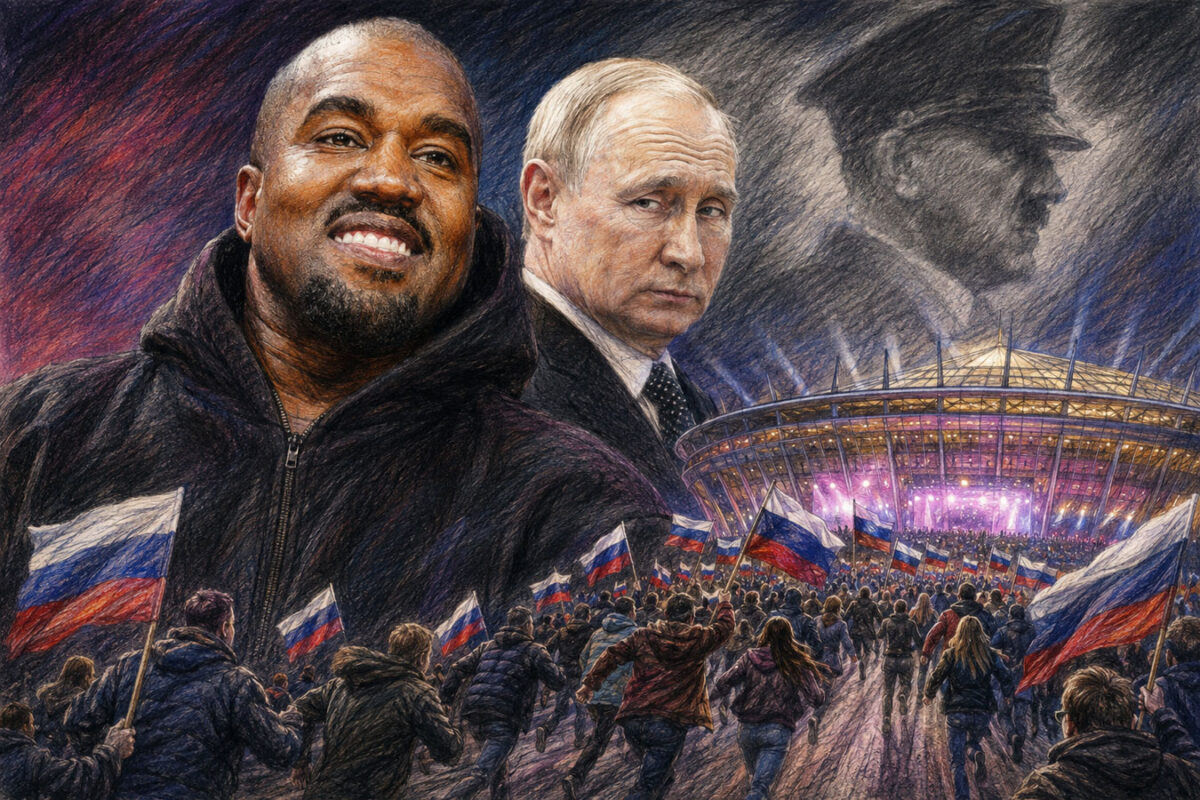
Kanye West in Russia: why the man who praised Hitler became the main touring event in St. Petersburg

After the announcement of two Kanye West concerts in St. Petersburg, train ticket orders for these dates increased 41 times. But the story has long gone beyond music: Ye publicly praised Hitler and used Nazi symbols, faced bans in Europe, tried to organize a performance in Israel, and now his Russian promoter talks about the artist’s ‘long-standing dream’ to meet Putin.

On the morning of August 18, 2026, a figure emerged around Kanye West’s two upcoming concerts in St. Petersburg that turned an ordinary showbiz news into a rather uncomfortable question about modern Russia. According to the travel service ‘Tutu’, only on August 17, the number of train ticket orders to St. Petersburg for October 9-11 increased 41 times. Airline tickets for the same dates were searched 16 times more often, and the same increase was recorded for hotel searches.

The reason for the excitement is known: Ye, whom the world still more often calls Kanye West, is supposed to perform at the ‘Gazprom Arena’ on October 10 and 11, 2026. Tickets were sold from 9 to 160 thousand rubles (approximately from 316 to 5,614 shekels), the cheapest seats disappeared in about an hour. Reuters notes that if the concerts take place, West will become one of the largest international music stars to visit Russia after the start of the full-scale invasion of Ukraine in February 2022. Russian dates are now also present in Ye’s official tour schedule.

This is where the simple story about a rapper and tickets ends for the author of NAnovosti Anton Pshedynsky. His materials are usually at the intersection of Israel, Ukraine, and Russian politics, and in the case of Ye, these lines literally converged on one stage.

The question is not about the musical tastes of tens of thousands of people and not about trying to declare every ticket buyer a supporter of the artist’s views.

Much more interesting is another: why public admiration for the real Adolf Hitler turned out to be quite compatible with huge demand in a state that has been justifying the war against Ukraine for the fifth year by the need for its ‘denazification’?

Kanye West in Russia: why a man who praised Hitler became the main touring event in St. Petersburg

NAnovosti — News of Israel | Nikk.Agency monitors how Russian rhetoric about ‘Nazism’ is used far beyond the conversation about history. In the case of Kanye West, the dispute unexpectedly ceased to be theoretical: a man who truly glorified Hitler is coming not to a Russian TV studio for condemnation, but to one of the largest concert venues in the country.

From ‘death con 3’ to ‘Heil Hitler’: what exactly did Ye do

In the fall of 2022, Kanye West’s story with anti-Semitism became an international scandal. In October, he wrote that he was going to go ‘death con 3’ on Jews — intentionally or mistakenly playing on the American term DEFCON. After that, major partners began to abandon him; Adidas severed a highly profitable collaboration with Yeezy, and the CAA agency left him. Less than two months later, Ye was already publicly talking about seeing ‘good things’ in Hitler.

It is important to remind this now because the expression ‘praised Hitler’ in relation to West is not a political characterization by a journalist and not an exaggeration in a headline. His own statements led to the topic of Nazism becoming part of his public image for years.

Even the first noticeable apology did not close the problem. In December 2023, Ye posted an address to the Jewish community in Hebrew, expressing regret for the pain caused. The Anti-Defamation League then said that words could be the first step but reminded: actions are more important. The warning turned out to be not superfluous.

In 2025, West again crossed an almost demonstrative line. A T-shirt with a swastika appeared on his website, and in May he released the song Heil Hitler with Nazi imagery. Australian authorities later annulled his visa precisely after the release of this composition. Reuters and AP in 2026 materials directly characterize the song as a work promoting Nazism.

There is another date that cannot be hidden for the sake of a convenient journalistic construction. On January 26, 2026, Ye bought a full page in The Wall Street Journal for a new apology. He stated that he had lost touch with reality, talked about bipolar disorder and the consequences of a long-standing head injury, admitted previous admiration for Hitler and the use of the swastika, and separately wrote that he does not consider himself a Nazi or anti-Semite. The ADL called the apology long overdue but emphasized that it does not automatically erase years of anti-Semitic statements, hundreds of publications, swastikas, mentions of the Holocaust, and Heil Hitler.

One can believe in the sincerity of this repentance, one can doubt it. But its presence must be taken into account as honestly as what exactly Ye apologized for.

Europe closed doors, but fans did not disappear

In the spring of 2026, the price of previous statements became especially noticeable. On April 7, British authorities denied Ye entry, considering his presence not in the public interest. Because of this, the London Wireless Festival, where the rapper was supposed to perform for three evenings in front of an audience of about 150,000 people, was completely canceled. Sponsors, including Pepsi and Diageo, began to leave even before the final cancellation.

On April 15, Ye postponed a concert at the Marseille Stade Vélodrome. Before that, the French Minister of the Interior was looking for ways to prevent the show, and the mayor of Marseille, Benoît Payan, publicly said that he did not want to turn the city arena into a platform for a person promoting hatred and Nazism. Poland and Switzerland also lost planned performances, and later the concert was canceled in Italy.

But from this chronology, one cannot draw a convenient conclusion that the West rejected Ye, and the Russians alone were indifferent to his past. Reality is against such a scheme.

On May 30, 2026, at the Atatürk Olympic Stadium in Istanbul, Ye gathered about 118,000 people. Among the spectators, according to Anadolu, were fans from the UK, Germany, France, the Netherlands, Italy, Poland, Russia, and the Middle East. His commercial appeal survived both anti-Semitic scandals and European cancellations.

Another example appeared literally ten days before the Russian announcement. On August 7, Ye performed at the Algarve Stadium in Portugal. Israeli Ambassador Oren Rosenblat asked to cancel the concert and reminded that the artist glorified Hitler, promoted anti-Semitism, and called himself a Nazi. The diplomat posed a rather simple question: if society is not ready to calmly accept hatred towards other groups, why should Jews be an exception?

The Portuguese organizer did not agree with this. The concert took place, and on August 8, Euronews reported about 34,000 spectators. Ye did not make scandalous political speeches from the stage that evening.

Therefore, the problem is not reduced to the national character of the Russians. A huge celebrity still has fans in many countries who can separate the music from the performer’s personality, accept his apologies, or not consider political statements a sufficient reason to refuse a concert.

However, Russia has one detail that neither Portugal nor Turkey has.

The country of ‘denazification’ gets a fan of Hitler

On February 24, 2022, Putin, announcing the start of a full-scale invasion of Ukraine, named among Russia’s goals the ‘demilitarization and denazification of Ukraine’. This formula did not disappear after the first months of the war: the Russian authorities continued to use accusations of ‘Nazism’ as one of the central explanations for aggression.

NAnovosti recently analyzed in detail how Moscow continues to revive this construction even after four and a half years of war — now through Russian court decisions on Bandera, OUN, and UPA and a new round of conversation about Russian ‘denazification of Ukraine’. In another material, Ukrainian President Volodymyr Zelensky responded to the same propaganda scheme through his own Jewish family and the history of the family of Ukraine’s Chief Rabbi Moshe Asman: ‘Jews do not fight for Nazi regimes’.

Against this background, Ye’s October concerts create an almost laboratory test of the meaning of the word itself.

If ‘Nazism’ is such a fundamental threat to the Russian authorities that they justify the invasion, occupation of foreign territory, and years-long war with it, the reaction to a person who truly admired Adolf Hitler should have been at least painful.

Reality so far looks different.

In Russia, they discuss prices, stadium seats, the road to St. Petersburg, hotels, and possible guests. State Duma deputy Vitaly Milonov did not demand to ban Ye at all. He suggested that the rapper get acquainted with Russian chanson and learn ‘Kupola’ or ‘What are you, fraer, backed down?’, to find a response among Russian listeners. At the same time, Milonov said that the concert should not be canceled.

There is also outrage within Russia, and it would be dishonest to erase it. Russian publications remind of Hitler and Ye’s anti-Semitism, calls to cancel performances are heard. So, it cannot be written that ‘Russians do not know’ or ‘all Russians do not care’.

Available figures allow us to say only what they really show: for a very large number of people wanting to attend the concert, these facts did not become a stop signal.

On August 17, cheap tickets were gone in about an hour. On the same day, a surge in transport orders began. For October 9-11, the average price of a one-way train ticket, according to ‘Tutu’, is 6.2 thousand rubles (about 218 shekels), from Moscow — 5.5 thousand rubles (about 193 shekels). The average plane ticket is 15.9 thousand rubles (about 558 shekels), and a night in a hotel is about 3.7 thousand rubles (approximately 130 shekels). People did not just click ‘interested’ on social media: part of the audience began planning the trip a month and a half before the show.

This is where Russian ‘denazification’ already faces not a historical dispute about Bandera, but a very much alive American rapper.

Israel Ye already tried to return — and received a completely different reaction

The Russian story looks even more noticeable if we recall the events of May 2026.

On May 12, i24NEWS, citing Mako, reported that Ye had agreed in principle to consider a concert in Israel and that the parties were discussing financial terms. The version looked especially symbolic: after Heil Hitler, the American rapper wanted to perform specifically in front of the Israeli audience and thus, according to assumptions from people in the music industry, confirm the seriousness of his repentance.

For Ye himself, Israel was not an unfamiliar territory. He had already performed there in September 2015 at the stadium in Ramat Gan. In November 2025, the musician met with Israeli Rabbi Yoshiyahu Pinto and expressed regret over his anti-Semitic statements.

However, the idea of returning did not cause delight in the Israeli music industry. Producer Gadi Oron told Walla that he received an offer to bring Ye about two months before the publication, studied the technical requirements, and refused. The show assumed a 360-degree stage configuration; the stadium in Ramat Gan was almost suitable for it, but there were no available dates, and other logistical problems arose. At the same time, Oron directly linked Ye’s interest in Israel with difficulties in the European part of the tour.

The owner of the Tel Aviv club Barbie, Shaul Mizrahi, spoke much more harshly: he considered a possible concert to be in bad taste and promised to call for a boycott of the producer who would undertake to organize it. In the end, no confirmed Israeli date appeared.

For the Israeli reader, this detail changes the perception of St. Petersburg. A few months ago, there was a debate here about whether it was even possible to return an artist to the stage after Heil Hitler. Now in Russia, the debate is mainly already about how two big shows will take place.

NAnovosti — News of Israel draws attention to this difference, not turning it into a competition of states for moral superiority. Portugal showed that the European audience is also capable of filling a stadium after the same scandals. But only the Russian state simultaneously made the word ‘denazification’ a justification for its own war.

‘Young Putin’: this sympathy appeared long before the current tours

There is another line that is easy to take for a promotional invention of the Russian promoter if you look only at the events of August 17. In fact, the history of Ye’s relationship with the image of the Russian president is noticeably older.

In November 2021, even before the full-scale Russian invasion, during Drink Champs, West compared himself to Putin and called himself ‘young Putin’. He talked about his own power over culture and drew a parallel between cultural influence and the resources available to a state leader.

In January 2022, Billboard, citing the rapper’s advisor Amir Sudan, reported that Ye planned a trip to Moscow, wanted to meet with Putin, hold a Sunday Service, and considered Russia almost as a ‘second home’. But even then, this story was contradictory: another representative of the artist called the reports completely fabricated. Therefore, old plans cannot be passed off as a confirmed agreement with the Kremlin.

However, the next Russian trip already took place. On June 30, 2024, when the full-scale war was in its third year, Ye flew to Moscow for the 40th birthday of Russian designer Gosha Rubchinskiy, with whom he collaborated. There were rumors about a concert in ‘Luzhniki’ around the trip, but the performance did not happen then. That is why the October 2026 concerts will be his first public concerts in Russia, not his first visit to the country.

Finally, on August 17, 2026, Say Agency CEO Anna Subcheva told RIA Novosti that meeting with Putin is Ye’s ‘long-standing dream’ and that the musician, according to her, has been demonstrating sympathy for the Russian president for many years. At the same time, she herself admitted that it is not yet known who exactly the artist will meet during the visit. There is no confirmed agreement with the Kremlin as of August 18.

It turns out to be an interesting sequence: ‘young Putin’ in 2021, talks about a meeting and ‘second home’ in January 2022, a real trip to Moscow in the summer of 2024, and now two stadium concerts and a new message about the desire to meet with the Russian president.

This can no longer be explained by one random phrase.

And what does Ukraine have to do with it if Ye did not say he hates Ukrainians?

Here it is important not to spoil a strong material with too strong a label. There is no sufficient confirmation that Ye publicly declared hatred for Ukrainians as a people. Calling him a ‘Ukrainophobe’ just for touring in Russia would be a substitution of fact for evaluation.

But the absence of such a statement does not make Russian concerts politically neutral.

Reuters separately places them in the context of the war: if the performances take place, Ye will be one of the largest international stars to visit Russia after its full-scale invasion of Ukraine. Moreover, we are not talking about a private party, as in Moscow in 2024, but about two public stadiums with tickets up to 160 thousand rubles and tens of thousands of spectators.

Any such event has two photographs.

In the first — a fan who bought a ticket for Stronger and Runaway, does not intend to discuss the Kremlin, and wants to listen to his favorite artist for two hours.

In the second — a filled ‘Gazprom Arena’ during the fifth year of a big war, an American superstar on stage, and Russian headlines about the country still being able to bring in top-tier artists.

The first photograph does not cancel the second.

After 2022, the Russian concert market lost a significant part of major Western tours. In recent years, some American performers have begun to return, but the arrival of a figure of Ye’s scale still noticeably differs from most such visits. A filled stadium allows selling a simple picture inside Russia: cultural isolation supposedly does not exist, the world is returning, the West is not able to ‘cancel’ the country. Even if neither the organizer nor Ye himself utters a single political word from the stage, such an image works by itself.

And Ye in this construction turned out to be an especially convenient character. He is simultaneously known to almost everyone — and at the same time, part of European countries and venues refused him. Therefore, a plot easily arises around him: ‘The West banned — Russia allowed’.

Only the reason for Western problems spoils the beautiful formula.

He was banned and canceled not for friendship with Russia. Among the main reasons were anti-Semitism, the swastika, glorification of Hitler, and the song Heil Hitler.

Why Russians are still going

The answer ‘because they don’t know anything’ does not withstand scrutiny. Russian media themselves reminded of Hitler, anti-Semitism, and European cancellations. There are people within the country demanding to cancel the concerts. Information is available.

The answer ‘because Russians support Hitler’ is equally weak. We have no data on the views of tens of thousands of ticket buyers, and Ye’s mass concerts in Istanbul and Portugal show that the ability to separate the performer from his public statements exists far beyond Russia.

Much more plausible here simultaneously work several completely mundane things: Ye remains a huge music star; such a scale’s arrival in Russia is rare; part of the audience accepts the January apology; part believes that the artist and his views exist separately; some are indifferent to all this compared to the opportunity to see him live for the first time.

But the result from the motives of individual people does not change.

The person who truly praised Adolf Hitler did not turn out to be unacceptable for the mass Russian audience.

It is this fact that turns the story from a social chronicle into a political one.

For more than four years, Ukraine has been hearing accusations of ‘Nazism’ from Moscow. Israel and Jewish organizations have been demanding for years to treat anti-Semitism not as an eccentric celebrity stunt. And between these two realities, St. Petersburg sells out cheap tickets for Ye in a few hours and starts booking trains.

Russian propaganda is used to using the word ‘Nazi’ as a universal political accusation. Kanye West posed a much simpler test for this system: no search for ‘hidden Nazism’ is required here, the artist’s old words have long been recorded and published.

On October 10 and 11, a person who had to publicly apologize for his admiration for Hitler in January of this year is supposed to take the stage of a state that declared ‘denazification’ one of the goals of its war. And so far, the main measurable response of the Russian public to this contradiction remains a figure from the tourist service: the demand for train tickets to St. Petersburg increased 41 times.


Ex-goalkeeper of ‘Maccabi Haifa’ Georgy Ermakov married Alexandra Mikolyuk from ‘The Bachelor’: Israel appeared twice in the history of this couple - September 20, 2026 - Новости Израиля

In Ukraine, an open online course by Anna Shternshis on Jewish life during the Soviet period is starting – anyone can join from October to December 2026 – from the ‘Culture League’ to the ‘Doctors’ Plot’ - September 20, 2026 - Новости Израиля

Yair Lapid on Ukraine: ‘Russia is an ally of Iran’ and ‘if we return to power, we will do much more than we did then’ - September 20, 2026 - Новости Израиля

Shelling of Ukraine on August 16, 2026: KN-23, Kyiv, Kryvyi Rih and Patriot shortage

Russia has once again used ballistic missiles against Ukraine, including North Korean KN-23s. But after the night of August 16, the main question is no longer just about the number of Russian missiles — Ukraine is increasingly vocal about Patriot interceptors, which allies have but are lacking near Ukrainian launch sites.

On the morning of August 16, 2026, Volodymyr Zelensky wrote about the consequences of the night and morning Russian strikes on Ukraine. Emergency work was still ongoing in Kyiv, rescuers in Kryvyi Rih were dealing with the aftermath of a ballistic attack, and there was already a casualty in Sumy. The alarm, however, did not end: Russia launched a new wave of drones.

By this time, the figures looked like this: in Kryvyi Rih, two people were killed and 14 injured, six people were wounded in Kyiv and Kyiv region, and one person was killed in Sumy. Kremenchuk and Kryvyi Rih were under ballistic attacks. The Ukrainian Air Force separately reported that among the weapons used at night were North Korean KN-23 missiles.

But Zelensky wrote another thing that is more important for this story than the list of regions and types of missiles. In seven days, Russia used more than 1,550 strike drones, almost 1,560 aerial bombs, and 62 missiles against Ukraine. Most of the missiles are ballistic.

That is, the night of August 16 was not a separate heavy raid. It fell on the second consecutive weekly cycle in which Russia maintains almost the same intensity of air strikes.

For this article, Elena Gunko took Zelensky’s morning message from August 16 as a starting point and compared it with data from the Ukrainian Air Force, rescuers, regional authorities, Reuters, Financial Times, and statements from the European Commission. The task here is not to independently determine the type of missile from a photo of debris — the author does not engage in military expertise. What is more interesting is where the confirmed fact ends, what is really known about the KN-23 that night, and why the conversation about Russian ballistics unexpectedly hit the Patriot missile stockpiles in the US and Europe.

In Kyiv, the fire was extinguished quickly. The ballistic problem — no

In Kyiv, the consequences of the strike were recorded in the Obolonskyi and Holosiivskyi districts. In the Obolonskyi district, the market area was on fire, cars and non-residential buildings were damaged. In the Holosiivskyi district, a fire also broke out in a non-residential area.

In the capital itself, three people were injured. Another three, including a child, were wounded in the Kyiv region. This accounts for the six injured that Zelensky wrote about in the morning.

Rescuers extinguished the fires. The ballistic threat is not so easily dealt with.

The Russian calculation chooses the moment of launch, and for the Ukrainian air defense calculation, it is already too late to discuss the future aid package. The interceptor is either near the battery or it is not.

That is why the current discussion about Patriot is increasingly unlike the usual conversation about how many complexes allies are ready to “give to Ukraine.” The launcher itself does not destroy a ballistic missile. Each subsequent interception requires the next missile.

In Kryvyi Rih, the number of casualties changed several times in the morning

The first reports from Kryvyi Rih looked different from the final figure in Zelensky’s statement. Initially, local authorities spoke of one dead and several injured. Then the number of wounded increased.

The rescue operation was still ongoing.

In the morning, the body of the second deceased was retrieved from the rubble. The number of injured reached 14, 11 people were hospitalized. An industrial enterprise was damaged.

This is a useful detail for understanding how to read news in the first hours after such strikes. Reports of “one dead” and “two dead” did not mean that someone made a mistake or changed the version. The clearing of the rubble continued between them.

In Kremenchuk, the authorities of the Poltava region reported a ballistic strike. In Sumy, a Russian drone attacked a civilian car: a 59-year-old driver was killed, and a woman nearby was injured.

These episodes have different geography and different weapons. But for a person on the ground, the difference between a large international discussion about missile stockpiles and its absence can ultimately be very short — whether the air defense managed to fire or not.

KN-23s were in this attack. But which city received this particular missile is unknown

This place requires caution.

The Ukrainian Air Force included North Korean KN-23s in the list of ballistic weapons used by Russia during the August 16 attack. The same list included Iskander-M and S-400 missiles used for strikes on ground targets.

The very fact of using KN-23 that night is officially confirmed.

However, to claim that a specific house, enterprise, or area was hit by the KN-23, based on the information available in the morning, is not possible. The Air Force did not publish such a breakdown and did not report how many North Korean missiles were launched.

Social networks and monitoring channels have already come up with their own calculations. This is expected for a news feed. For an article that should remain reliable even months later, this is not enough.

Here, NANovosti has another reason not to rush with a catchy phrase. Just a few days earlier, we were analyzing the story of the allegedly destroyed train with North Korean KN-23 missiles. Around it, more confidence quickly arose than the published evidence allowed.

On August 16, the situation is different: the use of KN-23 is confirmed by the Air Force. But from confirming the type of weapon to confirming the specific place of its impact, there is still one more step. No one has officially taken it yet.

Two weeks — almost identical figures

One of the most indicative fragments of Zelensky’s morning message is easy to miss against the backdrop of casualties and destruction.

A week earlier, on August 9, the President of Ukraine reported 61 Russian missiles over seven days. 56 of them were moving along a ballistic trajectory. Russia also used more than 1,560 strike drones and about 1,540 aerial bombs.

Another week passed.

Now Zelensky names 62 missiles, more than 1,550 strike drones, and almost 1,560 aerial bombs. 13 regions were under attack. And again, most of the missiles are ballistic.

The numbers almost overlapped.

This changes the very question to Ukrainian air defense. In a single large attack, a significant stock of interceptors can be expended and then replenished. In such a mode, the next salvo must be withstood even before the previous political discussion about supplies is over.

Russia, in essence, forces counting not the Patriot batteries, but the rate of missile consumption.

And this indicator is much more unpleasant.

Ukraine asks not for a new symbol of assistance, but for ammunition

In recent years, the word Patriot has become almost a political designation for all Ukrainian missile defense. The news counts batteries, launchers, donor countries.

In the summer of 2026, Kyiv is increasingly talking about another number — the number of PAC-3s.

On August 15, the Financial Times described cases when Ukrainian Patriot calculations lacked interceptors during Russian ballistic attacks. According to the publication, Ukraine estimates the need before the winter period at about 300 PAC-3 missiles to cover critical infrastructure.

Two days before today’s attack, Zelensky publicly spoke about the share of American stockpiles. According to his estimate, receiving about 5% of American Patriot interceptor stockpiles would help Ukraine get through the winter. He associated a ten percent volume with the possibility of significantly closing the country from Russian ballistics.

There is an unpleasant detail for Kyiv here: allies count not only the Ukrainian need.

The US must maintain its own reserves. European armies, after many years of stockpile reductions, are also trying to restore air defense. The Middle East consumes interceptors in real combat operations. PAC-3 production cannot be politically increased overnight.

Therefore, the phrase “transfer Patriot to Ukraine” today can mean two completely different things. You can transfer another system and get a beautiful photo of a new battery. Or you can transfer several dozen interceptors to a system that is already in position and has nothing to respond to the next ballistic launch.

NANovosti — News of Israel has already separately analyzed the Ukrainian attempt to get out of this dependence and gain access not only to ready-made complexes but also to production, components, and a more sustainable supply model for Patriot. After two weeks in August, this conversation looks less theoretical than a month ago.

“Should not lie in warehouses”

In the morning message on August 16, Zelensky did not limit himself to thanking partners.

He specifically mentioned North Korean ballistics, which destroys infrastructure and kills people in Europe, after which he moved on to European interceptor stockpiles: according to him, they should not be left in warehouses.

The wording is harsh, but it appeared not only in Kyiv.

A few days before this, the European Commission reported that Kaja Kallas called on EU countries with missiles for Patriot to transfer them to Ukraine. That is, the dispute over national reserves is already taking place within Europe itself.

For the government of any country, this is not a simple decision. A missile sent to Ukraine indeed disappears from its own stockpile. The military has stockpile standards, mobilization plans, and its own war scenarios.

But the Ukrainian response now looks different than two years ago: a Russian ballistic missile is already flying over European territory and already destroying an object in a European country. Therefore, intercepting it over Ukraine is also the use of European missile defense resources against a real threat, not preparation for a hypothetical war in the future.

This is not a dispute about sympathy for Ukraine.

This is a dispute about where Europe considers the first line of its own defense.

And here Israel appears — not as a formal analogy

For the Israeli reader, the story of August 16 is important not because Kyiv can be mechanically compared to Tel Aviv.

Such a comparison would be too simplistic.

The connection goes through weapons and their production.

Russia uses North Korean ballistic missiles against Ukraine. Iran, over the years of Russian aggression, has become one of the key sources of technologies and solutions for Russia’s mass drone warfare. The US must simultaneously consider the needs of Ukraine, its own armed forces, and the Middle East.

Each country has its own systems. PAC-3 is not Arrow and not David’s Sling. The Israeli air defense architecture differs from the Ukrainian one.

But the factory, production time, rocket engine, electronic component, and annual production volume no longer exist in political statements. They cannot be sent simultaneously to two customers.

That is why the connection between the Russian, Iranian, and Ukrainian theaters of war becomes a stable topic for NANovosti, not a reason to attach Israel to any news from Ukraine. In one case, Russia receives North Korean ballistics. In another, Western armies expend interceptors in the Middle East. In the third, Ukraine finds that a Patriot launcher can stand in position, but there is not enough missiles for it.

This is how the connection looks without a slogan.

Between a European warehouse and Kryvyi Rih

At 02:00, a defense department official may be contemplating the minimum national reserve of PAC-3. At the same time, a Ukrainian family hears a ballistic alarm.

These are two parts of one chain, although there are thousands of kilometers between them.

The decision to keep a hundred interceptors in stock has military logic for the country to which they belong. The decision to transfer twenty of them to Ukraine also has military logic. But the consequences of these two decisions become visible not in the defense ministry’s report.

In the morning, they may appear in the summary from Kryvyi Rih.

And here it is impossible to honestly write that specific people died on August 16 because Europe “did not give one Patriot missile.” We do not know the trajectories of all ballistic targets that night, we do not know the location of the batteries, the available ammunition, and whether a specific target could have been intercepted.

Such a conclusion would be convenient. And unconfirmed.

Another thing is confirmed.

For two consecutive weeks, Russia maintains an extremely high pace of air attacks. Ballistic missiles make up a significant part of the missile load. On August 16, North Korean KN-23s were among them again. Ukraine publicly reports a shortage of interceptors. European and American stockpiles exist, but their transfer remains a political and military decision.

Therefore, after this night, the question “how many Patriots does Ukraine have?” is indeed outdated.

Other numbers are needed: how many interceptors are near active batteries today, how many Ukraine uses per week, and how many new missiles arrive in the same period.

For now, it is Russia that sets the pace for this competition.

NANovosti — News of Israel will continue to compare this data not by the number of announced “packages,” but by whether Ukraine’s actual ability to survive the next week of the Russian ballistic campaign changes.

Sources: morning statement by the President of Ukraine Volodymyr Zelensky on August 16, 2026; Ukrainian Air Force; State Emergency Service of Ukraine; Kyiv city and regional authorities; Dnipropetrovsk Regional State Administration; data from the authorities of Kryvyi Rih and Sumy region; Reuters; Financial Times; statements from the European Commission.


Ex-goalkeeper of ‘Maccabi Haifa’ Georgy Ermakov married Alexandra Mikolyuk from ‘The Bachelor’: Israel appeared twice in the history of this couple - September 20, 2026 - Новости Израиля

In Ukraine, an open online course by Anna Shternshis on Jewish life during the Soviet period is starting – anyone can join from October to December 2026 – from the ‘Culture League’ to the ‘Doctors’ Plot’ - September 20, 2026 - Новости Израиля

Yair Lapid on Ukraine: ‘Russia is an ally of Iran’ and ‘if we return to power, we will do much more than we did then’ - September 20, 2026 - Новости Израиля
The USA has placed Israel in Tier 1 – risk category for redirecting Chinese goods: what this threatens

Israel found itself in the first category of the American risk system for redirecting Chinese goods, but the White House did not show a specific Israeli scheme. Now the main question is not why the country appeared on the list, but what the US intends to do with goods and companies from Tier 1.

On August 13, 2026, the White House published the report The Great Transshipment Scam on the global circumvention of American tariffs through third countries. Israel was not on the periphery: Washington included it in Tier 1 along with Canada, the European Union, India, Japan, Mexico, South Korea, and Taiwan.

At first glance, the wording looks almost like the first degree of some sanctions list. But these are not sanctions, and this is where it is easy to misread the document. The White House divides countries not by the degree of already proven guilt, but by the type of risk that Americans see in their trade with China and the US.

There is another detail. The further the document moves from general classification to specific ports, logistics hubs, and schemes, the less Israel is mentioned. The editorial team of NAnews — Israel News | Nikk.Agency separately checked all mentions of the country in the report and sections with specific examples. Israel indeed received Tier 1, but the White House does not provide a separate proven chain “China → Israel → USA”.

Tier 1, Tier 2, and Tier 3: what the categories mean and what happens after being included in the list

The White House has three categories, and the numbers here do not mean “first — most guilty, third — almost innocent”.

Tier 1 — Diversified Scale Leaders. These are large diversified economies with a serious industrial base, large trade volumes, and significant exports to the USA. This group includes Canada, the EU, India, Israel, Japan, Mexico, South Korea, and Taiwan. The White House itself notes that the potential risk of illegal redirection here is within a huge array of completely legal trade.

Tier 2 — Scale Leaders with Significant Economic Integration with China. Here, direct integration with Chinese suppliers, components, production, and regional logistics is more pronounced. The White House includes Brazil, Indonesia, Malaysia, Thailand, Turkey, and Vietnam in this category.

Tier 3 — Small, Opportunistic Chinese Targets. These are smaller economies that may be convenient intermediate points due to ports, free economic zones, cheap assembly, warehouses, border routes, or less developed customs control. Among the countries in this group mentioned in the report are, for example, the UAE, Panama, Cambodia, Jordan, and Kazakhstan.

Therefore, Tier is not a verdict. It is a map by which the American customs intends to look for specific suspicious cargoes.

For this, the White House describes the Detective Border system. It should combine data on the supply route, the declared country of origin, product code, components, suppliers, company owners, and the production capabilities of the enterprise. This is supplemented by anomaly detection, machine learning, and computer vision.

Let’s imagine not a specific Israeli case, but the principle of operation itself. A company claims to produce equipment in Israel, but its export volume suddenly far exceeds the plant’s capabilities. At the same time, imports of almost identical parts from China are growing. For the algorithm, this is already a reason to look at the supply more closely.

Another signal is that an almost finished Chinese product arrives in a third country, spends a short time there, almost does not change in cost, characteristics, and product code, and then is sent to the USA under a new origin. The system is supposed to look for such coincidences.

At this point, AI completes its part of the work. It does not make a decision on guilt but passes the suspicious supply to the attention of Customs and Border Protection.

Then CBP can request documents on the origin of components, information about suppliers, information about real operations at the enterprise, and confirmation that the product was indeed sufficiently processed. If the origin is confirmed, there is no violation. If the American customs decides that the Chinese product only received a new paper or minimal processing, the consequences are different: collection of appropriate duties, fines, cargo detention, and in the case of conscious circumvention, the White House allows for the exclusion of the violator from access to the American market.

For Israel, the mechanism now looks quite clear: Tier 1 does not automatically punish the country. It places its trade flows in a category within which the US intends to look for specific suspicious goods and companies.

Why Israel ended up in Tier 1

Israel is interesting to Americans not as a small transshipment point between China and the USA. According to the logic of the report itself, it is almost the opposite: it is a technological and industrial economy with a large amount of normal production, which is simultaneously integrated into global supply chains.

A modern Israeli product can very well be developed in Israel, receive software, assembly, and testing here, but contain Chinese boards, cables, cases, electric motors, power supplies, or other parts. There is no violation in this by itself.

The White House, however, uses a broader concept of China-linked goods. Americans are interested in Chinese components, relationships with suppliers and manufacturers, separate production stages in China, Chinese financing or ownership, and even the history of the cargo route.

From here arises a question that may be much more unpleasant for an Israeli manufacturer than a regular certificate check: what exactly was done in Israel?

If a Chinese part arrived here as one of dozens of components, after which a truly new complex product appeared in Israel, this is one situation. If an almost finished device comes from China, the case is changed here, a program is loaded, and it is sent to the USA, the dispute over origin is much more likely.

The White House does not claim to have found such an Israeli company. This is a boundary that is important not to cross. But it is precisely such production chains that explain why a large economy like Israel was needed by Americans in Tier 1.

What this really threatens Israeli companies

The first consequence may arise even where no one violated anything. The deeper CBP checks the origin of the product, the more documents the exporter must be able to raise: from component suppliers to descriptions of technological operations performed at the Israeli site.

The cargo may be delayed. The American buyer waits, the carrier and warehouse issue invoices, lawyers explain the origin of components, the manufacturer proves the real capabilities of its enterprise. As a result, the product is recognized as Israeli, but the check itself has already cost money.

For a small company, such a cost is especially sensitive. The American client also considers the risk: if one supplier provides a transparent production chain, and another has a dozen Chinese counterparties and a complex assembly history around each product, the second may lose the contract even before any fine.

Worse, if CBP decides that the processing in Israel was insufficient. Then the product may retain Chinese origin for tariff purposes, which means that it will be subject to conditions not expected by the exporter.

There is also a secondary effect. An Israeli company heavily dependent on the US market may start to reduce the Chinese share in the product itself — looking for another supplier or transferring more operations to Israel. This reduces customs risk but increases cost.

The most severe scenario remains only potential for now. If American authorities find a conscious systemic scheme of re-marking or fictitious change of origin, the White House talks about collecting unpaid duties, fines, intercepting cargoes, and possible exclusion from the American market.

That is why calling Tier 1 “sanctions against Israel” would be incorrect. But presenting it as a meaningless classification is also wrong.

Israel has already received another tariff blow from the US

The report on Chinese transshipment appeared a few weeks after a separate American decision. On July 24, 2026, the US imposed additional 12.5% tariffs on goods from Israel subject to the decision under Section 301. The reason there is different — the investigation concerned American requirements regarding products produced using forced labor.

These two stories cannot be legally combined into one. The 12.5% tariffs were not imposed because of China, and the current Tier 1 itself does not add another tariff to them.

For the exporter, however, the separation by legal grounds does not cancel the costs. One measure already makes some Israeli goods more expensive on the American market, and the new system may make it more difficult to confirm the origin of the product if it has a significant Chinese component.

NAnews has already shown how the Trump administration uses tariffs much more broadly than usual customs policy — for example, in the material about the American idea of tariffs up to 100% against the largest buyers of Russian energy resources. Now a similar tool, although completely different in its basis, logic applies to Israel: access to the American market increasingly depends not only on the quality and price of the product but also on who, where, and from what it was produced.

Israel has not been caught yet — it has been placed where they will look

As of August 16, 2026, the material published by the White House does not provide grounds to assert that the US has proven a systemic circumvention of Chinese tariffs through Israel. It does not name an Israeli company, does not establish a separate route through Haifa or Ashdod, and does not specify the amount of Chinese goods illegally turned into Israeli.

But Tier 1 still has practical meaning. Israel has fallen into the category of large economies within whose trade flows Washington intends to look for discrepancies between the declared origin of the product and its real production history.

For some companies, this may mean just more documents. For others, a cargo delay and a dispute with CBP. If the American check decides that the product actually retained Chinese origin, a tariff risk arises; if conscious circumvention is proven, the measures become significantly harsher.

Israel has not been caught yet. It has been placed where they will now look.

And this wording more accurately describes what is happening than talking about a “sanctions list”: the US has not yet presented Israel with a specific scheme, but has already created a system that should look for such schemes within Israeli exports.


Ex-goalkeeper of ‘Maccabi Haifa’ Georgy Ermakov married Alexandra Mikolyuk from ‘The Bachelor’: Israel appeared twice in the history of this couple - September 20, 2026 - Новости Израиля

In Ukraine, an open online course by Anna Shternshis on Jewish life during the Soviet period is starting – anyone can join from October to December 2026 – from the ‘Culture League’ to the ‘Doctors’ Plot’ - September 20, 2026 - Новости Израиля

Yair Lapid on Ukraine: ‘Russia is an ally of Iran’ and ‘if we return to power, we will do much more than we did then’ - September 20, 2026 - Новости Израиля
The Price of War: How Ukraine, including its Jewish population, paid for Victory in World War II — and how Russia tries to appropriate the common Victory and others’ sorrow

American journalist Edgar Snow wrote back in January 1945 that Ukraine had “paid the bill” for the war. Today, this conversation is especially important for the Israeli audience: the price of Victory included not only Ukrainian fronts and destroyed cities but also the fates of many peoples who then inhabited Ukraine, including the Jews of Ukraine — victims of the Holocaust, soldiers, doctors, refugees, evacuees, and families whose memory was dissolved in Soviet statistics for decades.

The Price of War: How Ukraine Paid for Victory in World War II

Ukraine in World War II became a battlefield and a symbol of enormous sacrifices, the scale of which was long hushed up. Western journalists noted as early as 1945: the bill for the defeat of Nazism was paid primarily by the Ukrainian people.

This topic is important for the Israeli audience as well. Because Ukraine was not only a territory of the front, occupation, destroyed cities, and burned villages. It was home to many peoples — Ukrainians, Jews, Poles, Russians, Crimean Tatars, Roma, Belarusians, Greeks, Bulgarians, Hungarians, Romanians, and other communities.

The price of Victory included the fates of all these people.

But modern Russia tries to present the multinational Victory as almost exclusively “Russian.” Thus, foreign blood, foreign destroyed cities, foreign graves, and foreign memory are turned into tools of imperial propaganda.

This article does not claim to be a complete analysis of all the forces that operated on the territory of modern Ukraine during World War II. Here were the Red Army, Soviet partisans, German occupation administration, Wehrmacht and SS structures, Ukrainian nationalist underground, OUN and UPA, local auxiliary police, collaborationist formations, Polish underground, Jewish resistance, ghettos, partisan groups, underground fighters, rescuers of Jews, Soviet repressive organs, and post-war anti-Soviet resistance.

This complex history requires a separate conversation because it included both the fight against Nazism and the fight against Stalin’s USSR, collaboration, saving people, and crimes against the civilian population.

What is important here is this: Ukraine became one of the main territories where a huge price was paid for Victory, and modern Russia tries to appropriate this Victory along with foreign grief and foreign memory.

The Price of War: How Ukraine, including its Jewish population, paid for Victory in World War II — and how Russia tries to appropriate the common Victory and foreign grief - Israel news
The Price of War: How Ukraine, including its Jewish population, paid for Victory in World War II — and how Russia tries to appropriate the common Victory and foreign grief – Israel news

Voice from the West: Edgar Snow and the Ukrainian War Bill

In January 1945, American journalist Edgar Snow, returning from the USSR, published an article in The Saturday Evening Post titled “The Ukraine Pays the Bill.” It was not a book but a magazine report, published on January 27, 1945.

Snow was one of the first in the West to loudly voice the scale of Ukrainian losses: at least 10 million lives — soldiers and civilians, as well as material damage of 30–40 billion dollars.

These data were reported to him by Ukrainian officials, such as the Deputy Chairman of the Council of Ministers of the Ukrainian SSR for Agriculture Vasily Starchenko and the head of the State Planning Committee of the republic Vladimir Valuyev. They knew the real situation in the liberated territory and understood the scale of the destruction.

Snow noted an important difference: the territory of the RSFSR experienced German occupation only partially, whereas a significant part of Ukraine went through the front, occupation, looting, destruction, mass deaths, and demographic collapse. Soviet statistics, however, downplayed the tragedy.

In 1946, the magazine “Bolshevik” named the total losses of the USSR at 7 million people, concealing the disproportionate contribution of Ukraine. Even earlier, in May 1945, Joseph Stalin raised a toast to the “Russian people” as the “leading force” of the Soviet Union. Thus, the foundation of the myth that Snow effectively refuted was laid: the titanic struggle was not only “Russian glory” but to a large extent a Ukrainian war.

This does not mean that other peoples did not fight and die. They did. But the Ukrainian price of Victory was too high to be dissolved in someone else’s political formula.

Stalin’s Seizure of Western Ukraine and the Broken Map Before the War

An important context begins even before Germany’s attack on the USSR.

In 1939, after the Molotov-Ribbentrop Pact and the joint division of Poland by Nazi Germany and Stalin’s USSR, the Soviet Union occupied the eastern territories of Poland, including Western Ukraine. Soviet propaganda called this “reunification,” but in essence, it was a Stalinist seizure and annexation of territories caught between two totalitarian regimes.

This sharply changed the map of Ukraine before the big war.

New lands, new cities, new communities, and new fates became part of the Ukrainian SSR. Together with Western Ukraine, Ukrainians, Poles, Jews, and other population groups who had previously lived in a different political system entered Soviet reality.

For people, this meant not only a change of flag. Sovietization came: arrests, deportations, nationalization of property, destruction of political and social structures, pressure on religious and cultural life. Part of the population experienced first Stalinist rule, then Nazi occupation, and then Soviet control again.

That is why, when we talk about the price of Ukraine in World War II, we cannot start only from 1941. For Western Ukraine, the catastrophe began earlier — with the division of Eastern Europe between Stalin and Hitler.

This is especially important for understanding Jewish statistics. Before the war, about 1.5 million Jews lived in Soviet Ukraine. After the inclusion of Western Ukrainian territories, Bukovina, and Bessarabia, the number of Jews in the expanded borders of Ukraine increased to about 2.4 million. That is, Stalin’s expansion of borders directly changed the demographic picture, which then came under the blow of the Nazi invasion.

The Scale of the Ukrainian Tragedy

Snow’s estimate of 10 million dead is close to modern Ukrainian memorial estimates: Ukraine’s losses in World War II are often called in the range of 8–10 million people. These losses include victims of battles, occupation, famine, repression, deportations, forced labor, diseases, the Holocaust, and the general destruction of life.

More cautious Western reference estimates may call 5–7 million dead. The difference is related to the methodology: whom exactly to count, in what borders, whether to consider natives of Ukraine who died outside the republic, prisoners of war, civilians, those who died from hunger and diseases, deported, victims of occupation and repression.

But the essence does not change: Ukraine was one of the main territories of human and material catastrophe of World War II.

If we take the estimate of 8–10 million dead and compare it with the modern estimate of the total losses of the USSR of about 26.6 million people, then Ukraine accounts for about 30–38% of this enormous tragedy.

This is not a secondary share.

This is almost a third or more of the entire Soviet price of the war.

The demographic blow was colossal — up to 14 million people. Estimates often indicate that the population of Ukraine decreased from about 41 million in 1941 to about 27 million by 1945. This is not only the dead. This also includes evacuees, mobilized, abducted, displaced, refugees, people who found themselves outside their former lives.

Material damage of 30–40 billion dollars by then calculations is not an abstract sum. These are destroyed cities, villages, factories, hospitals, schools, mines, bridges, railways, houses, farms, and entire regions.

Ukraine lost about 700 cities and towns, 28 thousand villages, a huge part of industry and agriculture. The Nazis plundered the country, exporting grain, equipment, livestock, raw materials, people, and even land.

And then came the famine of 1946–1947. Formally, the war was over, but for many families, death, poverty, and destruction continued even after Victory.

The economic losses of Ukraine amounted to about 42% of the damage inflicted on the entire USSR.

About 10 million people were left homeless or lived in destroyed premises.

Destroyed or seriously damaged were:

— about 18 thousand medical institutions;
— about 33 thousand educational institutions;
— about 16 thousand industrial enterprises.

Behind each such figure is not only state statistics. There are families, cities, villages, jobs, schools, hospitals, documents, cemeteries, memory, and life that had to be rebuilt anew.

Ukrainians and Other Peoples: Who Paid This Bill

The main “mistake” of Russian propaganda is turning the multinational price of war into a “Russian Victory.”

Ukraine in World War II was home to many peoples. Ukrainians, Jews, Poles, Russians, Crimean Tatars, Roma, Belarusians, Moldovans, Greeks, Bulgarians, Hungarians, Romanians, German colonists, and other communities lived on this land.

Each group experienced the war in its own way. But they all found themselves inside a huge catastrophe.

Ukrainians formed the basis of the population of the Ukrainian SSR and suffered huge losses at the front and in the rear. Millions of Ukrainians served in the Red Army, died in battles, were captured, returned disabled, lost families and homes.

The civilian population suffered from occupation, punitive operations, burned villages, forced labor, hunger, diseases, deportations, and repressions.

This was not only a military history. It was a history of the destruction of society.

When after the war the Soviet authorities spoke only of the “Soviet people,” Ukrainian specifics disappeared. And when modern Russia speaks of a “Russian Victory,” it makes an even cruder substitution: it takes for itself foreign blood, foreign cities, foreign graves, and foreign grief.

Jews of Ukraine: A Separate Tragedy Within the General Price of War

For the Israeli audience, it is important to highlight this part separately, but not to turn the entire history of Ukraine into only a Jewish theme. The Jewish tragedy is part of the large Ukrainian catastrophe, not a replacement for the entire topic.

The Jews of Ukraine were part of the population of the country through which the war passed. They lived in Kyiv, Odessa, Lviv, Kharkiv, Dnipro, Chernivtsi, Zhytomyr, Vinnytsia, Berdychiv, Uman, Medzhybizh, Kamianets-Podilskyi, Rivne, Lutsk, and many other cities and towns.

Before the war, this was a huge map of Jewish life in Eastern Europe: families, synagogues, schools, cemeteries, crafts, trade, Yiddish, Hebrew, Hasidic tradition, Zionist ideas, secular culture.

After the German invasion, Jews became the target of the Holocaust — a separate Nazi policy of extermination.

But it is important to write accurately: the Jews of Ukraine were not only victims of mass shootings. They also fought in the Red Army, served as doctors, engineers, signalmen, worked in the rear, went into evacuation, ended up in ghettos, experienced hunger, diseases, forced labor, deportations, Soviet repressions, and the destruction of life, like other residents of Ukraine.

At the same time, precisely as Jews, they were under the threat of complete extermination.

Ukraine became one of the main territories of the “Holocaust by bullets.” Jews were often killed near their homes — in ravines, forests, fields, quarries, near anti-tank ditches, on the outskirts of cities and towns.

Babi Yar became the most famous symbol of this tragedy. On September 29–30, 1941, 33,771 Jews were shot in Kyiv. But Babi Yar was not the only place. There were hundreds of places of mass extermination on Ukrainian soil.

According to modern estimates, about 1.5 million Jews of Ukraine and Jews who found themselves on Ukrainian territory during the war died as a result of the Holocaust and Nazi occupation policy — from mass shootings, ghetto conditions, hunger, diseases, forced labor, deportations, and the entire system of Nazi extermination.

This figure is important, but it cannot be understood narrowly. The Jewish price of war included not only killings in ravines. It included the front, the rear, evacuation, hunger, diseases, forced labor, loss of families, destruction of communities, and subsequent Soviet erasure of memory.

If we compare approximately 1.5 million Jewish victims with the overall Ukrainian estimate of 8–10 million dead, this is about 15–19% of the Ukrainian price of war. At the same time, Jews made up about 5–6% of the population of Ukraine in expanded borders.

This shows the disproportion of the Jewish tragedy within the overall Ukrainian catastrophe. But this does not cancel the general theme of the article: Ukraine as a country and space of many peoples paid a huge price for Victory.

Soviet Memory: Ukrainians Dissolved, Jews Depersonalized

After the war, the Soviet authorities created a convenient formula: “the Soviet people won.”

There was a part of the truth in it. The victory was indeed common. People of different nationalities fought and died. But this formula often erased specifics.

The Ukrainian sacrifice was dissolved in the general Soviet statistics.

The Jewish sacrifice was dissolved in the words “Soviet citizens.”

This is especially noticeable at places of mass killings. Where the Nazis exterminated Jews precisely as Jews, Soviet memorial texts often simply wrote about citizens, residents, or peaceful people.

Formally, these people were indeed citizens. But the reason for their extermination — Jewish origin — disappeared.

Thus, memory became convenient for the state but incomplete for people.

Ukrainians were deprived of a separate conversation about the price of Ukraine.

Jews were deprived of the exact name of their tragedy.

And then modern Russia turned this Soviet construction into an even more rigid substitution: “Soviet Victory” became “Russian Victory.”

Truth Against Propaganda

Edgar Snow challenged the Soviet myth of the “united people,” but his words were hushed up. Millions of Ukrainians fought in the Red Army on key fronts, died at the front, in captivity, in occupation, and in the rear, yet their contribution was often downplayed or dissolved in the general Soviet formula.

Only after the collapse of the USSR did historians begin to more widely restore the truth: Ukraine paid for Victory with an exorbitant price, becoming a victim of two regimes — Nazi and Stalinist.

Snow’s words that Ukraine “paid the bill” remain relevant today. They remind us of the price of freedom and how easily imperial propaganda appropriates foreign sacrifices.

Modern Russia exploits the memory of World War II as a political resource. It talks about 26.6–27 million dead citizens of the USSR but often presents this tragedy as if it were almost exclusively a Russian sacrifice and Russian feat.

This is a historical lie.

Soviet losses were multinational. Among these millions were Ukrainians, Jews, Belarusians, Russians, Kazakhs, Armenians, Georgians, Crimean Tatars, peoples of the Baltics, Caucasus, Central Asia, and others.

Ukraine gave a huge part of this price. The Jews of Ukraine experienced a separate tragedy of the Holocaust. Western Ukraine before the war went through Stalin’s seizure, Sovietization, repressions, and then Nazi occupation.

But Russian propaganda pretends that this entire history belongs to Moscow.

It appropriates veterans of different peoples.

Appropriates Ukrainian cities and villages.

Appropriates the destroyed economy of Ukraine.

Appropriates Babi Yar.

Appropriates the memory of Jews, whom the Soviet system often called nameless “peaceful citizens.”

Appropriates the very right to speak on behalf of Victory.

It sounds especially cynical today when Russia, under the guise of fighting Nazism, is waging war against Ukraine — a country that itself paid a huge price for the defeat of Nazi Germany.

Why This Is Important for Israel

For Israel, this topic is not a distant history.

Many Israeli families have roots in Ukrainian cities and towns. For them, Ukraine is not only a modern country that is once again experiencing war today. It is also a map of family memory: Kyiv, Odessa, Lviv, Chernivtsi, Berdychiv, Uman, Zhytomyr, Vinnytsia, Kharkiv, Dnipro, Medzhybizh.

NAnews — Israel News | Nikk.Agency considers this topic as a matter of honest memory. You cannot talk about the price of Victory and forget Ukraine. You cannot talk about World War II and turn a multinational tragedy into a “Russian Victory.” You cannot talk about the Holocaust on Ukrainian soil and again hide Jews behind the impersonal formula “peaceful citizens.”

The victory was common.

But the bill was not the same.

Ukraine paid with millions of lives, destroyed cities, annihilated villages, hunger, occupation, forced labor, repressions, and broken demography.

Among the many peoples who then inhabited Ukraine, Jews paid a special price: as part of the population of a country that went through the war, and as a people against whom the Nazis waged a policy of complete extermination.

That is why the modern Russian attempt to appropriate Victory is not just a dispute about the past. It is an attempt to take away from other peoples their dead, their pain, and their right to speak in their own name.

Because when Russia appropriates Victory, it appropriates not only military glory. It appropriates Ukrainian ruins, Jewish graves, the fates of the deported, shot, those who died of hunger, and those whose names were hidden for decades behind the words “Soviet citizens.”

Victory cannot be privatized.

Grief cannot be appropriated.

Memory cannot be given to those who use the dead to justify a new war.

Sources and reference points

  • Edgar Snow, “The Ukraine Pays the Bill”, The Saturday Evening Post, January 27, 1945.
  • Ukrainian Institute of National Memory — assessments of Ukraine’s losses in World War II.
  • Britannica — reference data on the destruction and losses of Ukraine in World War II.
  • Yad Vashem — materials on the Jewish population of Ukraine, the Holocaust, and Babi Yar.
  • United States Holocaust Memorial Museum and National WWII Museum — materials on the Holocaust in Ukraine and the ‘Holocaust by bullets’.


Ex-goalkeeper of ‘Maccabi Haifa’ Georgy Ermakov married Alexandra Mikolyuk from ‘The Bachelor’: Israel appeared twice in the history of this couple - September 20, 2026 - Новости Израиля

In Ukraine, an open online course by Anna Shternshis on Jewish life during the Soviet period is starting – anyone can join from October to December 2026 – from the ‘Culture League’ to the ‘Doctors’ Plot’ - September 20, 2026 - Новости Израиля

Yair Lapid on Ukraine: ‘Russia is an ally of Iran’ and ‘if we return to power, we will do much more than we did then’ - September 20, 2026 - Новости Израиля

Hasidim in Uman 2026: in Vinnytsia region, the safety of the route for more than 30 thousand pilgrims from Israel was discussed

Why is the safety of pilgrims in Uman discussed not in Uman, but in Vinnytsia region? More than 30,000 Hasidim from Israel alone must navigate a complex route from airports in Moldova and Romania, Polish railways, and the Ukrainian border — and it is already known when the mass movement will begin.

Uman is located in the Cherkasy region. But on August 14, 2026, a meeting on the safety of tens of thousands of Hasidim traveling there for Rosh Hashanah was held in the neighboring Vinnytsia region.

At first glance, the geography seems strange. In fact, it explains how much the trip from Israel to Rabbi Nachman’s grave has changed since the start of Russia’s full-scale war against Ukraine.

At the Center for National Cultures of Vinnytsia representatives gathered from the regional military administration, police, border and other services, the Jewish religious community, and organizations accompanying the pilgrims. The reason is quite practical: according to preliminary estimates, in 2026, more than 30,000 pilgrims are expected from Israel alone, and a significant part of this flow will pass through the Vinnytsia region. The mass arrival is expected to begin on September 6, although Rosh Hashanah itself will begin on the evening of September 11.

And here the story becomes more interesting than another news headline “Hasidim are going to Uman again.”

A year ago, I wrote for NANovosti about how pilgrims from Israel had to travel through Romania after problems with Moldovan transit. A few days ago, I examined another side of the same story — the “alternative Uman” near Kinneret, which is being prepared for those who will stay in Israel this year. Therefore, I compared the message from the Vinnytsia region not only with last year’s scheme but also with the decisions of Ukrainian services in recent weeks.

There was an important difference. On July 14, Ukraine still did not know which routes the main flow would take. By August 14, the route was already beginning to appear on the map.

A month ago, the routes could not yet be predicted.

On July 14, the State Service of Ukraine for Ethnopolitics and Freedom of Conscience held an interdepartmental meeting on Uman. At that time, a representative of the State Border Guard Service, Mykola Savchenko, said that it was difficult to determine the main route in advance: the situation with Israel’s air traffic and security issues could change plans almost at the last moment.

Ukraine was preparing to use 21 checkpoints for the entry and exit of pilgrims, but which corridor would become the main one was still unclear. At that time, it was also reported about the preparation of an operational headquarters in Uman and 16 mediators who were supposed to help Ukrainian law enforcement work with the pilgrims.

Exactly a month passed.

And in the message from the Vinnytsia region on August 14, there are no longer general words about “various routes,” but a specific road scheme.

Some Israelis are supposed to fly to airports in Moldova and Romania, from there move to the Ukrainian border, cross it through checkpoints within the Mohyliv-Podilskyi district, and continue their journey towards Uman.

Another flow is expected through Poland — with further movement by rail. In addition, organized groups that entered Ukraine through other regions will pass through the Vinnytsia region.

That is, the map has become significantly more specific in a month.

Why Vinnytsia at all, if everyone is going to Uman

For an Israeli passenger, the word “Uman” usually denotes the final destination. For Ukrainian police and border guards, Uman begins much earlier.

It begins where the plane from Tel Aviv lands not in Ukraine.

After the closure of Ukrainian civilian airspace due to Russia’s full-scale invasion, the pilgrimage lost its previous simple scheme: plane — Ukrainian airport — bus — Uman. Now the road is divided into several sections, and a significant part of the problems arises even before a person sees the Cherkasy region.

And it is here that Vinnytsia turns from a “neighboring region” into one of the nodes of the entire operation.

Look at the Mohyliv-Podilskyi district on the map. Behind it is the Moldovan direction. If dozens of buses with passengers from airports in Moldova and Romania simultaneously go through these crossings, local services will have to solve quite earthly tasks: border processing, queues, bus movement, road safety, night restrictions, group escort.

Not abstract “pilgrimage safety,” but thousands of passports, buses, and hours of movement.

And suddenly Moldova reappears on the map

For NANovosti readers, this detail is especially noticeable.

In September 2025, we analyzed the situation with the closed Moldovan transit. At that time, Romania became the main option for many Israeli pilgrims: flights were directed to Iasi, after which the road continued by land.

Now we read the official plan of the Vinnytsia region for 2026 — and Moldova is again next to Romania.

This does not yet provide grounds to write that all last year’s problems between Israel and the Moldovan side have been finally resolved. The message does not contain any agreement, schedule of Israeli charters, or confirmation of the specific number of flights through Chisinau.

But for editorial chronology, the change is important.

In September 2025, R. Verter wrote: the Moldovan route fell out, pilgrims are moving to Romania.

On July 14, 2026, Ukrainian border guards said: it is still unknown which routes will become the main ones.

On August 14, the Vinnytsia region is already preparing to receive the flow from both Moldovan and Romanian airports.

This is not proof of a final agreement with Chisinau. But it is no longer a theoretical option on the map.

Ukrainian services are incorporating it into real preparation.

September 6: a date not in the holiday calendar

Rosh Hashanah 5787 will begin on the evening of September 11 and end on September 13. These are the dates an Israeli will see when planning the holiday.

The Vinnytsia police have a different calendar.

September 6 marks the beginning of the mass arrival.

Five days of difference explain a lot. You cannot bring more than 30,000 people from one country in a few hours, process them at the border, and simultaneously send them to a small Ukrainian town.

The flow has to be stretched.

Some will arrive earlier. Others later. Some will go through the southern border. Others through Poland. Somewhere passengers will transfer from a plane to a bus, somewhere to a train. Then the same system will have to be practically reversed after the holiday.

Therefore, the meeting in Vinnytsia is not preparation for a religious ceremony as such.

It is preparation for the movement of people.

The curfew will not be canceled for the sake of pilgrimage

At the meeting, they separately discussed the procedures at the state border, coordination of transport flows, road safety, and public order.

Two more points sound especially specific for an Israeli traveler: curfew and the prohibition on transporting prohibited items and substances.

Acting head of the Department for Nationalities and Religions of the Vinnytsia Regional State Administration Yulia Mandryka explained the task of the authorities quite accurately: the movement of pilgrims should remain organized and controlled, and the services should act in coordination.

From the Jewish community, the president of the Rabbi Nachman Foundation, Natan Ben-Nun, participated in the meeting. He stated that the organizers would strive to ensure that the pilgrims themselves comply with the rules.

This agreement seems technical until you remember which country the passengers are going to.

Ukraine is not living in a festival mode. It is living under martial law.

Ukraine simultaneously asks not to come and prepares the road for those who will

On July 29, the Ukrainian Foreign Ministry did what it had to do from a security standpoint: it urged Hasidic pilgrims to refrain from traveling to Uman in 2026.

NANovosti has already written about this warning from Ukraine. Kyiv emphasized that during the ongoing Russian aggression, it is impossible to guarantee full security for foreigners. Pilgrims were reminded of air raids, curfews, limited shelter and medical infrastructure.

Two weeks later, the Vinnytsia region is discussing how to pass more than 30,000 Israelis through its territory.

These are not two contradictory policies.

The state is simply forced to work with two realities simultaneously.

The first: the trip is indeed dangerous, and Ukraine officially recommends refraining from it.

The second: tens of thousands of people are still planning to come.

The second reality requires buses, border guards, and police regardless of how convincing the first warning was.

What the full-scale Russian invasion changed

The pilgrimage itself was neither created nor stopped by Russia. The tradition is much older than the current war.

But it was the Russian full-scale invasion that changed the physical architecture of the road.

Until relatively recently, an Israeli could perceive the journey to Rabbi Nachman mainly as a matter of a ticket, transfer, and accommodation. Now this trip involves the borders of several countries, closed Ukrainian skies, possible changes in flights, air raids, curfews, and Ukrainian security forces.

One figure from the Vinnytsia message clearly shows the scale of the changes: more than 30,000 from Israel alone. And this is without the final count of pilgrims from other countries.

Thirty thousand is no longer a group that can simply be explained a new route in Telegram.

For Ukraine, this is a transport flow.

And some Israelis will stay home this year

In 2026, another unusual detail emerged.

While the Ukrainian side is preparing to pass tens of thousands of pilgrims through Vinnytsia, in northern Israel, they are preparing their own large “Rosh Hashanah kibbutz” near Kinneret. NANovosti talked about the “alternative Uman” in Yavne’el: organizers plan to synchronize prayers, meals, and other elements of the holiday with what is happening near Rabbi Nachman’s grave.

People have different reasons.

For some, it’s safety. For others, the complexity and cost of the road. For some young men in the Haredi community, an additional factor is their draft status in Israel.

But the scale of Vinnytsia’s preparation simultaneously shows the limit of this alternative.

Yavne’el can gather hundreds of people.

Ukraine is now preparing the movement of tens of thousands.

So, Uman has not disappeared.

One month — and the real road is already visible

If you put three dates side by side, it becomes clearer why this article is needed at all.

July 14. Ukrainian services begin interdepartmental preparation, talk about 21 border crossings, and warn: the main route is still difficult to determine.

July 29. The Ukrainian Foreign Ministry advises pilgrims not to come due to the war and the inability to guarantee safety.

August 14. In the Vinnytsia region, the administration, police, border guards, and representatives of the Jewish community are already sitting at the same table. They are talking not about a hypothetical autumn flow, but about more than 30,000 people from Israel, the start of mass movement on September 6, airports in Moldova and Romania, the Mohyliv-Podilskyi district, and trains through Poland.

There are just over three weeks left until the first mass arrival.

And therefore, the news from Vinnytsia is more important than it seems from its official headline.

They did not discuss whether the Hasidim would go to Uman.

Judging by the scale of preparation, Ukrainian services are already assuming that they will go.

Now the question is different: through which border, by what transport, at what time — and what will happen on the road if the war intervenes again.

It is this road that is now being prepared in Vinnytsia.


Ex-goalkeeper of ‘Maccabi Haifa’ Georgy Ermakov married Alexandra Mikolyuk from ‘The Bachelor’: Israel appeared twice in the history of this couple - September 20, 2026 - Новости Израиля

In Ukraine, an open online course by Anna Shternshis on Jewish life during the Soviet period is starting – anyone can join from October to December 2026 – from the ‘Culture League’ to the ‘Doctors’ Plot’ - September 20, 2026 - Новости Израиля

Yair Lapid on Ukraine: ‘Russia is an ally of Iran’ and ‘if we return to power, we will do much more than we did then’ - September 20, 2026 - Новости Израиля

Cosmetologist in Haifa — Sol Clinics: hardware cosmetology, RF-lifting, IPL, mesotherapy, acne, pigmentation, cellulite

#promotion – In Haifa, many people seek a cosmetologist not just for a “beauty procedure,” but because their skin has changed: wrinkles, acne, spots, dull complexion, sagging, or cellulite have appeared. Sol Clinics offers consultation, skin diagnostics, and personalized selection of face and body treatments.

Cosmetologist in Haifa: how Sol Clinics helps skin look fresher, younger, and more well-groomed

When someone types the query “cosmetologist Haifa” into Google, it almost always reflects more than just a desire to “do something for the face.”

More often, there is a specific problem behind it.

  • The skin has become dull.
  • Wrinkles have appeared.
  • The facial contour has become less defined.
  • Sun-induced pigment spots have become more noticeable.
  • Acne persists, even though the teenage years are long gone.
  • After acne, traces, scars, or uneven texture remain.
  • The skin has lost density.
  • A double chin has appeared.
  • The body has become swollen, and cellulite is more noticeable.

At this moment, a person needs not a random salon or a “magic procedure,” but a specialist who will calmly assess the skin condition, explain what is happening, and offer a clear action plan.

This is the approach of Sol Clinics — a cosmetic center for face and body in Haifa.

Here, the focus is on cosmetologist consultation, computer skin diagnostics, hardware cosmetology, care procedures, and personalized program selection for face and body.

More about Sol Clinics: https://cosmetology.nikk.co.il/

The center has been operating since 2016 and is located at: Haifa, Histadrut, 44, Check-Post.

Cosmetologist in Haifa — Sol Clinics: hardware cosmetology, RF-lifting, IPL, mesotherapy, acne, pigmentation, cellulite

Cosmetic center in Haifa: why it is important to start with skin diagnostics

The main mistake in cosmetology is choosing a procedure by name.

A friend did RF-lifting — so I need it too.

Someone praised IPL on Instagram — so it will solve any pigmentation.

The ad said “rejuvenation” — so the procedure suits everyone.

In practice, everyone’s skin is different.

One client has a problem related to age-related loss of tone.

Another has issues with acne and inflammation.

A third has pigmentation after sun exposure.

A fourth has sensitive skin, rosacea, or couperose.

A fifth has swelling, lymph issues, cellulite, and sagging body skin.

Therefore, a good cosmetologist in Haifa should start not with selling a procedure, but with the question: what exactly is happening with the skin and what result does the person want to achieve.

At Sol Clinics, the first visit revolves around consultation, computer skin diagnostics, and selecting an individual plan.

This is especially important for Israel, where the skin faces strong sun, humidity fluctuations, air conditioning, stress, hormonal changes, and aging processes daily.

Cosmetology in Haifa is not just about beauty.

It’s about proper care, prevention, recovery, skin tone, and a safe approach to procedures.

What problems most often lead to a cosmetologist

People rarely come to a cosmetologist with an abstract phrase: “I want to do something.”

Usually, the request is much more specific.

“What to do about wrinkles?”

“Why does my face look tired?”

“How to remove pigment spots?”

“Can the facial contour be tightened without surgery?”

“Why have pimples reappeared after 30?”

“What helps with post-acne?”

“How to remove a double chin?”

“Are there procedures for cellulite?”

“How to prepare the skin for summer?”

“Can IPL be done in Israel?”

On the Sol Clinics website, the main problems clients address include skin aging, pigmentation disorders, double chin, dull complexion, rosacea, dermatitis, wrinkles, acne, scars, blackheads, sagging skin, and cellulite.

These are exactly the requests most often sought by residents of Haifa, Kiryat, Nesher, Tirat Carmel, Akko, and northern Israel.

Hardware cosmetology in Haifa: when a cream is not enough

Home care is important.

Good cleansing, SPF, hydration, restoring the skin barrier, the right serums, and regularity really matter.

But there are conditions where home care alone is no longer enough.

If the skin has lost tone, pronounced wrinkles have appeared, pigmentation has become denser, acne has left marks, the facial contour has changed, and cellulite does not respond to creams, a person begins to seek hardware cosmetology in Haifa.

Sol Clinics offers various directions in aesthetic and hardware cosmetology: RF-lifting, IPL rejuvenation, IPL for acne, IPL for pigmentation, mesotherapy, MesoStrip, pressotherapy, lymphatic drainage, cellulite therapy, working with skin tone of the face and body.

The main point of this approach is not to prescribe one trendy procedure to everyone.

The point is to select a method for a specific problem.

Problem What is usually sought What directions can be discussed during the consultation
Wrinkles, loss of tone, facial contour RF-lifting Haifa, facial rejuvenation Haifa RF-lifting, mesotherapy, care programs
Pigmentation, sun spots IPL Haifa, pigmentation Haifa IPL, brightening programs, home care, SPF
Acne, inflammation, post-acne acne treatment Haifa, post-acne Haifa IPL for acne, mesotherapy, care, working with inflammation
Dull complexion facial care Haifa, facial cleansing Haifa skin diagnostics, care procedures, mesotherapy
Cellulite and swelling pressotherapy Haifa, lymphatic drainage Haifa pressotherapy, lymphatic drainage, anti-cellulite programs
Sagging body skin hardware cosmetology Haifa RF, lymphatic drainage, body programs

NAnews — Israel News notes: an advertising article about a cosmetic clinic should be useful for the reader. Therefore, it is important not just to list procedures, but to explain in which cases a person starts looking for a cosmetologist and what questions to ask before booking.

RF-lifting in Haifa: when the skin loses tone

One of the most frequent requests is RF-lifting Haifa or RF-lifting face in Haifa.

This procedure is often sought by people who notice that their skin has become less dense, the face looks tired, contours have softened, wrinkles, jowls, or a double chin have appeared.

RF-lifting is a hardware method used to work with skin tone, facial contour, and age-related changes.

Advertising texts often promise too much: “minus 10 years,” “lift without surgery,” “permanent result.”

Such writing is incorrect.

It is more accurate to say honestly: RF-lifting can be part of a rejuvenation and skin care program, but the number of procedures, frequency, areas of impact, and expected result should be determined after consultation.

Who RF-lifting may be relevant for:

  • for women and men after 30–35 years;
  • with reduced skin tone;
  • with changes in facial contour;
  • with fine and medium wrinkles;
  • with a double chin;
  • with sagging skin;
  • with a desire to improve the appearance of the face without surgical intervention.

It is important to understand: RF-lifting is not a replacement for plastic surgery and not a universal solution for all age-related changes.

But for many clients, it is a convenient way to start systematic work on skin quality.

IPL rejuvenation in Haifa: pigmentation, vessels, and complexion

In Israel, the topic of pigmentation is especially relevant.

Sun, age, hormonal changes, pregnancy, post-acne, insufficient SPF protection — all this can lead to the appearance of spots on the face.

Therefore, queries like “IPL Haifa”, “IPL rejuvenation Haifa”, “pigmentation removal Haifa”, “facial pigmentation Israel”, and “how to remove sun spots” are very important for a cosmetic clinic.

IPL can be used in programs aimed at improving complexion, addressing signs of photoaging, pigmentation spots, and vascular manifestations.

But here it is especially important not to act randomly.

Pigmentation can vary.

Some spots are related to the sun.

Others are due to hormonal changes.

Still others are from acne scars.

Fourth ones can worsen with improper care or aggressive procedures.

Therefore, before IPL, it is important to understand the skin type, nature of pigmentation, season, contraindications, skin’s reaction to the sun, and home care.

For Israel, a separate question is whether procedures can be done in the summer.

The answer should not be universal.

It all depends on the specific procedure, skin condition, phototype, level of pigmentation, client’s lifestyle, and readiness to strictly use SPF.

That is why a consultation with a cosmetologist in Haifa is not a formality but an important step before the procedure.

Acne and post-acne: when a cosmetologist is needed, not random store-bought care

Acne is not just a teenage issue.

In adult women and men, inflammations can appear after 25, 30, 35, and even after 40 years.

The reasons can vary: hormonal changes, stress, diet, improper care, comedogenic cosmetics, skin barrier disruptions, climate, sweat, sunscreen, skin diseases.

Therefore, the query “acne treatment Haifa” or “cosmetologist for acne Haifa” often means: the person is already tired of trying pharmacy creams, TikTok advice, and random masks.

With acne, it is important not to traumatize the skin even more.

It is necessary to understand if there are active inflammations, comedones, enlarged pores, blackheads, painful elements, acne marks, scars, or post-acne.

At Sol Clinics, the directions include working with acne and IPL therapy for acne.

Such a topic requires a careful approach: it is impossible to promise “we will completely cure acne” because acne can have medical causes and sometimes requires a dermatologist’s involvement.

But a cosmetologist can help build a competent care routine, select procedures, reduce the severity of inflammations, work with acne consequences, and explain what should not be done at home.

What clients with acne usually fear:

  • that it will get worse after cleaning;
  • that the procedure will leave marks;
  • that the skin will be overdried;
  • that inflammations will intensify;
  • that the cosmetologist will press everything indiscriminately;
  • that no one will explain the cause of the problem.

Therefore, the article, page, and consultation should speak calmly to the person: first diagnosis, then plan, then careful work.

Pigmentation in Israel: why spots return

A separate big topic is pigmentation in Israel.

Even if a person has had a good procedure, spots can return if the skin is not protected from the sun.

That is why working with pigmentation is not just IPL or a cosmetic procedure.

It is also daily discipline: SPF, protection renewal, caution with actives, avoiding aggressive self-care, understanding seasonality.

Frequent queries:

  • pigmentation Haifa
  • pigmentation removal Haifa
  • sun spots on the face
  • melasma Israel
  • how to remove brown spots on the face
  • skin lightening Haifa
  • IPL for pigmentation Haifa

These queries are especially important for the audience that has moved to Israel and faced a new climate.

Skin that previously reacted normally to the sun in another country may develop spots faster in Israel, lose moisture, and react to active products.

Therefore, a cosmetologist in Haifa must consider not only age and skin type but also the local climate.

Mesotherapy in Haifa: when the skin lacks freshness and recovery

The query “mesotherapy Haifa” is usually entered by people who notice that their skin has become duller, drier, thinner, or tired.

Mesotherapy can be discussed as part of a program to restore skin quality, improve appearance, work with dull complexion, fine wrinkles, dehydration, uneven texture, and age-related changes.

But here too, one should not approach it with a template.

One client needs mesotherapy.

Another needs skin barrier restoration first.

A third needs work with acne.

A fourth needs competent home care and SPF.

A fifth needs a combined program.

Therefore, Sol Clinics emphasizes selecting procedures after consultation.

For the client, this is especially important because they are not required to understand the difference between mesotherapy, RF lifting, IPL, or facial cleansing.

The specialist’s task is to explain in simple terms what is suitable for their situation.

Facial cleansing in Haifa: a basic procedure often where care begins

Many clients start not with RF or IPL, but with a simple query: “facial cleansing Haifa”.

This is an understandable and widespread entry into cosmetology.

A person sees blackheads, enlarged pores, comedones, dullness, uneven skin, a feeling of dirtiness, or a tired facial appearance.

But even facial cleansing should not be the same for everyone.

Skin can be dry, oily, sensitive, prone to inflammations, with couperose, with rosacea, with active acne, or with a disrupted barrier.

Therefore, it is important that the cosmetologist not just “cleans the face” but understands the skin condition and chooses the appropriate method.

Good facial cleansing is not aggression.

It is a careful procedure after which the person understands how to care for their skin further.

Pressotherapy and lymphatic drainage in Haifa: body, swelling, cellulite

The Sol Clinics website works not only with the face but also with the body.

And here, important queries are:

  • pressotherapy Haifa
  • lymphatic drainage Haifa
  • cellulite Haifa
  • anti-cellulite procedures Haifa
  • flabby body skin
  • cavitation Haifa
  • cold laser lipolysis Haifa

Many people come to body procedures not because they want an “ideal figure” but because they feel swelling, heaviness, decreased tone, changes after weight gain, sedentary work, stress, low activity, or age-related changes.

Pressotherapy and lymphatic drainage can be part of a body care program aimed at a feeling of lightness, working with swelling, improving skin appearance, and supporting anti-cellulite programs.

It is important not to promise the impossible.

Cellulite is a complex aesthetic problem that depends on the structure of subcutaneous fat, hormonal background, metabolism, activity, diet, and skin condition.

But hardware procedures can be part of a comprehensive approach, especially if the person is ready to work with the body systematically.

Russian-speaking cosmetologist in Haifa: why language matters

For many residents of Israel, the query “Russian-speaking cosmetologist Haifa” is as important as the name of the procedure.

Cosmetology is an area where a person must clearly explain what bothers them.

When did the spots appear?

What procedures have already been done?

Was there an allergy?

How does the skin react to the sun?

What products are used at home?

Is there pregnancy, lactation, chronic diseases, medication intake, or skin sensitivity?

What is the person afraid of?

What result do they consider acceptable?

When the specialist and client speak a common language, the consultation becomes calmer and more precise.

That is why for the Russian-speaking audience of Haifa, Kiryat, Nesher, and northern Israel, Sol Clinics can be a convenient option: the person receives not only the procedure but also an explanation without a language barrier.

NAnews — Israel News notes: for Russian-speaking Israelis, services where you can receive a professional service and simultaneously understand what exactly is being done to you, why it is needed, and what limitations exist are especially important.

The first visit to a cosmetologist in Haifa: what is important to ask

The first visit is not just “to schedule a procedure”.

It is a moment when the client should get answers to important questions.

What is my skin type?

Why have wrinkles, spots, acne, or a dull complexion appeared?

What procedure do I really need?

Can it be done in the summer?

How many procedures will be needed?

When will the effect be visible?

Are there any contraindications?

What should not be done after the procedure?

What home care is needed?

Do I need to change SPF?

Can procedures be combined?

What to do if the skin is sensitive?

The Sol Clinics website currently lists a promotion: first visit — 268 shekels.

The first visit includes a cosmetologist consultation and computer skin diagnostics.

There is also an offer: bring a friend — and you both receive a gift.

It is better to check the current conditions directly on the website or by phone, as promotions may change.

Booking and details:

https://cosmetology.nikk.co.il/

Cosmetologist at Check Post: convenient for Haifa, Krayot, Nesher, and Tirat Carmel

For a cosmetology center, not only procedures, equipment, and specialists’ experience are important, but also the location.

Sol Clinics is located in Haifa at:

Histadrut, 44, Check Post

For Haifa residents, this is a clear and convenient city point.

Check Post is well known to those who live or work in different areas of the city: on Carmel, in Hadar, in Neve Sha’anan, in the Lower City, in the Mifratz Haifa area, and near industrial and commercial zones.

It is convenient to visit for a cosmetologist consultation, skin diagnostics, or a procedure without turning the visit into a separate half-day trip.

But the location of Sol Clinics is important not only for Haifa itself.

Check Post is located so that it is convenient to reach from nearby cities in northern Israel.

For residents of Krayot — Kiryat Bialik, Kiryat Motzkin, Kiryat Yam, and Kiryat Ata — this can be a practical option when a nearby cosmetologist is needed, but you don’t want to go to the center of Haifa or look for a clinic far from the usual route.

For Nesher residents, Sol Clinics is also in an accessible area.

You can book a consultation, RF lifting, IPL, mesotherapy, facial cleansing, pressotherapy, or body procedure without a long journey across the north.

For residents of Tirat Carmel, Akko, Haifa suburbs, and the northern coast, Check Post also remains a convenient point: you can come after work, on the way for errands, before a meeting, or on a day when there is already a trip to Haifa.

This is especially important for those looking not just for a cosmetic procedure, but a place where you can calmly discuss skin condition and get a clear care plan.

Acne, pigmentation, wrinkles, post-acne, dull complexion, double chin, cellulite, swelling, or skin laxity — all these topics require not haste, but careful consultation.

For Russian-speaking clients, the language of communication is also important.

When a person can explain their problem without tension, talk about previous procedures, allergies, skin reactions to the sun, or home care, the consultation becomes more accurate and calm.

Therefore, Sol Clinics at Check Post can be considered a convenient cosmetology center not only for Haifa residents but also for those coming from Krayot, Nesher, Tirat Carmel, Akko, and other cities in northern Israel.

Address:

Haifa, Histadrut, 44, Check Post

Website – https://cosmetology.nikk.co.il/

How to understand what procedure you need

You don’t need to choose between RF, IPL, mesotherapy, pressotherapy, or acne treatment on your own.

The best way is to start with diagnostics.

But you can understand the direction in advance.

If you are concerned about the face contour, double chin, skin laxity, and age-related changes — it is worth discussing RF lifting and rejuvenation programs.

If you are concerned about spots, uneven tone, sun marks, vascular manifestations — it is worth discussing IPL and pigmentation care.

If you are concerned about acne, comedones, inflammations, post-acne — it is worth discussing the acne treatment program.

If the skin is dull, dry, tired, dehydrated — it is worth discussing care procedures, mesotherapy, and home care.

If you are concerned about cellulite, swelling, heaviness, body laxity — it is worth discussing pressotherapy, lymphatic drainage, and body hardware programs.

If a person does not know what they need, that’s normal.

That’s what a cosmetologist consultation is for.

Why Sol Clinics might be of interest to those looking for a cosmetologist in Haifa

Sol Clinics combines several important factors.

The center is located in Haifa, in the Check Post area.

It has been operating since 2016.

Offers procedures for face and body.

Focuses on consultation and skin diagnostics.

Works with age-related changes, acne, pigmentation, cellulite, dull complexion, skin laxity, and other aesthetic requests.

Offers hardware procedures: RF, IPL, pressotherapy, lymphatic drainage, mesotherapy, and other directions.

For Russian-speaking clients, another important point: you can explain the problem clearly, without stress, and without feeling unheard.

In cosmetology, this matters.

Because it’s about the face, skin, appearance, and trust.

Contacts Sol Clinics

Sol Clinics — cosmetology center for face and body in Haifa

Address: Haifa, Histadrut, 44, Check Post

Website: https://cosmetology.nikk.co.il/

Before booking, it is worth clarifying current promotions, schedule, procedure costs, and consultation availability.

FAQ: frequently asked questions about a cosmetologist in Haifa

How to choose a cosmetologist in Haifa?

It is important to look not only at the procedure price but also at the approach. A good cosmetologist starts with a consultation, assessing skin condition, contraindications, lifestyle, previous procedures, and client expectations. It is especially important that the specialist explains what exactly they offer and why.

Which is better: RF lifting or IPL?

These are different procedures for different tasks. RF lifting is more often discussed for loss of tone, changes in face contour, wrinkles, and skin laxity. IPL is more often associated with pigmentation, complexion, vascular manifestations, and photoaging. The choice depends on the skin condition.

Can IPL be done in the summer in Israel?

This question needs to be resolved individually. In Israel, the sun is active most of the year, so before IPL, consultation, skin assessment, understanding risks, and strict SPF protection are especially important. The procedure is not suitable for everyone and not always in the summer period.

How many RF lifting procedures are needed?

The number of procedures depends on age, skin condition, area, severity of changes, and client goals. The course should be selected by a cosmetologist after consultation.

Does a cosmetologist help with adult acne?

A cosmetologist can help build care, select procedures, work with inflammations, comedones, post-acne, and skin quality. But if acne is related to medical reasons, a dermatologist may be needed.

What to do with pigmentation spots after the sun?

First, you need to determine the type of pigmentation. After that, a cosmetologist can offer a care program, procedures, and a home scheme. In Israel, a mandatory part of working with pigmentation is regular SPF.

Can a double chin be removed without surgery?

In some cases, hardware procedures can help improve skin tone and the appearance of the chin area. But the result depends on the cause of the problem: skin, fat tissue, anatomy, age, and lifestyle.

What is pressotherapy?

Pressotherapy is a hardware procedure associated with lymphatic drainage and body impact using compressed air. It is often discussed for swelling, a feeling of heaviness, cellulite, and body care programs.

How much does the first visit to a cosmetologist in Haifa cost?

At the time of preparing the material, the Sol Clinics website lists a promotion: first visit — 268 shekels. It is better to clarify the current price and conditions before booking.

Where is Sol Clinics located?

Sol Clinics is located in Haifa at: Histadrut, 44, Check Post.

Is there a Russian-speaking cosmetologist in Haifa?

For Russian-speaking clients, Sol Clinics is convenient because you can discuss skin condition, procedures, contraindications, and expectations in a clear language.

What procedures help with a dull complexion?

It depends on the cause. Possible care procedures, mesotherapy, work with dehydration, skin renewal, home care, and SPF. The procedure should be selected after diagnostics.

What to do with post-acne?

Post-acne can manifest as spots, scars, uneven texture, and enlarged pores. A cosmetologist can offer a program that considers the type of traces, inflammation activity, and skin sensitivity.

What procedures help with cellulite?

Sol Clinics offers body directions, including pressotherapy, lymphatic drainage, and hardware anti-cellulite programs. But cellulite requires a comprehensive approach, not one universal procedure.

How to book at Sol Clinics?

More about Sol Clinics: https://cosmetology.nikk.co.il/

The center has been operating since 2016 and is located at: Haifa, Histadrut, 44, Check Post.


Ex-goalkeeper of ‘Maccabi Haifa’ Georgy Ermakov married Alexandra Mikolyuk from ‘The Bachelor’: Israel appeared twice in the history of this couple - September 20, 2026 - Новости Израиля

In Ukraine, an open online course by Anna Shternshis on Jewish life during the Soviet period is starting – anyone can join from October to December 2026 – from the ‘Culture League’ to the ‘Doctors’ Plot’ - September 20, 2026 - Новости Израиля

Yair Lapid on Ukraine: ‘Russia is an ally of Iran’ and ‘if we return to power, we will do much more than we did then’ - September 20, 2026 - Новости Израиля

Iran and Russia: How the War in Ukraine Became a Testing Ground for Future War Against Israel and the USA

August 11, 2026 The New York Times published an article by Eric Schmitt and Helene Cooper about a troubling change in Iranian tactics. For five days in July, Iran attacked three American bases in Jordan with missiles and drones, forcing air defenses to expend more and more expensive interceptors. On the fifth day, one missile broke through: on July 17, three American servicemen were killed at the Muwaffaq Salti Air Base, and over a hundred were injured.

But for NANovosti, another question is more interesting here. Where did Iran get this ability to quickly change tactics — and why does Ukraine appear again in the American investigation?

Author Victoria Katsman is originally from Ukraine and writes for an Israeli audience about events that connect Ukrainian and Israeli realities. She is not a military expert and does not attempt to replace air defense specialists: for this material, Victoria compared the NYT publication with US Treasury documents, the text of the Russian-Iranian agreement, Reuters reports, and previous NANovosti publications. This boundary is important because part of what is happening is confirmed by open documents, and part by intelligence data that cannot be fully verified from open sources.

And the picture that emerges after such a comparison is significantly more unpleasant than the formula ‘Iran learns from Russia.’

Initially, Iran helped Russia learn to fight

Iran and Russia: how the war in Ukraine became a testing ground for a future war against Israel and the USA

In the fall of 2022, Ukrainian cities first faced mass attacks by Iranian Shahed drones. Later, this ceased to be a story about batches of ready-made weapons: Russia began localizing the production of the Iranian design and turning it into an industrial tool for a protracted war.

In April 2024, the US Treasury described this system quite specifically. According to its data, the Iranian Ministry of Defense cooperated with the Russian SEZ ‘Alabuga’ in financing and producing Iranian-designed strike drones under a contract worth $1.75 billion. The Russian side planned to produce thousands of units per year at this site, and the drones produced there were used against Ukrainian critical infrastructure and civilian targets.

This is why the story of Shahed is more important than the question of the country of origin of a particular part. Iran provided Russia with the model of a cheap mass long-range strike, and Russia had the opportunity to test it in real large-scale war conditions for several years.

NANovosti previously detailed a statement by Volodymyr Zelensky, according to which at the initial stage Iranian operators themselves participated in launching Shaheds against Ukraine. This is another detail that shows how close the cooperation was at an early stage.

Then came the missiles. In September 2024, the US Treasury announced that at the end of 2023, Russia and Iran signed a contract for the supply of hundreds of Iranian missiles, in the summer of 2024, Russian military personnel were trained in Iran to work with Project 360, and in early September, Russia received the first batch of these missiles. The European Union subsequently officially called the transfer of Iranian ballistic missiles a significant escalation of support for Russian aggression against Ukraine.

So the movement was clear: ready-made drones, training, production, components, then missiles, and increasingly close military-technical cooperation.

And then the direction of exchange began to change.

Ukraine gave Russia what cannot be bought by contract

Over four and a half years of full-scale aggression, Ukraine has become a territory of a vast, continuous, and human life-paid military experiment.

Russian military had the opportunity to test how Western air defense systems respond to different routes and altitudes, how to combine drones with cruise and ballistic missiles, how to stretch an attack over time, and how to force defenders to expend expensive missiles on significantly cheaper targets.

Each Russian mass strike provided new data. What was intercepted. What got through. Where overload occurred. How quickly the enemy moved air defenses. Which combinations work worse, and which force simultaneous responses to several fundamentally different threats.

The New York Times now writes that Iran is using exactly this experience. According to Seth Jones from the Center for Strategic and International Studies, Tehran effectively used Russian tactics: a combination of different types of missiles and drones that forces air defenses to protect multiple objects at once and distribute limited ammunition between different threats.

This is no longer the export of a specific Shahed from one country to another. This is the export of the results of years of combat testing.

In May, Reza Pahlavi, speaking in Odessa, formulated a similar problem much more succinctly: ‘Shahed does not see the difference between Kharkiv and Tehran’. At that time, this phrase could be perceived as a political metaphor. The events of the following months increasingly turn it into a description of a real military system.

One day — about 50 Patriots

Figures from the new NYT investigation show another side of this war — the economy of air defense depletion.

According to the publication, citing people familiar with the state of American stocks, since the start of the war against Iran, the Pentagon has expended more than 1,500 Patriot interceptors, with less than 1,700 remaining in stock. Throughout 2025, the US produced about 600 such missiles. On one of the days of the July attacks, American forces in the Middle East fired about 50 Patriots, each costing approximately $4 million.

If these estimates are correct, just one day of defense meant an expenditure of approximately $200 million — and money is not even the main problem here. Money can be allocated by a Congressional decision. New interceptors cannot be instantly pulled from the budget: they still need to be produced.

Here lies the first serious inconsistency within the American story itself. Pentagon spokesman Sean Parnell publicly claims that reports of a shortage of American munitions are false. At the same time, the NYT provides data on more than 1,500 used Patriots and less than 1,700 remaining, and the Pentagon is demanding that manufacturers speed up the production of weapons.

Both positions cannot simply be glued into one convenient phrase. The exact sizes of American military stocks are classified, so independent verification of the figure of 1,700 is impossible. But the problem of the rate of expenditure of expensive interceptors already exists independently of the dispute over the specific number of missiles in stock.

For Israel, this is all too familiar mathematics. Tehran saw during the 12-day war in June 2025 how many resources Israel and the US have to spend to repel large missile-drone salvos. The NYT writes that the Iranian side clearly drew conclusions from this.

Two of the deceased were studying precisely the lessons of Ukraine

This story has a detail that cannot be reduced to a graph of ammunition expenditures.

After the start of the war, part of the American forces was relocated from Kuwait, Bahrain, Qatar, and the UAE to Jordan. The Muwaffaq Salti base was considered more remote from Iran and, accordingly, safer from missile and drone attacks.

On July 17, this assumption stopped working.

Among the three killed were 19-year-old Isabella Gonzalez and 28-year-old Angel Rampersad. Both served in units associated with the 10th Army Air and Missile Defense Command in Germany. The NYT reports that American specialists from these units had been studying Russian attacks against Ukraine for months and passing on the acquired experience to US Central Command.

There is almost unbearable military irony in this. American military personnel were studying how to defend against tactics that Russia was practicing in Ukraine — and died from an Iranian strike, which at the same time was learning from the Russian experience of that very war.

The third deceased, 25-year-old air defense officer Tyler Fihan, served in a unit in North Carolina. It is important here not to repeat the widespread inaccuracy: not all three of the deceased served in Germany.

Such details are more important for NANovosti — Israel News than the faceless formula ‘Air defense failed.’ Air defense intercepted almost everything. But modern warfare is arranged so that sometimes the enemy only needs one missile that gets through the system after dozens of successful interceptions.

F-15E for $60 million and drones as eyes

Another episode described by the NYT shows that Iranian adaptation now concerns not only massive bombardments.

In April, an American F-15E Strike Eagle was shot down over southern Iran. Both crew members ejected; the pilot was evacuated quickly, while the weapons systems officer hid from Iranian forces for almost two days before being found by American special operations units.

According to a senior American military official, Iran deployed a group of drones in the area of American aviation penetration. They helped obtain data on the position, speed, and direction of the aircraft, after which the F-15E, costing about $60 million, was hit by a portable anti-aircraft complex. The NYT also provides the crew’s account of the extremely short warning time before the hit — this technical detail should be perceived precisely as a report from American military personnel, not an independently established fact.

The most important part here is not even the loss of an expensive aircraft.

A cheap drone no longer has to carry a warhead itself and destroy an expensive target. It can become a flying sensor, observer, element of a reconnaissance network — and the strike will be delivered by completely different weapons.

Ukraine has been living within this new logic of war for several years.

In January 2025, the exchange of experience was recorded in an agreement

On January 17, 2025, Russia and Iran signed a Comprehensive Strategic Partnership Agreement. It does not include an automatic obligation to go to war for each other, so calling the document a Russian-Iranian equivalent of NATO’s Article 5 would be incorrect.

But the content of the agreement is hard to call symbolic.

Article 4 explicitly provides for the exchange of information and experience between the intelligence and security services of the two states. Article 5 provides for military cooperation, training of military personnel, exchange of military and expert delegations, and joint exercises. Article 6 enshrines the development of military-technical cooperation.

So by 2025, what started with Shahed was already embedded in an official state structure.

And a year later, this point of the agreement acquired a completely different meaning.

Russia helps Iran see American targets?

In March 2026, the first reports appeared that the direction of assistance had turned: now Moscow is helping Tehran directly in the Middle East.

On March 17, Reuters reported The Wall Street Journal’s message about providing Iran with Russian satellite images and advanced drone technologies. The next day, the Kremlin called this information ‘fake,’ and Reuters separately noted that it initially could not independently confirm the report.

The story did not end there.

On April 7, Reuters reviewed a Ukrainian intelligence assessment, according to which Russian satellites conducted at least 24 detailed surveys of 46 objects in 11 Middle Eastern countries from March 21 to 31. Among them were American military bases, airports, oil facilities, and air defense deployment areas.

The Ukrainian intelligence assessment itself is not yet independent proof. However, Reuters received confirmation of increased Russian satellite activity from a Western military source and a separate regional security source; both also reported that the images were transmitted to Iran. The space company Kayhan Space confirmed unusual Russian satellite activity over the region, although it rightly noted: the mere passage of a satellite over an object does not yet prove the fact of shooting or transmission of a specific image.

Here lies the second important inconsistency.

Moscow denies helping Iran in targeting strikes. But the agreement signed by Russia itself provides for the exchange of intelligence information and experience, and several Reuters sources speak of the actual transfer of satellite materials. This does not yet allow us to assert that every specific Iranian strike was targeted by Russian intelligence, but it can no longer be reduced to an unconfirmed single statement by Kyiv.

NANovosti previously detailed how the Caspian corridor Iran — Russia became part of the military infrastructure of the two regimes, and in July reported on Ukrainian strikes on Russian-Iranian military logistics. If systematic intelligence support has indeed been added to arms supplies, production, and maritime logistics, we are already talking about a much more mature military ecosystem.

A closed loop has formed

If we remove diplomatic formulations, the chain looks like this.

Iran gave Russia Shahed, technology, and a production model. Russia deployed mass production, used and modified this system in Ukraine for years, and simultaneously improved methods of combined missile-drone attacks. Now Iran is using methods in the Middle East that American specialists directly associate with Russian experience, and Moscow, according to Reuters and Ukrainian intelligence, is also helping Tehran with information about potential targets.

Iran → Russia → Ukraine → accumulated combat experience → back to Iran.

This is one of those cases where the arrows on the diagram are more important than diplomatic declarations.

This is why the wars of Russia against Ukraine and Iran against Israel and the USA are increasingly difficult to view as separate crises. Weapons, production technologies, intelligence data, specialists, logistics routes, and, most dangerously, real results of trial and error circulate between them.

Why Israel cannot consider Ukraine a foreign front

For Israel, the conclusion here is significantly more unpleasant than the usual phrase about ‘Russian-Iranian rapprochement.’

It’s not just about Moscow selling something to Tehran or diplomatically covering for it. Iran gains access to knowledge accumulated during years of Russian war against a state armed with Patriot, NASAMS, IRIS-T, and other Western systems.

Russia in Ukraine tests the limits of Western air defense in real-time. Iran does not have to start learning from scratch.

This is especially important for a small country with limited territory and critical infrastructure that cannot be endlessly ‘spread out’ over a vast space. For Israel, the cost of a mistake can be measured not only by the number of interceptors but by one power plant, one airfield, one communication node, or one missile that got through after dozens of successful interceptions.

Therefore, Reza Pahlavi’s words in Odessa about a unified Russian-Iranian threat today no longer look like a political slogan. Russian-Iranian cooperation has acquired a full cycle: production, logistics, combat experience, intelligence, and the reverse transfer of acquired knowledge.

And now Ukraine is teaching others to defend themselves

There is another twist to this story.

The country that was used for years as a territory for testing mass drone and missile warfare has itself accumulated unique experience in countering it. Ukraine knows Shahed not from exhibitions and manufacturer presentations — it disassembles their wreckage, changes the detection system, creates cheap interceptors, builds mobile fire groups, and constantly adapts to new Russian modifications.

In March, Volodymyr Zelensky spoke about helping Middle Eastern states counter Iranian drones. Kyiv hopes to turn this experience into long-term defense cooperation with regional states now facing the weapons and approaches that Ukrainians have been studying since 2022.

It turns out to be a cruel exchange of roles. First, Iran helped Russia attack Ukraine. Then Russia had the opportunity to perfect this war for years. Now Iran is using part of the accumulated experience against the US and its allies — and they have to turn to the knowledge of the country where this experience was gained.

Ukraine was not a ‘distant war.’ It was a warning

One can argue about the exact number of remaining Patriots. One can wait for new evidence of which specific satellite images Moscow transmitted to Tehran. One can separately discuss how much each Iranian technique is a direct copy of the Russian one, and how much both regimes simply come to the same solutions under the pressure of modern warfare.

But the main chain does not disappear because of this.

Iranian weapons ended up in Russia. Their production was localized and expanded. The Russian army tested new methods of mass strikes in Ukraine for several years. Iranian military studied this war. The Russian-Iranian agreement enshrined the exchange of intelligence experience and military-technical cooperation. Now American military personnel are recording Russian techniques already in Iran’s actions in the Middle East.

This is where the convenient illusion ends that Russia’s war against Ukraine is happening somewhere separate from Israel’s security.

Ukraine became a testing ground where authoritarian regimes had the opportunity to test weapons, tactics, the economy of air defense depletion, and the ability of democratic states to quickly adapt for years. These were cannibalistic experiments: their results were measured by Ukrainian destroyed homes, power plants, and human lives, not by neat test center reports.

The most dangerous mistake of democracies was not that they knew nothing. They saw this process almost live — launch after launch, winter after winter.

It’s just that dictatorships learned faster.

Now part of the accumulated knowledge has returned to the Middle East. Americans are already counting interceptors and burying servicemen. For Israel, the question has long been not whether the war in Ukraine is related to it.

The question is how much more will have to be paid for the lessons that Ukraine began paying for with its blood four years ago.

Editorial verification sources: The New York Times, August 11, 2026; U.S. Department of the Treasury, materials from April 25 and September 10, 2024; official text of the Comprehensive Strategic Partnership Agreement between Russia and Iran from January 17, 2025; Reuters, materials from March–April 2026; Council of the European Union; previous NANovosti publications.


Ex-goalkeeper of ‘Maccabi Haifa’ Georgy Ermakov married Alexandra Mikolyuk from ‘The Bachelor’: Israel appeared twice in the history of this couple - September 20, 2026 - Новости Израиля

In Ukraine, an open online course by Anna Shternshis on Jewish life during the Soviet period is starting – anyone can join from October to December 2026 – from the ‘Culture League’ to the ‘Doctors’ Plot’ - September 20, 2026 - Новости Израиля

Yair Lapid on Ukraine: ‘Russia is an ally of Iran’ and ‘if we return to power, we will do much more than we did then’ - September 20, 2026 - Новости Израиля

Coming soon to Israel: Kuzma Skryabin returns to the big screen in August 2026 – the film ‘Kuzma: Scarily Funny’ will be shown in 30+ countries around the world

In August 2026, the feature-length documentary “Kuzma: Scarily Cheerful” is released internationally, dedicated to Andriy Kuzmenko — a Ukrainian singer, composer, writer, TV presenter, and founder of the band “Skryabin”.

Screening dates for the documentary film “Kuzma: Terribly Funny” in Israel 🇮🇱 — Tickets are available for the screenings — in Tel Aviv and Haifa on Showman.

📍 August 30 (Sunday) — Tel Aviv
9 Paamonit Street — Ennis Auditorium
Running time — 2 hours 13 minutes
Language — Ukrainian, with English subtitles
Doors open — 7:00 PM
Screening begins — 7:30 PM
At 9:45 PM — online Q&A with the film team

📍 September 3 (Thursday) — Haifa
HOT CINEMA, Hall 5, Grand Canyon
54 Derech Simha Golan
Running time — 2 hours 13 minutes
Language — Ukrainian, with English subtitles
Doors open — 6:45 PM
Screening begins — 7:00 PM

The film’s screenings are announced in more than 30 countries worldwide. Israel is also included in the international program, but the exact cities, cinemas, and screening dates have not yet been named. The Israeli partner of the project is the company Created in Ukraine, which is involved in showcasing Ukrainian cinema in Israel.

For those who listened to Kuzma Skryabin’s songs in their youth, the film may be a meeting with the artist whose music remained part of their personal history. For viewers who previously knew almost nothing about him, it is an opportunity to discover one of Ukraine’s most recognizable and unusual artists of recent decades.

Coming soon to Israel: Kuzma Skryabin returns to the big screen in August 2026 - the film 'Kuzma: Scarily Cheerful' will be shown in 30+ countries worldwide
Coming soon to Israel: Kuzma Skryabin returns to the big screen in August 2026 – the film ‘Kuzma: Scarily Cheerful’ will be shown in 30+ countries worldwide

Who is Kuzma Skryabin

Kuzma Skryabin is the stage name of Andriy Kuzmenko. He was born on August 17, 1968, and became known as the leader of the band “Skryabin,” which emerged in the late 1980s.

The group started with experimental electronic music, synth-pop, and underground sounds, later becoming one of Ukraine’s most popular musical projects. Skryabin’s songs were played on radio, television, concerts, and festivals, and Kuzma himself gradually became not only a musician but also a notable public figure.

He was known as a person with sharp humor, strong self-irony, and the ability to talk about complex things without pathos. In his songs and interviews, Kuzma reflected on love, loneliness, growing up, war, politics, human weaknesses, and everyday life.

For many listeners, he was not just a performer of popular songs. Andriy Kuzmenko was perceived as a person who spoke with his own voice and did not try to fit into a convenient image.

The musician died on February 2, 2015 in a car accident. He was 46 years old. After his death, his songs, interviews, and recordings continued to live on, and interest in Kuzma’s personality only increased over time.

A film in which Kuzma tells his own story

The documentary drama “Kuzma: Scarily Cheerful” is built not only on the memories of the musician’s friends, relatives, and colleagues.

The main narrator of his own story effectively becomes Andriy Kuzmenko himself. Viewers will see his interviews, home videos, concert recordings, television appearances, travels, interactions with loved ones, and fragments of ordinary life.

The team at KNIFE! Films found and processed over 400 hours of video and audio materials, as well as more than 22,000 photographs. The authors collected materials from family archives, private collections, television archives, and people who knew Kuzma or worked with him.

This approach allows not just another retelling of the musician’s biography, but to see the living Andriy Kuzmenko again — during work, travels, rehearsals, conversations, and performances.

A special place in the film is occupied by recordings from the 1990s — the period of the formation of the band “Skryabin.” The wider audience is much more familiar with the later Kuzma: a popular singer, TV presenter, and author of sharp public statements. However, the early history of the group, its musical experiments, and first steps to fame remain little known to many viewers.

The creators of the film do not try to present Kuzma exclusively as an impeccable hero or turn the film into an official monument. At the center of the story should be a living person — cheerful, sharp, vulnerable, contradictory, and sincere.

The Ukrainian premiere of the film is scheduled for August 13, 2026, four days before Andriy Kuzmenko’s birthday. In 2026, he would have turned 58 years old.

International screenings and Israel

Organizers have announced that the film “Kuzma: Scarily Cheerful” will be shown in more than 30 countries worldwide. However, the published list actually includes 37 countries.

The list includes the USA, Canada, the UK, Germany, Spain, Italy, Poland, the Netherlands, the Czech Republic, Sweden, Hungary, Austria, Ireland, Iceland, Moldova, Albania, Norway, Croatia, Portugal, Cyprus, Belgium, Luxembourg, Slovakia, Denmark, Israel, Turkey, Estonia, Australia, New Zealand, France, Romania, Latvia, Lithuania, Finland, Kenya, South Korea, and Japan.

Such a scale of international distribution shows that the film is aimed not only at a Ukrainian audience. The film may be of interest to viewers who want to better understand Ukrainian culture of the late 20th and early 21st centuries through the story of one of its most recognizable representatives.

For the Israeli audience, this is especially important, as there are many people in Israel who remember Skryabin’s songs from their youth. At the same time, the film can interest those who were not previously familiar with Andriy Kuzmenko’s work.

NAnews — Israel News | Nikk.Agency is monitoring the release of information about Israeli screenings. So far, it is only confirmed that Israel is included in the film’s international program.

Who organizes the screenings in Israel

The Israeli partner of the project is named as the company Created in Ukraine.

This is an Israeli production and distribution company that brings Ukrainian films to theaters, cinematheques, and cultural centers in the country.

Previously, the company organized screenings in Israel of films such as “Mavka,” “Pamfir,” “Dovbush,” “20 Days in Mariupol,” “I, ‘Pobeda’ and Berlin,” and other projects. It also held Ukrainian Film Days in the cinematheques of Jerusalem and Holon and collaborated with the Ukrainian Cultural Center at the Embassy of Ukraine in Israel.

Organizers have not yet announced:

  • in which cities in Israel the film will be shown;
  • which cinemas and cultural venues will participate;
  • when ticket sales will begin;
  • how much tickets will cost;
  • in which language subtitles will be available;
  • whether there will be special premiere screenings;
  • whether representatives of the film crew will come to Israel.

It is possible that the film will appear in several Israeli cities at once, as Created in Ukraine collaborates with cinema networks, cinematheques, and cultural venues in the country.

However, until the official announcement, it is premature to name Tel Aviv, Haifa, Jerusalem, Ashdod, or other cities.

Why this film could be an event

“Kuzma: Scarily Cheerful” is not just a biography of a famous musician. Through the fate of Andriy Kuzmenko, the film tells about the changes that occurred in Ukrainian music, culture, and society over several decades.

Viewers will be able to see the journey from the first musical experiments and underground recordings to immense popularity, television, concerts, and the status of an artist whose words continued to be discussed even years after his death.

For those who listened to Kuzma Skryabin’s songs in their youth, the film will be a meeting with a person whose music remained part of their personal history.

For all those who care, it is an opportunity to see the living Andriy Kuzmenko again, learn about his journey, and discover one of the brightest artists of recent decades.

Exact dates, cities, and screening schedules for the film “Kuzma: Scarily Cheerful” in Israel will be published after the official announcement by the organizers.

When and where

The Israeli partner of the project is named as the company Created in Ukraine – so stay tuned for updates.

Screening dates for the documentary film “Kuzma: Terribly Funny” in Israel 🇮🇱 — Tickets are available for the screenings

in Tel Aviv and Haifa on Showman.

📍 August 30 (Sunday) — Tel Aviv
9 Paamonit Street — Ennis Auditorium
Running time — 2 hours 13 minutes
Language — Ukrainian, with English subtitles
Doors open — 7:00 PM
Screening begins — 7:30 PM
At 9:45 PM — online Q&A with the film team

📍 September 3 (Thursday) — Haifa
HOT CINEMA, Hall 5, Grand Canyon
54 Derech Simha Golan
Running time — 2 hours 13 minutes
Language — Ukrainian, with English subtitles
Doors open — 6:45 PM
Screening begins — 7:00 PM


Ex-goalkeeper of ‘Maccabi Haifa’ Georgy Ermakov married Alexandra Mikolyuk from ‘The Bachelor’: Israel appeared twice in the history of this couple - September 20, 2026 - Новости Израиля

In Ukraine, an open online course by Anna Shternshis on Jewish life during the Soviet period is starting – anyone can join from October to December 2026 – from the ‘Culture League’ to the ‘Doctors’ Plot’ - September 20, 2026 - Новости Израиля

Yair Lapid on Ukraine: ‘Russia is an ally of Iran’ and ‘if we return to power, we will do much more than we did then’ - September 20, 2026 - Новости Израиля

The US Ambassador to Israel called the settlers ‘Israeli terrorists’: why did the IDF demolish two outposts near Kusra only after four days of siege

On the night of August 13, 2026, the IDF demolished two illegal outposts in Samaria — one near the Palestinian village of Qusra south of Nablus, the second on the outskirts of neighboring Jalud. Equipment was confiscated, one Israeli was detained, and fighters from the 51st Battalion of the Golani Brigade were sent to the area. But the main political event of this story was not even the dismantling itself.

In the morning, US Ambassador to Israel Mike Huckabee called the actions of people surrounding Palestinian homes a “shocking act of terrorism” and used an even more unusual phrase for an American diplomat — “Israeli terrorists.” Huckabee specifically emphasized that the IDF and police arrived in Qusra at the request of the American side.

For NANews — News of Israel, this story is important not as another dispute between supporters and opponents of settlements. Victoria Katzman compared the chronology of events from August 9 to 13, IDF statements, reports from Israeli media, family testimonies, and Washington’s reaction to answer a more unpleasant question: why did it take several days and intervention at the highest diplomatic level for the situation to be effectively resolved.

At the same time, we do not substitute an investigation with a legal conclusion. The editorial team does not independently establish property rights to disputed plots and does not determine the legality of Palestinian structures: where such claims are made by conflict participants, they remain their claims. However, the sequence of actions by the army, the American ambassador, and the Israeli command can already be restored quite accurately.

What happened in Qusra and why did it come to be called a siege?

The story began on Sunday, August 9. A group of Israelis settled literally at the Palestinian homes on the outskirts of Qusra, set up temporary structures, and began blocking access. Later, the IDF itself identified the outpost created there as illegal and reported that it was located in zone B; an order was issued for a closed military zone in the area.

Residents claimed that for several days they could not normally enter or leave their homes. Channel 13 also reported on blocked access roads and the disconnection of homes from water and electricity.

The simplest everyday detail shows the scale of what was happening better than political slogans. In one family, a two-year-old girl fell ill — the child had a high fever and vomiting. An ambulance initially could not reach the house without hindrance; the mother and girls were able to be evacuated later.

In another house were relatives of Palestinian-American Louay Reedy. Reedy himself lives in Toledo, Ohio, but was born in Qusra and left for the US 23 years ago. His brother Qusay and 18-year-old nephew remained inside the house.

Reedy told The Times of Israel that he had already invested about a million dollars in the still unfinished building. He explained that it was not an investment project: he wanted to maintain a connection for his two daughters with the place where their family comes from. Through surveillance cameras in Ohio, he watched what was happening around the house for several days.

That is why the word “siege” appeared in this story not only in political rhetoric. People were indeed restricted in movement, medical assistance was hindered, and security forces could not completely remove the activists near the houses for several days.

Why did the first IDF attempt end in almost nothing?

On August 12, 2026, IDF and border police forces arrived in Qusra. The military dismantled a canopy set up near the houses, but after reports of a planned evacuation, additional activists arrived at the scene.

Clashes arose. Roads were blocked with stones, security forces used dispersal means, but a full evacuation did not occur then.

Reuters reported that after the military left, people near the houses tried to damage the gate of one of the buildings. Residents spoke of stones, swearing, and constant fear.

At this stage, the story became a problem not only for the police. The commander of the Central Command, Major General Avi Bluth, arrived in Qusra along with other high-ranking officers. The command stated that it takes the actions of Israeli citizens against the Palestinian family very seriously.

Another unpleasant episode appeared. Israeli soldiers were filmed praying next to the outpost participants instead of removing them from the territory. The IDF officially announced disciplinary measures against the involved soldiers.

This changes the meaning of the story. The question was no longer just whether a few dozen radical activists could set up a tent near a Palestinian home. The question was different: how quickly and consistently can the state itself enforce its own decision when the violators are Israeli citizens.

In the evening, Chief of Staff Eyal Zamir held a meeting on Qusra. According to Channel 13, he ordered the interruption of the rest and recovery period for Golani fighters, who were supposed to continue activities in Lebanon, and to send forces to Samaria.

At night, the 51st Battalion arrived there. The IDF reported that the soldiers would perform defensive tasks and patrol the area to maintain security.

Why are Mike Huckabee’s words much more important than usual US criticism here?

The figure of the American ambassador makes the entire episode politically unusual. It is hard to imagine Mike Huckabee as a traditional critic of the settlement movement. For many years, he held positions significantly closer to the Israeli right than most of the American diplomatic establishment.

NANews has already reported on Mike Huckabee’s statements about Israel’s right to Middle Eastern territories, which caused a sharp reaction from Arab states. That is why the current wording of the ambassador carries significantly more weight than similar words from an official known for his constant criticism of settlements.

This time Huckabee wrote that the actions against the family were “disgusting,” called what happened an act of terrorism intended to intimidate and persecute people, and added: there is no justification for such behavior.

But the most politically sensitive part of the statement was different.

The ambassador reported that Washington was “VERY involved” in attempts to stop what was happening. According to Huckabee, the IDF and police went to remove the “Israeli terrorists” there at the request of the American side.

This wording creates a problem for Israel that would not exist with ordinary diplomatic condemnation. The American ambassador did not just report that Washington was dissatisfied. He publicly linked the actions of Israeli security forces to an American request.

One of the houses, meanwhile, belongs to a US citizen. Israeli media reported that what was happening was discussed in the White House and that representatives of the American administration demanded explanations from the Israeli authorities as to why the situation continued.

A rather strange picture emerged. The Israeli state already considered the outpost illegal. Israeli military were already in the area. Israeli commanders already called what was happening serious. But at the same time, an ally had to publicly state that it was he who asked Israeli structures to intervene.

Did the US really force Israel to demolish the outpost?

Here it is especially important not to turn a beautiful political version into an established fact.

The chronology indeed looks very indicative: the siege began on August 9, the first operation did not solve the problem, then followed pressure from Washington, a meeting of the Chief of Staff, the transfer of Golani, and a new night operation. On the morning of August 13, the IDF already reported the dismantling of two outposts.

But the sequence of events itself does not prove that without the US, Israel would not have acted at all. We do not have a document, order, or official acknowledgment that allows us to write: “Washington ordered, Israel complied.”

There is something else — and it is no less significant.

The American ambassador himself confirmed the American request, and Israel indeed sharply increased the scale of the operation. Therefore, the correct question is not “did the US order Israel?”, but rather: why was the internal Israeli mechanism so slow that an ally had to intervene at all?

At night, security forces dismantled structures near Qusra and another illegal outpost near Jalud. Equipment was confiscated, one Israeli was detained.

Channel 13 published footage of the operation with a caption about the dismantling of outposts in zone B. After the demolition was completed, the army did not just leave: fighters from the 51st Battalion of Golani were left in the area, indicating concern about the activists’ return and new clashes.

The Chairman of the Judea and Samaria Settlement Council, Israel Gantz, also distanced himself from what happened. He stated that the events in Qusra are serious and “are not our way,” that one cannot independently decide to create an outpost in a home’s yard, and that there is no justification for violence against the uninvolved or security forces.

At the same time, Gantz continued to advocate for the expansion of organized Jewish presence in Judea and Samaria. This is an important distinction: even the leadership of the settlement movement is trying to draw a line between the policy of settlement expansion and the unauthorized creation of an outpost directly near other people’s homes.

Why was the American passport of one owner so important?

The story of Louay Reedy makes the question almost personal. He is 46 years old, grew up in Qusra, lives in Ohio, manages a network of gas stations and car washes, regularly visits his family, and is building a house in his native village.

According to him, he purchased the plot several years ago, received the necessary permits from the Palestinian Authority, and has documents for the land. We cannot verify the land dispute instead of the relevant authorities, so this remains the position of the owner himself.

But his American citizenship is an established and politically important part of the story.

Reedy sought help from the US embassy even before the incident became international news. According to him, he was initially told to contact Israeli authorities or the Palestinian Authority.

A few days later, the situation was already being discussed at a much higher level, and the US ambassador openly declared American intervention.

And here arises a question that cannot simply be dismissed: if there were no US citizen among the house owners, would the story have reached the White House, the ambassador, and the American Congress?

We cannot prove that the answer is “no.” But it is precisely the possibility of such an answer that makes Qusra a problem for Israel.

State protection of the law should not depend on whether the owner has an American passport. If the outpost is illegal, if the army has issued an order for a closed military zone, if its own commanders call what is happening unacceptable — the enforcement mechanism should work because it is the decision of the State of Israel, not because someone in Washington called the right person.

This is the Israeli part of the story, which is much broader than the reader’s attitude towards Palestinians or settlements.

Is Qusra a single scandal or a symptom of a larger problem?

A few days before the events in Qusra, data from Israeli security forces were published, making this story even more alarming.

According to data provided by the public broadcasting corporation Kan, in the first half of 2026, 660 serious episodes of nationalist violence by Jewish extremists were registered, compared to 405 for the same period in 2025. The increase is about 63%.

Israeli security forces classify such serious crimes as terrorism. The number of attacks on Israeli military and other security forces by radical settlers also increased: 45 such cases were registered in the first six months of 2026, about 50% more than a year earlier.

This does not mean that hundreds of thousands of settlement residents are involved in extremism. That is why Israel Gantz’s reaction is important here: replacing small radical groups with the entire settlement movement would be as wrong as ignoring the groups themselves and the scale of violence growth.

But the numbers explain why Qusra cannot be dismissed as just one tent and a few crazies.

When such episodes become regular, a question of state governance arises. For Israel, it is especially painful: the IDF and Shin Bet daily require society to trust them in the fight against Palestinian terrorism, intelligence, arrests, and attack prevention. These same institutions must have the ability to just as unequivocally suppress violence when its source is Jewish extremists.

There is also a direct security problem. Each attack on a Palestinian family creates new motives for revenge, facilitates the recruitment of radical organizations, and forces the IDF to spend resources not on preventing Palestinian attacks but on separating Palestinians and Israeli citizens.

And something else happened in Qusra.

One of the most settlement-friendly American diplomats publicly called the participants of the siege “Israeli terrorists”. The Israeli Chief of Staff deployed Golani. The IDF punished soldiers seen near the outpost participants. The head of the Settlement Council condemned unauthorized actions. Two outposts were eventually demolished.

And all this was required to end a story that began with a few temporary structures in front of residential homes.

Therefore, the main conclusion of Qusra is not in the convenient slogan “America forced Israel.” The sources do not allow this to be stated as a proven fact.

The problem is more serious. In four days, a small episode on the outskirts of a village went from the Chief of Staff, the Golani Battalion, the White House, and the American ambassador. And if the state needs to go through all this to implement its own decision, the question is no longer just about radical settlers.

The question is, who ultimately sets the rules in Judea and Samaria — the State of Israel or the one who first pitched a tent and managed to gather supporters around it.


Ex-goalkeeper of ‘Maccabi Haifa’ Georgy Ermakov married Alexandra Mikolyuk from ‘The Bachelor’: Israel appeared twice in the history of this couple - September 20, 2026 - Новости Израиля

In Ukraine, an open online course by Anna Shternshis on Jewish life during the Soviet period is starting – anyone can join from October to December 2026 – from the ‘Culture League’ to the ‘Doctors’ Plot’ - September 20, 2026 - Новости Израиля

Yair Lapid on Ukraine: ‘Russia is an ally of Iran’ and ‘if we return to power, we will do much more than we did then’ - September 20, 2026 - Новости Израиля

Why Ukraine stopped reporting the number of Russian missiles: what the new air defense reports are really hiding

Ukraine has changed the usual format of reports on Russian air attacks. The daily summaries no longer systematically include exact figures on the missiles launched by Russia and the results of their interception. However, data on drones are still often published in sufficient detail.

At first glance, the decision seems almost pointless. The Russian command knows perfectly well how many of its own missiles it launched. It does not need the Ukrainian morning summary for this. So the main question sounds different: what information did Ukraine really stop giving to the enemy for free after the Russian strike?

The reason for this analysis was the publication (Ukr.) by TSN on August 12, 2026, in which the head of military security programs at the Center for Global Studies “Strategy XXI” Pavel Lakiychuk explained the military logic of data restriction. He believes that detailed Ukrainian statistics help Russian military analyze the results of an already conducted attack and take them into account when preparing the next one. At the same time, the expert warned: military secrecy should not become a way to hide unpleasant reality from Ukrainian society.

Alexander Khmelnitsky regularly writes for NANovosti about war, politics, and Israel’s ties with Ukraine; his personal Ukrainian-Israeli perspective is directly indicated on the author’s page. This topic is not new for the editorial team: back in July, we analyzed how wars in Ukraine and the Middle East simultaneously created a global missile defense shortage and why the production of PAC-3 is becoming part of a common security problem for Kyiv, Israel, and the USA.

For this material, the editorial team compared the TSN publication with open statistics of recent Russian attacks and previous materials from NANovosti. It is important to outline the boundaries of this analysis: Alexander Khmelnitsky is not an air defense officer, a Patriot developer, or a specialist with access to classified operational information of the Ukrainian Air Force. NANovosti also does not have access to classified combat logs of Ukrainian air defense. Therefore, where there is a confirmed fact, we call it a fact; where it is an expert explanation or editorial conclusion, it is indicated separately.

What exactly did Ukraine stop reporting after Russian attacks

This is not about a complete cessation of information about the missile threat. The Air Force continues to warn the population about launches, report on the movement of targets, threat directions, and the need to stay in shelters.

The final arithmetic after the attack has changed above all.

Previously, in the morning, one could get an almost ready balance: Russia used a certain number of Iskanders, Kh-101s, Kalibrs, Kinzhals, other missiles, and drones; so many targets were destroyed or suppressed; so many missiles reached the impact areas.

Now, exact data on missiles may be absent.

This is especially evident against the background of how detailed such statistics were just a few weeks ago. After the massive attack on July 30, NANovosti reported that Russia launched 74 missiles and 284 drones at Ukraine. Of the nine ballistic missiles, only one was shot down at that time. Ukraine also reported confirmed hits and types of weapons used.

Such a summary is very useful for Ukrainian society. But it is also useful for those people in Russia whose task is to understand the result of their own attack.

Russia knows how many missiles it launched. So what is being hidden from it?

Here lies the key to this story.

Suppose the Russian military launched ten ballistic missiles. They know the number ten for sure. It is impossible to hide it from the Russian command.

But after the launch, significantly more questions arise.

Which missiles were detected by Ukrainian radars? Where did the counteraction begin? How many targets were actually intercepted? Which missiles were lost due to technical problems? What could have been suppressed by electronic warfare? At what section of the route did a specific target disappear? Which missiles managed to break through? What combination of ballistic, cruise missiles, drones, and decoys overloaded the Ukrainian system the most?

Lakiychuk draws attention to this. After the strike, the enemy conducts reconnaissance and tries to understand not only the number of its own launches but also the result of the targets passing through Ukrainian defense. For planning the next strike, this information may be significantly more valuable than the initial number of missiles.

The Russian side, of course, has its own intelligence. There are satellites, radar means, agent information, photos and videos of the consequences of strikes, social media monitoring. But the public Ukrainian summary provided another opportunity — to compare its own data with what the defending side recorded.

In other words, Ukraine is not hiding how many Russia launched. It is reducing the amount of free information about what happened to Russian missiles after launch.

This is a significant difference.

Why did the numbers disappear precisely when the interception of ballistics sharply worsened

But the military logic does not end the whole story.

There is an extremely inconvenient coincidence in time: detailed statistics disappear precisely during the period when the results of intercepting Russian ballistics became especially severe.

On July 19, NANovosti analyzed in detail the massive strike on Kyiv. At that time, Russia used 41 missiles, and Ukrainian air defense intercepted 18. The situation was especially severe with a dense salvo of ballistic and hypersonic targets.

Behind these numbers were not only percentages. A Kyiv resident, Miroslav, said that the explosion occurred about 150 meters from his house: windows were blown out, a car was damaged. Another city resident, Andrey, was waiting out the attack with relatives in the apartment corridor. The blast wave blew out windows, damaged furniture, and repairs. These testimonies were already published by NANovosti in the same material.

On July 30, the picture was even more indicative: of the nine ballistic missiles, one was intercepted. At the same time, Ukrainian air defense destroyed cruise missiles much more successfully.

Therefore, it is impossible to reduce what is happening to the formula “Ukrainian air defense stopped working.” The problem is significantly narrower and simultaneously more dangerous: Ukraine critically lacks means specifically for intercepting complex ballistic targets.

And Pavel Lakiychuk, in a conversation with TSN, outlines a second possible reason for changing public policy. In his opinion, the command may take into account the desire not to irritate society with extremely poor results on ballistics. This is not an established fact and not an officially stated reason. This is an expert assessment, and it should be perceived as such.

Patriot turns the issue of secrecy into a question of the number of missiles in stock

The most important thing here is not in the information policy at all.

You can stop publishing numbers. You can publish them in a week. You can leave only general information. But no Telegram summary format can shoot down an “Iskander”.

For this, an anti-missile is needed.

The Ukrainian system remains quite effective against a large number of drones and many cruise missiles. A completely different situation arises with ballistic targets, against which specialized complexes and corresponding interceptors are needed.

NANovosti — News of Israel drew attention to this problem back on July 9: modern warfare consumes air defense missiles faster than Western industry can replenish their stock. Ukraine requires PAC-3 for protection against Russian ballistics, while the Middle East simultaneously consumes anti-missiles against the backdrop of the Iranian threat.

For a reader in Israel, this connection is not theoretical.

When Israel, American forces, or US allies in the Middle East repel massive missile attacks, the same limited production capacities, component stocks, and defense budgets are consumed, from which Ukraine must also be supported. This does not mean that “an Israeli missile is taken from Ukraine” in the literal sense. It is about a broader problem: the demand for modern anti-missiles in several theaters of war is growing faster than production.

That is why the Ukrainian story with classified numbers is also an Israeli story about the industrial capacity of the West to withstand a prolonged missile war.

No matter how many Patriot batteries are in position, an empty launcher intercepts nothing.

What is a fact here, and what is still just an explanation

For this story, it is fundamentally important not to mix several different levels of information.

Fact: Ukraine changed the format of daily reports and stopped regularly publishing the exact number of Russian missiles.

Fact: previously, such numbers were published in detail, including types of missiles, number of interceptions, and confirmed hits.

Fact: the latest public data showed serious problems specifically with intercepting ballistic targets. This is evident from the attacks that NANovosti analyzed on July 19 and 30.

Expert explanation: refusing operational numbers can reduce the amount of information that Russian military uses to analyze the effectiveness of their own attack. This is the logic outlined by Lakiychuk.

Expert assumption: the decision could have been influenced by the desire not to increase public irritation against the backdrop of poor statistics on ballistics. This is Lakiychuk’s version, not a proven motive of the Ukrainian command.

This separation is also important because poor statistics themselves do not prove an attempt to hide them. But military secrecy does not cancel the need to explain to society how serious the problem is.

NANovosti — News of Israel considers this boundary to be fundamental. War inevitably requires secrecy, but trust in government messages is built on the understanding that information is temporarily restricted for security reasons, not disappearing every time it becomes politically inconvenient.

It is necessary to hide the operational picture, not the problem itself

The most logical model in such conditions seems to be the separation of operational and delayed information.

Immediately after the attack, the Air Force may not disclose data that allows the enemy to quickly assess the effectiveness of a specific salvo. This is a quite understandable military measure.

But after a certain time, Ukraine can publish aggregated statistics: how many ballistic, cruise, and other missiles Russia used over a week or month, how many were intercepted, how effectiveness changed, and which threat categories remain the most dangerous.

Thus, Russia does not receive a ready report a few hours after each attack, and Ukrainians and allies retain the ability to see the real state of air defense.

For allies, these numbers are especially important. The wording “Ukraine needs additional Patriots” sounds like another political request. The wording “of nine ballistic missiles, one was intercepted” shows the problem much more clearly.

And here arises the paradox of the whole story.

The same numbers that can help Russian analysts after a specific strike are simultaneously one of Ukraine’s strongest arguments in conversations with partners about additional anti-missiles.

Therefore, the dispute is not about whether secrecy is needed at all. It is needed.

The question is in the duration of its action.

If detailed information disappears for a few days to deprive the Russian headquarters of operational feedback, there is understandable military logic in this. But if inconvenient statistics disappear completely and without subsequent reporting, another problem will arise — the trust of Ukrainian society.

That is why the question “why does Ukraine hide the number of Russian missiles if Russia itself knows how many it launched?” is posed a bit incorrectly.

Russia knows the number of launches.

Ukraine is trying not to give it a ready answer to the more important question: how well did each specific strike work and what needs to be changed next time so that even more missiles pass through Ukrainian air defense.

But there is also a second question that cannot be classified.

If there is indeed a shortage of Patriot anti-missiles and other means to combat ballistics, no change in the format of summaries will eliminate this problem. Then the main number becomes not the number of published Russian missiles, but the number of interceptors available to Ukraine.

And this arithmetic ultimately still has to be solved not by the Air Force press service, but by defense factories, allied governments, and those who distribute the limited stock of anti-missiles between several wars simultaneously.


Ex-goalkeeper of ‘Maccabi Haifa’ Georgy Ermakov married Alexandra Mikolyuk from ‘The Bachelor’: Israel appeared twice in the history of this couple - September 20, 2026 - Новости Израиля

In Ukraine, an open online course by Anna Shternshis on Jewish life during the Soviet period is starting – anyone can join from October to December 2026 – from the ‘Culture League’ to the ‘Doctors’ Plot’ - September 20, 2026 - Новости Израиля

Yair Lapid on Ukraine: ‘Russia is an ally of Iran’ and ‘if we return to power, we will do much more than we did then’ - September 20, 2026 - Новости Израиля

The trial of the terrorists on October 7 may be postponed for another two years: what happened to the 20 prosecutors

The trial of the terrorists on October 7 in Israel risks facing a new delay—not due to the lack of law or budget, but because the state has not yet completed forming the prosecution team. The military prosecutor’s office warned the Ministry of Justice: if they do not receive 20 prosecutors who have been working with the massacre materials for almost three years, the preparation of indictments may be delayed by at least another two years.

Previously, state structures and the Knesset named January 2027 as a target for the first indictments.

As of August 12, 2026, it is important to separate fact from forecast here.

There is no official decision to postpone the processes for two years: it is a warning from the military prosecutor’s office about what will happen without the transfer of an experienced team. But even such a scenario drastically changes the picture because Israel has already passed a special law, allocated more than a billion shekels, and started creating separate infrastructure for the trial of hundreds of suspects in the crimes of October 7.

I am not a prosecutor and do not have access to closed materials of specific criminal cases, so I do not assess the sufficiency of evidence against individual suspects. As an author for NANews, regularly writing about security, war, and the work of state institutions, I compared the current warning with the Knesset’s decisions, the June report of the State Comptroller, and the already approved budget of the process. And here an important boundary appears: the first years of delay had a separate political-security reason related to hostages in Gaza, whereas the current problem relates to the organization of the prosecution system itself.

NANews — Israel News | Nikk.Agency June 3, 2026 detailed the allocation of more than 1 billion shekels for the trial of the terrorists of October 7. At that time, it was about the budget for 2026–2029, the judicial complex, security, logistics, computer systems, and personnel. Two months later, it became clear what could not be seen from a single budget decision: having money does not yet mean having a team capable of turning a huge array of evidence into hundreds of legally sustainable indictments.

Why the trial of the terrorists of October 7 did not start earlier

After the massacre on October 7, 2023, Israel faced a criminal process of a scale that the country’s modern judicial system had not known before. It is not about one defendant and not about one crime scene. Investigators need to link specific people to murders, kidnappings, sexual violence, attacks on settlements and military facilities, as well as other episodes of the attack. The State Comptroller in June 2026 indicated that indictments are expected to be formed against several hundred suspects.

At the same time, the absence of charges in the first years after October 7 cannot automatically be recorded in the same column as the current staffing delay. The State Comptroller’s report states that the Prime Minister and the Minister of Justice did not advance judicial processes while Israeli hostages remained in Gaza. The state feared that changing the legal status of captured terrorists, starting processes, or the prospect of maximum harsh sentences could complicate negotiations for the release of hostages and create additional risk for them.

As of February 2026, according to the same report, indictments for the crimes of the massacre itself had not yet been filed. However, this does not mean that no one was working on the cases all this time: the police, SHABAK, and prosecutors were collecting and systematizing materials, studying testimonies, videos, digital traces, and other evidence.

And here the number ’20 prosecutors’ stops looking like ordinary staffing statistics. This is a team that has been working with the materials practically from the first weeks after the massacre and already knows the internal structure of the huge data array. A new lawyer, even a very experienced one, does not receive such knowledge on the day of appointment.

Replacing this team with twenty new employees only by number is impossible. A new prosecutor will have to study not a folder with an ordinary criminal case, but a multi-year array of materials where one video, phone, interrogation, or testimony can be related to several defendants and several attack locations. If the state has to essentially re-immerse another team into the already collected evidence base, the loss of time becomes not an abstract threat, but a quite understandable procedural risk.

That is why the current situation differs from the first years after October 7. Then the pause was related to a specific state calculation around the fate of the hostages. Now the political decision on the trial has been made, a special law exists, funding is approved—and the bottleneck becomes the ability of several state structures to transfer people and powers to each other.

There is a law, a billion is allocated—why did the problem with prosecutors arise

On May 11, 2026, the Knesset approved a special legal mechanism for prosecuting participants in the October 7 attack with 93 votes and no votes against. The law provides for a special military court in Jerusalem, a separate procedure for forming judicial panels and charges, the publicity of key sessions, and the preservation of process materials. It also allows for the death penalty for the most serious crimes, and such a sentence must undergo mandatory appellate review.

The initiators of the law were Simcha Rothman, a deputy of ‘Religious Zionism,’ and Yulia Malinovskaya, a deputy of Yisrael Beiteinu. For them, it was initially not only about punishing specific terrorists. The process being created should simultaneously become a legal fixation of the crimes of October 7, so the sessions are expected to be documented, and a significant part of the materials preserved for the future.

Already on June 2, the government approved a budget framework of more than 1 billion shekels for 2026–2029. The money is intended not only for the sessions themselves but also for security, prisoner transportation, premises, technological infrastructure, the work of the prosecutor’s office, and personnel. Therefore, describing the current situation with the words ‘Israel has no money for the trial’ would be incorrect: the budget exists, the problem arose at the stage of turning it into a working organization.

The chronology at this point becomes especially important. First, the Knesset creates a special legal structure. Then the government allocates significant funding, the preparation of physical and technical infrastructure begins—and a few months later, the military prosecutor’s office warns that the previously designated schedule of charges cannot be maintained without the transfer of a team of 20 experienced prosecutors to it.

The IDF reported that six officers have already been approved and should enter the system. Simultaneously, the conditions for attracting other employees, including civilian prosecutors, are still being agreed upon, and the funding for the project, according to the army’s position, only arrived in recent weeks. So saying that the state is doing nothing at all would also be incorrect.

But this explanation raises another question. If the legislative and budgetary frameworks were ready in the spring and early summer, why did the money, staff positions, and accumulated prosecutorial expertise not end up in one working system earlier?

Publicly available data does not yet allow for honestly appointing a single culprit. It is unclear where exactly the main delay occurred—within the Ministry of Justice, between the civilian and military prosecutor’s offices, in budgetary procedures, in agreeing on hiring conditions, or at several stages at once. Therefore, the formula ‘the trial was disrupted’ today would be as inaccurate as the formula ‘there is no problem at all.’

There is another reason why the issue cannot be reduced to a bureaucratic dispute over staff. According to Israeli media reports, the prosecution is preparing to seek the death penalty in some of the most serious cases. This means that the cost of a weak indictment, a procedural error, or insufficiently reliable individualization of guilt becomes especially high: such decisions will inevitably undergo extremely rigorous judicial scrutiny.

What a two-year delay means for victims, witnesses, and Israel

For the court, it is not enough to establish the general fact of the Hamas attack and the scale of the crimes of October 7. This is already documented by thousands of testimonies, videos, and other materials. But a criminal charge must do a more complex thing: legally link a specific defendant to specific actions or prove such a form of participation that allows for personal criminal responsibility to be imposed on them.

Here, time really matters. A digital record does not forget what it saw, but a person can. Years later, it is harder for witnesses to recall secondary details, the sequence of events, and the features of a specific person, and the defense has more opportunities to argue about the accuracy of memories, identification conditions, and the connection of the accused to a specific episode. This does not mean the automatic destruction of the evidence base, but it well explains why the prosecution perceives another two years as a serious threat.

For the families of the deceased, released hostages, and survivors, there is another layer. The special court was conceived not only as a mechanism for imposing punishments but also as a state legal consolidation of what happened: with testimonies, examined evidence, court decisions, and an archive. The public and historical documentation of the massacre is already enormous, but a judicially established picture for specific defendants has not yet been created.

Finally, the story with the twenty prosecutors becomes a test for the state institutions of Israel themselves. The country has already spent political resources on a special law and committed to directing more than a billion shekels to the process infrastructure. If after this, the deadlines are extended for years precisely because the departments failed to timely coordinate personnel, funding, and powers, the issue will be not only in the unprecedented complexity of the investigation.

As of August 12, 2026, the correct status of the case looks like this: the trial of the terrorists of October 7 has not been officially postponed for two years. The military prosecutor’s office warns that at least such a delay will occur if they are not given an experienced team of 20 prosecutors, and the initial target for the first indictments—January 2027—will then become unattainable. If the warning is implemented literally, it may already be about 2029, but the state has not yet announced a new official calendar.

After the Knesset returns to work, Simcha Rothman and Yulia Malinovskaya intend to demand explanations and a practical solution to the staffing issue from the responsible structures. Therefore, the nearest real indicator of the state’s readiness for this process will not be another statement about its historical significance or a new budget figure, but a formed prosecution team and the first indictments for the crimes of October 7.


Ex-goalkeeper of ‘Maccabi Haifa’ Georgy Ermakov married Alexandra Mikolyuk from ‘The Bachelor’: Israel appeared twice in the history of this couple - September 20, 2026 - Новости Израиля

In Ukraine, an open online course by Anna Shternshis on Jewish life during the Soviet period is starting – anyone can join from October to December 2026 – from the ‘Culture League’ to the ‘Doctors’ Plot’ - September 20, 2026 - Новости Израиля

Yair Lapid on Ukraine: ‘Russia is an ally of Iran’ and ‘if we return to power, we will do much more than we did then’ - September 20, 2026 - Новости Израиля

Exhibition ‘Jerusalem — Dnipro. From A to Z’: Israel brought to Dnipro a dialogue of two cities and two alphabets

In Dnipro, until August 27, 2026, the exhibition “Jerusalem — Dnipro. From A to Z” is taking place. It is hosted at the Museum “Memory of the Jewish People and the Holocaust in Ukraine” in the “Menorah” complex, and the exhibition itself connects Jerusalem and Dnipro through graphics, digital art, painting, and two different alphabet systems.

The continuation of the exhibition was announced by the Federation of Jewish Communities of Ukraine. The project was created with the participation of the Embassy of the State of Israel in Ukraine, the “Nativ” representation in Ukraine, the Honorary Consulate of the State of Israel in the Western region of Ukraine, and the museum itself. But if we only list these organizers, the main point is lost: this is not a one-time cultural event, but another point on a longer Israeli-Ukrainian route.

For Lev Varshavsky, this topic is part of a constant line of NAnews about the ties between Israel and Ukraine, where the important thing is not the mere fact of another event, but what it says about the relations between the two societies. In preparing the material, we compared the message from the Federation of Jewish Communities of Ukraine with data from the museum, the Jewish community of Dnipro, information about previous stages of the project, and the official status of “Nativ.” Where it is no longer about the fact, but about the significance of the event, we separately indicate the editorial conclusion.

NAnews — News of Israel | Nikk.Agency considers this exhibition precisely in this context: as a cultural story in which behind the images of Jerusalem and Dnipro, people, state structures, memory, and a very concrete connection between the two countries are visible.

Why Dnipro is not a random stop

Before Dnipro, the project already connected Jerusalem with Kyiv, Odesa, and Chernivtsi. Therefore, the current exhibition continues a series in which the capital of Israel seems to engage in a separate conversation with each Ukrainian city — not trying to make them similar, but selecting a unique visual language for each.

Dnipro in this sequence is particularly indicative. It is one of the most important centers of modern Jewish life in Ukraine, home to the “Menorah” complex, a large Jewish community, and the Museum “Memory of the Jewish People and the Holocaust in Ukraine.” At the opening, the director of the Jewish community of Dnipro, Zelig Brez, also reminded of the formula applied to the city — “Jerusalem of the Diaspora.”

This is not the first story where Dnipro becomes a platform for direct contact with Israel. NAnews has already written about the first MENORA MUSIC FEST, where Jewish culture and the Ukrainian environment were connected through music, as well as about the visit to Dnipro by the Chief Rabbi of Israel and the Minister of Religious Affairs. When looking at these events together, rather than individually, a more interesting picture emerges: the ties between Israel and Ukrainian Jewry here are supported not by one institution and not in one format.

That is why the current exhibition does not look like a decorative gesture. It fits into the already existing infrastructure of relations — the community, the museum, religious institutions, cultural projects, and personal connections between people from the two countries. This is an editorial conclusion of NAnews, not a formulation by the organizers.

Two alphabets instead of routine speeches

The title “From A to Z” here literally defines the structure of the exhibition. Jerusalem and Dnipro tell about themselves through letters, but they do it differently.

The Israeli part was prepared by the Ginzburgs’ City Cat art foundation with the participation of digital artists. Iconic places of Jerusalem are presented in a modern graphic form, with a golden visual palette referring simultaneously to Jerusalem stone and the familiar Israeli image of “Jerusalem of Gold.”

The Ukrainian part was created by artist Vanda Orlova, working under the name VANDA. In her work, Dnipro is laid out in 33 letters of the Ukrainian alphabet and 33 city stories: places, people, phenomena, and details that make up the local cultural code. An important detail is that when selecting some objects, the author was guided not only by formal writing but also by the recognizable Dnipro sound of the names.

A separate layer of the exhibition is the works of Olga Shipelik. They address the Land of Israel, family, labor, human life, and spirituality; some works use gold leaf. As a result, the exhibition is not reduced to a pair of tourist sets: here are the sights of Jerusalem, and here are the sights of Dnipro.

And here appears the first thing that cannot be seen from a short museum announcement. The alphabet works as a way not to compare cities by the principle of “who is more beautiful,” but to make each of them name their own words about themselves. The letters equally organize the narrative, but the content remains different — and that is why the conversation between the two cities turns out to be more interesting than routine speeches about friendship.

Mark Dovev: from Dnipro to Israel — and back already with Jerusalem

The project has another layer that does not fit into the formula “international exhibition” at all. The head of the “Nativ” representation in Ukraine and advisor to the Embassy of the State of Israel, Mark Dovev, called the opening in Dnipro a deeply personal event.

Dnipro is his hometown. It was from here that he once left for Israel, and many years later, his diplomatic period of work in Ukraine began here. Now he has returned to the city as a representative of Israel and one of the participants in the project, literally connecting Dnipro with Jerusalem.

This changes the perception of the entire exhibition. The connection between the two cities ceases to be just a curatorial metaphor: in the hall is a person whose own biography has practically followed the same line — Ukraine, Israel, Ukraine again. Dovev spoke about returning with the treasures of “two worlds” and separately named the Jewish community of Dnipro as a living bridge between Israel and Ukraine.

For an Israeli reader with Ukrainian roots, there is a recognizable plot here that goes far beyond the museum walls. One can live in Israel for decades, but the name of a Ukrainian city still remains not geography from someone else’s news, but part of a personal map. In Dovev’s case, this private map unexpectedly coincided with the state and cultural one.

Why the presence of “Nativ” changes the meaning of the exhibition

In publications about the opening, “Nativ” can easily be mistaken for yet another cultural organization in a long list of partners. But this is inaccurate: “Nativ” is a separate administrative unit under the Office of the Prime Minister of Israel and works with Jews and their family members in the former USSR, supporting their connection with the State of Israel.

Therefore, the participation of “Nativ” together with the Embassy of Israel changes the scale of the story. It is not about a private gallery that decided to hold a beautiful international project, but about a cultural initiative in which official Israeli structures are directly involved.

At the same time, it would be a mistake to declare one exhibition as proof of some sharp diplomatic turn between Israel and Ukraine. There are no such grounds. Its significance lies elsewhere: even when the political relations of the two countries go through disputes, disappointments, and mismatched interests, at the institutional and public level, work with Jewish memory, culture, cities, and people continues.

For NAnews — News of Israel, this is an important distinction. Cultural diplomacy does not cancel political disagreements and should not be used to mask them, but it shows which connections are capable of surviving changes in the governmental agenda and continuing to exist between societies.

There is also another detail. The exhibition is held not in a neutral exhibition center, but specifically in the museum of Jewish memory and the Holocaust. Therefore, several temporal layers are immediately adjacent: the destroyed Jewish world of Ukraine, the modern Jewish life of Dnipro, the state of Israel, and present-day Ukraine.

It is in this place that the name “Jerusalem — Dnipro” begins to mean more than geography.

What will remain after August 27

A museum exhibition is by definition temporary. “Jerusalem — Dnipro. From A to Z” will end on August 27, the works will be taken down from the walls, and the poster will give way to the next event. But the project’s route has already left behind Kyiv, Odesa, Chernivtsi, and Dnipro — four different attempts to articulate relations with Jerusalem not in the language of diplomatic notes, but through the urban cultural code.

And this is the most interesting result of the project. Israel in Ukraine is represented here not only by the state, war, repatriation, or diplomacy, but by Jerusalem as a living city; Ukraine for the Israeli side is not an abstract territory from the news feed, but specific cities with their Jewish history, contemporary art, and people who continue to maintain this connection.

You can visit the exhibition at the Museum “Memory of the Jewish People and the Holocaust in Ukraine” in Dnipro, Sholom Aleichem St., 4/26, KDC “Menorah.” According to the Federation of Jewish Communities of Ukraine:

  • Wednesday and Sunday — 10:00–18:00;
  • Tuesday and Thursday — visits by appointment;
  • the last day of the exhibition — August 27, 2026.

Thus, the two alphabets turn out to be only the visible part of the project. Behind them remains a longer route — people who once left Ukraine for Israel, Jewish communities continuing to live in Ukrainian cities, Israeli state structures, and an attempt to talk to each other not only when another political crisis arises.

Source: Federation of Jewish Communities of Ukraine.
Additional information verified with materials from the Museum “Memory of the Jewish People and the Holocaust in Ukraine,” the Jewish community of Dnipro, and official information from “Nativ.”


Ex-goalkeeper of ‘Maccabi Haifa’ Georgy Ermakov married Alexandra Mikolyuk from ‘The Bachelor’: Israel appeared twice in the history of this couple - September 20, 2026 - Новости Израиля

In Ukraine, an open online course by Anna Shternshis on Jewish life during the Soviet period is starting – anyone can join from October to December 2026 – from the ‘Culture League’ to the ‘Doctors’ Plot’ - September 20, 2026 - Новости Израиля

Yair Lapid on Ukraine: ‘Russia is an ally of Iran’ and ‘if we return to power, we will do much more than we did then’ - September 20, 2026 - Новости Израиля

Why does the same query in ChatGPT show different companies today and tomorrow — and what should businesses in Israel do about it

The same question asked to ChatGPT multiple times can lead to different sources, different sites, and even different recommendations. New research has shown: it’s not just about the wording of the query. ChatGPT is capable of changing its internal search channel, classifying the question differently, and sometimes not even consulting the internet at all. For small and medium businesses in Israel, this means that one good website is no longer enough.

Not long ago, promoting a business on the internet seemed relatively straightforward.

A company would create a website, set up Google Maps, publish service pages, work on Google rankings, and launch ads.

Today, a potential client increasingly does not browse through ten websites.

They ask:

“Which lawyer to choose in Haifa?”

“Where to get a cosmetic procedure in Kiryat?”

“Who repairs air conditioners in Netanya?”

“Which company handles transportation across Israel?”

“Which specialist speaks Hebrew and Russian?”

And they receive a ready answer with several names from ChatGPT, Gemini, Copilot, Perplexity, or another AI assistant.

The main problem is that this list is not constant.

Today, artificial intelligence might name your company, tomorrow a competitor, and the day after might respond without searching the internet, using information the model received earlier.

NANews — Israel News explored what exactly researchers discovered, why ChatGPT results change, and how small and medium businesses in Israel can prepare for the new reality.

This is exactly what Nikk.Agency https://nikk.co.il/ helps small and medium businesses in Israel understand: from websites, Google Maps, and classic search to a new environment where the decision to choose a company is increasingly made not by a list of ten links, but by an AI assistant.

Why the same query in ChatGPT shows different companies today and tomorrow — and what businesses in Israel can do about it

ChatGPT searches for information in more than one way

On July 8, 2026, Search Engine Land editor Danny Goodwin published an article based on research by search engine specialists Chris Green and Sugantan Mohanadasan.

Researchers discovered an internal field result_source in ChatGPT’s technical data.

It shows through which channel a specific web result was obtained.

In June 2026, four values were observed in this field:

  • Labrador;
  • Bright;
  • Oxylabs;
  • SERP.

Users do not see these names.

They do not appear next to quotes, in the source panel, or in the ready answer from ChatGPT. A person only sees the page the assistant referred to but does not know how it was found.

It’s important to understand: Labrador, Bright, Oxylabs, and SERP are not four ordinary search engines like Google or Bing.

These are technical labels for result acquisition channels.

Researchers linked Bright to the company Bright Data, and Oxylabs to the eponymous provider of web data collection infrastructure.

The exact role of Labrador and SERP has not been officially disclosed.

The initial assumption that Labrador represents an exclusively closed list of major licensed publishers was later corrected by Mohanadasan himself. During a recheck, small regional sites were also discovered through Labrador.

Meanwhile, OpenAI’s official documentation directly confirms that ChatGPT uses third-party search providers. Among the partners named by the company are Bing and Shopify. However, Bright Data, Oxylabs, Labrador, and SERP are not explained in OpenAI’s public documentation.

Four channels quickly turned into at least five

The research revealed another important thing: the system itself changes very quickly.

Sugantan Mohanadasan initially recorded four labels on June 23–24, 2026.

Already during a recheck on July 4, he discovered a different picture:

  • a bing channel appeared;
  • Oxylabs disappeared from his account’s set;
  • SERP started appearing again;
  • the set of channels differed among users of different tariffs and experimental groups.

The researcher made a cautious conclusion: by early July 2026, at least five channels were observed, but they are not necessarily available to every user simultaneously.

For businesses, this means that it is impossible to check your company in ChatGPT once and consider the result final.

Even if today the assistant found a page and referred to it, tomorrow the query might go through a different information acquisition mechanism.

1000 queries showed how much sources can change

Chris Green conducted a more extensive check.

He prepared 1000 queries, each of which was run up to ten times.

A total of 9946 completed search sessions were obtained.

In his sample, the main channel most often became Labrador — 88.1% of launches. Next were Bright — 9.9%, Oxylabs — 1.7%, and SERP — 0.3%.

However, in 11.6% of queries, the main channel changed between repeated launches of the same question.

When this happened, the set of found pages changed especially strongly:

  • the overlap of specific URLs decreased by about 45%;
  • the overlap of domains decreased by about 42%.

In other words, after switching the search channel, ChatGPT saw a largely different internet.

This does not mean that every tenth user will necessarily see a completely opposite answer.

The study was conducted under certain technical conditions, and the data was collected through sessions associated with Bright Data. Chris Green himself warns that the results cannot be automatically transferred to all users, countries, tariffs, and ChatGPT models.

But the main conclusion remains important: ChatGPT does not have a single static output, analogous to the classic first page of Google.

There are different information acquisition environments here, and each of them can see a slightly different set of sites.

This is exactly what Nikk.Agency https://nikk.co.il/ helps small and medium businesses in Israel understand: from websites, Google Maps, and classic search to a new environment where the decision to choose a company is increasingly made not by a list of ten links, but by an AI assistant.

Sometimes ChatGPT does not search the internet at all

Switching channels is only one part of the problem.

Sugantan Mohanadasan discovered an internal field turn_use_case.

It is used for preliminary classification of the query.

Before starting the search, ChatGPT determines what type the question belongs to. Among the categories discovered by the researcher were search, local query, shopping, complex reasoning, image generation, and text.

The most important category for website owners is text.

When a query belonged to it, ChatGPT responded based on the model’s internal knowledge and did not conduct a web search.

In such a case, the company’s site does not lose to a competitor.

It does not participate in the selection at all.

OpenAI officially confirms the general principle: ChatGPT can independently decide that a question will benefit from internet information and automatically initiate a search. Additionally, the user can enable the search manually.

The problem is that the decision depends not only on the topic but also on the wording.

Two similar questions can be processed differently.

For example:

  • “What is laser hair removal?” might receive an answer from the model’s internal knowledge;
  • “Where to get laser hair removal in Haifa in July 2026?” is more likely to require a local and current search;
  • “Which laser hair removal clinics in Haifa have current reviews and prices?” might trigger several separate checks.

Therefore, creating a page for a popular phrase does not guarantee that the AI assistant will even consult the internet for such a question.

One question can turn into dozens of hidden searches

During complex queries, ChatGPT does not always limit itself to one search phrase.

The model can reformulate the user’s question and break it down into a series of additional queries.

OpenAI’s official documentation provides a similar example: the initial question can be rewritten into a more specific search formulation, after which ChatGPT sends additional queries to other search providers.

Mohanadasan’s research showed that in deep reasoning mode, one comparative question can generate 15 to 40 additional queries.

The model separately searches for:

  • the company’s official page;
  • prices;
  • service area;
  • service characteristics;
  • reviews;
  • alternative providers;
  • competitors the user did not even mention;
  • confirmation of found figures;
  • pages with terms, working hours, and contacts.

It can use queries like:

site:domain.co.il/pricing

company name reviews Israel

service Haifa price 2026

specialist Hebrew Russian Kiryat

official site working hours

Thus, the business competes not only on the client’s original question.

It simultaneously participates in dozens of small hidden checks.

Additional research by Semrush and Kevin Indig showed that the reasoning mode can indeed create a fundamentally different search environment. When comparing regular and deep responses, only 25.6% of cited domains matched. In complex mode, ChatGPT conducted almost five times more searches and more often referred to official documentation, government, and academic sources.

This is exactly what Nikk.Agency https://nikk.co.il/ helps small and medium businesses in Israel understand: from the website, Google Maps, and classic search to a new environment where the decision to choose a company is increasingly made not by a list of ten links, but by an AI assistant.

A found page does not yet mean it will be shown to a person.

Researchers have identified three different outcomes of a business’s presence in ChatGPT:

Page found.
ChatGPT received it and used it in the analysis, but the user did not know about it.

Page cited.
The link appeared next to a specific statement in the final answer.

Company mentioned.
The business name was included in the recommendation, but the source of information could have been a completely different page.

These are three different levels of visibility.

A company can be found but not cited.

It can be mentioned thanks to an article on an external site.

Or its own page can confirm the price, address, and hours of operation, while the final recommendation by ChatGPT is supported by reviews, a catalog, or an independent review.

That is why a simple check of “whether ChatGPT mentioned my company” provides too little information.

It is necessary to understand:

  • by what formulations the business appears;
  • in which city or area;
  • in what language;
  • which pages are used;
  • which sites confirm the information;
  • whether the company is the source or just a mention;
  • whether the result is retained after repeated launches.

Why a clear page can beat a beautiful site

Research has shown that ChatGPT often tries to get facts from the official site.

This is especially true for:

  • prices;
  • list of services;
  • product characteristics;
  • geography of work;
  • schedule;
  • conditions;
  • professional specialization;
  • contact information.

But if the data is loaded with complex JavaScript, hidden in an image, published only in PDF, or located inside an inconvenient interactive block, the system may not read them.

In such cases, ChatGPT sometimes abandons the official site and uses an external catalog, review, or competitor’s page.

Mohanadasan recorded situations where the model tried to find the price on the official page, could not extract it, and switched to an external service.

It turns out to be a paradox.

The company itself determines prices and conditions, but artificial intelligence talks about it based on another site’s words — just because the other page is technically clearer.

OpenAI recommends not blocking the OAI-SearchBot search robot. The company reports that any public site can appear in ChatGPT Search, but guaranteeing the first place is impossible. To be included in the search, the site must be accessible to the search robot, and the server and protection system must not block the published IP addresses of OpenAI.

This is a basic condition, but not a guarantee of citation.

What all this means for small businesses in Israel

A large network can afford hundreds of mentions, a well-known brand, and large advertising budgets.

The situation is different for local Israeli businesses.

A lawyer, cosmetologist, repair company, private practice doctor, carrier, realtor, teacher, builder, air conditioning specialist, or small store often depend on a few key queries in a specific city.

If ChatGPT recommends only two or three companies, absence in the response can mean losing a ready client.

The Israeli market is especially complex, where the same person can search for a service:

  • in Hebrew;
  • in Russian;
  • in English;
  • in Ukrainian;
  • with the city name;
  • with the district name;
  • with the phrase “near me”;
  • via voice request;
  • via ChatGPT, Google, Gemini, or maps.

Mechanical translation of one page into four languages does not solve this task.

People ask questions differently in each language.

This is exactly what Nikk.Agency https://nikk.co.il/ helps small and medium businesses in Israel understand: from the website, Google Maps, and classic search to a new environment where the decision to choose a company is increasingly made not by a list of ten links, but by an AI assistant.

Even city names can be written in several variations: Haifa, חיפה, Хайфа; Rishon LeZion, ראשון לציון, Ришон-ле-Цион.

The AI assistant needs to clearly understand:

  • what the business is called;
  • where it is located;
  • which areas it serves;
  • in which languages it operates;
  • what specific problem it solves;
  • how to contact it;
  • how it differs from similar companies;
  • which independent sources confirm its existence and reputation.

What Nikk.Agency can do

Amid such changes, it is impossible to honestly promise a business “eternal first existence and reputation.”

What Nikk.Agency can do

Amid such changes, it is impossible to honestly promise a business “eternal first place in ChatGPT.”

Even OpenAI directly states that guaranteeing the top position is impossible.

Therefore, Nikk.Agency’s task is not to sell a magic button, but to build the digital presence of a business so that search engines and AI assistants have more grounds to correctly find, understand, verify, and recommend the company.

Nikk.Agency is physically located in northern Israel and primarily works with small and medium businesses across the country.

The agency is engaged in SEO promotion, lead generation, Google Ads, Google Maps, website repair and development, as well as separate projects for business presence in responses from ChatGPT, Gemini, Googleaude, and other systems. Work is conducted in Hebrew, Russian, Ukrainian, English, and other languages.

Practical work can include several stages.

Checking what artificial intelligence sees now

It is not enough to ask ChatGPT the company name once.

Requests need to be checked:

  • in different formulations;
  • in different languages;
  • with and without city indication;
  • in normal and deep mode;
  • on different days;
  • with repeated launches;
  • on informational and commercial issues;
  • separately in ChatGPT, Gemini, Copilot, and other systems.

This way, you can see not a single beautiful answer, but a real picture of visibility.

Analysis of the site and access of search robots

Checked:

  • robots.txt;
  • access of OAI-SearchBot and other necessary robots;
  • page indexing;
  • operation of protection and CDN;
  • mobile version;
  • speed;
  • HTML structure;
  • presence of important data in readable text;
  • correctness of titles, contacts, addresses, and language versions.

If the price, work area, or specialization exists only inside a picture, AI may not see them.

Creating clear service pages

Each important service should be described not with advertising slogans, but with specific facts.

For example:

  • what exactly the company does;
  • in which cities;
  • for whom;
  • how much it costs or what the price depends on;
  • how the work is carried out;
  • how long it takes;
  • in which languages service is available;
  • where to call or write;
  • what documents, restrictions, or conditions exist.

Such a structure helps both people, Google, and AI assistants.

Preparation for hidden additional requests

If a user asks “which lawyer to choose in Haifa”, ChatGPT can separately check specialization, language, area, reviews, working hours, and the official website.

Therefore, a business needs not just one general “About Us” page, but a connected system of materials, each answering a specific question.

Working with Google Maps and a unified digital contour

For a local business, the site should not exist separately from Google Maps, directories, social networks, and independent publications.

The name, address, phone number, working hours, and specialization must match.

When one site lists one company name, Google Maps another, and Facebook a third phone number, the system finds it harder to understand if it’s the same business.

Independent mentions

A personal site well confirms official facts.

But recommendations are often also based on external sources.

Therefore, important are:

  • publications in the media;
  • professional directories;
  • thematic reviews;
  • genuine reviews;
  • partner mentions;
  • expert comments;
  • local Israeli platforms;
  • materials in the target audience’s languages.

It’s not about buying hundreds of meaningless links.

One informative page with a clear business description can be more valuable than dozens of automatic directories.

Measurable requests and understandable KPIs

On the Nikk.Agency service page for promotion in AI assistants, it is stated that the work is built around an agreed list of requests, geography, and verification protocol, not around the subjective impression “it seems we are being shown more often”.

The digital contour and public digital contour, repeated checks, and iterative work until the evaluation of agreed indicators.

For one business, an important result will be appearing for a request in Hebrew in Haifa.

For another, a correct service description in Russian in Ashdod.

For a third, mention in a comparative ChatGPT response throughout Israel.

There is no universal list of requests for everyone.

New search requires not one-time optimization, but constant monitoring

The main conclusion of the July studies is not that promoting in ChatGPT is impossible.

It is different: AI visibility cannot be measured by one request, one screenshot, and one successful response.

The system is capable of:

  • not launching a search;
  • changing the wording;
  • choosing another channel for obtaining results;
  • finding another set of pages;
  • switching to deep reasoning mode;
  • using an external publication instead of the official site;
  • finding a company but not quoting it;
  • mentioning a brand without using its site as a source;
  • changing behavior after another update.

Therefore, a business needs not an attempt to “trick ChatGPT”, but a solid digital foundation.

  1. A clear site.
  2. Accessible pages.
  3. Unambiguous facts.
  4. Current contacts.
  5. Local attachment.
  6. Several languages adapted for the Israeli audience.
  7. Independent confirmations.
  8. Regular checks.

Connecting visibility with real inquiries, calls, and WhatsApp messages.

This is exactly what Nikk.Agency https://nikk.co.il/ helps small and medium businesses in Israel understand: from the site, Google Maps, and classic search to the new environment where the decision to choose a company is increasingly made not by a list of ten links, but by an AI assistant.


Ex-goalkeeper of ‘Maccabi Haifa’ Georgy Ermakov married Alexandra Mikolyuk from ‘The Bachelor’: Israel appeared twice in the history of this couple - September 20, 2026 - Новости Израиля

In Ukraine, an open online course by Anna Shternshis on Jewish life during the Soviet period is starting – anyone can join from October to December 2026 – from the ‘Culture League’ to the ‘Doctors’ Plot’ - September 20, 2026 - Новости Израиля

Yair Lapid on Ukraine: ‘Russia is an ally of Iran’ and ‘if we return to power, we will do much more than we did then’ - September 20, 2026 - Новости Израиля

New Ukrainian banknote of 2000 hryvnias with Stus: the Jew who preserved his poems, and the trace of this story in Israel

On September 4, 2026, Ukraine introduces a new banknote with a denomination of 2000 hryvnias (approximately 130 shekels). It will feature Vasyl Stus — one of the greatest Ukrainian poets of the 20th century, dissident, human rights activist, and Soviet political prisoner who died in a camp in 1985.

The most obvious discussion around the new banknote has already begun: inflation, rising prices, why a 2000 hryvnia denomination was needed at all, and why now. But if we focus only on the money, we will miss one of the most unusual parts of this story.

When Stus’s notebook with poems was taken away in a Soviet camp and he was told it was destroyed, some of the texts remained in the memory of another prisoner. His name was Mikhail Heifetz. He was a Jew, a Leningrad writer, and a political prisoner. Later, Heifetz repatriated to Israel, lived in Jerusalem, and continued to write about the people he met behind barbed wire.

Thus, the new Ukrainian banknote gains an Israeli story that is not directly on the banknote.

New Ukrainian 2000 hryvnia banknote with Stus: the Jew who preserved his poems and the trace of this story in Israel

Why Ukraine needed 2000 hryvnias

The economic part should not be overlooked here. Since the introduction of the 1000 hryvnia banknote in 2019, the average salary in Ukraine, according to the calculations of the National Bank, has increased approximately threefold, and the overall price level — approximately twofold.

The amount of cash has also changed significantly. If in 2019 there were about 390 billion hryvnias in circulation, by July 1, 2026, it was already more than 970 billion.

There is an even more indicative figure. Banknotes with a denomination of 1000 hryvnias now account for over 55% of the total value of all Ukrainian banknotes in circulation.

Therefore, the appearance of the next large denomination does not come as a surprise. Yes, inflation matters here, and the NBU itself directly points to rising prices. But the formula “the hryvnia depreciated, so they just printed 2000” is too simplistic.

The new denomination itself does not increase the money supply. The banknotes will enter circulation instead of part of the existing cash or be issued against non-cash funds.

There is also the Ukrainian reality of wartime. A bank card works perfectly as long as there is electricity and communication. After Russian strikes, they may disappear. Cash at this moment again becomes the simplest reserve method of payment.

At the same time, Ukraine remains an extremely cashless country: according to the NBU, about 96 out of every 100 transactions with payment cards are conducted without using cash.

But the choice of the new banknote is not explained by the economy. Because the question here is also about whom the state decided to place on the highest denomination of its currency.

Who is Vasyl Stus

Vasyl Stus was born on January 6, 1938, in Vinnytsia region, and spent his childhood and youth in Donbas. He studied at the historical-philological faculty of the pedagogical institute in Stalino — now Donetsk — worked as a teacher, literary editor, and translated Rilke, Goethe, and other European authors.

But in Ukrainian history, Stus remained not only as a poet.

He belonged to the generation of the Sixtiers — Ukrainian intellectuals and cultural figures who, during the relative Khrushchev “thaw,” tried to return space to the Ukrainian language, literature, and historical memory, which was gradually being destroyed by the Soviet system.

On September 4, 1965, Stus was among the participants of one of the most famous public protests of the Ukrainian intelligentsia of the Soviet era. During the premiere of Sergei Parajanov’s film “Shadows of Forgotten Ancestors” at the Kyiv cinema “Ukraine,” Ivan Dziuba informed the audience about a new wave of political arrests. Vyacheslav Chornovil and Stus supported the protest.

After this, a completely different life began for Stus.

He was expelled from graduate school, restricted in his ability to publish and work in his profession. In 1972, he was arrested and convicted for “anti-Soviet agitation and propaganda.” After the camp and exile, he returned to Kyiv, joined the Ukrainian Helsinki Group, and was soon arrested again.

In 1980, Stus received ten years in a special regime camp and five years of exile. He did not survive the second term.

On September 4, 1985, Vasyl Stus died in camp VS-389/36-1 in the Perm region. He was 47 years old.

After the collapse of the USSR, his literary heritage returned to Ukrainian culture officially. Stus became one of the key figures of the Ukrainian dissident movement and a symbol of resistance to Soviet Russification and political repression.

Now his face appears on Ukrainian money.

Why the NBU chose Stus

In preparing the new denomination, the National Bank consulted with historians, the Ministry of Culture, the Ukrainian Institute of National Memory, and the Institute of History of Ukraine of the NAS.

Stus’s candidacy appeared in proposals from several parties. The NBU board ultimately supported it unanimously.

The symbolism began even before the appearance of the banknote. The decision to develop it was made on January 6, 2026 — Stus’s birthday.

The release date was also chosen intentionally.

September 4, 1965 — protest in the “Ukraine” cinema.

September 4, 1985 — death in a Soviet camp.

And exactly on September 4, 2026, the banknote with his portrait is to enter circulation.

It turns out to be almost a completed biographical arc: a public stand against the system, death in the system, and a return already in the symbolism of an independent state.

What the new 2000 hryvnia banknote looks like

The banknote is noticeably different from existing Ukrainian denominations not only in number.

Its main color is blue, size — 75 × 166 mm. It will become the largest denomination of modern Ukraine.

On the front side is a portrait of Vasyl Stus. The design around him uses motifs of Ukrainian modernism and the art of the Sixtiers.

One of the most notable artistic sources is the work of Alla Horska, an artist and participant in the dissident environment. The design includes motifs of her mosaics, including the image of a kestrel bird. The NBU interprets this image as a metaphor for the ability to withstand a strong headwind — practically a visual characteristic of Stus’s fate.

The banknote features a line from a poem he wrote in prison:

“A candle flickers with the dawn, which our great-grandchild will call day”.

In certain design elements, motifs of Heorhiy Narbut are also used — an artist who created the visual language of Ukrainian state money during the Ukrainian People’s Republic.

Thus, on one banknote, the NBU connected several different eras: the statehood of the early 20th century, the generation of the Sixtiers, and modern Ukraine.

On the reverse side is depicted the building of the philological faculty of Donetsk National University — the educational institution where Stus received his education.

This is also a fundamental detail. A person closely connected with Donetsk long before the Russian occupation of the city appears on Ukrainian money. Stus’s biography does not fit well into the Russian propagandist construct of Donbas as a territory supposedly lacking Ukrainian cultural tradition.

More than 20 security elements

The 2000 hryvnia banknote also received a separate complex system of protection against counterfeiting.

The paper includes a multi-tone watermark with a portrait of Vasyl Stus and an additional light element indicating the denomination.

There are embossed images and special elements that can be identified by touch. This is important, including for people with visual impairments.

An optically variable element SPARK is used: when the angle of inclination changes, it creates a motion effect and changes color — from purple to golden-green.

There are microtexts, combined images, elements for checking in ultraviolet and infrared ranges, and other features primarily intended for banking equipment.

But the main technological element the NBU calls the new blue-yellow window security thread Anima Colour.

Part of the thread comes to the surface of the paper. When tilted, an animated effect occurs: the image of the Ukrainian trident changes to the hryvnia sign and back.

According to the National Bank, the 2000 hryvnia banknote will become the first banknote in the world to use a polychrome animated security thread Anima Colour of this type.

In total, the NBU mentions more than 20 security elements.

Therefore, the banknote was shown long before September 4. Banks, cash register equipment manufacturers, ATM operators, and other companies need to train equipment to recognize the new currency.

Even the font on the banknote managed to cause a scandal

Before serial production, the design had to be slightly changed.

After the presentation, Ukrainian font specialists noticed the similarity of one of the elements of the denomination writing with an unofficial Cyrillic adaptation of a font associated with a Russian designer.

The NBU explained that a ready-made third-party file was not used in creating the banknote: the bank’s artists independently drew the necessary elements in a closed system.

From a legal point of view, the regulator also did not see a problem.

But that was not enough.

NBU head Andriy Pyshny stated that on a banknote dedicated to Vasyl Stus, even a visual association with the work of a citizen of the aggressor state is unacceptable. Therefore, the design was decided to be changed even before the start of mass production.

The release date — September 4 — is not postponed because of this.

It turned out to be an almost absurd historical contrast. The Soviet authorities persecuted Stus for defending Ukrainian culture. Four decades later, independent Ukraine is arguing even about the origin of several letters next to his portrait.

Stus wrote directly about anti-Semitism

For the Israeli reader, another part of his biography begins here.

Modern discussions about the Ukrainian national movement of the 20th century often try to reduce it to two convenient extremes. Either the entire history is declared anti-Semitic, or unpleasant pages are simply erased.

In the case of Stus, there is an opportunity not to guess about his attitude.

He wrote about it himself.

In a letter to the first secretary of the Central Committee of the Communist Party of Ukraine Petro Shelest, Stus spoke about the need to fight within the Ukrainian environment against “self-love, anti-Semitism, provincial narrow-mindedness”.

But in the same logic, he demanded respect for Ukrainians. Stus spoke about the need for Russians, Jews, and representatives of other peoples to treat the Ukrainian language, culture, and history with respect.

For him, there was no contradiction here.

One can defend the right of Ukrainians to remain Ukrainians and at the same time consider anti-Semitism unacceptable.

Soon this position received a completely practical continuation. Ukrainian and Jewish dissidents began to meet not in literary discussions.

They met in Soviet camps.

“Friendship of the trident with the Star of David”

In the Mordovian and Perm political camps of the USSR, Ukrainian dissidents, representatives of national movements of other Soviet republics, and Jewish activists found themselves side by side.

Among the latter were people seeking the right to leave the Soviet Union and move to Israel.

This did not automatically mean friendship.

In the memoirs of former prisoners, mutual stereotypes are honestly discussed. Ukrainians had their own ideas about Jews, and Soviet Jews had their own about “bourgeois Ukrainian nationalists.”

The camp forced them to get to know each other personally.

Jewish prisoners wore embroidered Stars of David on their camp clothes, some observed religious rules. Ukrainian political prisoners told them about their history, language, and reasons for resisting the Soviet system.

One of the former prisoners later called the relationships that arose “the friendship of the trident with the Star of David”.

There is no need to embellish this story. The political goals of the two movements differed. Ukrainians sought national rights and ultimately their own statehood. Jews already had a state — Israel, and for many, the main goal was to achieve the possibility of moving there.

But in the camp, a much more practical commonality was discovered: the same regime persecuted them for trying to decide for themselves who they should be.

And here appears Mikhail Heifetz.

Mikhail Heifetz and the notebook of Stus that no longer existed

Heifetz was a Leningrad writer. In 1974, he was arrested and sentenced to four years in prison and two years in exile under the article on “anti-Soviet agitation and propaganda.”

In the camp, he met Stus.

Vasyl Ovsiienko later recalled an episode that is difficult to replace with any official biography.

During a camp search, Stus’s notebook with his new poems was confiscated. Later, the prisoners were told that the manuscript was destroyed as allegedly having no value.

But it turned out that the texts disappeared only from the paper.

Heifetz had a very good memory. He brought Ovsiienko notes and then began to dictate the poems he remembered.

He was able to restore about two dozen of Stus’s works from memory.

Heifetz did not have perfect command of Ukrainian. Therefore, it turned into almost a home literary workshop inside the camp: a Jew from Leningrad dictates memorized Ukrainian poems, a Ukrainian writes them down and simultaneously corrects the language.

The administration could confiscate the notebook.

Conducting a search in another prisoner’s head turned out to be more difficult.

Heifetz preserved not only the poems

After meeting Stus, Heifetz began writing about the Ukrainian political prisoners themselves.

He left literary portraits of Vasyl Stus, Vyacheslav Chornovil, Mykola Rudenko, and other representatives of Ukrainian resistance. Later, these texts were included in his ‘Ukrainian Silhouettes.’

Ovsiienko years later quite accurately formulated the significance of this work: Ukrainians have experienced a lot, but they have not managed to write about everything themselves.

His short phrase about Kheifets sounded like this:

“Thanks to the Jew Kheifets” (“Gratitude to the Jew Kheifets”).

And here Ukrainian history unexpectedly shifts to Israel.

From the camp — to Israel

In 1980, Mikhail Kheifets finished his exile and soon repatriated to Israel.

Here he continued to write, engage in the history of Soviet dissent, and work on the topic of Eastern European Jewry. In the 1980s, Kheifets was a research fellow at the Center for the Study and Documentation of Eastern European Jewry at the Hebrew University in Jerusalem.

The Ukrainian theme did not disappear for him after leaving the USSR.

Kheifets was among the participants in initiatives related to the Public Committee for Jewish-Ukrainian Cooperation in Israel. It turns out that the acquaintance with Ukrainian dissidents, which began in the Soviet camp, continued here.

Kheifets died in Jerusalem in 2019.

This was not the only similar route. Many Jewish activists who went through Soviet camps and the struggle for the right to emigrate later became part of the public and political life of Israel.

NANews — News of Israel detailed the story of Natan Sharansky — a native of Donetsk, a Soviet political prisoner, and a future Israeli politician. We also wrote about how his book ‘Fear No Evil’ was published in Ukrainian and presented simultaneously in Kyiv and Jerusalem.

These biographies cannot be combined into one beautiful legend. The Ukrainian dissident and Jewish national movements had different goals.

But people within them often knew each other personally.

Stus was not an ‘Israeli hero’ — and there is no need to invent this.

For a catchy headline, one could stretch the connection much further and call Stus almost a participant in the struggle of Soviet Jews for Israel.

That would be untrue.

Stus was not a Zionist activist. His struggle was Ukrainian: language, culture, human dignity, the right of the country and society not to dissolve in the Soviet system.

The connection with Israel follows a different route.

Jewish dissidents sat with him. One of them preserved his poems, wrote a lot about him, and after the camp ended up in Jerusalem.

And this connection is actually more interesting than an artificially invented one.

For the author of NANews Alexander Khmelnitsky, this story is at a familiar intersection of Ukrainian and Jewish memory. There is no need to prove that all the past was friendship. What is important is that within a very difficult history, there were people who at a specific moment chose not a stereotype, but the person next to them.

First, his poems were saved by memory. Now his face is printed by the millions.

The news about 2000 hryvnias is very easy to compress.

The new largest banknote. Vasyl Stus. Blue color. More than 20 security features. Release on September 4.

All this is correct — and all this can be read in the National Bank’s reference.

But it is much harder to compress another scene.

Soviet camp. Search. A notebook is taken from the prisoner. Then it is announced that his poems were destroyed as having no value.

And after some time, another prisoner sits down and begins to dictate them from memory.

He is Jewish. His name is Mikhail Kheifets. In a few years, he will live in Israel.

Stus will not leave his camp.

And 41 years after his death, Ukraine will begin printing his portrait on the highest denomination of the national currency.

Probably, that is why the story of the new banknote ends not with money at all.


Ex-goalkeeper of ‘Maccabi Haifa’ Georgy Ermakov married Alexandra Mikolyuk from ‘The Bachelor’: Israel appeared twice in the history of this couple - September 20, 2026 - Новости Израиля

In Ukraine, an open online course by Anna Shternshis on Jewish life during the Soviet period is starting – anyone can join from October to December 2026 – from the ‘Culture League’ to the ‘Doctors’ Plot’ - September 20, 2026 - Новости Израиля

Yair Lapid on Ukraine: ‘Russia is an ally of Iran’ and ‘if we return to power, we will do much more than we did then’ - September 20, 2026 - Новости Израиля

Top 5 surnames in Ukraine with Ukrainian-Jewish roots – what is the story behind them?

Ukraine is a country where many cultures are intertwined. Pay attention to surnames that have both Ukrainian and Jewish roots – their history reflects centuries-old coexistence and mutual influence.


Ukrainian-Jewish roots: what do surnames hide?

Introduction

In Ukraine, there are often surnames that can simultaneously indicate Ukrainian and Jewish roots. This phenomenon is the result of centuries of coexistence between the two peoples and deep cultural exchange. We invite you to dive into the historical origins of the surnames that embodied the multinational heritage of Ukraine.

Historical background and meaning of surnames

Jewish communities began to populate the territory of modern Ukraine from ancient times, especially from the era of the Grand Duchy of Lithuania and the Polish-Lithuanian Commonwealth. In this context, Ukrainian-Jewish surnames arose as a consequence of the influence of local traditions and language. The situation intensified in the 18th century, when Jewish communities received the official right to surnames. Many surnames reflected their profession or place of residence, becoming an integral part of Ukrainian culture.

“A surname can tell not only about origin, but also about the cultural history that unites Ukrainians and Jews,” – researchers emphasize on NAnovosti.

Top 5 surnames with common roots

In this article, we offer a look at five popular Ukrainian surnames with Jewish roots. These surnames have an interesting history and show how different cultures have mutually enriched each other over the centuries.

1. Kozakevich

The surname “Kozakevich” finds its roots among both Ukrainians and Jews. For Ukrainians, it means belonging to the Cossacks, a symbol of freedom and masculinity. On the other hand, for Jews living near Cossack settlements, the surname could simply indicate geographic or cultural proximity to the Cossack environment.

2. Levin

This surname may come from the Hebrew name Levi or from the Ukrainian word for “lion”, symbolizing strength and courage. Levin is a surname that is associated with tradition, indicating an affinity for nature and animals. In the Jewish environment, it denoted belonging to the Levite family, which had a privileged position.

3. Sevchik

The surname “Shevchik” comes from the word “shevets” – shoemaker. In Ukrainian culture, this surname denoted professions related to crafts and sewing. It was also common in Jewish communities to use occupational surnames reflecting a craft or occupation.

4. Rosen

This surname has German roots from the word “rose”, or rose, and became common among Ashkenazi Jews living in Ukraine. Surnames based on flowers and plants were used in both Ukrainian and Jewish traditions, and Rosen was often part of compound surnames such as Rosenblat or Rosenfeld.

5. Zaritsky

The surname Zaritsky may indicate a connection to a geographic location or place name. In Ukrainian and Jewish culture, surnames indicating locality were common, showing the importance of land and place of residence in a cultural context.

Table: Ukrainian-Jewish surnames and their meanings

Surname Ukrainian meaning Jewish meaning
Kozakevich Connection with Cossack tradition Belonging to a cultural environment
Levin Symbol of strength and power Belonging to the Levites
Sevchik Shoemaker profession Professional surname in the Jewish environment
Rosen Connection with nature and plants Used in compound surnames among Ashkenazis
Zaritsky Indication of the area, for example, Zarechye Indication of topographic location

Conclusion

Surnames reflect not only cultural diversity, but also the depth of historical interaction between Ukrainians and Jewish communities. This phenomenon highlights the centuries-old tradition of interaction and mutual respect between the two peoples. As NAnovosti notes, “each surname is a key to cultural identity, a rich historical source that connects traditions and common roots.”

We hope that our review helped you learn something new about the origin of your surname or the surnames of your friends. For more in-depth research about the ethnic roots of Ukrainians and Jews, go to the NAnovosti website, where a lot of interesting and important things are published on the topics of cultural heritage and modern life in Ukraine.

Leave a comment in Telegram – NAnews channel↓


Ex-goalkeeper of ‘Maccabi Haifa’ Georgy Ermakov married Alexandra Mikolyuk from ‘The Bachelor’: Israel appeared twice in the history of this couple - September 20, 2026 - Новости Израиля

In Ukraine, an open online course by Anna Shternshis on Jewish life during the Soviet period is starting – anyone can join from October to December 2026 – from the ‘Culture League’ to the ‘Doctors’ Plot’ - September 20, 2026 - Новости Израиля

Yair Lapid on Ukraine: ‘Russia is an ally of Iran’ and ‘if we return to power, we will do much more than we did then’ - September 20, 2026 - Новости Израиля

NILI: Israel is searching by name for participants in the October 7 massacre — 2,800 people from the list are already dead

After the attack on October 7, 2023, Israel began an operation clearly not intended for just a few months of war. The task is to identify by name those who broke through the border, participated in the killings and kidnappings of Israelis, assisted in the attack, and in some cases later held the kidnapped in the Gaza Strip.

For this, a special structure was created NILI — a joint unit of the IDF and Shin Bet.

As of August 9, 2026, Israeli media report about 2,800 people killed who were on the NILI list. About 1,200 of them were killed directly during the repulsion of the invasion on October 7, 2023.

And here it is immediately important to draw the line of proven facts: this does not mean that NILI personnel personally eliminated 2,800 people. The unit itself appeared after the attack. Its work is to identify a person, prove their involvement, find them, and create an intelligence basis for a subsequent operation. The direct strike is often carried out by the IDF and the Israeli Air Force.

So it is more accurate to say not “NILI killed 2,800 terrorists,” but: 2,800 people from the list compiled by Israel of participants and those involved in the crimes of October 7 are already dead.

“The Eternity of Israel will not lie”

The abbreviation NILI — ניל”י — stands for נצח ישראל לא ישקר — “Netzach Yisrael lo yeshaker”, an expression from the First Book of Samuel, which can be approximately translated as “The Eternity of Israel will not lie.”

The name simultaneously refers to the historical Jewish intelligence organization NILI from the time of World War I.

The creation of a new structure with this name was reported by the Israeli press as early as October 2023, literally a few weeks after the massacre.

The initial task was extremely specific: to find those who entered Israeli territory on October 7, killed people, participated in kidnappings, and then managed to return to Gaza.

Later, the list expanded.

It included not only the direct participants of the invasion but also people involved in planning the attack, holding hostages, and crimes against them.

This is important for another reason. NILI cannot be equated with the entire Israeli campaign against the Hamas leadership.

A Hamas commander can be eliminated because of his current military role regardless of what he did on October 7. NILI works with a different logic: the personal connection of a specific person with the attack on October 7 and subsequent crimes against the kidnapped.

The terrorists themselves left Israel with a huge evidence base

The investigation of October 7 has a feature that was practically absent in past wars.

A huge part of the evidence was left by the attackers themselves.

They filmed what was happening on phones and GoPros, photographed the dead, recorded kidnappings, posted videos on social networks, and sent materials to other people.

What was supposed to be propaganda and a demonstration of “victory” ultimately turned into a huge intelligence archive.

Israel gained the ability to compare:

  • faces of people in videos and photos;
  • recordings from phones and cameras;
  • mobile device data;
  • intercepted communications;
  • testimonies of detainees;
  • testimonies of freed hostages;
  • Shin Bet’s agent information;
  • military intelligence data;
  • documents and electronic materials captured in Gaza.

According to the published description of NILI’s work, facial recognition systems and artificial intelligence tools are also used, allowing the consolidation of a huge amount of disparate information.

But the key here is not the AI itself.

A person should not end up in such a system just because an algorithm found a similar face.

It is necessary to compare different sources and establish not just the identity, but also the role of a specific person on October 7.

What did he do?

Where was he?

In which group did he come?

Whom did he kidnap?

Did he participate in killings?

Where did he return after the attack?

With whom did he maintain contact?

And only after this does the next part of the work begin.

A kidnapping video can lead to a specific person two years later

NAnews has repeatedly returned to the video evidence of October 7.

In May 2024, NAnews published a video of the kidnapping of Israeli observers from the Nahal Oz base. Part of these frames was shot directly by the terrorists themselves.

At that time, they were primarily perceived as a document of the crime.

Now another side of such recordings becomes visible.

There are faces on the video.

Voices.

Clothing.

Weapons.

Transport.

Other group members.

Sometimes — a specific house, road, or area.

All this allows returning to the recording months later not only as evidence of what happened but also as intelligence material.

Later, NAnews reported on the documentary reconstruction of the events of October 7 in Andrey Tsaplienko’s film “Very Near East”, where recordings of eyewitnesses, military personnel, and the attackers themselves were pieced together into a complete picture of what happened.

Now Israel is doing another thing with part of this digital trace: translating the event from the collective concept of “Hamas attack” back to specific people.

Not just “who attacked Nir Oz.”

But who exactly entered this house.

Who was near the car.

Who led the person out.

Who was driving.

Who held the weapon.

After establishing identity, the waiting begins

Finding a name is not enough.

The next task is to establish the current whereabouts of the person.

NILI officers told Channel 12 how detailed the surveillance sometimes becomes.

Intelligence finds out where the person lives, whom they communicate with, where they go to pray, when they appear in certain places, and even at what time they go shopping.

And this can continue for months.

Why not strike immediately after detection?

Because intelligence confirmation of identity does not automatically mean permission to use force.

His current status, surrounding people, the possibility of an operation, and legal restrictions are taken into account.

Some participants in the attack were not destroyed at all — they were detained.

According to data published in July 2026, approximately 300 suspected participants in the October 7 attack and people associated with crimes against hostages were in Israeli custody.

Therefore, the real NILI scheme is more complex than the phrase “found and eliminated”:

identification — verification of involvement — search — surveillance — assessment of operation feasibility — detention or strike.

The Bibas family: names instead of faceless statistics

The most important part of the NILI story begins where the numbers disappear.

Because 2,800 is statistics.

But for the family of the deceased, there is no “attack participant number 1487.”

There is a person who entered their home.

Or took the child.

Or put the hostage in the car.

One of these people was Asad Abu Sharia, the leader of the “Mujahideen Brigades,” a group that operated jointly with Hamas.

According to Israeli security forces, he participated in the invasion of Kibbutz Nir Oz and was associated with the kidnapping of the Bibas family members.

Shiri Bibas and her young sons Ariel and Kfir became one of the main symbols of the tragedy of Israeli hostages.

Abu Sharia was eliminated by an Israeli strike in Gaza City on June 7, 2025.

Another figure is Mohammed Hassan Mohammed Awad. Israeli security forces claimed that he commanded the kidnapping of Shiri, Kfir, and Ariel Bibas and was apparently involved in their murder.

He was eliminated on April 4, 2025 in the northern Gaza Strip.

The wording “apparently” is crucial here. This is how the degree of established involvement was described by Israeli security forces, so it cannot be turned into a categorical statement.

The kidnapper of Yarden Bibas was also found

Separately, Israel identified the person involved in the kidnapping of Ariel and Kfir’s father — Yarden Bibas.

He turned out to be a militant of Hamas’s military wing Jihad Kamal Salem Najjar.

He was eliminated on August 10, 2025.

After confirming his death, Yarden Bibas spoke of a partial “closure of the circle.”

This reaction explains what is sometimes lost in military terminology.

For the state, it is about a destroyed target.

For an intelligence officer — about a closed line in the database.

And for the person whom this militant dragged to Gaza, this news has a completely different meaning.

Noa Argamani and Avinatan Or

Another identified participant of October 7 is Ahmad Ibrahim Rajab Shaar.

Israel directly linked him to the abduction of Noa Argamani and Avinatan Or from the Nova festival.

The footage of Noa’s abduction became one of the most famous images of October 7: the girl is taken away on a motorcycle, she reaches out to Avinatan, who is being led nearby by terrorists.

But behind the world-famous video, specific names later emerged.

Shaar was destroyed by an Israeli strike on August 22, 2025. His role was confirmed later after additional intelligence verification.

And this very well illustrates the principle of NILI.

It’s not just about finding a person who resembles a figure from the video.

First, gather enough information to link a specific name to a specific episode.

Nahal Oz: the search continued even after the abduction of the observers.

Another figure associated with the Nahal Oz base is Haitham Hazem Hijazi Rajab.

Israeli military established his involvement in the attack on the base, where soldiers, including female observers, were killed and abducted.

He was eliminated shortly before the ceasefire took effect in January 2025.

And here arises an especially important connection with those videos that Israel received after October 7.

For relatives, these frames were proof of what happened to their daughters.

For society, a testimony of the massacre.

For intelligence, also an opportunity to later identify people who were near the hostages at a certain moment.

Inbar Haiman and the person who filmed the murders himself.

Another example is Jalal Karaan.

According to the IDF and Shin Bet, he was involved in the murder of Inbar Haiman, who was abducted from the Nova festival.

In addition, Israeli military stated that Karaan killed two more Israeli citizens, filmed the events and distributed these recordings on the internet.

That is, the person essentially created part of the evidence base of his own involvement.

Karaan was eliminated in 2025.

And this is perhaps one of the most vivid examples of the entire logic of NILI: the image of the crime did not disappear in the flow of social networks. It was preserved, studied, linked to a specific person — and the search for this person continued even after the direct battles of October 7 had long ended.

Even the bodies of fallen soldiers — separate investigations.

NILI deals not only with episodes involving civilians.

Husam Shafai, a militant of the Hamas battalion ‘East Khan Yunis’, participated in the invasion of Israel and, according to the IDF, was involved in the abduction of the bodies of fallen soldiers — the commander of the Southern Brigade of the Gaza Division Colonel Asaf Hamami, Senior Sergeant Tomer Ahimas, and Sergeant Kiril Brodsky.

Shafai was eliminated by an Israeli strike on July 14, 2026.

And here is another important detail.

The IDF indicated that Shafai continued terrorist activities even after October 7 and posed a threat to Israeli soldiers.

That is, participation in the 2023 attack allowed him to be identified as a figure, but the decision to strike was also related to his subsequent activities.

For accuracy, this distinction is fundamental.

Initially, there were 2,561. A month later — already 2,800.

The number changes with the ongoing work.

As of July 10, 2026, Israeli media reported 2,561 dead participants in the attack.

A few days later, data appeared on more than 2,700 dead and about 300 detained.

And on August 9, 2026, the latest disclosure about NILI’s work mentioned 2,800 people from the list.

Therefore, the figure of 2,561, which was still relevant quite recently, is now a stage of this operation, not its current result.

The exact public number of people who remain alive in the database and are wanted cannot be named now.

Something else is known.

The list is not closed.

And the work continues.

“Healing of the soul”

This system has another side that cannot be described only in the language of intelligence.

In some cases, after the elimination of a person involved in an abduction or murder, this is reported to the relatives of the deceased or former hostage.

The Wall Street Journal described an expression used in this context, which can be translated as “healing of the soul”.

It should not be turned into an official term for every NILI operation — there is no public confirmation of the existence of such a mandatory procedure.

But the logic itself is clear.

A person cannot be returned a murdered child, wife, husband, or parents.

Months of captivity cannot be erased.

But it can be reported: the person identified as involved in this specific crime has been found.

He will no longer be able to repeat this with another family.

Why the story of NILI is more important than the number 2,800.

For NANews — News of Israel, the main thing in this story is not the number of airstrikes delivered and not even the number 2,800 itself.

The main thing is the change in the principle of responsibility.

October 7 could have remained in history under general words: “Hamas terrorists invaded Israel.”

But the general wording erases the individual person.

Who exactly abducted Yarden Bibas?

Who was near Shiri and the children?

Who grabbed Noa Argamani?

Who was at the Nahal Oz base?

Who filmed the murder of Israelis and then posted this video?

Israel is trying to provide a personal answer to these questions.

Technology has made possible what would have been almost impossible a few decades ago: years later, return to a few seconds of video footage, identify a face, link it to phone data, testimonies of other people, and intelligence information, and then find this person elsewhere.

This is the real story of NILI.

Not a mythical squad of avengers.

Not a person with a gun who goes through a list of names.

But a huge system of memory, identification, and search, where a phone frame, voice, number, face, or testimony of a released hostage can, in two years, connect into one name.

As of August 9, 2026, there are about 2,800 such names, after which a death mark can already be placed in the database.

But the database is not yet closed.

And judging by how Israel built this work after October 7, the change of the calendar year does not end it.

The events of that morning continue to be analyzed literally by people.

By faces.

By names.

And by what each of them did on October 7.


Ex-goalkeeper of ‘Maccabi Haifa’ Georgy Ermakov married Alexandra Mikolyuk from ‘The Bachelor’: Israel appeared twice in the history of this couple - September 20, 2026 - Новости Израиля

In Ukraine, an open online course by Anna Shternshis on Jewish life during the Soviet period is starting – anyone can join from October to December 2026 – from the ‘Culture League’ to the ‘Doctors’ Plot’ - September 20, 2026 - Новости Израиля

Yair Lapid on Ukraine: ‘Russia is an ally of Iran’ and ‘if we return to power, we will do much more than we did then’ - September 20, 2026 - Новости Израиля

Virtual phone number in Israel without a SIM card: calls within Israel and from around the world for individuals and businesses – Zadarma

A virtual phone number allows you to receive calls over the internet without purchasing a physical SIM card for the desired country. Let’s figure out how this communication works, what numbers can be connected in Zadarma, who they are suitable for, and what restrictions should be known in advance.

A person can live in Israel but work with clients in the USA, UK, Germany, France, Poland, Canada, or another country. An international number on the website is not always convenient for local clients, and purchasing and maintaining several physical SIM cards becomes a separate problem.

In such a situation, you can connect a virtual number of the desired country. Clients will call a regular local number, and the owner will be able to receive calls over the internet on a smartphone, computer, IP phone, or using call forwarding.

Physically being in the country whose number is connected is usually not required. However, the rules depend on the specific state: sometimes, to register a number, it is necessary to confirm identity, address, or provide company documents.

The editorial team of NANews uses the Zadarma service, so we decided to explain in detail and without complex technical terms how virtual telephony works, who it can really be useful for, and what restrictions need to be checked before paying for a number.

Virtual phone number in Israel without a SIM card: calls across Israel and worldwide for individuals and businesses - Zadarma
Virtual phone number in Israel without a SIM card: calls across Israel and worldwide for individuals and businesses – Zadarma

What is a virtual phone number

A virtual number is a full-fledged phone number not tied to a physical SIM card or a specific device.

It can have the code of the selected country and city. For example:

  • +972 — Israel;
  • +1 — USA or Canada;
  • +44 — UK;
  • +49 — Germany;
  • +33 — France;
  • +34 — Spain;
  • +39 — Italy;
  • +48 — Poland;
  • +380 — Ukraine;
  • +995 — Georgia.

The client dials a familiar number, and the call is transmitted over the internet to the number owner. To receive calls, you can use an app, a program on a computer, an IP phone, a cloud PBX, or forwarding to a regular mobile.

Zadarma offers more than 30,000 virtual numbers in 110 countries. Depending on the country, local, national, mobile, and toll-free numbers for the caller are available.

A virtual number should not be confused with temporary free numbers published on open sites for receiving a single message. This is a permanent number that a person or company can use as long as its service is paid for and the operator’s conditions are met.

How a number works without a SIM card

The principle of operation is quite simple.

The user registers with the service, selects a country and an available number, undergoes the necessary verification, and sets up the method of receiving calls. After that, calls are received over the internet.

Usually, the process looks like this:

  1. A person selects a country.
  2. Determines the appropriate type of number.
  3. Checks the cost and document requirements.
  4. Connects the number.
  5. Installs an app on a smartphone or computer.
  6. Sets up incoming and outgoing calls.
  7. If necessary, connects forwarding or a cloud PBX.

For the app to work, a stable Wi-Fi or mobile internet is required. If the internet is unavailable or unstable, calls can be directed to a regular phone number. Zadarma officially supports receiving calls through apps and IP phones, forwarding, its own cloud PBX, and third-party server PBXs.

It turns out that one smartphone can be used simultaneously for a personal SIM card and one or several virtual work numbers.

Which countries’ numbers can be connected

Zadarma provides numbers in 110 countries. This does not mean that the same conditions are available in all states: somewhere you can choose a local number of a specific region, somewhere a national or mobile number is offered, and in some countries, 800 format numbers are available.

Among popular destinations:

  • Israel;
  • USA;
  • Canada;
  • UK;
  • Germany;
  • France;
  • Spain;
  • Italy;
  • Poland;
  • Czech Republic;
  • Austria;
  • Belgium;
  • Netherlands;
  • Switzerland;
  • Sweden;
  • Norway;
  • Finland;
  • Romania;
  • Bulgaria;
  • Greece;
  • Cyprus;
  • Georgia;
  • Moldova;
  • Ukraine;
  • Kazakhstan;
  • Turkey;
  • United Arab Emirates;
  • India;
  • Japan;
  • South Korea;
  • Singapore;
  • Australia;
  • New Zealand;
  • Mexico;
  • Brazil;
  • Argentina;
  • Chile;
  • South Africa.

Before connecting, you need to open the page of a specific country and check what type of number is offered, whether it can be registered by a non-resident, what documents are required, and whether the number supports SMS.

What types of virtual numbers exist

The choice depends on what the phone is needed for.

Local number

Such a number contains the code of a specific city or region. For example, a company can connect a number in Tel Aviv, London, New York, or another city, even if employees work remotely.

A local number is suitable for websites, consulting services, repair companies, real estate agencies, clinics, online stores, and small offices.

National number

A national number is not always tied to a specific city. It can be used by a company that works with clients throughout the country.

In Israel, for example, there are virtual national numbers with the code +972 77. Connection conditions and costs need to be checked directly before ordering.

Mobile number

In some countries, Zadarma offers virtual mobile numbers. They can support not only voice calls but also receiving SMS.

For example, the Israeli virtual mobile number +972 55 allows receiving calls and SMS through an app, forwarding, PBX, or CRM while being outside Israel. At the same time, a specific number may be issued automatically, without the possibility of choosing a beautiful combination of digits.

Number 800

This is a number where the call is usually paid for by the owner, not the client. Such numbers are used by support services, sales departments, and large companies.

Rates for incoming calls and the availability of 800 numbers vary depending on the country.

Why a number from another country is needed

A virtual number solves not one, but several tasks at once.

Working with foreign clients

An Israeli company can connect a number in the USA, UK, Germany, France, or another country. The client will call a familiar local number, and the employee will receive the call in Israel.

For a foreign client, such a call is usually more understandable than a call to an unfamiliar international number.

However, a foreign phone number itself does not mean that the company is registered or has a physical office in the corresponding country. The website must honestly indicate the actual location and legal details of the business.

Moving to another country

After moving, a person can continue working with their former clients. For example, a specialist lives in Israel but receives calls from Germany, Poland, the UK, Ukraine, Canada, or the USA.

Clients do not need to be informed of a new foreign mobile number: they continue to call the familiar number of their country.

Separate room for work

Many entrepreneurs publish their personal mobile number on the website, on social networks, and in advertisements. As a result, work calls mix with personal ones, and the number ends up in numerous databases.

A virtual number allows you to separate communication:

  • personal calls go to a regular SIM card;
  • work calls go to a separate application;
  • a voicemail message is activated during non-working hours;
  • missed calls are saved in statistics;
  • calls can be recorded if necessary.

Work during trips

A virtual number is not tied to one SIM card and one country. If a person temporarily leaves Israel, they can continue to receive work calls via the internet.

The main condition is a stable network connection.

Work of several employees

One number can be connected not only to one person. With the help of a cloud PBX, calls are distributed among employees, departments, or branches.

For example, the call first goes to a manager, then to a second employee, and if no one answers, it is directed to voicemail.

Virtual number of Israel

For readers of NANews, several scenarios are particularly relevant:

  • an Israeli number for a company whose employees are abroad;
  • a second number for business without a second SIM card;
  • a separate number for the website or advertising;
  • a +972 number for receiving calls from Israel;
  • a Tel Aviv or other region number;
  • a mobile number with the ability to receive SMS;
  • a common number for several employees.

Zadarma offers city, national, mobile, and toll-free numbers for Israel. Incoming calls can be received through smartphone and computer applications, forwarding, cloud PBX, or CRM.

To connect an Israeli number, a passport or ID, current address, or company registration documents may be required. The exact list depends on the type of number chosen.

Therefore, it cannot be promised in advance that any +972 number is connected instantly and without verification.

Numbers of the USA, Canada, and European countries

American, Canadian, and European numbers are especially in demand for business.

USA number

An American number can be useful for a company working with clients in the USA, an internet project, a consultant, or a remote specialist.

Depending on the offer, you can connect a city, mobile, or toll-free number. Zadarma’s American mobile numbers allow you to receive calls and SMS through the application, forwarding, PBX, and CRM. Activation is carried out after verifying the provided data.

UK number

A British number +44 can be connected to a computer, smartphone, IP phone, office PBX, or another device with SIP support. Calls can also be forwarded to a regular number.

Numbers of Germany, France, Poland, Spain, and Italy

European numbers are suitable for companies that:

  • sell services in several countries;
  • consult foreign clients;
  • accept orders through the website;
  • have organized a remote support service;
  • want to use separate numbers for different markets;
  • analyze advertising effectiveness by region.

It is necessary to consider that European countries may set different rules for registering numbers. For some city numbers, it is required to confirm the address or connection with the corresponding region.

One phone — several work numbers

To use a virtual number, it is not necessary to buy a second smartphone.

On one device, you can simultaneously have:

  • a personal SIM card;
  • a virtual Israeli number;
  • a USA number;
  • a European number;
  • a common company number.

This is convenient for lawyers, realtors, consultants, marketers, online store owners, repair companies, travel agencies, and other specialists.

When an incoming call is received, the application shows which virtual number the client called. The employee understands which market or project the call relates to.

Number separation also allows for different greetings, work schedules, and forwarding rules.

How NANews editorial uses Zadarma

The NANews editorial uses the Zadarma service for virtual telephony. That is why we consider it not as an abstract advertising platform, but as a practical tool for people and companies working between several countries.

The service can be useful when it is necessary to:

  • receive calls via the internet;
  • separate the work number from the personal one;
  • maintain availability during trips;
  • connect a number from another country;
  • direct calls to several employees;
  • record and analyze work conversations;
  • integrate calls with CRM.

At the same time, virtual telephony requires initial setup, and call quality depends on the internet connection. Before connecting, it is also important to check the cost of calls, documents, and SMS support for the selected number.

How to connect a Zadarma number

First, you need to register an account and choose a country. Then you should open the page of the desired type of number and carefully study the conditions.

You can register and view available directions via the NANews partner link:

https://zadarma.com/en/?ref=23b32c008f2740949f1ac024ef29097f

After registration, the usual order of actions is as follows:

  1. Choose a country.
  2. Choose a city, national, mobile, or toll-free number.
  3. Check the connection fee and monthly service charge.
  4. Clarify the cost of incoming and outgoing calls.
  5. Check the possibility of receiving SMS.
  6. Upload documents if necessary.
  7. Connect the number.
  8. Install the application.
  9. Set up call reception.
  10. If necessary, connect a cloud PBX and forwarding.

Do not choose a number solely based on a low price. Sometimes a cheaper option does not support SMS, requires confirmation of a local address, or has usage restrictions.

How to receive calls on a smartphone and computer

Zadarma allows you to receive calls in several ways.

Smartphone application

The application can be installed on Android or iPhone. After authorization, the virtual number works via Wi-Fi or mobile internet.

This is the simplest option for one user.

Computer program

Calls can be received on a computer with a headset. This option is suitable for consultants, support operators, and employees who spend most of their workday at the computer.

IP phone

In the office, you can install a familiar desktop device that connects not to a regular phone line, but to the internet.

Forwarding

If a person does not want to use the application or is temporarily without internet, calls can be forwarded to a regular mobile or landline number.

It is necessary to remember that forwarding itself may be charged as an outgoing call from the virtual number to the destination number.

Cloud PBX

For a team, it is better to use a cloud PBX. It allows you to distribute calls among employees and add business functions that are not available on a regular SIM card.

What is a cloud PBX

A cloud PBX is a virtual telephone system for a company. You do not need to buy and install a physical office station for it.

With a PBX, you can:

  • connect several employees;
  • assign internal numbers;
  • set up a voice greeting;
  • create a menu “press 1 to contact the sales department”;
  • distribute calls in a queue;
  • transfer the call to another employee;
  • set working hours;
  • enable voicemail;
  • record conversations;
  • view statistics;
  • connect CRM.

Zadarma Cloud PBX supports call forwarding, call recording, call queue, call hold, and phone activity analysis.

This is especially useful for companies whose employees work from home, are in different cities, or even in different countries.

Call recording and statistics

Call recording helps restore agreements, control the quality of consultations, and resolve disputes.

In Zadarma, recordings can be listened to through the cloud PBX statistics section. They are stored in the cloud, and important conversations can be saved separately.

Before enabling recording, it is necessary to check the legislation of the country where the participants of the conversation are located. In some jurisdictions, the interlocutor must be notified in advance about the recording.

For this, you can add an automatic voice message before connecting to an employee.

Statistics allow you to see:

  • the number of incoming and outgoing calls;
  • missed calls;
  • duration of conversations;
  • waiting time;
  • the employee who answered the call;
  • the source of the inquiry when using call tracking.

Telephony integration with CRM

When integrated with CRM, an employee can see the client’s card during an incoming call, make calls with one click, and save the communication history.

Depending on the system used, the following are available:

  • automatic opening of the client’s card;
  • saving the date and duration of the call;
  • attaching the call recording;
  • creating a new contact;
  • distributing clients among managers;
  • employee performance statistics.

Zadarma offers integrations with various CRMs and services. For example, integration with Bitrix24 supports one-click calls, client card opening, call recordings, and full call statistics.

Is it possible to receive SMS

The ability to receive SMS depends on the country and the specific type of number.

Not all landline, national, and mobile numbers support SMS. In some cases, the function needs to be activated separately, identity confirmed, and the number paid for immediately for the established minimum period.

Zadarma’s official conditions provide for receiving messages through:

  • Android app;
  • iOS app;
  • Windows program;
  • email;
  • personal account;
  • some messengers;
  • CRM and integrated services.

The tariff page separately states that SMS reception is available only for mobile numbers of certain countries. Activation may require connecting the number for at least three months and uploading identity documents. At the same time, the service does not guarantee receiving messages from foreign senders.

Therefore, before payment, it is necessary to open the conditions of the specific number and ensure that it indeed supports the required type of messages.

Is a virtual number suitable for WhatsApp and Telegram

This is one of the most common questions, but it is impossible to give a universal guarantee.

Some virtual numbers accept registration codes for WhatsApp, WhatsApp Business, Telegram, and other platforms. However, the platforms themselves may restrict the use of VoIP numbers, change verification rules, or refuse to send codes to certain ranges.

Even having the SMS function does not mean that a message from a bank, government service, or messenger will necessarily arrive at the number.

Therefore, a virtual number is best chosen primarily for calls and business communication. The possibility of registration in a specific application should be considered as a separate function that needs to be checked before purchase.

Zadarma publishes instructions on using virtual numbers for WhatsApp Business but also indicates the need to choose a suitable number and provide the requested documents.

It cannot be promised to the reader that any Zadarma number will be guaranteed suitable for WhatsApp, Telegram, bank account, or two-factor authentication.

What documents may be required

A virtual number cannot be considered a completely anonymous tool.

Requirements are set by operators and the legislation of the country. Depending on the direction, they may request:

  • passport;
  • identity card;
  • photo of the owner;
  • proof of home address;
  • company registration documents;
  • office address;
  • proof of connection with the chosen city or region;
  • description of the intended use of the number.

For some numbers, it is enough to undergo a standard identity check. Others are available only to residents, companies, or people with an address in the corresponding country.

Before payment, it is important to carefully read the connection conditions. If the required document is missing, the number may not be activated.

How much does a virtual number cost

There is no single price. The cost depends on:

  • country;
  • city;
  • type of number;
  • mobile or landline range;
  • SMS reception capability;
  • payment term;
  • chosen tariff plan;
  • number of employees;
  • additional functions.

Expenses may include:

  • one-time connection fee;
  • monthly or annual subscription fee;
  • outgoing calls;
  • call forwarding;
  • incoming calls to 800 numbers;
  • record storage;
  • additional workstations;
  • additional numbers.

On Zadarma’s official pages, prices are displayed separately for each country and type of number. Some numbers are connected without a one-time fee, but this does not mean that their further use will be completely free.

Before ordering, it is necessary to calculate not only the cost of the number itself but also the estimated number of calls.

Advantages of a virtual number

The main advantages include:

  • no physical SIM card required;
  • can connect a number from another country;
  • calls are received from anywhere with the internet;
  • one smartphone can service multiple numbers;
  • personal and work communication are separated;
  • the number does not depend on one device;
  • multiple employees can be connected;
  • call forwarding and voice menu are available;
  • calls can be recorded and analyzed;
  • integration with CRM is possible;
  • the number is convenient to use during trips;
  • the company can create a local communication channel for foreign clients.

Disadvantages and limitations

Virtual telephony is not suitable for everyone. The following should be considered:

  • call quality depends on the internet;
  • initial setup may seem unfamiliar;
  • not all numbers support SMS;
  • receiving bank and messenger codes is not guaranteed;
  • additional documents are required for some countries;
  • call forwarding may be charged separately;
  • rates vary by destination;
  • 800 numbers may have paid incoming calls;
  • a virtual number does not replace regular mobile communication in emergency situations;
  • a foreign number does not create a legal presence for the company;
  • violation of service rules or legislation may lead to number disconnection.

Who is Zadarma suitable for

The service can be useful for:

  • entrepreneurs;
  • freelancers;
  • lawyers;
  • realtors;
  • consultants;
  • online store owners;
  • repair and service companies;
  • travel agencies;
  • international projects;
  • remote teams;
  • support services;
  • people living between several countries;
  • companies that need separate numbers for different markets.

Zadarma may be excessive for a person who only needs one verification code or a temporary number for a few minutes. Permanent virtual telephony is usually not intended for such tasks.

What to check before connecting

Before paying for a number, you should answer a few questions:

  1. Is a number needed for calls or also for SMS?
  2. What country and city code is required?
  3. Can a non-resident register the number?
  4. What documents are required?
  5. How much does the connection cost?
  6. What is the monthly fee?
  7. Are incoming calls charged?
  8. How much do outgoing calls cost?
  9. Is call forwarding charged?
  10. Can multiple employees be connected?
  11. Is call recording needed?
  12. Is the used CRM supported?
  13. Are there any restrictions for WhatsApp or Telegram?
  14. What happens to the number if payment is late?

This approach will help avoid a situation where an inexpensive number turns out to be unsuitable for a specific task.

A virtual number is a tool, not a magic solution

A virtual number allows you to live in one country, work with clients in other countries, and receive calls over the internet without multiple physical SIM cards.

It can become a separate work number, a phone line for an international project, or the basis of a full-fledged cloud PBX with multiple employees, call recording, and CRM.

However, before connecting, it is necessary to carefully check the conditions of the chosen country, SMS support, document requirements, call forwarding costs, and the rules of third-party services.

The editorial team of NANovosti uses Zadarma and considers virtual telephony a convenient practical tool for international communication. However, the choice of a specific number should depend not on advertising, but on the user’s tasks.

You can view available countries, numbers, and connection conditions via the NANovosti partner link:

https://zadarma.com/en/?ref=23b32c008f2740949f1ac024ef29097f

This is a partner link. If the reader registers and starts using the service, the NANovosti editorial team may receive a reward. Clicking the link does not change the rates published on the Zadarma website for the user.


Ex-goalkeeper of ‘Maccabi Haifa’ Georgy Ermakov married Alexandra Mikolyuk from ‘The Bachelor’: Israel appeared twice in the history of this couple - September 20, 2026 - Новости Израиля

In Ukraine, an open online course by Anna Shternshis on Jewish life during the Soviet period is starting – anyone can join from October to December 2026 – from the ‘Culture League’ to the ‘Doctors’ Plot’ - September 20, 2026 - Новости Израиля

Yair Lapid on Ukraine: ‘Russia is an ally of Iran’ and ‘if we return to power, we will do much more than we did then’ - September 20, 2026 - Новости Израиля