How to prepare a large house in Israel for Shabbat and holidays: a conversation about GENIUS

Preparing a large family home for Shabbat and Jewish holidays requires not only time but also proper work distribution. Israeli blogger and author of NANews Elena Gunko discussed with a GENIUS representative the capabilities of the steam system, its limitations, and the procedure for a free home demonstration.

Information about the availability of demonstrations, travel geography, and payment options is provided by the company representative; current conditions should be clarified before contacting.

In a religious or Haredi family, house cleaning is rarely limited to one major campaign a year. Preparation for Shabbat is repeated every week, and throughout the year, it is joined by Rosh Hashanah, Yom Kippur, Sukkot, Simchat Torah, Hanukkah, Purim, Passover, Shavuot, and family celebrations.

The larger the family, the harder it is to leave all the work for the last day. The kitchen continues to be used, children move from room to room, festive dishes are prepared, spaces are cleared for guests, and additional sleeping places are organized. A freshly washed floor can get dirty again, and fingerprints quickly appear on glass doors, cabinets, and tables.

For the preparation of this material, Israeli blogger and author of NANews Elena Gunko, who has Ukrainian roots and media experience, spoke with a representative of the GENIUS steam cleaning system. The focus of the conversation was not on advertising promises but on practical questions: what tasks the equipment can really ease, for which surfaces hot steam is not suitable, how to safely use the system in a home with children, and what happens during a free demonstration.

You can clarify the possibility of a free GENIUS home demonstration, available cities, and current payment options on the website: https://green-cleaner.nikk.co.il/

Home for Shabbat and holidays without a marathon: how large families in Israel change their cleaning approach

A large house needs a different cleaning order

The usual advice “start cleaning in advance” is of little help to a family where the kitchen operates several times a day, the living room simultaneously serves as a place for rest, study, and children’s games, and the bathroom is constantly used by all family members. During the conversation, the GENIUS representative explained that it is more practical to divide the house into zones and determine in advance which tasks can be completed over several days and which inevitably have to be left for the eve of Shabbat or a holiday.

In advance, you can tidy up window and door tracks, grout lines, space under furniture, guest rooms, and hard-to-reach areas of the kitchen. It is also better to perform work in advance that requires moving tables, chairs, or other pieces of furniture.

Closer to the holiday, floors, sinks, work surfaces, the dining table, the entrance area, and rooms that the family continues to use every day usually remain.

This distribution does not make cleaning instantaneous. But it helps avoid a situation where, in the last few hours, the whole family tries to simultaneously clean the kitchen, prepare rooms, set the table, and make space for guests.

Why the kitchen takes the main load

In a home where large family meals are regularly prepared, the kitchen usually becomes the most challenging area.

Grease settles around the stove and oven, steam rises to the hood and cabinets, crumbs fall under appliances, and dirt gradually darkens in the grout lines between tiles. Cabinet handles, countertop edges, chair legs, and the sides of the refrigerator quickly get dirty.

Before the holiday, attention is most often focused on the countertop, stove, and sink. However, many contaminants remain in window tracks, under the table, around appliances, and in the joints between furniture elements.

The GENIUS representative told Elena Gunko that hot steam can ease the cleaning of some suitable hard surfaces and hard-to-reach places. It helps soften certain types of dirt and reach areas where it is inconvenient to work with a regular sponge or cloth.

At the same time, the result depends not only on the power of the equipment. The material of the surface, the nature of the contamination, the chosen nozzle, and the correct use of the system are important.

For which tasks hot steam can be used

When following the manufacturer’s recommendations, the steam system can be considered an additional tool for regular home maintenance.

This may involve grout lines, window tracks, certain tile areas, the bathroom, suitable kitchen surfaces, some glass elements, and those types of floors for which temperature and moisture exposure is allowed.

The main advantage of this approach is not in trying to clean the entire house in one day. Separate labor-intensive tasks can be distributed throughout the week: today deal with the tracks, in a few days — the bathroom grout, then — a suitable kitchen area.

As a result, preparation for Shabbat or a holiday begins not with dirt accumulated over several months, but with regular tidying up.

Which surfaces require caution

During the conversation, limitations were discussed separately. There is no universal mode suitable for absolutely all materials.

Natural wood, some types of laminate, painted coatings, adhesive joints, and delicate upholstery may be sensitive to high temperature and moisture. Damage may not appear immediately: the material can change color, deform, lose its protective coating, or start to delaminate.

Before treatment, it is necessary to check the manufacturer’s recommendations for the surface and test the impact on a small inconspicuous area. The steam jet should not be held in one spot for too long.

The fact that the system operates on water does not mean it can be used without checking on any furniture, floor, textile, or kitchen equipment.

Can household chemicals be completely abandoned

In a home with children, not only cleanliness matters but also the ability to quickly return the room to regular use. After using some strong agents, the kitchen or bathroom may need to be ventilated, and treated surfaces additionally rinsed with water.

The steam system operates on water and, when performing suitable tasks, can reduce the need for some traditional household chemicals.

However, it is not about completely abandoning cleaning agents. Some stains require special compositions, and certain surfaces cannot be safely treated with hot steam.

You can clarify the possibility of a free GENIUS home demonstration, available cities, and current payment options on the website: https://green-cleaner.nikk.co.il/

Therefore, it is wiser to evaluate each task individually. When dirt can be removed with water and steam, there is no need to automatically apply a strong-smelling agent. If the material or stain requires special treatment, the manufacturer’s recommendations should be followed.

How to safely use the system in a home with children

The system should be used by an adult. Children and pets should be kept at a safe distance from the hot steam jet, heated nozzles, and the equipment itself during operation.

During the demonstration, it is important to ask the representative to show how to prepare the device for operation, correctly install the nozzle, hold the hose, stop the steam supply, and clean the equipment after use.

It is also necessary to find out:

  • how long it takes for the system to heat up and cool down;
  • which surfaces are prohibited from being treated;
  • how to change nozzles;
  • whether water can be added during operation;
  • what actions can damage the equipment;
  • where special caution should be exercised.

Safety should be more important than cleaning speed.

How preparation changes before Jewish holidays

Each holiday has its own household tasks. Therefore, there is no single cleaning plan for the entire year.

Rosh Hashanah

Before Rosh Hashanah, the main focus is on the kitchen, festive table, chairs, living room, bathrooms, and rooms where relatives will stay overnight.

If guests are expected, it is advisable to complete deep kitchen cleaning before the active preparation of festive dishes begins. Bedding and additional sleeping places should also be prepared in advance.

Yom Kippur

Many families strive to complete major household tasks before the start of the fast. Almost immediately after Yom Kippur, preparation for Sukkot begins, so it is better not to postpone complex tasks to the short interval between holidays.

Sukkot and Simchat Torah

In addition to regular house cleaning, the balcony, yard, entrance area, sukkah installation site, and passages that guests will use are added.

After the holiday, it is necessary to clean leaves, dust, crumbs, and traces from moving tables and chairs.

Hanukkah

During Hanukkah, additional load falls on the stove, kitchen backsplash, table, and floor. Oil, frying, donuts, candles, and children’s activities can leave greasy, sticky, or waxy traces.

Wax should be removed in a way suitable for the specific material. Hot steam should not be automatically directed at it without checking the permissible method of surface treatment.

Purim

Mishloach manot, drinks, sweets, packaging, and the festive meal increase the load on the kitchen and living room.

Sticky stains are better removed immediately before they dry on the table, chairs, or floor.

Shavuot

Before Shavuot, the load on the kitchen, oven, refrigerator, and dining area increases again. It is more convenient to combine baking and dairy dish preparation with phased cleaning, not leaving all the work for the last hours.

Can steam replace koshering before Passover

Elena Gunko discussed this question separately with the representative, as before Passover, regular physical house cleaning intersects with the requirements of family religious practice.

During preparation, cabinets, drawers, the refrigerator, tracks, space between chairs, areas under appliances, and other places where crumbs might have remained are checked.

The steam system can help with the physical cleaning of suitable surfaces. However, using hot steam by itself is not halachic koshering of the kitchen, dishes, or equipment.

Questions of hagalah, libun, separation of meat and dairy, and family traditions should be discussed with a rabbi.

The physical cleanliness of a surface and its halachic status are not the same. The steam system can be a tool for cleaning but does not replace religious rules for preparing the kitchen and dishes for Passover.

Not only holidays: guests and family events

Large families prepare the home not only for dates in the Jewish calendar. Additional cleaning is required before a brit milah, bar mitzvah, engagement, Shabbat Chatan, family meal, or the arrival of relatives.

In such cases, priority is given to areas that guests will use: the entrance area, living room, dining room, kitchen, bathrooms, and prepared sleeping places.

The complex and less noticeable part of the work can be done in advance. On the day of the meeting, floor washing, table setting, and final arrangement of things remain.

How the free GENIUS home demonstration works

One of Elena Gunko’s main questions was how a family can evaluate the system before deciding to purchase.

The GENIUS offer is structured so that a person does not have to rely solely on photos, advertisements, or videos. First, a representative’s visit is agreed upon, who comes home and shows the equipment’s work on real surfaces.

The family can pre-select one or two areas that really create difficulties during regular cleaning. For example, grout lines, window tracks, tiles, glass surfaces, part of the kitchen, or a suitable floor area.

During the meeting, the representative shows the nozzles, explains the operation procedure, maintenance, limitations, and safety requirements. They can be asked questions about specific materials and check how well the equipment meets the conditions of this particular home.

According to the provided information, the demonstration is conducted for free and does not create an obligation to purchase the system. The decision is made after the family has seen the equipment in action.

Detailed information about the home demonstration is available on the website:

https://green-cleaner.nikk.co.il/

When cost and payment options are discussed

The cost and payment methods are discussed after the demonstration if the family decides that the equipment suits them.

The representative informs about the current payment options. This may include the possibility of spreading the amount over several payments.

The number of payments, payment methods, and other commercial conditions should be clarified directly before ordering, as offers may change.

This sequence allows first to see the result on one’s own surfaces, ask questions, assess the convenience of use, and only then proceed to discuss the purchase.

In which cities can the possibility of a demonstration be clarified

According to the information provided by the GENIUS representative at the time of preparing the material, the possibility of a home demonstration can be clarified in several cities in the north and center of Israel.

In the north, this includes Haifa, Kiryat, Akko, Nahariya, Karmiel, Safed, Tiberias, Afula, Nof HaGalil, Nazareth, Nesher, Tirat Carmel, Yokneam Illit, Migdal HaEmek, and Katzrin.

In the central region, the possibility of a demonstration can be clarified in Tel Aviv, Petah Tikva, Bnei Brak, Ra’anana, Hod HaSharon, Givat Shmuel, Ramla, Lod, Modi’in, and Rishon LeZion.

Representatives can also work in certain areas with a large number of religious and Haredi families. In Haifa, this includes Hadar, Ramat Vizhnitz, and Meonot Geula. In Bnei Brak — Ramat Elchanan, Zichron Meir, Kiryat Herzog, Pardes Katz, and Kiryat Vizhnitz.

The availability of visits depends on the specific address and the specialist’s schedule. Before scheduling a meeting, it is necessary to confirm whether the home is within the current service area. The list of cities and areas is provided in the material.

What questions to ask during the demonstration

The home demonstration is useful not only for the opportunity to see the result. It allows getting answers to practical questions.

It is advisable to find out in advance:

  • which surfaces are allowed to be treated;
  • which materials are sensitive to temperature and moisture;
  • how long it takes to prepare the system;
  • which nozzles are included in the kit;
  • how to clean and maintain the equipment;
  • how to use it safely in a house with children;
  • what are the existing limitations;
  • what is the current cost;
  • is installment payment available;
  • does the specific address fall within the service area.

It’s better to choose in advance a section that is really difficult to clean in the usual way. Then the demonstration will show not abstract possibilities of the system, but its operation in the conditions of a specific house.

Not a miracle remedy, but an additional home tool

The steam system does not cancel regular cleaning, is not suitable for all materials, and does not turn a large house into a constantly sterile environment.

Its possible advantage lies elsewhere: individual labor-intensive tasks can be distributed throughout the week. One day to clean the guides, another day the tile joints, then tackle the appropriate section of the kitchen or bathroom.

It is reasonable to make a final decision only after testing the equipment on real surfaces and getting answers to questions about safety, limitations, maintenance, and payment.

You can find out about the possibility of a free GENIUS home demonstration, available cities, and current payment options on the website: https://green-cleaner.nikk.co.il/

The decision to purchase is made after the demonstration. The possibility of installment payments and other commercial terms must be confirmed directly before processing.


Ex-goalkeeper of ‘Maccabi Haifa’ Georgy Ermakov married Alexandra Mikolyuk from ‘The Bachelor’: Israel appeared twice in the history of this couple - September 20, 2026 - Новости Израиля

In Ukraine, an open online course by Anna Shternshis on Jewish life during the Soviet period is starting – anyone can join from October to December 2026 – from the ‘Culture League’ to the ‘Doctors’ Plot’ - September 20, 2026 - Новости Израиля

Yair Lapid on Ukraine: ‘Russia is an ally of Iran’ and ‘if we return to power, we will do much more than we did then’ - September 20, 2026 - Новости Израиля

Alexander Filippenko in Israel: “Where is the exit? Where is the road?” — an evening of theater, memory, and personal choice – in October 2026

Alexander Filippenko, one of the most recognizable theater and film actors, will perform in Israel in the fall of 2026 with the program “Where is the Exit? Where is the Road?” The tour will take place in Netanya, Ashdod, Haifa, and Tel Aviv.

This is not an ordinary creative evening and not a standard meeting with an artist.

In the program, Filippenko combines literature, theater, personal memories, and a conversation about time — the very time that for many people was divided into “before” and “after” after February 24, 2022.

For the Israeli audience, this visit is important not only as a cultural event. Filippenko is an artist with a significant Soviet and Russian biography, but recent years have added another context to his name: a public anti-war stance, departure from Russia, support for Ukraine, and continued performances beyond the official Russian stage.

Where and when will Alexander Filippenko’s performances take place in Israel

The tour schedule covers four cities in Israel. All performances will start at 19:00.

Netanya

October 7, 2026, Wednesday
Hechal HaTarbut – Auditorium
4 Raziel St.

Ashdod

October 9, 2026, Friday
Matnas Duna-Yud
90 Keren Kayemet LeIsrael St.

Haifa

October 11, 2026, Sunday
Rappoport Hall
138 HaNasi Ave.

Tel Aviv

October 13, 2026, Tuesday
Tel Aviv Museum – Recanati Hall
27 Shaul HaMelech Ave.

Tickets

Tickets – are already available for purchase via the link

Alexander Filippenko in Israel: 'Where is the Exit? Where is the Road?' — an evening of theater, memory, and personal choice - in October 2026
Alexander Filippenko in Israel: ‘Where is the Exit? Where is the Road?’ — an evening of theater, memory, and personal choice – in October 2026

For Netanya, Ashdod, Haifa, and Tel Aviv, such evenings usually become not just part of the program but a meeting point for different audiences: people who remember Filippenko from cinema and theater, repatriates from Ukraine, the Ukrainian community in Israel, viewers for whom the topic of culture after the war is no longer neutral.

What is ‘Where is the Exit? Where is the Road?’

The program ‘Where is the Exit? Where is the Road?’ is structured as a monologue and personal conversation with the audience. Alexander Filippenko takes the stage not only as a performer of texts but as a person who lives these texts together with the audience.

The evening will be composed of prose, poetry, theatrical memories, and life stories. The program includes excerpts from Nikolai Gogol’s ‘Dead Souls’, Mikhail Zoshchenko’s works ‘The Steamboat’ and ‘Product Quality’, Sergey Dovlatov’s ‘The Reserve’, Boris Pasternak’s ‘Christmas Star’, as well as poems by Semyon Kirsanov, Yuri Levitansky, and Zhenya Berkovich.

The intonation itself is important here. Filippenko has long been known as an actor who can work on the edge of grotesque, irony, and tragic depth. His manner is not limited to beautiful reading of the text: he turns literary material into a living scene, where behind every word lies experience, memory, and inner freedom.

A special place in the program will be occupied by the artist’s personal stories — about filming in two versions of ‘The Master and Margarita’, working with Sergey Yursky, Alexei German, Sergey Loznitsa, and other directors. For the audience, this is a chance to hear not only famous texts but also the backstage story of an era, told by a person who was its direct participant.

Filippenko: why this evening sounds different

Alexander Filippenko was born on September 2, 1944, in Moscow. He graduated from MIPT, then the Shchukin Theater School, worked at the Taganka Theater, the Vakhtangov Theater, the Mossovet Theater. His filmography includes more than a hundred works, including ‘Visit to the Minotaur’, ‘Hard to Be a God’, ‘The Master and Margarita’, ‘Our Armored Train’, ‘Throw’, ‘Steps of the Emperor’, and other films.

At the same time, the Ukrainian trace in his biography is also noticeable.

Filippenko acted in films and TV projects related to Ukrainian cinema and Ukrainian studios: ‘Bumbarash’, ‘Born by the Revolution’, ‘The Last Resort of Kings’, ‘The Black Arrow’, ‘The Bridge Through Life’, ‘The Pit’, ‘A Woman for All’, ‘I Am Alone’.

For many viewers, he is remembered as one of the most striking performers of ‘dark side’ roles in Soviet and post-Soviet cinema. Filippenko played characters with sharp, almost grotesque energy: Koschei the Immortal, Death, Koroviev, and Azazello in versions of ‘The Master and Margarita’. Later, the wide audience also remembered him for the role of Andrey Zabaluev in the series ‘Poor Nastya’.

But today, Filippenko’s biography is read not only through the list of roles.

Back in March 2014, after the Russian intervention in Ukraine and the occupation of Crimea, he, along with a number of well-known Russian figures in science and culture, expressed disagreement with the Russian government’s policy in Crimea. This position was outlined in an open letter.

In 2018, Filippenko also supported Ukrainian director Oleg Sentsov, who was in Russian custody.

After the start of Russia’s full-scale invasion of Ukraine, the artist openly spoke out against the war. Ukrainian and emigrant media reported that his departure from Russia was related to his political position. The Mossovet Theater did not renew his contract in 2022, and concerts in Russia began to be canceled.

In his interview with DW, Alexander Filippenko stated that for him, February 24, 2022, when Russia attacked Ukraine, is one of the most shameful days in his life. He left his native country without hesitation and settled with his family in Lithuania.

The actor stated that he is ashamed of Russia and does not want to return to a country where dictatorial times have returned, against which he spoke out even during the USSR.

Moreover, Alexander performed a concert in Vilnius, where all proceeds from ticket sales were directed to help the Armed Forces of Ukraine. The actor also criticizes Russian propaganda and disinformation about the war.

A special symbol was his photograph in an embroidered shirt, published on Ukrainian Embroidery Day. In the caption, the artist recalled Kyiv, the Dovzhenko studio, chestnuts, friends, coziness, and warmth. For many, this gesture was important precisely because it came from a person whose professional life had been associated with the Russian stage for decades, but who did not hide behind it after the start of the war.

Together with his family, he lives in Vilnius (Lithuania) and is engaged in volunteer activities, participating in fundraising to help Ukrainians.

After moving to Europe, the artist did not stand aside and actively helps to raise funds for Ukrainians affected by the war.

The artist speaks sharply about dictatorial regimes and has repeatedly stated that he does not intend to return to Russia.

Alexander Filippenko in Israel: 'Where is the Exit? Where is the Road?' — an evening of theater, memory, and personal choice - in October 2026 - Israel news
Alexander Filippenko in Israel: ‘Where is the Exit? Where is the Road?’ — an evening of theater, memory, and personal choice – in October 2026 – Israel news

In a number of publications, it was also reported that Filippenko performed literary concerts in Europe, and the proceeds from certain events were directed to help Ukraine and the Armed Forces of Ukraine. In addition, the actor criticized Russian propaganda and disinformation about the war.

For NAnovosti — Israel News – Nikk.Agency, Alexander Filippenko’s visit to Israel looks not only as a point on the cultural program. This event is at the intersection of theater, memory, war, and personal choice. In Israel, where a large Ukrainian community lives and many people are connected with the culture of the former USSR, this context is especially acute.

The name of the program ‘Where is the Exit? Where is the Road?’ in this sense sounds almost biographical. It is a question not only literary but also human. Where is the exit for an artist when the familiar country becomes a source of war? Where is the road if the old stage closes and silence becomes a form of consent?

Filippenko answers this not with a slogan, but with a stage. Literature. Voice. Memory.

That is why the Israeli performances in October 2026 may become more than just a tour of a famous actor. For some viewers, it will be a meeting with a master of theater and cinema. For others, an evening about the price of personal position. For others, an opportunity to hear how classical literature suddenly begins to speak about today without direct political declarations.

‘Where is the Exit? Where is the Road?’ — a question that each viewer may hear in their own way. But in Alexander Filippenko’s story, it has already received a specific continuation: not to be silent, not to return to a convenient role, and to go where the word can still sound free.

Tickets are already available

The tour schedule covers four cities in Israel. All performances will start at 19:00.

Netanya

October 7, 2026, Wednesday
Hechal HaTarbut – Auditorium
4 Raziel St.

Ashdod

October 9, 2026, Friday
Matnas Duna-Yud
90 Keren Kayemet LeIsrael St.

Haifa

October 11, 2026, Sunday
Rappoport Hall
138 HaNasi Ave.

Tel Aviv

October 13, 2026, Tuesday
Tel Aviv Museum – Recanati Hall
27 Shaul HaMelech Ave.

Tickets

Tickets – are already available for purchase via the link


Ex-goalkeeper of ‘Maccabi Haifa’ Georgy Ermakov married Alexandra Mikolyuk from ‘The Bachelor’: Israel appeared twice in the history of this couple - September 20, 2026 - Новости Израиля

In Ukraine, an open online course by Anna Shternshis on Jewish life during the Soviet period is starting – anyone can join from October to December 2026 – from the ‘Culture League’ to the ‘Doctors’ Plot’ - September 20, 2026 - Новости Израиля

Yair Lapid on Ukraine: ‘Russia is an ally of Iran’ and ‘if we return to power, we will do much more than we did then’ - September 20, 2026 - Новости Израиля

Satmar, Gur, and a million dollars: why the Haredim are ready to take the fight with Israel to the USA and The Hague

At a closed meeting between influential leader Gur Yaakov Aryeh Alter and American representative of Satmar Yoel Landau, discussions were held about funding legal defense for yeshiva students, appeals to the US Congress, and complaints to The Hague. Behind one piece of news lies a much older conflict: why one part of the Haredim has been fundamentally distancing itself from the State of Israel for decades, while another participates in its governments — and why these two models are now beginning to converge.

Satmar and Gur against the draft of Haredim: $1 million, ‘Agudat Israel’, US Congress, and The Hague

In Israel, the story of the Haredim draft has received an unexpected international continuation.

Сатмар, Гур и миллион долларов: почему харедим готовы вынести борьбу с Израилем в США и Гаагу

On August 7, the media reported on a meeting between Yoel Landau from the American Hasidic movement Satmar and the Gur Rebbe Yaakov Aryeh Alter — the head of the largest Hasidic community in Israel and one of the most influential leaders of ‘Agudat Israel’.

The meeting discussed funding the fight against the conscription law. According to media reports, the money is proposed to be directed not only to lawyers for yeshiva students detained for failing to appear for the draft but also to an international campaign: appeals to the US Congress and complaints against Israel in The Hague. Yoel Landau and his partners are ready to allocate 1 million dollars for the project.

Channel 13, which first published the recording of the closed meeting, reports plans to create a special structure with external funding. At the meeting, representatives of the Haredi side spoke about discrimination, selective application of the law, police actions during protests against the draft, and even compared what is happening in Israel to North Korea.

But a million dollars is only the visible part of this story.

To understand why a representative of the radically anti-Zionist Satmar ended up at the same table with the leader of Gur, who has influenced Israeli governments through ‘Agudat Israel’ for decades, one needs to go back more than a hundred years.

Who are the Satmar

Satmar is one of the largest Hasidic movements in the world.

The name comes from the city of Satu Mare, now located in Romania. Modern Satmar formed around Rabbi Joel Teitelbaum, and after the Holocaust, its main center became the USA — primarily New York.

The YIVO Encyclopedia defines Satmar as an ultra-conservative anti-Zionist Hasidic movement. Under Joel Teitelbaum, opposition to Zionism became one of the central parts of his religious ideology.

And here it is important to understand: it is not just about dislike for a specific Israeli government, prime minister, or Supreme Court decisions.

The classic Satmar position is significantly deeper.

For Satmar, the problem begins with Zionism itself

At the core of Joel Teitelbaum’s approach is the religious idea that the Jewish people should not independently restore political sovereignty until the coming of the Messiah.

One of the foundations of this approach was the interpretation of a Talmudic fragment about the so-called ‘three oaths’.

In the Satmar tradition, this leads to the conclusion: the return of Jews to the Land of Israel as a religious and personal action is permissible and important, but the creation of a national state by political, diplomatic, and military means is a completely different matter.

Therefore, for Satmar, it is possible to simultaneously:

  • love the Land of Israel;
  • consider Jerusalem a holy city;
  • live in Jerusalem;
  • help the Jews of Israel;
  • and at the same time not recognize the Zionist State of Israel as a religious value.

This is the fundamental difference between Satmar’s anti-Zionism and ordinary political opposition.

Why money is so important for Satmar

From this ideology follows a practical principle: religious institutions should be as independent as possible from the Zionist state.

The logic is simple.

If the state funds a school, yeshiva, or kollel, the state gains the ability to set conditions.

It can require the teaching of certain subjects.

It can control funding criteria.

It can link the budget to compliance with legislation.

And in today’s Israel, it can link the funding of religious institutions to the status of students not fulfilling military obligations.

Satmar has been building an alternative system of massive private charity for decades.

And this is where Yoel Landau appears.

Who is Yoel Landau

Landau is an American businessman from the Satmar environment and a major donor to ultra-Orthodox institutions.

Calcalist in 2025 wrote that he made his fortune primarily in the business related to nursing homes in New York, and estimated his fortune at about half a billion dollars.

His relationship with Gur did not start yesterday.

In 2025, when Gur’s institutions faced the loss of state funding amid the draft crisis, Yaakov Aryeh Alter went to the USA to raise donations.

Landau provided a private plane for the trip.

But along with transportation, he offered Gur something much more serious.

‘Stop depending on the state’

In June 2025, the Haredi publication B’hadrei Haredim published the content of a letter from Landau to Alter.

The essence of the proposal was practically revolutionary for Gur: to transfer its system of institutions to the Satmar model and stop depending on the budgets of the ‘Zionist government’.

That is, Landau proposed not just to close another budget gap.

He proposed changing the relationship of an entire Hasidic community with the State of Israel.

A year later, we see the next step.

Now private money is proposed to be used not only instead of the state budget but also to resist the actions of the state — lawyers, legal defense, and an international campaign.

This is why the current meeting is so important.

And who are the Gur

Gur is another Hasidic tradition and a completely different political model.

The dynasty originated in the Polish town of Góra Kalwaria. Before the Holocaust, Gur was the largest Hasidic movement in central Poland and had a huge influence on the religious life of Polish Jewry.

After the destruction of European communities, the center of the movement was restored in Israel.

Today, Gur is considered the largest or one of the largest Hasidic communities in the country. Its current head is Yaakov Aryeh Alter.

But the main difference between Gur and Satmar is not in the size of the community.

They gave two completely different answers to the emergence of the State of Israel.

Satmar said: stay away

The classic position of Satmar:

  • Zionism is religiously erroneous;
  • therefore, there is no need to participate in the political system it created;
  • it is advisable not to depend on it financially;
  • Jewish religious life should exist independently of the state.

Gur chose participation

Gur is also historically not a Zionist movement in the usual Israeli sense.

But its strategy is completely different.

The state exists.

Millions of Jews live within it.

Therefore, the Haredim should have the opportunity to influence its decisions, protect their schools, yeshivas, family structure, and religious norms through political institutions.

And here ‘Agudat Israel’ appears.

What is ‘Agudat Israel’

‘Agudat Israel’ appeared back in 1912, decades before the creation of the State of Israel.

The Israel Democracy Institute notes that the movement was created as a political tool to preserve the ultra-Orthodox way of life in the face of modernization and Zionism.

One of the most important participants in the formation of the movement was precisely Gur. YIVO writes that the Gur Rebbe Avraham Mordechai Alter was a prominent figure in the creation of Agudas Yisroel, and representatives of the movement, close to Gur leaders, later worked first in the Polish parliament and then in the Israeli Knesset.

After the creation of Israel, ‘Agudat Israel’ made a historic compromise.

It did not become a Zionist party, but it entered the political system of Israel.

Representatives of the movement participated in the forming state bodies, and a party representative worked as a minister in the first Israeli governments until 1952.

Today, the political scheme looks something like this:

Gur and other Hasidic courts form the basis of ‘Agudat Israel’.

‘Agudat Israel’ represents the Hasidic part of the Ashkenazi Haredi world.

The Lithuanian Haredim are represented by ‘Degel HaTorah’.

Together they form the political bloc ‘Yahadut HaTorah’.

It is through this system that the Haredim get Knesset members, seats on committees, influence on coalition agreements, and state budgets.

A strange paradox arises

From the point of view of a secular Israeli, the structure can indeed seem difficult to explain.

The political representatives of the Haredim:

  1. participate in elections;
  2. sit in the Knesset;
  3. enter coalitions;
  4. receive state budgets;
  5. achieve funding for their own institutions;
  6. influence governments.

But at the same time, part of their religious leadership considers the decisions of state institutions as secondary to the decisions of rabbis.

Why?

Because in the traditional Haredi worldview, the state is not the highest source of authority.

Such a source is the Torah and Halacha.

And when state law and rabbinical leadership decisions begin to directly contradict each other, conflict becomes inevitable.

The draft is precisely such a conflict

For most Israelis, the question today sounds very simple.

Israel has been living for years under conditions of war and extraordinary pressure on the army.

Reservists spend tens and hundreds of days in service.

Families are left without parents.

Businesses lose workers.

Military personnel die and get injured.

The IDF objectively needs people.

On May 20, 2026, the head of the IDF’s Planning and Personnel Management Department, Brigadier General Shay Tayeb, stated in the Knesset Foreign Affairs and Defense Committee that the army lacks about 12 thousand servicemen, including approximately 6–7.5 thousand fighters.

Against this backdrop, maintaining large-scale exemptions for young Haredi men is becoming increasingly unacceptable to a significant part of society.

But the Haredi leadership views the problem differently.

Why the army is perceived as a threat

It’s not just about the reluctance to wear a uniform or follow orders.

For the closed Haredi community, the IDF is one of the most powerful mechanisms for integrating a person into the general Israeli society.

A young man leaves the yeshiva.

He enters a completely different social system.

He interacts with secular Israelis.

He encounters technology and the internet.

He sees other family models.

He works alongside people who live completely differently.

After service, it is easier for him to enter the labor market and receive professional education.

For the state, this can be an advantage.

For a very closed religious community, it’s a risk.

Therefore, the issue of conscription turns into a struggle not only for the status of individual yeshiva students.

It’s a struggle for how autonomous the Haredi community can remain within Israel.

NANews — Israel News explained in detail the structure of Haredi yeshivas and the content of education in them in a separate article from July 15, 2026. It’s important to see one detail there: for the religious world, years of studying the Talmud and Halacha is perceived not as a way to avoid ‘normal life,’ but as a central duty and the very model of life for a yeshiva student.

This does not negate the debate about equality of duties to the state. But without understanding this motivation, it is impossible to understand why the conflict turned out to be so severe.

In July, the state already tried to stop the arrests

On July 14, 2026, the Knesset finally approved a temporary provision to suspend the arrests of yeshiva students who meet the established criteria.

58 deputies voted for, 54 against.

The law applied to students who actually spend the established number of hours per week in the yeshiva and was supposed to be in effect until November 30, 2026.

During the same period, the Knesset adopted the Basic Law on the Value of Torah Study: 63 deputies supported, 52 opposed.

That is, the dispute has already gone far beyond the framework of a few arrested students.

Israel is essentially trying to legally define how to simultaneously combine:

  • the value of Torah study;
  • the duty to defend the state;
  • equality of citizens;
  • the needs of the IDF;
  • the autonomy of the Haredi community.

And it is at this moment that American Satmar capital enters the conversation.

What Landau proposes

According to Israeli media, Channel 13 and Ynet, the proposal consists of several levels.

First — to finance lawyers for every yeshiva student who faces detention or other legal consequences.

Second — to create a special fund.

Third — to document cases that the Haredi side considers discrimination or excessive use of force.

Fourth — to appeal to US political structures, including Congress.

And finally — to move part of the struggle to the international legal arena, including appeals to The Hague.

The publications do not specify which international judicial body in The Hague should be the target of such a campaign and what legal procedure will be used.

But for understanding the political significance of the meeting, this is not even the main thing.

The main thing is the very transition from internal coalition struggle to external pressure.

Why this meeting is unusual even for the Haredi

Because Satmar and Gur have historically been almost at opposite ends of Haredi politics.

Satmar has said for decades:

do not associate religious life with the Zionist state.

Gur responded with its practice:

we may not be Zionists, but we will participate in the state and use its political system.

And suddenly, the Satmar financial model is in demand at a time when Gur’s relations with the state are in crisis.

First, Landau proposed:

we don’t need state money — we’ll raise our own.

Now the next stage:

if the state applies the law against your students — we’ll pay for lawyers and take the fight abroad.

This is no longer an ordinary donation.

This is the creation of an alternative source of political stability.

Money changes the balance

The state has the ability to influence religious institutions primarily because it allocates budgets.

This is how any modern state works.

Want state funding — meet the established requirements.

But what happens if large foreign donors can completely replace this money?

Then the pressure through the budget sharply weakens.

That is why the Satmar model is potentially much more important than a specific million dollars.

Today we are talking about $1 million for a legal campaign.

But behind Satmar in the US is a huge independent network of schools, religious institutions, businesses, and charities.

If such a model spreads to large Israeli Hasidic communities, the State of Israel will have to deal with social structures that live within the country, participate in its politics, but financially depend less and less on it.

Why this is especially important now

NANews — Israel News already wrote in the summer of 2026 that the issue of conscription has become one of the central conflicts surrounding the future of Israeli society.

On July 14, we thoroughly analyzed the confrontation around the temporary ‘immunity’ for Haredim not appearing for service and the position of the IDF.

And even earlier in the ‘Understand Israel’ project, we examined a broader question: Israel consists not just of ‘religious’ and ‘secular.’ Haredim, religious Zionists, traditional and secular citizens respond differently to fundamental questions about the nature of the state, the army, religious law, and civic responsibility.

And the current meeting shows this conflict almost in its pure form.

Do they really ‘have a bad attitude towards Israel’?

For Satmar, such a question has one answer, and for Gur, another.

Satmar is indeed ideologically anti-Zionist.

For its classical religious teaching, the problem is embedded in political Zionism itself and the independent creation of a state before the messianic redemption.

Gur is not Satmar.

Gur is not a Zionist movement, but for decades it has been a participant in the Israeli political system.

Therefore, it is more accurate to speak not of Gur’s hatred of Israel, but of a completely different hierarchy of values.

For most citizens, the state establishes the law, and the citizen is obliged to comply with it.

For the Haredi religious leadership, religious duty is above state law.

As long as these two systems can negotiate, there is a political compromise.

When they fail to agree, what Israel observes today begins.

What is the main risk for the state

The most serious question is not even whether any complaints in The Hague can lead to a practical result.

Much more important is another process.

If Gur and other large Haredi structures gain the ability to:

  • not depend on state budgets;
  • finance their institutions from the US;
  • pay for their own legal protection;
  • create external political connections;
  • and transfer internal Israeli disputes to the international level,

then the very structure of relations between the Haredim and the state changes.

Previously, it was largely a trade within Israel:

  • votes in the Knesset;
  • coalition support;
  • budgets;
  • exceptions;
  • ministerial and parliamentary positions.

Now another level appears — a private transnational system of influence, which Israel controls much less.

Why is it beneficial for Satmar

Because for Satmar, it is a confirmation of its own historical model.

For decades, its leaders told other Haredim:

do not make the existence of the Torah world dependent on the money of the Zionist state.

Gur chose a different path and became one of the most influential political forces within Israel.

But the draft crisis showed the weak spot of this model.

The state can say:

you receive money from us — therefore, you must comply with our conditions.

And Landau essentially proposes to remove this dependency.

Not to convince Gur to become Satmar tomorrow.

Not to force it to immediately leave the Knesset.

But to give it the opportunity to say to the state:

your money is no longer as necessary to us as before.

Politically, this may prove to be much more important than loud words about The Hague.

The main question is just beginning

The story of Landau and Alter is not just a strange episode about a millionaire from New York who decided to pay for lawyers for Israeli yeshiva students.

We are facing a clash of two models of Jewish life.

The first says: The State of Israel is the central common institution of the Jewish people, and its citizens must jointly bear responsibilities, including the defense of the country.

The second responds: The Torah and the religious community existed long before the modern state, and the state has no right to destroy this way of life even under the pretext of equal responsibilities.

For decades, Gur tried to live between these two worlds — not becoming a Zionist movement, but participating in the Zionist state.

For decades, Satmar proved that such a compromise would sooner or later lead to dependency.

Now a Satmar donor comes to the leader of Gur precisely when this dependency has become painful and offers money.

First — instead of the state budget.

Now — to fight state decisions.

And therefore, the main question of the meeting is not what exactly the first million dollars will be spent on.

The main question is — is the largest Israeli Hasidic movement gradually beginning to adopt the Satmar model of independence from the State of Israel while remaining within its political system?

There is no answer yet.

But this is exactly what should be watched further.

Source of information: the material was prepared by Elena Gunko for NANews based on a publication by Israelinfo on August 7, 2026, an exclusive material from Channel 13, a publication by Ynet, materials from the Israel Democracy Institute, YIVO Encyclopedia, official Knesset reports, and Haredi sources about previous contacts between Yoel Landau and Gur. NANews independently added the historical context of the relations between Satmar, Gur, and ‘Agudat Yisrael’, the connection of the current meeting with the crisis of yeshiva funding, and previously published editorial materials on the Haredi draft.

Proof boundary: public sources report on agreements and discussions about creating a legal structure, funding the defense of yeshiva students, appeals to the US Congress and The Hague. At the time of publication, NANews does not have documents on the registration of such a fund, the transfer of the promised million dollars, or an already filed international complaint. If such documents appear, this part of the material should be updated.


Ex-goalkeeper of ‘Maccabi Haifa’ Georgy Ermakov married Alexandra Mikolyuk from ‘The Bachelor’: Israel appeared twice in the history of this couple - September 20, 2026 - Новости Израиля

In Ukraine, an open online course by Anna Shternshis on Jewish life during the Soviet period is starting – anyone can join from October to December 2026 – from the ‘Culture League’ to the ‘Doctors’ Plot’ - September 20, 2026 - Новости Израиля

Yair Lapid on Ukraine: ‘Russia is an ally of Iran’ and ‘if we return to power, we will do much more than we did then’ - September 20, 2026 - Новости Израиля
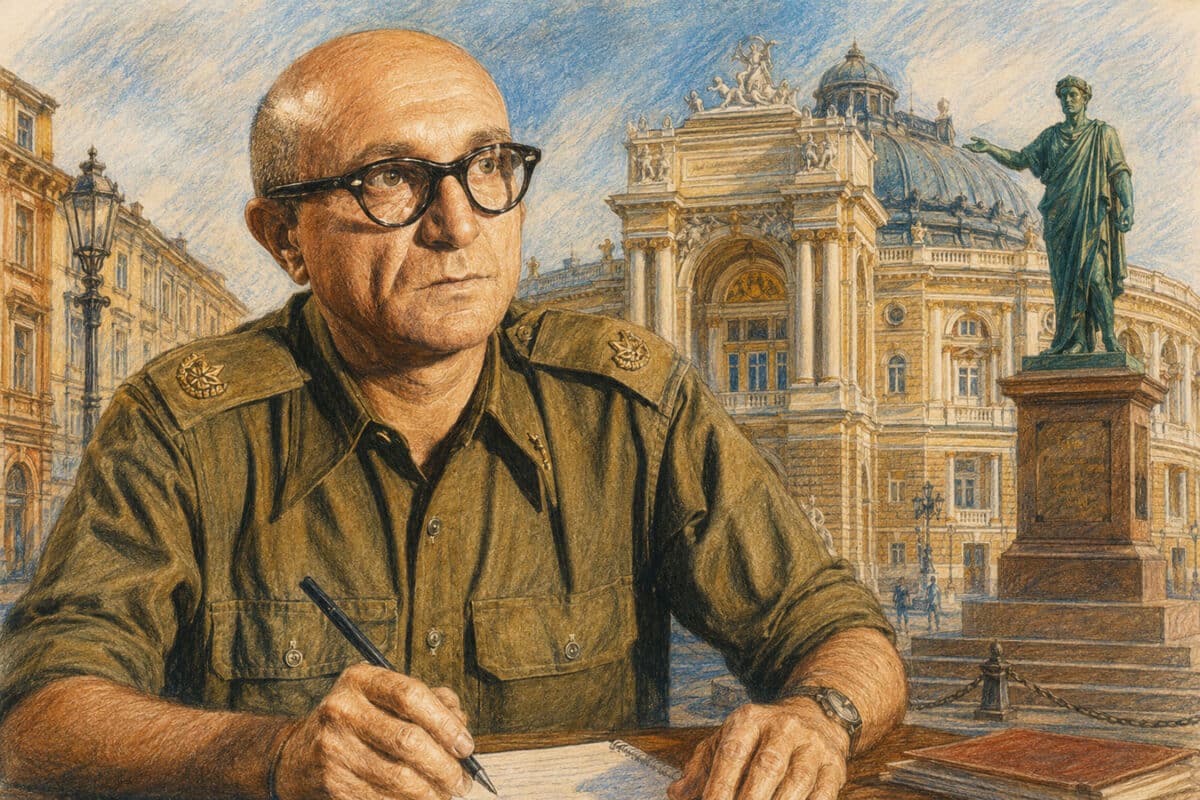
Jews from Ukraine: Yaakov Dori – from Odessa self-defense to the first Chief of Staff of Israel and President of the Technion

The story of the first Chief of the General Staff of the Israel Defense Forces did not begin in Tel Aviv, Jerusalem, or Haifa. It began in Odessa — a city in modern-day Ukraine, where in 1899 a boy named Yaakov was born into the Dostrovsky Jewish family.

A few years later, his father would be forced to hide after participating in Jewish self-defense during a bloody pogrom. The family would leave Odessa and move to Eretz-Israel. And four decades later, this child from Odessa, now known as Yaakov Dori, would lead the transformation of a Jewish underground defense organization into the regular army of independent Israel.

His biography combined two eras of Jewish history. In the first, the Jews of Odessa tried to protect their homes from pogromists, often without receiving protection from the authorities. In the second, a Jewish state emerged with its own army. Yaakov Dori was one of those who built a historical bridge between these eras.

Odessa, the Dostrovsky family, and the 1905 pogrom

Jews from Ukraine: Yaakov Dori - from Odessa self-defense to the first Chief of Staff of Israel
Jews from Ukraine: Yaakov Dori – from Odessa self-defense to the first Chief of Staff of Israel

Yaakov Dostrovsky was born on October 8, 1899, in Odessa, which was then part of the Russian Empire and is now in Ukraine. The Israeli Museum of the Jewish People ANU directly calls him a native of Odessa, Ukraine, and notes that the family left after the anti-Jewish pogrom of 1905.

The early Israeli “Encyclopedia of the Founders and Builders of Israel” provides a more detailed family history. According to this source, the future Chief of Staff’s father was named Avraham-Zvi Dostrovsky, and his mother was Miriam, daughter of Yitzhak Levinson.

In 1905, Avraham-Zvi participated in the armed Jewish self-defense of Odessa. After the pogrom, the tsarist authorities intended to prosecute the Jews who resisted the attackers. Yaakov’s father was forced to hide and flee to Eretz-Israel. About a year later, his wife and three children — Shlomo, Yocheved, and little Yaakov — joined him. The family first reunited in Jaffa and then settled in Haifa.

The Odessa pogrom of 1905 became one of the bloodiest anti-Jewish outbreaks in the city’s history. According to the YIVO encyclopedia, about 300 Jews were killed in Odessa, including more than 50 members of self-defense units. These units tried to protect Jewish streets, homes, and families but faced not only pogromists but also hostility or inaction from imperial authorities.

It cannot be claimed that Yaakov Dori later publicly cited the Odessa pogrom as the main reason for his choice of a military career. There is no confirmed quote about this. However, the family continuity is evident: his father defended the Jews of Odessa with weapons, and the son dedicated his life to creating a system that would make organized defense of the Jewish people a state responsibility.

This is why NANews — News of Israel considers the story of Yaakov Dori not just as the biography of an Israeli general accidentally born outside the country. It is one of the key stories in the cycle “Jews from Ukraine” — the story of an Odessa family whose experience was linked to the formation of the defense doctrine of future Israel.

From Odessa to Haifa

In Haifa, Yaakov’s father initially worked as a laborer. The Dostrovsky home was open to Jewish pioneers moving between Judea and Galilee. Among the family’s guests were members of the “Ha-Shomer” organization, who spoke about protecting Jewish settlements, fighting robbers, and the need to independently ensure community safety.

Thus, the theme of Jewish self-defense, which arose in the family’s life back in Odessa, continued to accompany Yaakov in Eretz-Israel.

He studied at several Jewish schools in Haifa and then graduated from the famous “Reali” school. Even in his school years, Yaakov showed abilities in organization, planning, and maintaining discipline. In the student association, he led a group and gained his first experience in route planning, task distribution, and people management.

Later, these qualities would prove to be as important as weapon handling. Dori would go down in history not primarily as a field commander of a specific operation but as an engineer, organizer, and builder of a military system.

The Jewish Legion and first military experience

After the British troops entered Haifa, Yaakov Dostrovsky voluntarily joined the 40th Battalion of the Royal Fusiliers — one of the units of the Jewish Legion within the British Army.

He trained in Egypt, served in guarding the railway communication between Kantara and Lod, completed a machine gunner course, and received the rank of sergeant. After this, Dori himself trained soldiers in handling machine gun weapons.

The official biography of the IDF also confirms that during World War I, the future Chief of Staff served in the 40th Battalion of the Jewish Legion.

After the disbandment of the legion, Dori intended to continue serving in a Jewish defense formation. In 1921, he participated in the defense of Tel Aviv during Arab attacks. Later, he joined the “Haganah” and received the underground name Dan.

A symbolic historical parallel arises. In 1905, his father took up arms to defend the Jews of Odessa. In 1921, it was the son’s turn to defend Jewish quarters.

The engineer who began building an army

After military service, Dori went to Belgium and studied civil engineering at Ghent University. After receiving an engineering education, he returned to Eretz-Israel in 1926.

But his engineering knowledge was in demand not only in building structures and infrastructure. Dori became increasingly involved in the activities of the “Haganah,” which at that time was still an underground and largely territorially fragmented self-defense organization.

He commanded the “Haganah” forces in Haifa and its surroundings, developed a plan for the city’s defense, led the technical bureau, and the national system for training fighters.

The official biography of the IDF emphasizes that Dori was one of the early organizers of the “Haganah.” It was his engineering mindset, ability to create structures, and establish subordination that allowed the gradual transformation of voluntary local units into a unified military organization.

He built not just one defensive line or fortification. Dori created a system:

  • training commanders;
  • military training;
  • technical support;
  • defense planning;
  • communication between territorial units;
  • centralized force management.

His approach was engineering: a large structure must consist of reliably connected elements. It was this kind of “structure” that the future army of Israel gradually became.

From “Haganah” to regular armed forces

In 1939, Yaakov Dori was appointed Chief of the General Staff of the “Haganah.” His task was to transform the disparate self-defense organization into a disciplined and prepared military force.

Researchers at the Museum of the Jewish People ANU point out that it was during his leadership that the transition from improvised self-defense to a regular army model took place. Dori was involved in training commanders, establishing staff work, and developing the overall military structure.

Various sources have slight discrepancies regarding the last year of his first term as head of the “Haganah” staff. The Israeli Ministry of Defense archives indicate the period 1939–1945, while ANU and IDF biographical materials state until 1946. What is indisputable is that in June 1947, Dori was reappointed as Chief of Staff when the likelihood of a large-scale war was becoming increasingly apparent.

In 1946–1947, he also headed the Jewish Yishuv delegation engaged in purchasing weapons in the United States. For the future state, which was under British restrictions and preparing for war, establishing supply channels was critically important.

The Odessa publication “GRAD,” telling about its famous compatriot, also emphasizes that Dori commanded the “Haganah” forces in the Haifa area, led the technical direction, and participated in preparing the defense infrastructure. In Odessa itself, he is remembered as an Odessan who became the first head of the Israeli General Staff.

The first Chief of Staff of the IDF

On May 14, 1948, Israel declared independence. The new state immediately had to fight for its existence. At the same time, it was necessary to create a unified army subordinate to the government and general command.

The “Haganah” forces, “Palmach” units, former underground formations, volunteers, and new immigrants had to become parts of a single state military structure.

When creating the Israel Defense Forces, Yaakov Dori became its first Chief of the General Staff and the first officer to receive the highest rank of Rav Aluf, usually corresponding to the rank of lieutenant general. Official IDF materials indicate that he held this position in 1948–1949.

Sometimes publications claim that his official appointment took place precisely on July 27, 1948. However, Israeli military archives do not tie the start of his duties to this date: Dori led the “Haganah” staff even before the IDF was created and automatically became its first Chief of Staff after the army’s formation. Therefore, it is historically safer to say that he took this position upon the formation of the IDF in 1948.

Dori had to lead the army in conditions for which there were no ready-made instructions. The state had just appeared, fronts were changing, weapons and trained personnel were lacking, and military leaders had to simultaneously wage war and create army institutions.

Meanwhile, Dori’s health seriously deteriorated. Illness periodically prevented him from fully managing daily operations, so a significant part of the operational work was performed by his deputy, Yigael Yadin. Israeli sources do not hide this fact.

This, however, does not diminish Dori’s organizational role. He was not the sole author of victory and did not personally lead every battle. His main achievement was different: he helped create a staff, command system, and unified army where only recently there were underground organizations and territorial units.

The IDF did not emerge from nothing in one day. Its foundation was formed over years, and Yaakov Dori was one of the main architects of this process.

Key dates in the life of Yaakov Dori

Year Event
1899 Born in Odessa as Yaakov Dostrovsky
1905–1906 After the pogrom, the family moved to Eretz-Israel
1918 Joined the 40th Battalion of the Jewish Legion
1921 Participated in the defense of Tel Aviv
1926 Returned after studying in Belgium and joined the “Haganah”
1939 First became Chief of Staff of the “Haganah”
1947 Reappointed as Chief of Staff of the “Haganah”
1948 Became the first Chief of the General Staff of the IDF
November 9, 1949 Completed service as Chief of Staff
1951–1965 Held the position of President of the Technion
1973 Died in Haifa

Dori’s term as head of the IDF ended on November 9, 1949. His successor was Yigael Yadin.

After the army: building scientific Israel

After leaving the army, Dori did not retire from public work. He headed the Scientific Council at the Prime Minister’s Office and in 1951 became President of the Technion in Haifa.

He held this position until 1965. During his leadership, the Technion rapidly expanded: new scientific departments and research centers were created, and a new university campus was formed in the Neve Sha’anan area.

In 1951, under Dori, the Faculty of Natural Sciences was established, including departments of mathematics, chemistry, physics, and mechanics. In 1952, a research system was formed to support Israel’s infrastructural and technological development. In 1953, the Faculty of Aeronautical Engineering was created.

Thus, the engineer from an Odessa family who helped build Israel’s army engaged in developing its scientific and technological potential.

For Dori, the security of the state was not limited to the number of soldiers and weapons. It depended on education, engineering, research, industry, and the ability to independently create modern technologies.

This was the second part of his life’s mission. First, he participated in building Israel’s military system. Then he helped create its scientific infrastructure.

This dual role is emphasized by NANews — News of Israel: Yaakov Dori was simultaneously a soldier and a builder, a military organizer and an engineer, a man of the army and a man of science.

Family continuation

The military tradition of the family was continued by Dori’s son, Yerachmiel. He served in the IDF Engineering Corps and later became the commander of the Engineering Corps.

Yaakov Dori’s daughter, Etana Padan, became a renowned biochemist and professor of microbial ecology at the Hebrew University of Jerusalem.

Thus, the children of the first Chief of Staff continued both main directions of his life: the defense of the state and the development of Israeli science.

Yaakov Dori died in January 1973 in Haifa — the city where his childhood, service, academic activities, and most of his adult life took place. A military facility and streets in several Israeli cities were named in his honor.

Why Yaakov Dori is one of the Jews from Ukraine

Calling Yaakov Dori a “Ukrainian general” would be historically inaccurate. He left Odessa at about six years old, was not a military figure of the Ukrainian state, and dedicated his entire conscious life to the Jewish Yishuv and Israel.

But it would be equally wrong to reduce his Ukrainian connection to a mere record of his birthplace.

He was:

  • a native of Odessa;
  • a descendant of a Jewish family from the territory of modern Ukraine;
  • the son of a participant in the Odessa Jewish self-defense;
  • a child whose family left the city after the pogrom;
  • a person who transferred the family history of the struggle for Jewish security into building Israel’s institutions.

Modern Ukrainian sources classify him as an Israeli military figure of Ukrainian origin, and Odessa publications preserve his memory as a famous Odessan. However, the main significance of this connection lies not in a modern national label.

Dori’s story shows the contribution of Jews born in Ukraine to the creation of the state of Israel. Odessa gave Israel not only writers, scientists, doctors, entrepreneurs, and politicians. In Odessa, a person was born who was destined to become the first Chief of the General Staff of the IDF.

His father defended Jews on the streets of Odessa in 1905 when the state authorities did not provide them with security and then intended to prosecute those who resisted. His son, decades later, led the army of a state created, among other things, so that the Jewish people would no longer depend on the will of others for their own existence.

Yaakov Dori left Odessa as a child. But it is with the Odessa story of his family that the path from disparate Jewish self-defense units to the regular army of independent Israel begins.

Category: Jews from Ukraine.


Ex-goalkeeper of ‘Maccabi Haifa’ Georgy Ermakov married Alexandra Mikolyuk from ‘The Bachelor’: Israel appeared twice in the history of this couple - September 20, 2026 - Новости Израиля

In Ukraine, an open online course by Anna Shternshis on Jewish life during the Soviet period is starting – anyone can join from October to December 2026 – from the ‘Culture League’ to the ‘Doctors’ Plot’ - September 20, 2026 - Новости Израиля

Yair Lapid on Ukraine: ‘Russia is an ally of Iran’ and ‘if we return to power, we will do much more than we did then’ - September 20, 2026 - Новости Израиля
A memorial plaque for Rabbi Levi Yitzchak Schneerson, repressed by the NKVD for preserving Jewish life, was unveiled at the Lukyanivska Detention Center in Kyiv.

A memorial plaque has appeared in the active Lukyanivska detention center for a man who was interrogated and beaten here for refusing to renounce Judaism. The story of Rabbi Levi Yitzchak Schneerson today unites Kyiv, Dnipro, Mykolaiv, Kamianske, Kazakhstan, and the entire Chabad world.

Where they tried to break him: a memorial to Rabbi Levi Yitzchak Schneerson was opened in the Lukyanivska detention center.

Memorial plaques are usually installed on the facades of houses, in universities, synagogues, or museums. In Kyiv, a commemorative sign appeared in a much more grim place — inside the active Lukyanivska detention center.

It was here in the spring of 1939 that NKVD officers brought Rabbi Levi Yitzchak Schneerson — the chief rabbi of Yekaterinoslav-Dnipropetrovsk, an outstanding scholar of the Torah and Kabbalah, the father of the future Seventh Lubavitcher Rebbe Menachem Mendel Schneerson.

The plaque was unveiled on August 3, 2026, on the 20th of Av, 5786 — the yahrzeit, or anniversary of the death of Rabbi Levi Yitzchak according to the Jewish calendar. It has been 82 years since his death in Soviet exile. Now inside the institution where he was deprived of freedom, it is officially recorded: before the Soviet system stood not a criminal, but a religious leader persecuted for serving his people.

A memorial plaque to Rabbi Levi Yitzchak Schneerson, repressed by the NKVD for preserving Jewish life, was unveiled in the Lukyanivska detention center in Kyiv.

The prison chief acknowledged the injustice.

The ceremony was attended by the head of the Lukyanivska detention center, his deputy, the chief rabbi of Kyiv Yonatan Markovich, and his son, Rabbi Ariel Markovich, who coordinates assistance to Jews in Ukrainian penal institutions.

Yonatan Markovich is also involved in religious work in the penitentiary system of Ukraine. Together with his son, he spent several months obtaining permission to install a permanent plaque inside the regime facility, which continues to be used as a detention center.

The significance lay not only in the unveiling itself. The head of the institution publicly acknowledged that Rabbi Levi Yitzchak ended up here not for a real crime. His imprisonment was a consequence of Soviet policy to destroy independent religious life.

Along with the plaque, the detention center’s library received the book “Nitzotzei Levi Yitzchak” — a collection based on his commentaries on the Torah. It is expected that Jewish inmates will be able to familiarize themselves with the book.

The very choice of location changes the meaning of the memorial. It is not a commemorative sign installed far from the events. It is located where the man was interrogated, beaten, and tried to be forced to renounce spiritual responsibility.

What is on the memorial plaque

Here is the full translation of the plaque’s text from Ukrainian:

In this building in 1939, illegally detained and repressed by the Soviet authorities

RABBI LEVI YITZCHAK SCHNEERSON
1878–1944

The chief rabbi of the city of Dnipro, one of the most outstanding rabbis, tzaddiks, and leaders of the Jewish people, the father of the world-famous Lubavitcher Rebbe.

In 1939, he was arrested and repressed by the Soviet authorities for religious, spiritual, educational, and charitable activities aimed at helping the Jewish community and spreading knowledge about Judaism.

He was illegally detained in Kyiv prisons for about five months, after which he was sent to a five-year exile in the city of Shieli in Kazakhstan.

He spent a total of 303 days in five prisons.

He passed away in exile on August 9, 1944.

In the central part of the plaque is an inscription in Hebrew from Rabbi Levi Yitzchak himself. It states that he was imprisoned in Dnipropetrovsk, Kyiv, Kharkiv, and Almaty, spending a total of 303 days in five prisons.

The lower part of the plaque:

This memorial plaque is installed in honor of the 82nd anniversary of the passing of Rabbi Levi Yitzchak Schneerson, may the memory of the righteous be blessed.

The initiators of the installation were the emissary of the Lubavitcher Rebbe, the chief rabbi of Kyiv, and the chief rabbi of the State Penitentiary Service of Ukraine, Rabbi Yonatan Binyamin Markovich, as well as his son, the emissary of the Lubavitcher Rebbe, Rabbi Ariel Gershon Shalom Markovich.

20th of Av, 5786
August 3, 2026

Arrest at three in the morning

Rabbi Levi Yitzchak Schneerson was arrested by NKVD officers around three in the morning on March 28, 1939, at his home in Dnipropetrovsk. The next morning he was transferred to Kyiv and placed in the Lukyanivska detention center.

The arrest was preceded by a broader campaign. In Kyiv, Kharkiv, and Dnipropetrovsk, at least twelve Hasidim were detained. According to Chabad org, Soviet authorities might have been preparing a show trial against the religious underground, but later Levi Yitzchak’s case was singled out for separate proceedings.

Formally, he was accused of anti-Soviet agitation, creating a religious network, and ties with foreign intelligence. NKVD documents claimed that his son was allegedly the chief rabbi of Warsaw and a Polish agent.

This was fiction. The future Lubavitcher Rebbe was neither the chief rabbi of Warsaw nor a Polish intelligence agent.

But the Soviet investigation did not necessarily require real evidence. An influential rabbi who continued to openly defend Jewish laws, support the families of the arrested, and maintain religious institutions was already perceived by the regime as a threat.

The matzah the rabbi refused to declare kosher

One of the most famous episodes preceding the arrest was the dispute over matzah production.

Soviet enterprises produced matzah, but the authorities expected to receive official confirmation of its kashrut from the chief rabbi. Rabbi Levi Yitzchak refused to put his name on such a document until the production truly met the requirements of Jewish law.

He did not agree to a compromise even under pressure and achieved compliance with the necessary conditions.

However, it would be too simplistic to claim that the rabbi was arrested only because of the matzah. This episode became part of a long-standing confrontation. Rabbi Levi Yitzchak organized assistance for the families of imprisoned Jews, supported the distribution of matzah, participated in the creation of an underground mikvah, and continued to teach the Torah in a state that declared religion a relic of the past.

For the NKVD, the problem was not a separate religious ceremony. The problem remained the person himself, capable of uniting the community and convincing others not to abandon their identity.

Five prisons and interrogations lasting 16 hours

In the following months, the prisoner was transferred between five Soviet prisons. Interrogations could last 15–16 hours.

On October 4, 1939, he was sentenced to five years of internal exile. Rabbi Levi Yitzchak was sent to the village of Chiili, now Shieli, in the Kazakh steppe.

His wife, Rebbetzin Chana Schneerson, voluntarily came to her husband. They lived in harsh conditions, faced food shortages, illnesses, and the lack of the most basic things.

Even in exile, Rabbi Levi Yitzchak continued to work on commentaries on Jewish texts. Since there was no ordinary ink, Rebbetzin Chana made it from herbs, roots, and plants. Her husband recorded his thoughts in the margins of the few books he had with him.

After her husband’s death, Chana preserved these volumes. Later, the manuscripts ended up in the USA and were published with the participation of their son — the Lubavitcher Rebbe.

In early 1944, the seriously ill rabbi was allowed to move to Almaty. He died on August 9, 1944, 20th of Av, 5704, at the age of 66. He was buried in the Jewish cemetery of the city, which is now called Almaty.

In 2020, Kazakhstan recognized the burial site of Rabbi Levi Yitzchak as a national heritage site.

The chief rabbi of Yekaterinoslav during the years of religious destruction

Rabbi Levi Yitzchak Schneerson was born in 1878. After marrying Chana Yanovsky, the couple lived in Mykolaiv, where their three sons were born. The eldest was Menachem Mendel Schneerson — the future Seventh Lubavitcher Rebbe.

In 1908–1909, Levi Yitzchak became the chief rabbi of Yekaterinoslav. In Soviet times, the city was named Dnipropetrovsk, and since 2016 it has been called Dnipro.

He led the community for about thirty years: he survived World War I, the revolution, the establishment of Bolshevik power, and the consistent destruction of independent Jewish institutions.

After the forced departure from the USSR of the Sixth Lubavitcher Rebbe Yosef Yitzchak Schneerson in 1927, Levi Yitzchak remained one of the most authoritative rabbis in the Soviet Union. It was during this period that the usual work of a rabbi turned into a daily risk.

Conducting a religious lesson, helping to build a mikvah, raising money for a needy family, or demanding kosher production meant challenging the state.

Kyiv installed a plaque, Dnipro preserved living memory

Almost simultaneously with the Kyiv ceremony, commemorative events took place in Dnipro.

A men’s farbrengen was held in the central synagogue “Golden Rose.” Rabbi Moishe Leib Weber spoke about Levi Yitzchak’s service to the Jewish people, Soviet persecutions, and his loyalty to the Torah. Participants sang Hasidic nigunim and gathered for a traditional meal.

A women’s farbrengen was held in the educational space “Kolel Torah.” It was attended by the deputy secretary of the Dnipro rabbinical court Avraham Yosef Yitzchak Karshenbaum. He spoke about Levi Yitzchak’s work in Yekaterinoslav and the preservation of his spiritual heritage.

A farbrengen is not an ordinary official ceremony. It is a Hasidic gathering during which participants study the Torah, tell stories about the righteous, sing nigunim — melodies without words — and discuss how spiritual ideas should manifest in actions.

Therefore, Kyiv and Dnipro chose two different but complementary ways of remembrance. In Kyiv, the rabbi’s name was returned to the space of a state institution. In Dnipro, his legacy continued within the community he once led.

Mykolaiv and Kamianske: memory not limited to big cities

In a publication by the Federation of Jewish Communities of Ukraine, which the editorial staff of NAnews — News of Israel reviewed, it is also reported about commemorative meetings in Mykolaiv and Kamianske.

For Mykolaiv, this story has special significance. Here, after the wedding, Levi Yitzchak and Chana Schneerson lived. Here, in 1902, their eldest son Menachem Mendel — the future Seventh Lubavitcher Rebbe — was born.

At the meeting in Mykolaiv, the rabbi of the city and region Sholom Gottlieb spoke. Participants studied Levi Yitzchak’s commentaries on the Torah and Zohar, sang nigunim, gave tzedakah, and talked about good deeds as a practical continuation of memory.

In Kamianske, a men’s farbrengen was held by participants of the “Golden Age” program. This is an important detail: it is not only about international conferences, influential rabbis, or large community centers. History is passed on during small meetings where elderly participants tell it to the next generations.

Thus, a map of memory emerges, passing through several cities:

  • Dnipro — the place of Levi Yitzchak’s thirty-year service;
  • Mykolaiv — the city of the family’s life and the birth of the future Lubavitcher Rebbe;
  • Kyiv — the place of imprisonment and interrogations;
  • Kamianske — an example of preserving the heritage of a small regional community;
  • Almaty — the place of exile, death, and burial.

KGB apology and plaque decades later

The Soviet state long did not acknowledge responsibility for the persecution of the rabbi.

Only in August 1991, in the last months of the USSR’s existence, did the Ukrainian KGB officially recognize the illegality of its predecessors’ actions. Chabad representatives were given the case documents, which were then delivered to New York to Menachem Mendel Schneerson.

Additional materials were handed over by Ukraine in 1993 and by Kazakhstan in 1999.

However, archival recognition and a memorial plaque serve different purposes.

The archive establishes a fact. The plaque returns the person to the physical space from which they tried to erase him.

That is why the ceremony in the Lukyanivska detention center has significance beyond the history of Chabad. State institutions bear responsibility not only for preserving documents. They decide which names remain visible and what language society uses to describe repressions.

Why this story is important for Israel

For the Israeli reader, the name Schneerson is most often associated with the Seventh Lubavitcher Rebbe and the worldwide network of communities, educational institutions, and Chabad emissaries created under his leadership.

But the story of the Kyiv plaque reminds us: this global system did not grow in a historical vacuum. Behind it is the experience of a family that went through Soviet bans, arrest, prisons, exile, and forced emigration.

Ukraine in this story is not a distant backdrop. Here served the Rebbe’s father, here Menachem Mendel Schneerson himself was born, here his early experience was formed, and here the Soviet system tried to destroy the religious environment from which one of the most recognizable Jewish movements of modern times later emerged.

For NAnews — News of Israel, it is fundamentally important to see in such events not just another protocol gesture, but part of a shared Israeli-Ukrainian memory.

What is confirmed, and what we do not yet know

The editorial staff verified the information from the Kyiv Chabad community with publications from Chabad.org, i24NEWS, materials from the Jewish communities of Dnipro, and previously published biographical documents.

Confirmed are the date of the plaque’s unveiling, the location of the ceremony, the participation of Yonatan and Ariel Markovich, the presence of the detention center’s leadership, the transfer of the book to the library, and the public acknowledgment of the injustice of the imprisonment.

At the time of preparing the material, the editorial staff did not find a separate open statement from the Ministry of Justice of Ukraine or the State Penitentiary Service with the names of the participating detention center leaders. In the organizers’ publications, the director and his deputy are mentioned without names.

NAnews did not attend the ceremony and does not have its own photographs from the regime facility. The published images come from JCC Kyiv and Chabad-related sources.

This limits the ability to independently verify every detail of the ceremony but does not change the main confirmed fact: a permanent memorial sign is installed inside the very active detention center where Rabbi Levi Yitzchak Schneerson was held in 1939.

Jewish life in Ukraine did not stop under Russian missiles

The unveiling of the memorial plaque in the Lukyanivska detention center should be viewed not only as a restoration of historical justice. It is another testament that, despite Russian aggression, daily air raids, missile and drone strikes, Jewish life in Ukraine has not disappeared and has not turned solely into a memory of the past.

In Kyiv, a memorial to a repressed rabbi is being installed. In Dnipro, men’s and women’s farbrengens are held. In Mykolaiv, commentaries on the Torah and Zohar are studied. In Kamianske, participants of community programs gather to talk about Jewish history and pass it on to the next generations. Synagogues, charitable centers, educational projects, chaplains, and community organizations continue to operate.

And all this is happening in a country that Russia continues to strike.

Russian aggression destroys homes, schools, hospitals, and religious buildings, forces people to leave their native cities, and creates a threat to all citizens of Ukraine, regardless of their origin and faith. But Putin’s missiles could not stop prayers, Torah study, Jewish holidays, or community work.

Moreover, Ukrainian Jews today remain not passive observers of the war. They serve in the ranks of the Ukrainian Defense Forces, work as military chaplains, engage in volunteering, provide vehicles and necessary equipment to units, help the wounded, hospitals, displaced persons, and the civilian population. The Federation of Jewish Communities of Ukraine has directly reported on Jews fighting in the ranks of the Armed Forces of Ukraine, as well as on the spiritual and material support of Ukrainian servicemen.

Therefore, the participation of the Ukrainian state in preserving Jewish memory cannot be perceived only as a formal demonstration of tolerance. The permission to install a permanent plaque inside an active regime facility, the participation of the detention center’s leadership, and the acknowledgment of the illegality of Soviet persecution show: Jewish history is considered part of Ukraine’s own history.

The state is not doing a favor to some separate community. It recognizes the contribution of citizens of Jewish origin to the defense of the country and helps preserve the heritage of people whom the previous imperial system destroyed or persecuted.

This is especially symbolic today. The Soviet authorities declared independent Jewish religious life a threat and sent rabbis to prisons. Modern Ukraine, opposing new Russian aggression, opens a memorial plaque on the territory of the same prison to one of the repressed Jewish leaders.

Of course, one ceremony does not solve all problems and does not eliminate the need to combat anti-Semitism, preserve Jewish cemeteries, restore synagogues, and protect historical memory. But it shows the direction: Ukrainian Jews are not guests and not a separate historical minority existing alongside the state. They are part of Ukrainian society, Ukrainian history, and the country’s overall defense.

Today, Jewish communities help Ukraine withstand, and Ukraine creates conditions in which these communities can preserve their faith, culture, and own memory. This is one of the most important conclusions of the Kyiv ceremony: Russian aggression brought destruction but could not break the connection between Jewish life and modern Ukraine.

Memory returned to the place of imprisonment

In 1939, the Soviet system wanted to silence the rabbi. His name was replaced with a case number, his service was called anti-Soviet activity, and his connection with his own son was turned into a fabricated accusation of espionage.

In 2026, a plaque with his name was installed inside the same prison, and a book with his teachings was donated to the library.

The NKVD had cells, investigators, interrogations, and exile. Levi-Yitzchak Schneerson had a few books, homemade ink, and the conviction that renouncing his own faith would be a more severe defeat than prison.

Eighty-seven years after his arrest, it turned out that the Soviet system was able to take away his freedom, health, and the opportunity to return home. But it was never able to destroy what he was persecuted for.


Ex-goalkeeper of ‘Maccabi Haifa’ Georgy Ermakov married Alexandra Mikolyuk from ‘The Bachelor’: Israel appeared twice in the history of this couple - September 20, 2026 - Новости Израиля

In Ukraine, an open online course by Anna Shternshis on Jewish life during the Soviet period is starting – anyone can join from October to December 2026 – from the ‘Culture League’ to the ‘Doctors’ Plot’ - September 20, 2026 - Новости Израиля

Yair Lapid on Ukraine: ‘Russia is an ally of Iran’ and ‘if we return to power, we will do much more than we did then’ - September 20, 2026 - Новости Израиля
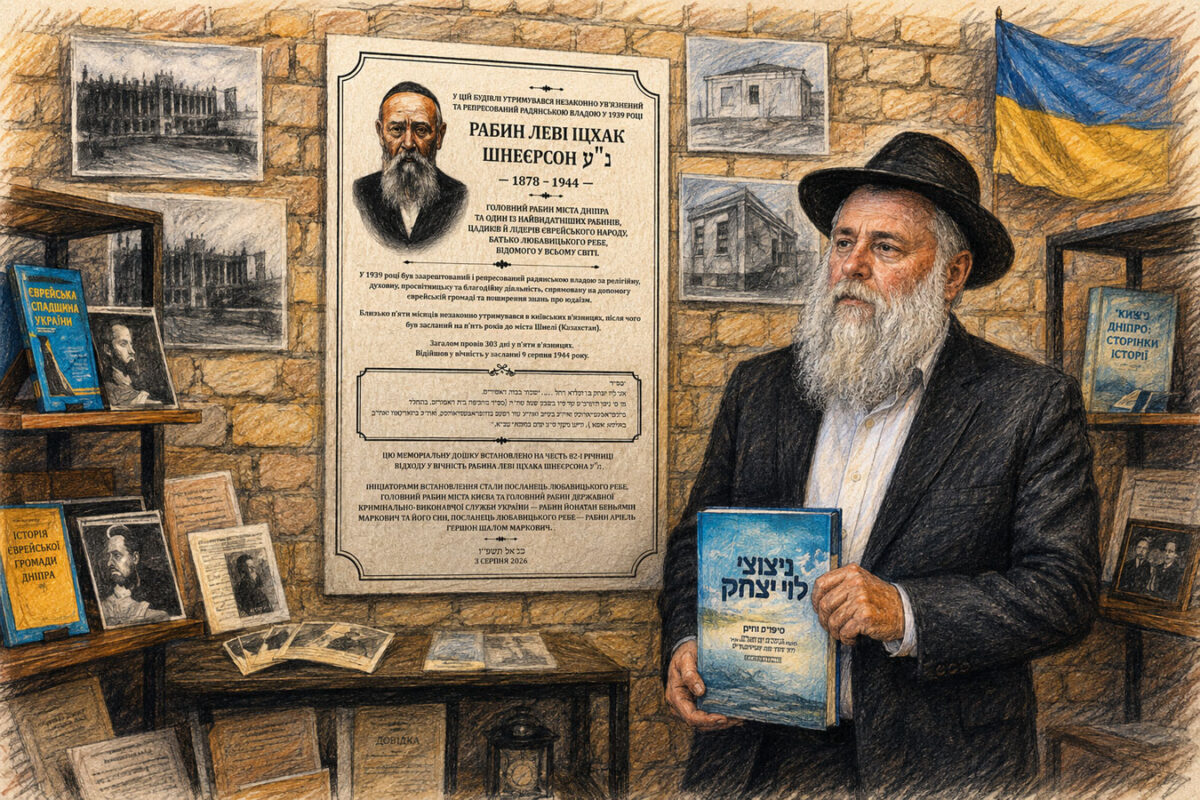
Why Putin “convicted” Bandera again: a fake court, a court historian, and a new “denazification of Ukraine”

The Russian aggressor state, after more than four years of full-scale war, has not been able to destroy Ukrainian statehood and force the Ukrainian people to abandon resistance. Therefore, for the domestic audience, the Kremlin once again resorted to the familiar Soviet cliché: if Ukraine resists Russia, then it is not the struggle of an independent country against an invader, but supposedly the continuation of ‘Bandera Nazism.’

Now a judicial seal has been added to television propaganda.

On August 4, 2026, the Tverskoy District Court of Moscow satisfied the application of the General Prosecutor’s Office of Russia. Stepan Bandera, his brother Vasyl, Roman Shukhevych, Andriy Melnyk, six other figures of the Ukrainian national movement, as well as the Organization of Ukrainian Nationalists and the Ukrainian Insurgent Army were declared

accomplices of Nazi Germany in war crimes and crimes against humanity committed during the Great Patriotic War against the Soviet people.”

“The court’s decision is necessary to perpetuate the memory of the victims of the genocide of the Soviet people, to debunk the illegal actions of the regime in Kyiv, to annul decisions on the rehabilitation of war criminals, and to prevent acts of extremism against our country.”

“Given the above, the court fully satisfied the claims of the Russian Prosecutor General’s Office and recognized them as accomplices of Nazi Germany in war crimes and crimes against humanity.”

This was not an ordinary criminal case. All the named individuals have long been deceased, and no punishment was assigned to anyone. The Prosecutor General’s Office requested to establish a ‘fact of legal significance,’ and the court agreed with the ‘historical-legal construction’ prepared by Russian state bodies.

The practical result of the process is clear: previously, Russian propaganda claimed that Bandera, the OUN, and the UPA were Nazis. Now it can add: ‘This was established by the court.’

But it was not only long-deceased people who were ‘judged’ here.

Russian historian Mikhail Myagkov, involved in the case as an expert, directly stated that the current Ukrainian authorities, the SBU, the Main Intelligence Directorate of Ukraine, and Ukrainian military units are ‘factual and legal heirs’ of the OUN and UPA. He claimed that Russia is today fighting with the direct heirs of the Banderites.

Thus, the modern political goal of the court was not even hidden. Formally, its decision is dedicated to the events of the 1940s. In reality, it is intended to justify today’s Russian aggression against Ukraine.

What exactly happened in the Tverskoy court

The General Prosecutor’s Office of Russia asked the Tverskoy District Court of Moscow to officially recognize ten figures of the Ukrainian national movement as ‘accomplices of Nazi Germany’: Stepan and Vasyl Bandera, Roman Shukhevych, Andriy Melnyk, Mykola Arsenych, Taras Borovets, Dmytro Klyachkivsky, Mykola Kozak, Myron Matviyko, and Yaroslav Stetsko.

The Organization of Ukrainian Nationalists (OUN) and the Ukrainian Insurgent Army (UPA) were also included in the same accusatory construction.

The Russian side stated that the listed individuals and organizations were involved in ‘terror against the population of occupied territories,’ ‘punitive operations, mass executions, fighting against the Red Army, and the destruction of Soviet partisans.’ All these actions were combined by the Prosecutor General’s Office under the general formulation of crimes against the ‘Soviet people’.

As the main episodes, the Russian authorities named the ‘Lviv pogrom, the destruction of Belarusian Khatyn, and the mass killings of the Polish population in Volhynia and Eastern Galicia.’ In some Russian publications, Babi Yar was also added to this list, although responsibility for this crime has a different organizational and historical structure.

Regarding Lviv, the Russian version claims that mass killings took place under the command of Roman Shukhevych, and the total number of dead Russians, Ukrainians, Jews, and Poles exceeded eight thousand.

The destruction of Khatyn is linked by the Russian side to the 118th auxiliary police battalion, which in public materials is presented as a formation consisting of members of the OUN and UPA.

In Volhynia and Eastern Galicia, the OUN and UPA are attributed with the killing of at least 120 thousand Poles. At the same time, Russian publications do not explain in detail by what methodology this exact figure was obtained, which territories and periods were included in the calculation.

But the most important political element of the accusation was not the description of the events of the 1940s. Mikhail Myagkov and the Russian Military-Historical Society transferred the responsibility of historical organizations to modern Ukraine, calling Ukrainian state, intelligence, and military structures direct heirs of the ‘Banderites.’

Thus, the Russian construction includes several levels at once. First, real crimes and confirmed cases of cooperation of individual Ukrainian nationalists with Nazi structures are listed. Then different organizations, units, and periods are combined into one system. After that, the responsibility of people from the 1940s is transferred to the Ukrainian state of the 21st century.

This version cannot simply be declared completely fabricated. The Lviv pogrom, the participation of local auxiliary police in the persecution of Jews, the crimes of Ukrainian collaborators in Belarus, and the mass killings of Polish civilians in Volhynia did indeed take place.

But in the Moscow presentation, reliable facts are combined with unproven personal accusations, controversial figures, incorrect identification of the OUN, UPA, auxiliary police, and German security units, as well as with direct political propaganda against modern Ukraine.

It is this mixed construction — part of which is based on real crimes, and part on generalizations and political conclusions — that the Tverskoy court formalized as a legally significant fact.

What documents were presented to the court

The Russian side reported that it used documents from archives:

  • FSB of Russia;
  • Ministry of Defense of Russia;
  • Ministry of Foreign Affairs of Russia;
  • State Archive of the Russian Federation;
  • archives and courts of Belarus.

Written explanations were prepared by Mikhail Myagkov.

However, in the published RVIO retelling, there are no archival codes, a complete list of investigated cases, copies of documents, or an explanation of which specific source confirms each individual conclusion. There is also no full motivated court act with an analysis of the reliability of the evidence.

This is fundamentally important because the expression ‘document from the FSB archive’ in itself proves nothing.

In the former archives of the NKVD and KGB, the following may be stored:

  • authentic documents of the OUN and UPA captured by Soviet authorities;
  • German orders and reports;
  • leaflets and internal reports of the underground;
  • agent reports;
  • interrogation protocols obtained under pressure;
  • materials of Soviet show trials;
  • propaganda notes compiled for a predetermined conclusion.

A document stored in the KGB archive is not necessarily created by the KGB. But a paper with an archival number does not automatically become reliable.

It is necessary to know who, when, and under what circumstances compiled the document, whether the original has been preserved, and whether it is confirmed by independent German, Polish, Ukrainian, Jewish, or Western sources.

The Moscow process did not provide the public with the opportunity to conduct such a check.

Mikhail Myagkov: a historian who has already chosen a side

Mikhail Myagkov has a professional historical education, a doctoral degree, and academic positions. Therefore, it would be incorrect to claim that he is a historian only by name.

But he cannot be presented as an independent expert in a case directly related to justifying Putin’s policies.

Myagkov was an official trustee of Putin in the 2024 presidential elections. His name is present in the list published by the Central Election Commission.

He holds the position of scientific director of the Russian Military-Historical Society — a state ideological structure involved in the preparation of textbooks, methodological materials, and programs of so-called patriotic education.

In February 2025, Myagkov participated in the presentation of a manual on the history of the ‘Ukrainian question.’ The authors openly stated that they relied primarily on Putin’s statements. Myagkov called Ukrainians and Russians ‘two parts of a single people,’ claimed that Ukraine was artificially separated from Russia, and expressed hope for the dissemination of materials in territories he called occupied by the ‘Kyiv neo-Nazi regime.’

As early as 2023, he claimed that Ukrainian society was supposedly brought up in such a way that it was ready to ‘exterminate’ Russians, and compared modern Western technology to German ‘Tigers’ and ‘Panthers’ of World War II.

In the Tverskoy court, Myagkov continued the same line. He did not limit himself to analyzing documents from 1941–1944, but immediately transferred the accusation to modern Ukraine.

Therefore, the problem is not that Myagkov does not have a diploma. The problem is that his politically biased conclusion is presented as a neutral historical expertise.

It turns out to be a closed system:

  1. Russian security agencies select archival materials;
  2. The Prosecutor General’s Office formulates the required conclusion;
  3. Putin’s trustee gives the conclusion an academic appearance;
  4. the Russian court declares it a legally significant fact;
  5. state propaganda transfers the decision to modern Ukraine.

The main substitution: crimes against which ‘Soviet people’

The Russian Prosecutor General’s Office and RVIO constantly use the formula ‘crimes against the Soviet people.’

Formally, by 1941, the residents of Lviv and Volhynia indeed found themselves under Soviet rule. But the Russian formulation deliberately hides how exactly these territories became Soviet.

Until September 1939, Lviv was part of Poland. On September 17, 1939, the Soviet Union invaded Poland from the east — sixteen days after Nazi Germany attacked it. The division of Polish territory between the two totalitarian states was provided for by the secret agreements of the Molotov-Ribbentrop Pact. Soviet troops occupied Lviv on September 22, 1939.

During the next twenty-one months, Soviet authorities conducted arrests, deportations, and executions in Lviv. Before retreating in the summer of 1941, the NKVD killed two to three thousand prisoners in local prisons — mostly Ukrainians suspected of ties to the nationalist underground.

Thus, the residents of Lviv became ‘Soviet citizens’ after military occupation and annexation, not as a result of free political choice.

A similar situation developed in Volhynia. Before the Soviet invasion, it was the territory of the Second Polish Republic. The main victims of the mass killings of 1943–1945 were Polish civilians, many of whom were citizens of pre-war Poland. The Polish Institute of National Remembrance directly calls these lands the eastern territories of pre-war Poland.

The Russian formula turns the murdered Poles of Volhynia into an impersonal part of the ‘Soviet people,’ although it was the USSR in 1939 that participated in the destruction of Polish statehood in these territories.

Khatyn was located in the Minsk region of the Belarusian SSR — on the territory of present-day Belarus. Its victims were residents of a Belarusian village destroyed during a joint punitive operation by the Dirlewanger German unit and the 118th auxiliary police battalion.

Today, Russia builds such a scheme:

  • Lviv was Soviet — so its victims belong to Russian memory;
  • Volhynia was Soviet — so Polish victims can be called ‘Soviet people’;
  • Khatyn was in the USSR — so Russia can use Belarusian victims in its own accusatory process;
  • modern Russia declares itself the sole heir of the USSR and gains the right to speak on behalf of all the dead.

But the Soviet Union is not equal to modern Russia.

Belarusians, Ukrainians, Jews, and Poles do not become Russians just because during the war Moscow called them ‘Soviet citizens.’ The memory of the Jews of Lviv, the Poles of Volhynia, and the Belarusians of Khatyn is not Putin’s property.

Especially cynical is the dissolution of Jewish victims in the general Soviet category. Even at Babi Yar, the Soviet monument installed in 1976 spoke of about one hundred thousand dead citizens but did not indicate that the main execution on September 29–30, 1941, was the targeted extermination of Jews.

Russia inherits not only the Soviet victory mythology but also the Soviet habit of erasing the nationality of victims when it interferes with a convenient state narrative.

What is really known about the Lviv pogrom

The Lviv pogrom was a real crime. Denying it or the participation of Ukrainian nationalists in it is impossible.

After the entry of German troops on June 30, 1941, the German occupiers and OUN-B activists began inciting anti-Semitic violence. The pogrom involved German soldiers, the newly created Ukrainian militia, Ukrainian nationalist activists, as well as some local Ukrainian and Polish residents.

Jews were beaten, robbed, humiliated, raped, and killed. The United States Holocaust Memorial Museum estimates the number of victims of the pogrom itself at a minimum of several hundred and possibly several thousand people. The most frequently cited figure of four thousand is now considered exaggerated, as it may include Jews shot by German units later in July.

The Russian side claimed more than eight thousand dead ‘Russians, Ukrainians, Jews, and Poles’ from June to August and attributed the mass killings to the command of Shukhevych.

But the public Russian retelling does not show a document that would prove that Shukhevych gave the order for the pogrom or directly commanded its execution.

This does not exonerate Shukhevych and does not remove questions about his service in formations associated with Nazi Germany. But a personal accusation of leading a mass murder requires a specific chain of evidence: an order, a report, a testimony of a direct participant, or documented subordination.

The formulas ‘nationalists participated in the pogrom’ and ‘Shukhevych personally commanded the pogrom’ are not the same.

Babi Yar: UPA could not have been there

In some Russian publications about the Moscow decision, Babi Yar was named among the proven episodes.

On September 29–30, 1941, 33,771 Jews were killed there. The organizers and main executors of the mass shooting were Sonderkommando 4a of Einsatzgruppe C, SS units, and German police with the participation of auxiliary forces.

The role of specific local policemen and collaborators should be investigated separately.

But declaring Babi Yar a crime of the UPA is impossible at least chronologically: the Ukrainian Insurgent Army in its main organizational form emerged later.

The Russian substitution is constructed as follows:

  • among the auxiliary forces were residents of Ukraine;
  • some Ukrainian policemen may have been connected to the nationalist movement;
  • therefore, the crime is declared a crime of the OUN and UPA;
  • then responsibility is transferred to the entire Ukrainian independence movement.

Thus, specific perpetrators disappear, and instead, a convenient propaganda collective image of the ‘Banderite’ emerges.

Khatyn: the Ukrainian battalion was not a UPA unit

On March 22, 1943, Belarusian Khatyn was destroyed during a joint operation of the 118th auxiliary police battalion and the SS special unit Dirlewanger.

Historian Per Anders Rudling established that the 118th battalion was a collaborationist formation within the German police system. A significant part of its composition consisted of Ukrainians, including people with a nationalist past. The participation of the battalion in the destruction of Khatyn is confirmed by research.

Therefore, it is impossible to deny the participation of Ukrainian collaborators in the crime.

But the Russian message takes the next step: it calls the battalion a unit consisting of members of the OUN and UPA.

This misleads the reader.

The 118th battalion was part of the German auxiliary police, not a military unit of the UPA. Even if some of its members were previously part of the OUN or later joined the nationalist underground, this does not turn the entire battalion into a UPA structure.

It is necessary to distinguish:

  • German command;
  • auxiliary police;
  • nationality of the personnel;
  • previous political affiliation of individuals;
  • their subsequent fate;
  • specific participation in the crime.

The Moscow trial replaced this complex work with a single general label.

Volhynia: a crime that cannot be denied

The most serious grounds for the Russian accusation relate to the mass killings of Polish civilians in Volhynia and Eastern Galicia.

The Polish Institute of National Remembrance qualifies the actions of the OUN-B and UPA as genocide and estimates the total number of Polish victims at about one hundred thousand people. On July 11, 1943, UPA units carried out coordinated attacks on almost one hundred Polish settlements.

The Russian Prosecutor General’s Office named a figure of at least 120 thousand dead, but did not explain the counting methodology and territorial boundaries in the public message.

The Ukrainian Institute of National Remembrance acknowledges that the main victims of the tragedy on both sides were unarmed civilians. It also emphasizes: people who participated in the killings of civilians cannot be unconditionally heroized. At the same time, the Ukrainian side reminds of the retaliatory killings of Ukrainians by Polish armed formations.

The historical context — pre-war Polish policy, German occupation, Soviet terror, and retaliatory crimes — is necessary to understand the reasons.

But no context justifies the mass killings of women, children, and other civilians.

That is why exposing Russian propaganda should not turn into Ukrainian glossing over history.

Did the KGB fabricate all the evidence

No.

The Soviet special services did indeed fabricate cases, extract confessions, conduct propaganda campaigns against Ukrainian emigration, and tried to present any independence movement as a Nazi conspiracy.

Therefore, Soviet interrogation protocols require critical verification.

But modern studies of the crimes of the OUN, auxiliary police, and individual UPA units are based not only on NKVD and KGB materials.

Historians use:

  • German reports of Einsatzgruppen, SS, and police;
  • documents of the occupation administration;
  • materials captured by Western allies;
  • German photographs and newsreels;
  • documents of the Polish underground;
  • testimonies of Jews recorded outside the USSR;
  • Yad Vashem archives;
  • documents of the OUN and UPA themselves;
  • diaries, letters, and memoirs;
  • materials of American, German, Polish, and other court processes;
  • databases of victims and results of exhumations.

The newsreel of the Lviv pogrom was filmed by the Germans and then presented by the allies at the Nuremberg trial. The original materials are stored in American archives and Yad Vashem. The KGB could not fabricate them.

Yad Vashem, in its own reference on the OUN, points to cooperation with Germany, participation of organization members in German battalions, the formation of Ukrainian administration and police, as well as subsequent German repressions against the leadership of the proclaimed Ukrainian state.

American studies also conclude the participation of OUN members and UPA units in the destruction of Jews in Western Ukraine.

At the same time, modern researchers expose Soviet exaggerations. For example, they do not confirm the Russian thesis that almost the entire Ukrainian auxiliary police consisted of OUN members. The composition of the police was much more complex and included people of different nationalities, biographies, and political beliefs.

Therefore, both extremes are incorrect:

“The KGB proved everything” — false.

“All the crimes of the OUN and UPA were invented by the KGB” — also false.

What the Nuremberg trial decided

The Nuremberg Tribunal did not recognize the OUN or UPA as criminal organizations.

The indictment included the leadership corps of the Nazi party, Gestapo, SD, SS, SA, Reich government, General Staff, and High Command of the German armed forces. The OUN and UPA were not included in this list.

Bandera, Melnyk, and Shukhevych were also not defendants of the International Military Tribunal.

Therefore, Nuremberg did not condemn them.

But it also did not acquit them: the question of their personal criminal responsibility was simply not considered.

On February 11, 1946, the Soviet prosecution presented the testimony of former Abwehr officer Erwin Stolze. He claimed to have contacted Bandera and Melnyk and gave them instructions to organize anti-Soviet subversive activities after Germany’s attack on the USSR.

This is important evidence of cooperation with German military intelligence.

However, accepting the document as evidence of Abwehr activity is not a verdict on Bandera, Melnyk, or the OUN.

The correct formulation looks like this:

  • Nuremberg received evidence of Bandera and Melnyk’s contacts with the Abwehr;
  • Bandera and Melnyk were not defendants;
  • The OUN and UPA were not considered as organizations that the tribunal should recognize as criminal;
  • there was no separate decision on their guilt or innocence.

The Moscow court of 2026 did not repeat Nuremberg’s decision. It created a new internal Russian act for a modern political purpose.

Why Putin needed this now

The Russian propaganda construct works because it starts with real facts.

Some Ukrainian nationalists collaborated with Germany.

Some OUN activists participated in anti-Semitic violence.

Ukrainian collaborators served in the auxiliary police.

UPA units committed mass killings of Polish civilians.

But then substitutions begin.

Different factions of the OUN, UPA, Taras Borovets’ formations, German auxiliary police, and individual guard battalions are declared a single organization.

Different crimes — Lviv, Babi Yar, Khatyn, and Volhynia — are combined into one accusatory package.

The responsibility of specific individuals is transferred to the entire Ukrainian independence movement.

Then it is transferred to modern Ukraine.

A simple scheme emerges for the Russian domestic audience:

  1. The OUN collaborated with Germany.
  2. Ukraine honors some figures of the national movement.
  3. Therefore, modern Ukraine is a Nazi state.
  4. Consequently, the Russian invasion is supposedly a new fight against Hitler.

The last conclusion is a lie.

The United States Holocaust Memorial Museum stated back in February 2022 that Putin distorts and appropriates Holocaust history, falsely claiming that democratic Ukraine needs ‘denazification’.

The Moscow court added legal decoration to this propaganda.

This is especially needed by the Kremlin now, when the promised quick victory did not happen, Ukraine continues to resist, and the Russian audience needs to be explained again why the war is dragging on and why the aggressor cannot subdue the Ukrainian people.

Instead of acknowledging the failure, the Kremlin again offers the usual answer: the ‘Nazis’, ‘Banderites’, and the West are to blame.

What Ukraine must acknowledge

Russia has no right to use the crimes of the 1940s to justify modern aggression.

But Ukraine should also not respond to Russian propaganda with unconditional heroization of all OUN and UPA figures.

The struggle for independence is not an automatic indulgence.

A person could oppose Soviet totalitarianism and at the same time:

  • hold anti-Semitic views;
  • collaborate with Germany;
  • participate in criminal structures;
  • bear political or command responsibility for the killings of civilians.

An honest Ukrainian memory policy should include opening archives, continuing exhumations, publishing the names of victims, cooperating with Polish and Israeli researchers, and rejecting sterile biographies of historical heroes.

Such an approach does not weaken Ukraine.

It demonstrates the difference between a democratic society capable of discussing its own crimes and Putin’s Russia, where the court, prosecutor’s office, and state historian jointly produce the only permitted version of the past.

Israel should not choose between two myths

For the Israeli audience, this story has special significance.

Israel has the right to demand from Ukraine an honest conversation about the anti-Semitism of the OUN, the participation of nationalists in the auxiliary police, and the killings of Jews.

People and organizations with such a past cannot be turned into impeccable heroes without explaining the price paid by Jewish and Polish civilians for their activities.

But Israel should also not allow Russia to privatize the memory of the Holocaust.

Putin uses Jewish victims not to protect Jews, but to justify the war against Ukraine. The Russian state first dissolves the Jews of Lviv and Babi Yar into the category of the ‘Soviet people’, then declares itself the owner of their memory, and then uses this memory as an accusation against Ukrainians of the 21st century.

A consistent Israeli position should include four points:

  • crimes against Jews must be named regardless of the nationality of the perpetrators;
  • criminals cannot be unconditionally heroized;
  • modern Ukraine is not a Nazi state;
  • the memory of the Holocaust cannot serve as justification for Russian aggression.

NANews — News of Israel considers the Moscow process precisely from this point of view: acknowledging the crimes of Ukrainian nationalists does not mean recognizing the Kremlin’s version of history.

The memory of the Jews of Lviv, the Poles of Volhynia, and the Belarusians of Khatyn does not belong to Russia.

Putin condemned Bandera again, but the verdict is intended for Ukraine.

Stepan Bandera was killed by an agent of the Soviet special services in Munich in 1959. 67 years later, a Russian court issued him another symbolic verdict.

But Bandera can no longer respond to the accusations. The OUN and UPA in their historical form of the 1940s have long ceased to exist.

There exists a modern Ukraine, which Russia is trying to destroy and subjugate.

That is why Mikhail Myagkov in court spoke not only about the past. He directly called the current Ukrainian authorities and military structures the ‘legal successors’ of the Banderites and stated that Russia is fighting precisely against them today.

With this phrase, he revealed the meaning of the entire process.

The Russian authorities needed not only archives, not only Bandera, and not only the memory of the victims. They required judicial confirmation of the main propaganda thesis of the war: Ukraine is allegedly a continuation of the Nazi movement, and Russia is the liberator.

But the crimes of people from the 1940s are not inherited by an entire nation.

They do not turn a democratic state of the 21st century into the Third Reich.

They do not give Russia the right to attack, occupy territories, destroy cities, and kill Ukrainians.

Putin ‘condemned’ Bandera again because it is increasingly difficult for the Russian aggressor state to explain to its own audience why the heroic resistance of the Ukrainian people could not be broken.

The Moscow court did not restore historical justice.

It took real crimes, mixed them with unproven accusations, appropriated the memory of other peoples for Russia, and turned the deceased Jews, Poles, and Belarusians into tools of today’s Russian war.

How the material was prepared

The NANews editorial team compared the public statement of the Russian Military Historical Society about the process with materials from the United States Holocaust Memorial Museum, Yad Vashem, documents of the Nuremberg Trials, publications of the Ukrainian and Polish Institutes of National Memory, and academic studies of the destruction of Khatyn.

The editorial team did not receive its own copies of the materials presented by the Prosecutor General’s Office to the Tver Court and does not claim that every document in the case was falsified. The main complaint of the article relates to the absence of verifiable connections between individual documents and the broad political conclusions of the court in the public Russian retelling.

The original editorial value of the material lies in comparing specific Russian accusations with independent sources, analyzing the appropriation of the concept of the ‘Soviet people,’ and explaining why this process is important for the Israeli-Ukrainian audience.


Ex-goalkeeper of ‘Maccabi Haifa’ Georgy Ermakov married Alexandra Mikolyuk from ‘The Bachelor’: Israel appeared twice in the history of this couple - September 20, 2026 - Новости Израиля

In Ukraine, an open online course by Anna Shternshis on Jewish life during the Soviet period is starting – anyone can join from October to December 2026 – from the ‘Culture League’ to the ‘Doctors’ Plot’ - September 20, 2026 - Новости Израиля

Yair Lapid on Ukraine: ‘Russia is an ally of Iran’ and ‘if we return to power, we will do much more than we did then’ - September 20, 2026 - Новости Израиля

Jews from Ukraine: Abba Khushi, the man who “built Haifa”

Abba Hushi played a key role in the formation of modern Israel. His contribution to the development of Haifa, where he was mayor from 1951 to 1969, will forever go down in history.

Abba Khushi, a famous Israeli politician and public figure, was born on May 23, 1898 in the city of Turka, Lviv region, Ukraine (at that time – Austria-Hungary).

His real name is Abba Schneller. He was born into a middle-income Jewish family. Mother, Liba, grew vegetables and fruits, and stepfather, Alexander Shneler, was a haberdasher. The family raised six children.

From childhood, Abba showed curiosity and a penchant for learning. He graduated from cheder, then attended high school, where he studied Latin, Greek, German, Ukrainian, Polish and Hebrew. His dream was to become a doctor, and he even signed his notebooks as “medical student.” However, the First World War ruined his plans, forcing the family to fight for survival.


Participation in the Jewish movement in Poland

After the end of the war and his return to Turku in 1918, Abba faced new challenges. Turka found itself under the control of Poland, where anti-Semitism was gaining strength. This prompted young Abba to join “Ha-Shomer ha-Tza’ir” – Zionist youth movement.

Organization “Ha-Shomer ha-Tza’ir” was engaged in protecting the Jewish population from pogroms. Under the leadership of Abba and his associates in Turk, attacks on Jewish families were stopped. They created a Jewish guard force that protected the community while pogroms continued in other cities in Poland.

On August 4–5, 1918, the “Ha-Shomer ha-Tza’ir” conference was held in Turk, where Abba spoke as one of the leaders of the movement. It was here that he first expressed his desire to emigrate to Palestine to build a Jewish national home.


Literary talent and inspiration

In 1920, at a conference in Lvov, Abba Khushi publicly read his poem “In Galilee, in Tel Hai” for the first time. It was dedicated to Yosef Trumpeldor, a hero of the Jewish resistance in Palestine. This work inspired many young people to repatriate.

Abba Khushi was not only an activist, but also a poet, his words instilled hope in the hearts of Jewish youth who dreamed of returning to their historical homeland. His participation in Hashomer HaTza’ir was an important step in the formation of his leadership qualities.


Emigration to Palestine

In the spring of 1920, Abba and his comrades emigrated to Palestine. The first years of life in the new land were difficult: Khushi worked on road construction, led labor battalions and participated in creating the infrastructure of the future state.

However, his connection with Ukraine remained forever. Abba returned to Poland and Ukraine several times to raise funds to purchase land and establish kibbutzim in Israel. He also inspired Jewish youth to immigrate by talking about the importance of the Jewish state.


Abba Hushi in the history of Israel

The Power and Meaning of Hashomer HaTza’ir

The Hashomer HaTza’ir organization played a key role in protecting the Jewish population of Ukraine in the early 20th century. Thanks to the efforts of Abba Hushi and his associates, many Jewish communities were spared the tragedies that befell other regions.

On the website NAnews – Israel News you will find more materials about the contribution of Jews from Ukraine to the formation of Israel.

Haifa under the leadership of Abba Khushi

In 1951, Abba Khushi was elected mayor of Haifa, and his reign lasted almost two decades. These years became a turning point for the city, which, under his leadership, became one of the leading cultural and economic centers of Israel.

Abba Khushi’s main achievements in Haifa:

  1. Creation of the University of Haifa

    Education has always been a priority for Abba Khushi. He was at the forefront of the creation of the University of Haifa, which became an important academic center in Israel.

  2. Museums and cultural institutions
    • The Museum of Japanese Art was founded.
    • The Mane-Katz Museum, a famous Israeli artist, was created.
    • Theaters and cultural venues are supported.
  3. Infrastructure and transport
    • The Carmelite Line, Israel’s first and only underground railway, was built, connecting the city’s districts and making Haifa more accessible.
  4. Residential and cultural areas

    During his reign, new districts were built, including Neve Sheananwhere the Culture and Leisure Center later appeared, named in his honor. This center includes:

    • Hall for cultural events with 500 seats.
    • Lecture hall for 100 seats.
    • Classrooms and gyms.
  5. Economic development

    Abba actively supported industry and trade, which helped create jobs and attract investment to Haifa.


Recognition and legacy

Abba Hushi left Haifa as a city that became an example for other municipalities in Israel. His influence was not limited to infrastructure and culture. He always believed that the most important task was the integration of new repatriates. Thanks to his efforts, many Jews who arrived from Europe and Arab countries were able to find their home in Haifa.

Abba Khushi died on March 24, 1969.

Conclusion

The story of Abba Khushi is an example of how ties between Ukraine and Israel become the basis for great things. His childhood in Turk, participation in Hashomer HaTza’ir, and helping to defend the Jewish communities of Ukraine shaped his leadership skills, which he later used to build modern Haifa.

Read more about prominent Jews of Ukraine and Israel on the website NAnews – Israel News.

…………

Read on WhatsApp – channel NAnews ↓ — Israel News

Read on Telegram – channel NAnews ↓ — Israel News

Text”Jews from Ukraine: Abba Khushi, the man who “built Haifa””appeared first on NAnews – Nikk.Agency Israel News NIKK.


Ex-goalkeeper of ‘Maccabi Haifa’ Georgy Ermakov married Alexandra Mikolyuk from ‘The Bachelor’: Israel appeared twice in the history of this couple - September 20, 2026 - Новости Израиля

In Ukraine, an open online course by Anna Shternshis on Jewish life during the Soviet period is starting – anyone can join from October to December 2026 – from the ‘Culture League’ to the ‘Doctors’ Plot’ - September 20, 2026 - Новости Израиля

Yair Lapid on Ukraine: ‘Russia is an ally of Iran’ and ‘if we return to power, we will do much more than we did then’ - September 20, 2026 - Новости Израиля

Russia shot at Kyiv like in a shooting range: 17 dead, more than 40 injured, and not a single missile shot down

Tonight, terrorist Russia once again killed the capital of Ukraine.

Not on the front line. Not in the trenches. Not during a battle with Ukrainian soldiers.

Putin’s troops struck Kyiv and the Kyiv region with ballistic missiles, anti-ship missiles, and jet drones. The railway station, warehouses of civilian enterprises, building materials production, a brewing company, and ordinary civilian logistics facilities were hit.

As of 09:32 on August 5, 2026, Volodymyr Zelensky reported 17 dead and 44 injured. The President of Ukraine published these figures on the official Telegram channel, expressing condolences to the families of the deceased.

This number reflects the situation exactly at 09:32. Rescue operations continued, so earlier and later separate reports from Kyiv and the region might contain different figures. They cannot be mechanically summed up: data came in at different times and could be clarified after identifying the deceased and checking the lists of the injured.

143 means of attack against Kyiv and the region

Russia shot Kyiv like a shooting range: 17 dead, 44 injured, and not a single missile shot down

The Russian attack began on the evening of August 4. According to the Ukrainian Air Force, from 18:00 Russia used 143 air attack means.

Among them:

  • 24 Iskander-M/S-400 ballistic missiles;
  • four Zircon/Onyx anti-ship missiles;
  • 115 drones Shahed, Gerbera, Italmas, Parody, and other types;
  • a significant part of the Shahed strike drones were equipped with jet engines.

The main direction of the attack was the Kyiv region. As of 08:30, Ukrainian air defense reported the destruction or suppression of 98 drones. The official morning report did not mention the interception of any of the 28 launched missiles.

This needs to be formulated precisely.

It cannot be claimed that all anti-missiles in Ukraine have run out or that air defense has completely ceased to exist. Ukrainian forces destroyed dozens of Russian drones. However, there was not enough protection against the salvo of ballistic and anti-ship missiles that night.

And the result is measured not by interception percentages. It is measured by the bodies of people.

Eight people died because they didn’t make it to the last train

The most terrible story of this attack happened at the Kvitneva railway station in the Brovary district of the Kyiv region.

The head of the Brovary district military administration, Vitaliy Bigun, reported that eight people died on the platform. The electric train was delayed, so people did not manage to board the last train and stayed waiting at the station. Nearby, Russian troops attacked logistics and warehouse facilities.

Ukrzaliznytsia confirmed that the deceased were found on the territory of the railway platform near the attacked logistics centers. During the massive strike, train traffic and station operations were temporarily halted, and passengers and staff were evacuated.

A few minutes of delay.

Just a few minutes between an ordinary trip and death.

People stood on the platform, waiting for the train, and probably thought about home, work, relatives, or how to get to the next station. They were not involved in the war. They did not operate weapons. They were not at a military facility.

Russia killed them near the last train.

And after this, Russian propaganda will again talk about some ‘logistics strikes,’ as if the word ‘logistics’ cancels the presence of living people.

Russia destroyed enterprises that ensure ordinary life

Zelensky specifically emphasized that the main targets of the attack were the warehouses of civilian enterprises. He listed a brewing company, building materials warehouses, and civilian logistics — objects not related to military operations.

One of the heaviest blows was dealt to the infrastructure of the Epicenter group of companies — Ukraine’s largest retailer of building materials and home goods.

The company reported the complete destruction of two large warehouse complexes. In the logistics and production complex in Kalynivka, an employee died, and three more workers were injured and hospitalized.

A missile also hit the production site of Epicentr Ceramic Corporation. Industrial furnaces were destroyed, forcing the enterprise to stop. About 20 employee cars burned completely near the complex. Full restoration of production may take from one and a half to two years.

This is not just the loss of a few buildings.

These are destroyed jobs, disrupted supplies, halted production, and years of work destroyed in a few minutes by Russian missiles.

Russia is fighting not only against the Ukrainian army. It is trying to destroy Ukraine’s ability to live: to build houses, transport goods, produce products, send parcels, use the railway, and maintain the economy.

NANews — News of Israel has already written about how Russian terrorists deliberately destroy Ukrainian warehouses, publishing houses, enterprises, and civilian infrastructure. The current attack continues this line: Moscow seeks not just to cause material damage but to make normal life impossible.

What is known about the cluster warhead

The specialized Ukrainian publication ‘Militarny’ reported that among the missiles used on Kyiv were Iskander missiles with a cluster warhead. Similar information was disseminated by other Ukrainian publications, citing the nature of multiple detonations after the strike.

A cluster warhead opens over the territory and scatters many individual combat elements. This sharply increases the area of impact and danger to people nearby.

However, the editorial office must draw a clear line: in Zelensky’s post, the type of warhead was not specifically mentioned, and the final conclusion should be given by military specialists, police, and investigative bodies.

Therefore, the correct wording is as follows:

According to reports from specialized Ukrainian sources, Iskander missiles with a cluster warhead may have been used during the attack. The final official confirmation of the examination results has not been published at the time of preparing the material.

What Zelensky said about interceptors

Volodymyr Zelensky directly linked human casualties to the lack of means capable of intercepting ballistic missiles.

“Ballistic interceptors are what could have saved the lives of those who died today.”

He stated that delays in supplies and the reluctance of partners to transfer anti-ballistic defense means to Ukraine lead to such casualties and destruction. Zelensky also demanded new sanctions against Russian enterprises involved in the production of ballistic missiles, as a significant part of this industrial chain is still not under restrictions.

NANews previously analyzed in detail why the problem is not the complete disappearance of Ukrainian air defense, but the acute shortage of specific interceptors needed against ballistic missiles. Even working Patriot batteries cannot protect cities if the stock of missiles does not match the scale of Russian salvos.

In a previous article on the massive strike on Kyiv, the editorial office already asked allies the same question: why do interceptor missiles remain in warehouses while Russian ballistic missiles hit Ukrainian cities?

After the night of August 5, this question became even more terrifying.

Now, alongside it stand 17 dead.

The helplessness of the West has become part of Putin’s calculation

Russia sees the shortage of Ukrainian missile defense.

It sees how many interceptors allies are transferring, how long new supplies are discussed, and how many months can pass between a political promise and the arrival of ammunition.

And Russia uses this window.

When Putin understands that ballistic missiles can reach the target, he does not become more cautious. He launches them by the dozens.

When Western politicians again call to ‘avoid escalation,’ Russia turns this caution into permission for the next strike.

When partners delay supplies, it is not the West that pays. It is the passenger at Kvitneva station. The warehouse worker. The driver. The guard. The woman sleeping in her apartment.

Russia shoots one of the largest cities in Europe almost like a shooting range — and does so because it has not yet faced a price that would make it stop.

Condolences after the strike do not intercept missiles.

Condemnation does not destroy the launcher.

Another promise does not bring home people who did not make it to the train.

Ukraine must have the right to destroy the infrastructure of missile terror

Ukraine cannot just try to shoot down Russian missiles over its cities.

If Russia retains the ability to prepare launches with impunity, deploy installations, produce ballistics, receive foreign components, and choose the time of the next attack, the initiative remains with the aggressor.

Ukraine must receive modern means and the political right to destroy:

  • launchers before launch;
  • stockpiles of ready missiles;
  • strike control centers;
  • enterprises of the Russian missile program;
  • transport hubs used for weapon transfer;
  • supply chains of electronics and components;
  • financial intermediaries servicing military production.

This is not revenge. This is the protection of people.

The state is not obliged to wait until a missile is launched towards its capital and then try to shoot it down over residential areas.

What this attack means for Israel

Israelis do not need an explanation of how a ballistic missile differs from a diplomatic statement.

Israel has been building a multi-layered missile defense system for decades because it understood: one complex is not enough, one type of interceptor is not enough, and even the most modern system is powerless without a stock of missiles.

For Israel, the story of Kyiv is not a distant war ‘somewhere in Europe.’ Relatives and friends of Israelis live in Kyiv, Jewish communities, diplomats, volunteers, and people connected with Israel by thousands of family and historical ties work there.

Israel has already participated in strengthening Ukrainian missile defense: Ambassador Michael Brodsky confirmed the transfer of Patriot systems to Ukraine, previously in service in Israel.

But the night of August 5 showed that even transferred systems do not solve the problem without a sufficient number of interceptors.

NANews — News of Israel considers this attack as part of the overall Israeli-Ukrainian security agenda. Ukraine and Israel are in different military conditions, but both countries face one basic question: will their citizens receive protection before the next salvo — or will politicians again start acting only after the appearance of the deceased?

Personal position of Pavlo Shveyko

I was born in Kyiv.

For some, it’s a name in an international news feed. For me, it’s a city that shaped my understanding of home, memory, and belonging.

When I read that Russia launched 24 ballistic missiles at Kyiv and the region, I don’t see an air raid map. I think about the streets, stations, courtyards, and people who continue to live in the city despite Putin’s attempts to turn their lives into endless anticipation of the next explosion.

Eight people didn’t make it to the train.

One Epicenter employee died at work.

Dozens more people were injured.

And all this happened not because Russia ‘missed the target.’ The main targets, according to Zelensky himself, were civilian warehouses, infrastructure, and logistics.

Russia destroys the possibility of normal life and expects the world to once again limit itself to words.

The term ‘genocide’ has a precise international legal content, and the final legal qualification is given by competent courts. But no legal caution should hide the moral essence of what is happening: the Russian state systematically kills Ukrainian citizens, destroys cities, enterprises, energy, culture, and the country’s infrastructure.

The West must stop this policy of destruction.

Not after winter. Not after the next attack. Not after a new death toll.

Now.

What the editorial confirms and what is still being verified

At the time of preparing the material, it is confirmed:

  • Zelensky reported 17 dead and 44 injured at 09:32;
  • Russia used 24 ballistic missiles;
  • four Zircon/Onyx missiles were launched;
  • 115 drones were used, a significant part of the Shahed strike drones were jet-powered;
  • Air defense destroyed or suppressed 98 drones;
  • the morning report did not mention the interception of Russian missiles;
  • eight people died at the Kvitneva station after missing the delayed train;
  • an employee of ‘Epicenter’ died, and three other workers were injured;
  • two large warehouse complexes and a ceramic tile production were destroyed.

Information about the use of a cluster warhead has been published by specialized Ukrainian sources, but requires final confirmation by official expertise.

The main primary source of the material is the official statement of Volodymyr Zelensky, published on August 5, 2026, at 09:32. Data on the means of attack are verified with the report of the Air Forces of Ukraine, information about the Kvitneva station is checked with the statements of the head of the Brovary RVA and ‘Ukrzaliznytsia’, and the consequences for ‘Epicenter’ are verified with the company’s report.

The number of dead and injured may change after the completion of rescue operations and data verification.


Ex-goalkeeper of ‘Maccabi Haifa’ Georgy Ermakov married Alexandra Mikolyuk from ‘The Bachelor’: Israel appeared twice in the history of this couple - September 20, 2026 - Новости Израиля

In Ukraine, an open online course by Anna Shternshis on Jewish life during the Soviet period is starting – anyone can join from October to December 2026 – from the ‘Culture League’ to the ‘Doctors’ Plot’ - September 20, 2026 - Новости Израиля

Yair Lapid on Ukraine: ‘Russia is an ally of Iran’ and ‘if we return to power, we will do much more than we did then’ - September 20, 2026 - Новости Израиля
Bar Mitzvah in Israel Three Years After Evacuation from Ukrainian Zhitomir from Russian Bombs: The Fate of Jewish Children from Ukraine

Three boys from the Jewish orphanage “Alumim” in Zhytomyr and two of their friends celebrated their bar mitzvah in Ashkelon three years after fleeing from Putin’s aggression. Israel became their new home — they speak Hebrew, study in Chabad schools, and dream about the future despite the trauma of the past.

This story is a symbol of the strong connection between the Jewish people of Ukraine and Israel, and proof of a true miracle made possible thanks to love, faith, and the support of the entire community.

Under bombs — into the future: children of the “Alumim” orphanage celebrate bar mitzvah in Israel

On June 26, 2025, the Israeli portal ynet reported on an emotional event: a bar mitzvah for five teenagers, three of whom are alumni of the Jewish orphanage “Alumim” in Zhytomyr, held in Ashkelon. This was not just a religious ritual. It was an act of return, maturity, recognition, and reunion with Jewish destiny.

Three years ago, these children, like thousands of other Jews in Ukraine, woke up to the sounds of explosions. Since then, their path has been full of pain — but also care, friendship, faith, and new hope in Israel.

Bar mitzvah in Israel three years after evacuation from Ukrainian Zhytomyr due to Russian bombings – the story of Jewish children from Ukraine. NAnews – Israel News, June 28, 2025

“Alumim” Orphanage: an island of love and light

The “Alumim” orphanage, founded in 2006 in the village of Zarechany, became the heart of Jewish life in Western Ukraine. It was established by Rabbi Shlomo Wilhelm with support from the Or Avner Foundation and the Federation of Jewish Communities of Ukraine.

  • Education based on Jewish traditions and Hebrew
  • Children from 2 to 18 years old, including orphans and children from disadvantaged families
  • Schooling, sports, psychological care, and a warm family atmosphere

“It was not just a structure. It was a real home,” staff members recall.

Before the war began in 2022, “Alumim” was a symbol of Jewish care and a “family home” for dozens of children. After the invasion, the building emptied — but its spirit moved to Israel.

Zhytomyr — cradle of Jewish culture

Zhytomyr is a historic center of Jewish life in Ukraine. It had schools, printing houses, yeshivot, and underground Chabad cheders in the 20th century that survived repression. Before the war, Jews made up one-third of the city’s population — over 30,000 people.

The “Alumim” orphanage became the center of Jewish childhood in the region. Living conditions, care, and religious atmosphere made it a unique place. After the war began, educators were left with 80 children and enormous responsibility — and the idea of evacuation was born.

Putin’s aggression destroys childhood

On February 24, 2022, Putin’s army launched a full-scale invasion of Ukraine. Zhytomyr came under attack, and the orphanage was in danger. Bombs fell near the home where 80 children lived.

“We woke up to deafening noise. Outside — smoke and sirens. 80 children panicked. Educators had to hide their fear while bombs kept falling,” — recalls Malka Buket.

Escape under fire

The decision to evacuate the children came quickly. First — to Chernivtsi, then — to Israel. The border was crossed on foot, without documents, with small children carried in arms. It was a heroic evacuation.

KKL-JNF and Keren LeYedidut carried out an emergency evacuation of about 100 children aged 2 to 18.

Nes Harim: first Jewish refuge

Upon arrival in Israel, children were placed in the Nes Harim center in the Jerusalem Forest. Volunteers provided clothing, toys, psychological support, and Hebrew classes. They celebrated holidays and slowly adapted to their new life.

Ashkelon: new life and bar mitzvah

In 2025, the children moved to Ashkelon. On June 26, five teenagers, three of them from “Alumim,” celebrated their bar mitzvah. The event was organized by Rabbi Shlomo Wilhelm. Rabbis, local leaders, and Minister Yaakov Margi attended.

“Each child has their own story and pain. But to see them happy, confident, and speaking Hebrew — it’s a miracle,” said Rabbi Wilhelm.

“Just as Jews received the Torah at Mount Sinai, so our children receive it here in Ashkelon — with love and light,” said Rabbi Mendel Lieberman.

Table: journey from war to bar mitzvah

Year Event
2006 “Alumim” orphanage founded
2022 Start of Putin’s aggression. Evacuation of children
2022–2023 Adaptation in Nes Harim
2024 Move to Ashkelon
2025 Bar mitzvah and integration into Israeli society

NAnews — Israel News

NAnews emphasizes: the story of the “Alumim” children is not just a humanitarian case. It is proof of the strength of the Jewish community, the bond between Ukrainian and Israeli Jews, and the ability to overcome even war.

While Putin’s army drops bombs on children’s heads, Israel extends a helping hand. The bar mitzvah in Ashkelon is not the end — it’s just the beginning. These children now have a home. A community. A future.


Ex-goalkeeper of ‘Maccabi Haifa’ Georgy Ermakov married Alexandra Mikolyuk from ‘The Bachelor’: Israel appeared twice in the history of this couple - September 20, 2026 - Новости Израиля

In Ukraine, an open online course by Anna Shternshis on Jewish life during the Soviet period is starting – anyone can join from October to December 2026 – from the ‘Culture League’ to the ‘Doctors’ Plot’ - September 20, 2026 - Новости Израиля

Yair Lapid on Ukraine: ‘Russia is an ally of Iran’ and ‘if we return to power, we will do much more than we did then’ - September 20, 2026 - Новости Израиля

The mechanics of “resetting”: why there are no riots in the Russian Federation, even though the war against Ukraine has long become a systemic humiliation of its own citizens

The question “why doesn’t Russia rebel” is being asked in Ukraine and increasingly in Israel, where the war in Europe is not seen as a “distant conflict” but as part of a common axis of threats: Moscow–Tehran (Hamas, Hezbollah, Houthis, and other allied RF terrorist formations), suppression technologies, drones, missiles, sanctions, Syria. On the surface, the answer seems simple: fear and propaganda. But that’s too narrow. NV report offers a set of explanations — weak horizontal connections, targeted “deals” of the state with families, a repressive environment, fatigue without organization. The essence is that the Kremlin has turned the war into a controlled conveyor, where the “human cost” does not turn into political action.

We will add our own analysis to this: which arguments really hold, where they are insufficient, and what might break the current model.

Mechanics of 'zeroing': why there are no riots in the Russian Federation, although the war against Ukraine has long become a systemic humiliation of its own citizens
Mechanics of ‘zeroing’: why there are no riots in the Russian Federation, although the war against Ukraine has long become a systemic humiliation of its own citizens

1) Disunity and lack of horizontal connections — this is not a metaphor, it’s infrastructure

The argument about “weak horizontal connections” often sounds like a psychological diagnosis, but in reality, it is institutional. Protest is not an emotion, but logistics: where to gather, how to spread information, who organizes legal protection, who coordinates mutual aid, where are the media channels, how to collect money, how to connect different cities.

In Russia, this infrastructure has been systematically dismantled for years: public organizations were declared “foreign agents,” independent media were closed, local activists were imprisoned, any “self-organization” was labeled as a threat to the state. The result: even if there are many dissatisfied people, they do not form an active network. This explains the paradox: high fatigue coexists with a low capacity for collective action.

Another important point: disunity is not a “national character,” but the result of policy. The regime encourages atomization: let people compete with each other for resources, status, safety. Disunited people are easier to control. This is not unique to Russia; it is a standard tool of authoritarian systems that fear not protests, but solidarity.

2) “Deals” with families and private compensation instead of public justice

The second pillar is targeted “tension relief” through money and administrative decisions. The family of a deceased person may receive compensation, benefits, “help” with documents. From a moral standpoint, this does not negate the tragedy. But from a management standpoint, it works: the pain becomes a private matter for the family, not a public conflict.

This mechanism has two bonuses for the authorities. The first is the neutralization of a potential pressure group. Relatives of the deceased could become a mass movement, as has happened in other wars. But when each case is “closed” separately, a unified subject does not form.

The second is the attachment of a person to the state. The family becomes dependent on payments and decisions of officials. This encourages silence: “just so it doesn’t get worse,” “don’t take away benefits,” “don’t start problems.” In an authoritarian system, even formal assistance often acts as a tool of control.

3) Fear is important, but not directly: fear is a network of small threats

Yes, repression suppresses protest. But the risk of prison is not as effective as the sum of small threats: job loss, problems at the university for children, pressure on business, fines, searches, “preventive conversations,” the risk of being listed as unreliable. This makes publicity toxic. A person may hate the war but chooses the strategy of “not sticking out.”

Here is an important detail: fear works as long as people believe that the regime has long arms and that resistance is pointless. As soon as there is a sense of the regime’s instability, fear begins to fail. Therefore, repressive regimes often appear “monolithic” right up to the moment when they break down sharply. Not because people suddenly became brave, but because fear ceased to be rational.

4) Propaganda is not the main engine. The main engine is the habit of powerlessness and the lack of experience of results

Explaining everything with propaganda is convenient, but it’s an oversimplification. Propaganda helps justify the war in conversation and reduces cognitive dissonance. But even many of those who do not believe the TV do not protest.

The reason is deeper: a significant part of society has no experience that protest brings change. If a person sees for decades that the authorities do not respond, elections do not change reality, rallies end in detentions — a habit of political helplessness forms. Not “I support,” but “I decide nothing.” This is the foundation of passivity.

The scheme looks cynical: the regime can tolerate growing discontent if this discontent is not organized and does not turn into action. Therefore, the authorities fear not criticism in the kitchen, but coordination on the street.

5) The war is unevenly distributed: capitals lived “as if nothing was happening” for a long time

Our key addition to NV’s logic is the unevenness of pain. The war in Russia has long been “smeared” across the periphery. Recruitment, losses, death notices, material incentives hit harder on poor regions, small towns, national outskirts. And large cities — especially Moscow and St. Petersburg — tried to live in showcase mode: cafes, shopping centers, services, holidays.

The regime does everything to prevent the war from becoming “capital.” Because the protest potential in capitals is higher: more people with resources, more connections, more media coverage. As long as the war remains “regional” in terms of human cost, the likelihood of a nationwide explosion is lower. This is not an excuse. This is an explanation of the mechanics.

6) The alternative to protest is departure, evasion, internal sabotage

Another reason for the “silence” is not because people are satisfied, but because the protest has gone into other forms. Some have left (including to Israel). Some have gone into “internal emigration”: silence, refusal to participate in politics, minimizing contact with the state. Some evade: relocations, fake certificates, gray schemes, avoiding military enlistment offices, refusal of publicity.

This slowly but steadily destroys the social fabric. The problem is that such “quiet protest” does not give an immediate political effect but undermines trust and manageability. The regime can live with this as long as it maintains forceful control and financial cushions.

7) The army as a mirror of society: money becomes a tool of coercion

NV describes an important point about the “contract model” and payments. On paper, this looks like a voluntary choice. In practice, more often — as economic coercion. When there is no decent work in the region, high payments for a contract turn into a trap. The regime buys the loyalty of poverty.

At the same time, the increase in payments is a sign of a problem, not strength. If recruitment were stable, there would be no need to constantly raise the price of human life. When the price rises, it means motivation falls, and the risk of refusal increases.

And then a toxic internal economy of the army appears: extortion, “paid” decisions, corruption, violence. This destroys morale and discipline. And this is also a factor that can lead to unexpected breakdowns — not necessarily mass riots in the squares, but to a loss of manageability within the institution that should be the regime’s support.

8) Does this mean there will be no rebellion? No. It means that rebellion depends not on morality, but on manageability

The most common mistake is to expect a rebellion as “moral retribution”: since the war is unjust, people must come out. In reality, mass protests arise when manageability breaks down: when the usual model “you endure — we maintain the appearance of normality” stops working.

Triggers that can really change the picture:

— Mobilization affecting large cities massively.
If the war ceases to be “regional” and becomes “capital,” the protest risk rises sharply.

— Economic blow that cannot be masked by payments and loans.
When incomes fall, jobs disappear, “peaceful” expectations collapse — passivity decreases.

— Management collapse in the regions.
If local elites stop “resolving” the consequences of the war, accumulated anger can become massive.

— Major military failure.
Not in the form of “news,” but in the form of a breakdown of the sense of control, when even apolitical people begin to think that the authorities are leading the country to disaster.

9) Why is this important to Israel

For Israel, the question is not academic. Russia has long ceased to be a “neutral player” and actively interacts with Hamas, with Iran, its terrorist proxies — Hezbollah, and other terrorists) and its military capabilities. Any strengthening or weakening of Russian stability reflects on regional threats: technology supplies, sanctions regimes, political deals in Syria, export of repressive practices.

As long as the Kremlin maintains internal stability through disunity and redistribution of pain, it can continue the war and simultaneously negotiate in the Middle East. But this model has a limit. When the war begins to “come home” — to capital families, to the economy, to everyday life — the regime faces what it fears most: not criticism, but a mass refusal to be governed.

This is precisely the practical meaning of the “zeroing theory.” The war turns into a mechanism that nullifies a person — their rights, safety, dignity, choice. But the system holds as long as the nullification remains individual, fragmented, “one by one.” As soon as it becomes collective and synchronous — the walls begin to crack.

NAnews — Israel News | Nikk.Agency


Ex-goalkeeper of ‘Maccabi Haifa’ Georgy Ermakov married Alexandra Mikolyuk from ‘The Bachelor’: Israel appeared twice in the history of this couple - September 20, 2026 - Новости Израиля

In Ukraine, an open online course by Anna Shternshis on Jewish life during the Soviet period is starting – anyone can join from October to December 2026 – from the ‘Culture League’ to the ‘Doctors’ Plot’ - September 20, 2026 - Новости Израиля

Yair Lapid on Ukraine: ‘Russia is an ally of Iran’ and ‘if we return to power, we will do much more than we did then’ - September 20, 2026 - Новости Израиля

Open conflict between the Minister of Defense and the IDF command: who decides the fate of army commanders?

An unprecedented public dispute has erupted in Israel between Defense Minister Israel Katz and the IDF command. On the evening of August 2, 2026, Katz announced on the “Patriots” program on Channel 14 that the new commander of the Central Military District should be Major General David “Dado” Bar-Kalifa, who will replace Major General Avi Blut.

However, almost immediately after the minister’s speech, the army press service reported that his statement was not coordinated with Chief of Staff Eyal Zamir. The IDF emphasized: Blut continues to command the Central District, enjoys the full confidence of the Chief of Staff, and decisions on replacing generals should be made in accordance with established procedures.

On the morning of August 3, Katz’s office tried to shift the focus. Representatives of the minister stated that he allegedly did not announce the immediate dismissal of Blut, but only confirmed a future personnel rotation proposed by the Chief of Staff himself back in the spring.

As a result, several questions were at the center of the scandal: who appoints generals in Israel, can the defense minister publicly announce the successor of the current commander without coordinating the timing with the Chief of Staff, and is a military commander obliged to abandon a professional security decision if it contradicts the minister’s political line.

What exactly did Israel Katz say

During an interview on Channel 14, Katz sharply criticized Avi Blut for his actions in the case of settler Tal Inon Dardik.

The minister stated that the commander of the Central District and the Jerusalem District Prosecutor’s Office went to court contrary to his policy. Katz acknowledged that the general might have had legal authority for such a step, but emphasized that military command should consider the decisions of political leadership.

After this, Katz announced that he decided to implement the appointment of Major General Dado Bar-Kalifa to the position of commander of the Central District.

“I announced that I decided to implement the decision — to appoint Major General Dado Bar-Kalifa as the commander of the Central District,” the minister said.

Katz described Bar-Kalifa as a representative of the “generation of heroes and victory” and expressed confidence that he would pursue a more aggressive policy.

From the context of the television appearance, it could be concluded that Katz decided to replace Blut due to disagreements over the Dardik case. This is why the first reports from Israeli media presented the statement as an announcement of the general’s resignation live on air.

The IDF publicly opposed the minister’s version

The reaction of the army press service followed almost immediately.

The IDF stated that the defense minister’s words were not coordinated with Chief of Staff Eyal Zamir. The army separately emphasized that Avi Blut continues to command the Central District “in a complex environment, professionally, courageously, and selflessly.”

“Major General Avi Blut enjoys full confidence,” the statement said.

In addition, the IDF reported that the Chief of Staff does not intend to change commanders in key positions during the current sensitive period. If a decision on a personnel replacement is made, it must be made by the Chief of Staff, after which it will be approved in accordance with existing rules.

This statement was essentially a public refutation of the defense minister’s words. The army command made it clear that there was no agreed decision on the immediate termination of Blut’s powers.

For the Israeli security system, such an exchange of statements is extremely unusual. As noted by NANews — News of Israel, disputes between the defense minister and the Chief of Staff have occurred before, but they were usually discussed in closed meetings, not in a live television broadcast.

Katz stated that it was not about dismissal

After the sharp reaction of the IDF, Katz’s office presented a different version of events.

According to the minister’s representatives, back in late April 2026, Eyal Zamir recommended appointing Dado Bar-Kalifa as the next commander of the Central District. The Chief of Staff allegedly asked Katz to interview the candidate.

In June 2026, the minister met with Bar-Kalifa and concluded that he was a suitable candidate. Therefore, the statement on air, according to Katz’s office, was not about the immediate dismissal of Blut, but about appointing Bar-Kalifa during the next personnel cycle.

Thus, the parties are essentially talking about different things.

Katz’s position IDF’s position
Zamir recommended Bar-Kalifa back in April The minister’s statement on August 2 was not coordinated
The minister has already interviewed the candidate Blut continues to command the district
The appointment should take place in the next personnel cycle Currently, there are no plans to change key commanders
Katz does not consider his words an immediate dismissal The official decision must be made by the Chief of Staff

The main dispute, therefore, concerns not only Bar-Kalifa’s candidacy but also the timing, the order of announcing the decision, and who had the right to publicly announce the future replacement.

Who appoints generals in the IDF

The assertion that generals are appointed exclusively by the Chief of Staff is incomplete. But the defense minister cannot unilaterally appoint or remove a district commander.

According to the current system, the Chief of Staff determines candidates for positions at the major general level and presents the chosen candidate to the defense minister. The minister acts as the approving authority.

The State Comptroller of Israel indicated that the Chief of Staff is the body that appoints officers starting from the rank of colonel, and the defense minister approves such appointments. For positions at the major general level, the process takes place directly between the Chief of Staff and the minister: the former determines the candidate, the latter must approve it.

Therefore:

  • Katz cannot independently appoint a new district commander without the Chief of Staff’s decision;
  • Zamir cannot finalize the appointment without the minister’s approval;
  • both parties must agree on the candidate, timing, and order of assuming the position;
  • announcing the decision live on air does not replace the official personnel procedure.

The State Comptroller also previously noted that the procedure for appointing major generals was not fully formalized and largely relied on the established practice of negotiations between the defense minister and the Chief of Staff.

This is why the current public dispute has created such a dangerous precedent: each side can claim that the other is interfering with its authority.

The case of Tal Inon Dardik

The immediate reason for the confrontation was the case of settler Tal Inon Dardik.

An administrative restraining order was in effect against him, signed by the commander of the Central District on the recommendation of the Shin Bet. Such orders can prohibit a person from being in certain areas of Judea and Samaria, returning to a specific outpost, contacting certain people, or moving freely.

The decision can be made based on closed intelligence materials that are not always fully provided to the suspect and his lawyers.

Dardik was prohibited from being at the farm outpost where he lived. After violating the order’s conditions, he was detained. Therefore, formally, he was in custody not because of administrative detention without trial, but because of the alleged violation of the administrative restraining order.

According to a Shin Bet document published by Israeli media on July 22, 2026, Dardik is suspected of involvement in violence, abuse, and severe sexual humiliation of a Palestinian.

The police reported that during the investigated incident, a group of Jews attacked Palestinians, among whom were women and children. Several victims, according to the investigation, were tied up, and four required medical assistance. The mere existence of suspicions does not mean that Dardik’s guilt has been established by the court.

No ordinary criminal indictment was filed against him. This is why the security services used administrative measures, relying on closed information about the alleged danger.

Why the commission lifted the restrictions

The military appeals commission did not find Dardik innocent and did not reject the Shin Bet’s intelligence materials.

The dispute concerned whether the commander of the Central District had the right to require Dardik to serve house arrest at his mother-in-law’s house. The commission ruled that a relative cannot be forced to provide her home for the execution of an administrative restriction.

The army was offered to find another realistic solution. This could be another agreed apartment or separate housing that the state would have to rent to enforce the order.

Thus, the commission’s decision was primarily procedural. It did not mean that Dardik was found not involved in the alleged violence or that the Shin Bet abandoned its assessment of his danger.

The minister visited Dardik in custody

Even before the current conflict, Katz took an extremely unusual step — personally met with Dardik at his place of detention.

Along with the minister, reserve Colonel Avichai Tanami, appointed by Katz as a special coordinator for working with the so-called “hill youth,” attended the meeting.

During the meeting, Dardik was offered several alternative options for house arrest. However, he refused them and demanded to be allowed to stay either in his own home or in his parents’ house. At that time, Dardik was on a hunger strike.

On July 28, 2026, Katz stated that due to deficiencies in the order’s issuance, it should not be extended, and the problem should be solved “by other means.”

However, this statement did not mean the immediate cessation of existing restrictions. According to Ynet, the order was calculated to last until the end of 2026. In addition, the appeal of the prosecutor’s office and the Central District concerned not Katz’s decision on future extension, but the court’s requirement to find an enforceable alternative to the current house arrest.

Blut and the prosecutor’s office continued to consider Dardik potentially dangerous and appealed to the Jerusalem District Court, trying to maintain the restrictions in another form.

It was this step that Katz called actions contrary to the minister’s policy.

Avi Blut remains the commander

As of August 3, 2026, Avi Blut has not been officially dismissed and continues to hold the position of commander of the Central District.

He assumed the position in July 2024, replacing Major General Yehuda Fuchs, who commanded the district for about three years.

Blut comes from the religious Zionism community, wears a knitted kippah, and previously held positions as commander of the Judea and Samaria Division, commander of the commando brigade, commander of the “Maglan” unit, and military secretary to the prime minister.

Therefore, the current dispute is difficult to present as a usual confrontation between a right-wing government and an allegedly “left-wing” army general. In reality, it is about a deeper question: is a district commander obliged to follow the professional assessment of the IDF and the Shin Bet, even if this assessment contradicts the defense minister’s policy.

Reaction of the opposition and the settler movement

Katz’s statement was criticized by representatives of the opposition and former high-ranking military officials.

Former Prime Minister Naftali Bennett stated that the government is trying to “dismantle the IDF from within.” Former Chief of Staff Gadi Eisenkot called the incident an unprecedented decline in relations between political and military leadership and emphasized that the army should not become a tool for party primaries.

Reserve Major General Ofer Winter also criticized the manner in which Katz announced the commander’s replacement.

Notably, representatives of the settler movement also spoke out against the way Katz announced the replacement of the commander.

The head of the Beit El local council, Shay Alon, stated that the unexpected announcement live on air without coordination with the Chief of Staff harms the settlements and the fight against terror. The Judea and Samaria Settlements Council also supported Blut, noting his results in countering terrorist structures.

At the same time, Knesset member Limor Son Har-Melech from the “Otzma Yehudit” party supported Katz. She stated that Blut allegedly paid more attention to prosecuting settler activists than fighting Palestinian terror and acted contrary to the elected leadership’s policy.

Why this conflict is more important than the fate of one general

The dispute over Avi Blut and Tal Inon Dardik goes far beyond a single personnel appointment.

Political leadership has the right to determine Israel’s overall defense policy. However, operational decisions about specific threats are made by professional structures — the army, the Shin Bet, the police, and the prosecutor’s office.

If a minister can force a military commander to abandon a security assessment due to political pressure, there is a risk of politicizing IDF decisions. But if the army command can completely ignore the orders of the elected minister, the opposite problem arises — the erosion of civilian control over the armed forces.

As emphasized by NANews — News of Israel, the stability of the Israeli system depends not on the victory of one side, but on adherence to procedure. The Chief of Staff must professionally select candidates, the defense minister must approve appointments and determine overall policy, and decisions on specific cases must be made based on law and verifiable security assessments.

At the moment, Katz considers Dado Bar-Kalifa the future commander of the Central District. The IDF, in turn, states that Blut continues to perform his duties and his replacement is not planned in the near future.

Until the parties agree on an official personnel procedure, the minister’s statement on television remains a political declaration, not a completed appointment.


Ex-goalkeeper of ‘Maccabi Haifa’ Georgy Ermakov married Alexandra Mikolyuk from ‘The Bachelor’: Israel appeared twice in the history of this couple - September 20, 2026 - Новости Израиля

In Ukraine, an open online course by Anna Shternshis on Jewish life during the Soviet period is starting – anyone can join from October to December 2026 – from the ‘Culture League’ to the ‘Doctors’ Plot’ - September 20, 2026 - Новости Израиля

Yair Lapid on Ukraine: ‘Russia is an ally of Iran’ and ‘if we return to power, we will do much more than we did then’ - September 20, 2026 - Новости Израиля

From Empire to Putin’s Russia: How the Abolition of the Pale of Settlement Helps Understand “Great Russian” Anti-Semitism

On April 2, 1917, the Provisional Government officially abolished religious and national restrictions in the former Russian Empire. For Jews, this meant the end of the Pale of Settlement — one of the most well-known systems of state discrimination in European history. Formally, the document was adopted on March 20, 1917, according to the old style, which is April 2 according to the new. It was this act that closed an era in which origin and faith determined where a person could live, what they were allowed to do, and to what extent they were recognized as a full-fledged resident of the country.

For the Israeli audience, this date is important not as a museum reference.

From the empire to Putin’s Russia: how the abolition of the Pale of Settlement helps to understand “Great Russian” anti-Semitism

It is important because it shows the mechanism of anti-Semitism in action. First, the state declares the Jew a “special case.” Then it draws boundaries of permissible existence on the map. Then this administrative discrimination begins to affect education, trade, property rights, career, mobility, and security.

The history of the Pale of Settlement is not only about the past of the Russian Empire but also about how power turns the Jewish question into a tool of governance, suspicion, and pressure.

How the empire created an anti-Semitic geography

The Pale of Settlement did not arise out of nowhere.

After the partitions of the Polish-Lithuanian Commonwealth in the second half of the 18th century, Russia acquired vast territories along with a large Jewish community. It was about 900,000 Jews who found themselves inside the empire after the partitions of Poland. The Russian authorities, who previously did not want to allow a mass Jewish presence within their old borders, decided not to equalize these people in rights but to allocate a special residential zone for them.

This is how the Pale of Settlement was formed. In 1783, 1791, and 1794, Catherine II issued decrees restricting the commercial rights of Jews to territories recently annexed from Poland and the Ottoman Empire. Later, this regime turned into a stable system: the Jewish population could be used in the new western and southern lands but was not allowed free integration into central Russia. Even in the descriptions of historians, it is clear that economic calculation and traditional anti-Jewish prejudices were combined here.

It is important to understand the scale.

The Pale of Settlement was not a small enclave but a vast area of almost 500,000 square miles, stretching from the Baltic to the Black Sea. It included large parts of present-day Ukraine, Poland, Belarus, Lithuania, Moldova, and other territories. But the large size did not make this regime softer. On the contrary: it was a gigantic zone of limited existence, within which additional prohibitions also applied. Jews were often forbidden to settle in certain municipalities, especially in rural areas, and living outside this zone was generally not allowed.

What the Pale of Settlement did to Jewish life in the lands of present-day Ukraine

For Ukraine, this history is especially important because a significant part of the Pale of Settlement passed through Ukrainian provinces.

By the beginning of the 20th century, the Pale included, in particular, the Kyiv, Podolia, Volhynia, Poltava, Chernihiv, Kherson, Yekaterinoslav, and Taurida provinces. According to the 1897 census, 4,899,300 Jews lived there — 94 percent of the entire Jewish population of the Russian Empire. Of these, 82 percent lived in cities, towns, and shtetls, and in the urban structure of the region, Jews made up 36.9 percent. In other words, the empire not only limited geography. It forcibly formed a special social world of crowding, forced urbanization, and constant legal vulnerability.

It was from this environment that the shtetls of Eastern Europe, familiar from family memory and Jewish literature, grew.

But this picture cannot be romanticized.

The shtetl was not a freely chosen form of life but largely a consequence of legal pressure. The Pale of Settlement directed Jews into trade, crafts, intermediary professions, small urban businesses because access to land, wide resettlement, and many other forms of normal economic life were restricted by law. Later, under Alexander II, exceptions appeared for some merchants, craftsmen, educated people, and those who served in the army, but this did not cancel the main principle: freedom for a Jew was considered not a right but a rare exception.

Such a system almost inevitably generated violence. At the beginning of the 20th century, a new wave of pogroms swept across Ukraine. After Kishinev in 1903 and Gomel in 1903, a series of attacks also engulfed Ukrainian cities, and in 1905, major pogroms occurred in Kamianets-Podilskyi, Yekaterinoslav, Kyiv, Kremenchuk, Mykolaiv, Odesa, Chernihiv, Simferopol, and other places.

When the state singles out a group as “alien” for decades, public violence receives a ready ideological framework.

It is no coincidence that millions of people began to leave. Between 1881 and 1914, about two million Jews left the tsarist empire and went to the West, primarily to the USA. This was an exodus not only from poverty but also from a political regime that explained to Jews from generation to generation that they lived in the empire conditionally, under supervision, and according to separate rules.

For many families in Israel, the memory of this era has been preserved not in textbooks but in the biographies of grandfathers and great-grandfathers. And therefore, in the material for NAnews — News of Israel | Nikk.Agency April 2 is not an abstract anniversary, but a date that is still heard in the family history of the Jewish East of Europe.

Formally, the system began to crumble during the First World War.

In 1915, significant parts of the Pale turned into a frontline zone, many Jews fled east, and the authorities were forced to lift some residence restrictions almost everywhere except the capitals. But legally, the point was only put by the Provisional Government in the spring of 1917. From that moment, the state no longer had the right to divide residents by national-religious criteria in matters of residence and civil rights.

Why this story resonates again today when it comes to Putin’s Russia

Of course, modern Russia is not the 19th-century Russian Empire, and a literal Pale of Settlement does not exist today.

But the historical logic of anti-Semitism has not disappeared. It has simply changed form.

If earlier the authorities restricted Jews through maps and laws, today they increasingly use the Jewish theme as a political tool, a propaganda plot, and a language of suspicion. The US State Department, in its report on religious freedom in Russia for 2023, wrote about the rise of openly anti-Semitic rhetoric in the public space. And in January 2024, the State Department released a separate material on how successive occupants of the Kremlin used anti-Semitism for disinformation and propaganda.

One of the most famous examples is the words of Sergey Lavrov in May 2022, when he, responding to a question about the Jewish origin of Volodymyr Zelensky, claimed that Hitler allegedly had Jewish roots. Israel called this an unforgivable lie and summoned the Russian ambassador, and the German government’s commissioner for combating anti-Semitism also condemned this statement. It was not about a marginal figure from the street, but about the foreign minister of a nuclear power.

A year later, Putin himself went even further.

In June 2023, he publicly stated that Zelensky was allegedly “a disgrace to the Jewish people.” This was said about the President of Ukraine, whose family is directly connected to the history of the Holocaust and whose Jewish origin has long been known. This approach is important not only for its crudeness. It shows the very principle: the Kremlin again turns to the theme of Jewishness not as a real human identity but as a tool for political humiliation, substitution, and manipulation.

In the fall of 2023, this atmosphere went beyond television rhetoric. In Makhachkala, an anti-Semitic crowd stormed the airport in search of passengers from a flight from Tel Aviv. People were “caught” right after arrival, and then Putin blamed the West and Ukraine for what happened, without providing evidence. A few days later, Reuters separately wrote that local Jews felt particularly vulnerable after these events. When the authorities play with xenophobic myths for years, they cannot seriously pretend that outbreaks of street hatred arise on their own.

In the summer of 2024, Dagestan was again at the center of events: armed attackers attacked a synagogue and a church in Derbent, as well as facilities in Makhachkala. Reuters noted that the synagogue caught fire, and the former chief rabbi of Moscow, Pinchas Goldschmidt, after these events, spoke about the worsening situation of Jews in Russia, ongoing anti-Semitism, and that many would be better off leaving the country. This is no longer a dispute about words. It is a matter of the physical safety of Jewish communities.

There is also another important symptom — pressure on Jewish organizations.

In 2022, the Russian Ministry of Justice demanded the liquidation of the Russian branch of “Sohnut,” a structure associated with the repatriation of Jews to Israel. Reuters noted at the time that many in Israel saw this as a political signal against the backdrop of Russia’s war against Ukraine and deteriorating relations with Jerusalem.

This episode itself is not equal to the Pale of Settlement, but it clearly shows the old habit of the state: Jewish autonomy, Jewish connections with the outside world, and Jewish self-organization are perceived as something that can be controlled and suspected at any moment.

That is why April 2, 1917, sounds modern again today.

Then not just an old norm was abolished, but the very idea that a Jew should live by separate rules. In the empire, these rules were drawn on the map.

In Putin’s Russia, they are more often drawn through propaganda, hints, conspiracy theories, xenophobic mobilization, and selective pressure. The form has changed, but the logic is recognizable: Jewishness is again turned not into part of normal civil life, but into a political object. And therefore, the memory of the abolition of the Pale of Settlement is not only about the past. It is also a way to more accurately see what is happening now.


Ex-goalkeeper of ‘Maccabi Haifa’ Georgy Ermakov married Alexandra Mikolyuk from ‘The Bachelor’: Israel appeared twice in the history of this couple - September 20, 2026 - Новости Израиля

In Ukraine, an open online course by Anna Shternshis on Jewish life during the Soviet period is starting – anyone can join from October to December 2026 – from the ‘Culture League’ to the ‘Doctors’ Plot’ - September 20, 2026 - Новости Израиля

Yair Lapid on Ukraine: ‘Russia is an ally of Iran’ and ‘if we return to power, we will do much more than we did then’ - September 20, 2026 - Новости Израиля

Matzah Made in Ukraine for the whole world: Moshe Asman spoke about expanding production in Uman and Dnipro

On August 2, 2026, the Chief Rabbi of Ukraine, Moshe Reuven Asman, spoke about the matzah production operating in the country, which is sent to Jewish communities worldwide under the Made in Ukraine label. The Rabbi reported that he visited one of the production sites in Uman. Another matzah bakery operates in Dnipro.

According to Moshe Asman, the enterprise is currently expanding and looking for new employees. The published announcement mentions a salary of approximately 60 to 80 thousand hryvnias per month, free housing, and the opportunity to work in a team, a significant part of which consists of Ukrainians with Jewish roots.

According to the official NBU exchange rate on August 3, 2026, the declared salary of 60–80 thousand hryvnias corresponds to approximately 4.1–5.5 thousand shekels per month. For Ukraine, this is a high level of pay: the offer is about two to two and a half times higher than the average salary in the country, and considering free housing, it looks especially attractive for production workers. However, it is unclear from the announcement whether the amount is before or after taxes.

“Few people know, but a matzah bakery has been operating in Ukraine for many years, making matzah for the whole world under the Made in Ukraine brand,” the rabbi wrote.

Matzah Made in Ukraine for the whole world: Moshe Asman spoke about the expansion of production in Uman and Dnipro

NAnovosti studied the history of the enterprise and found that it is most likely about the company Tiferet HaMatzot” — Tiferet HaMatzot, producing handmade kosher matzah in Dnipro and Uman. This is not a seasonal small bakery, but a Ukrainian production created more than two decades ago, whose products are indeed purchased in Israel, the USA, the UK, and other countries.

What the enterprise offers to new employees

According to Moshe Asman’s publication on August 2, 2026, vacancies are open in production. The rabbi specifically emphasized that the labor of employees is “valued with dignity.”

The announcement lists the following conditions:

Conditions What is reported
Salary About 60–80 thousand hryvnias per month
Housing Provided for free
Cities Dnipro and Uman
Production Handmade kosher matzah baking
Reason for recruitment Enterprise expansion

However, the publication does not specify specific professions, shift duration, number of working days, registration procedure, or whether the amount is before or after taxes. Therefore, the salary and free accommodation should be correctly presented as the conditions stated in Moshe Asman’s announcement.

Contact numbers were published.

The number of the Dnipro enterprise is also listed in the open catalog of Ukrainian companies. It is reported that the private enterprise “Tiferet HaMatzot” was officially registered on December 4, 2002, and its main activity is the production of bread and bakery products.

More than 20 years of Ukrainian matzah

The history of “Tiferet HaMatzot” began in Dnipro in the early 2000s. According to Chabad org, its own matzah production in the city was launched in 2002. Before that, the Jewish community of Dnipro, like many other communities of the former Soviet Union, received matzah mainly from Moscow. After the restoration of Jewish religious life in independent Ukraine, the situation changed: Dnipro not only provided itself with matzah but also sent it abroad.

According to Ukrainian registration data, the enterprise was legally registered in December 2002. In a number of publications, the opening of the production site is attributed to 2003. Thus, by 2026, the production has been operating for about 23 years.

The project developed as a family business associated with the Stambler family. In 2021, a second production branch was opened in Uman — a city that occupies a special place in Jewish life in Ukraine and annually receives tens of thousands of Hasidic pilgrims. The management of the new site was associated with Mendy Stambler.

How much matzah is produced in Dnipro and Uman

Public data on volumes differ as they relate to different years, seasons, and production sites.

In February 2022, just before the start of Russia’s full-scale war against Ukraine, management reported that about 90 people worked at the two enterprises. The production plan for that year was approximately 100 tons of handmade matzah.

Most of the products were intended for export to the countries of the former Soviet Union, Western Europe, and other regions. A separate part was intended for 160 Jewish communities that were part of the Federation of Jewish Communities of Ukraine.

In February 2024, the head and founder of the Dnipro enterprise, Stella Umanskaya, said that only the site in Dnipro produces about 60 tons of matzah per year. Among the supply directions, she named the USA, Israel, France, Belgium, Italy, and Hungary.

In reports after the Russian missile strike on Uman in December 2025, a figure of about 70 tons of products was mentioned. Probably, different figures reflect the volumes of a specific site, a separate season, or the entire production association. Therefore, the most accurate general formulation is as follows: Ukrainian enterprises annually produce tens of tons of handmade matzah, and the declared total plans in certain years reached 100 tons.

Ukrainian matzah is sold in 14 countries

In December 2023, Ukrainian Forbes reported that the products of “Tiferet HaMatzot” are exported to 14 countries.

Among the main markets were named:

  • Israel;
  • USA;
  • United Kingdom;
  • France;
  • Belgium;
  • Italy;
  • Portugal;
  • Canada;
  • Mexico;
  • Argentina;
  • Australia;
  • Hungary.

The enterprise gained fame thanks to the combination of Ukrainian wheat, manual labor, and strict kosher control. Ukrainian matzah was present in the markets of Israel and the USA even in the early years of the bakery’s operation. In a publication by the Jewish Telegraphic Agency from March 2004, it was reported that a significant part of the products was sent to Israel, Western Europe, and the United States.

For the Israeli audience, this story is especially important. A product without which Passover is unimaginable has been produced in Ukraine for many years and reaches the tables of Israeli families. This is one of the little-known but real examples of economic and cultural ties between Ukraine and Israel.

As NAnovosti — News of Israel notes, the Made in Ukraine label in this case means not just the country of origin. Behind it are Ukrainian wheat, jobs for representatives of Jewish communities, and the preservation of religious tradition during the war.

Why handmade matzah must be prepared in 18 minutes

“Tiferet HaMatzot” primarily produces handmade shmurah matzah. The word “shmurah” translates as “guarded” or “carefully controlled.”

The process begins with the control of wheat and flour. It is necessary to prevent the grain from coming into contact with moisture, which could lead to fermentation. Only two main ingredients are used in the bakery — flour and water.

After they are combined, a strict countdown begins. From kneading the dough to completing the baking, no more than 18 minutes should pass. Workers quickly knead the dough, divide it into parts, roll out thin round sheets, pierce them, and send them into a hot oven.

A large timer is installed at the Dnipro enterprise, counting down each production cycle. After the batch is completed, work surfaces and tools are thoroughly cleaned so that dough residues do not start to ferment and do not get into the next batch.

The work requires high speed and precise coordination. That is why experienced employees are of particular value to the enterprise: a sequence violation or delay can make the entire batch unsuitable for use on Passover.

Production continued after the start of the full-scale war

As early as February 22, 2022, two days before the full-scale Russian invasion, the bakery management reported that they were trying to produce as much matzah as possible in advance in case of transport stoppage and supply disruptions.

At that time, representatives of the enterprise stated that even in the event of the start of a major war, they would try to maintain production, as Jewish communities must receive matzah for Passover.

These words turned out not to be an exaggeration. Production indeed continued to operate during air raids, power outages, and Russian attacks on Ukrainian cities.

A Russian drone nearly destroyed the bakery in Dnipro

On the evening of March 29, 2023, Russian drones attacked Dnipro. One of the drones broke through Ukrainian air defense and hit an enterprise located next to the main Dnipro matzah bakery.

Surveillance cameras inside the building recorded a bright flash. The explosion shook the bakery, after which the electricity went out. A large fire started at the neighboring facility, threatening production and stocks of already prepared matzah.

Ukrainian rescuers managed to stop the spread of the fire. The matzah bakery itself survived and continued preparing products for Passover.

A missile fell 50 meters from the bakery in Uman

The second production site was threatened on December 26, 2025, when Russian troops launched a missile strike on Uman.

According to Ukrainian authorities, six people were injured in the attack, including two children. Residential buildings and other infrastructure were damaged in the city.

Later, representatives of the Jewish community reported that the missile fell approximately 50 meters from the “Tiferet HaMatzot” matzah bakery. At that moment, dozens of employees were inside.

The blast wave knocked out windows, damaged the main entrance, and the technical equipment in the yard. None of the enterprise’s workers were injured.

Thus, both sites — in Dnipro and Uman — have been in close proximity to Russian strikes during the years of the full-scale war.

Not just a religious product, but also jobs

The matzah bakery was conceived from the very beginning not only as a production project. It became a source of permanent employment for representatives of the local Jewish community.

As early as 2015, journalists wrote that the enterprise provided stable work for dozens of Jews and non-Jews in the region, where the economic situation was complicated by Russian aggression in eastern Ukraine. For many employees, the bakery was not a temporary seasonal job but a permanent place of work.

Moshe Asman’s new publication shows that this social aspect has been preserved. Now the enterprise offers a salary that significantly exceeds the average income in many Ukrainian regions and also provides housing.

At the same time, potential employees should separately clarify the terms of the employment contract, schedule, probation period, salary after taxes, and requirements related to observing kosher rules.

Why this story is important for Israel

The story of “Tiferet HaMatzot” connects several topics at once: Jewish tradition, Ukrainian production, international export, and the life of communities during the war.

Matzah from Dnipro and Uman:

  • is sold in Israel and the USA;
  • is supplied to European Jewish communities;
  • is distributed free of charge among some needy Jews in Ukraine;
  • creates jobs in Dnipro and Uman;
  • continues to be produced despite Russian attacks;
  • preserves the technology of handmade shmurah matzah.

For NAnovosti — News of Israel, it is especially significant that the enterprise continues to expand after strikes that could have completely stopped production. Ukrainian matzah has become not only a product for the international market but also a symbol of preserving Jewish life in a country experiencing a full-scale war.

Moshe Asman’s publication on August 2, 2026, effectively opened up to a wide audience a little-known part of Ukrainian-Israeli relations. On store shelves or on the festive table in Israel, there may be matzah, handmade by Ukrainian workers in Dnipro or Uman — under air raid sirens, with all religious requirements observed, and with the label Made in Ukraine.


Ex-goalkeeper of ‘Maccabi Haifa’ Georgy Ermakov married Alexandra Mikolyuk from ‘The Bachelor’: Israel appeared twice in the history of this couple - September 20, 2026 - Новости Израиля

In Ukraine, an open online course by Anna Shternshis on Jewish life during the Soviet period is starting – anyone can join from October to December 2026 – from the ‘Culture League’ to the ‘Doctors’ Plot’ - September 20, 2026 - Новости Израиля

Yair Lapid on Ukraine: ‘Russia is an ally of Iran’ and ‘if we return to power, we will do much more than we did then’ - September 20, 2026 - Новости Израиля

Hosting for a website in Israel: prices, WordPress, and our experience with the ‘Business 4G’ plan

Reliable hosting for a website, including for an Israeli site, does not necessarily have to cost hundreds of shekels per month. We talk about the capabilities of the company “Hosting ‘Ukraine’”, compare prices with other providers, and explain why NANews – Israel news uses the ‘Business 4G’ plan.

An Israeli company’s website can be hosted on a server outside of Israel and still function properly in Hebrew, English, or multiple languages simultaneously. For visitors, the speed of page loading, stability, security, and accessibility of the site are important, not the country of registration of the hosting company.

One such international solution is the company “Hosting ‘Ukraine’”, operating on the domain Ukraine.com.ua.

It offers:

  1. regular virtual hosting,
  2. enhanced business plans,
  3. VPS,
  4. dedicated servers,
  5. domain registration,
  6. corporate email, and
  7. cloud services.

The main reason we consider this service not as a random advertising recommendation is personal experience: the NANews site is hosted on the ‘Business 4G’ plan of the company “Hosting ‘Ukraine’”.

Hosting for a website in Israel: prices, WordPress, and our experience with the 'Business 4G' plan
Hosting for a website in Israel: prices, WordPress, and our experience with the ‘Business 4G’ plan

NANews is a multilingual news project on WordPress with a large number of publications, images, constant database updates, and regular visits by search robots. We use this plan ourselves and therefore recommend it to Israeli site owners based on real work, not just descriptions on the provider’s page.

What is known about the company “Hosting ‘Ukraine’”

The service’s history began in 2004 when the hosting infrastructure was launched for its own projects and client sites. Public hosting appeared in 2006, and in 2008 the company moved to the address Ukraine.com.ua and began actively promoting site hosting services.

In 2010, the number of servers serving the hosting exceeded 100. In 2013, the company opened a data center with 28 server racks with a calculated capacity of 240 kW, and in 2015 it received ICANN accreditation. By 2020, the number of servers exceeded 1000. In 2021, a second server with a capacity of 350 kW was launched.

The exact current number of clients is not published on the open page, so it would be incorrect to provide an unconfirmed figure. But the published history shows that this is not a newly created small project, but an infrastructure that has been developing for more than twenty years.

The company declares its own server infrastructure, server connections at 10 Gbps, and a total network bandwidth of 280 Gbps. NVMe disks, AMD EPYC and AMD Ryzen processors, ECC error-correcting memory, and IPv6 support are used.

The company calls its service the first fully automated hosting and domain registrar in Ukraine. Ordering services, activating hosting, registering domains, payments, and a significant part of technical operations are performed automatically. According to the company, the API covers 99% of the control panel functions.

This is hosting for any sites

The company’s name does not limit the geography of clients or the language of hosted sites.

On the servers, you can host:

  • an Israeli company’s site;
  • a project in Hebrew;
  • a site in English;
  • a multilingual portal;
  • an online store;
  • a news resource;
  • a lawyer’s, realtor’s, or private clinic’s site;
  • a blog;
  • an educational platform;
  • a corporate portal;
  • an application in PHP, Python, or Node.js;
  • several sites of a web studio.

The service interface and control panel are available in English, Russian, and Ukrainian. The site’s content can be in any language.

For Hebrew, the right-to-left text direction — RTL — is important. It depends not on the hosting, but on the WordPress theme, template, and CSS. Modern management systems use UTF-8 encoding, so Hebrew works correctly on the server just like English or any other language.

Why an Israeli site does not necessarily need to be hosted in Israel

The physical location of the server affects network latency but is not the only or even always the main factor in site speed.

WordPress loading is significantly affected by:

  • the quality of the theme;
  • the number and quality of plugins;
  • the size of images;
  • caching;
  • the state of the database;
  • third-party advertising scripts;
  • connected fonts;
  • video;
  • the overall weight of the page.

A well-optimized site on an international server can load faster than a poorly configured site physically located in Israel.

For the Israeli audience, Cloudflare can also be connected. CDN stores the site’s static files in a distributed network and delivers them to the visitor from the nearest available node. This reduces the impact of the distance to the main server and simultaneously helps filter out some malicious traffic.

The company declares a direct connection of the data center to major international communication operators and the ability to move sites between servers without stopping their operation. The online migration technology has been used since 2009.

Regular hosting for small sites

For a business card site, blog, landing page, or small company, it is not necessary to immediately purchase a powerful business plan.

The minimum ‘Fast’ package provides:

  • 10 GB on an NVMe disk;
  • hosting for one site;
  • 512 MB memory limit;
  • free SSL;
  • automatic backups;
  • email on your domain;
  • protection against malicious bots;
  • antivirus check;
  • five-day test.

The price starts from €4 per month with long-term payment. The monthly price is €7.

According to the official exchange rate of the Bank of Israel on July 31, 2026, one euro equals 3.5 shekels.

Therefore, €4 is approximately ₪14, and €7 is about ₪25 excluding the bank’s currency transaction fee.

The ‘Best’ plan provides 20 GB, allows hosting up to five sites, and increases the memory limit to 1 GB. The cost starts from €8 per month, and monthly payment is €13 — approximately from ₪28 to ₪46.

The ‘Quality’ plan provides 30 GB and a memory limit of up to 1.5 GB. It costs from €12 per month or €18 with monthly payment — approximately from ₪42 to ₪63.

The ‘from’ prices apply when a long payment period is selected. Before ordering, you need to check the final cost and the period for which the payment is deducted.

What is included in regular hosting

Even the minimum package provides not only space for files.

Among the declared features:

  • NVMe disks;
  • free SSL certificate;
  • Apache and OpenLiteSpeed;
  • MySQL 8.4 or 5.7;
  • different PHP versions;
  • SSH;
  • Python;
  • Git and SVN;
  • Memcache and OPcache;
  • IPv6;
  • backup;
  • antivirus;
  • two-factor authentication;
  • protection against CMS password guessing;
  • email with POP3, IMAP, and SMTP;
  • email virus and spam check;
  • automatic installation of popular CMS.

Some additional features and cloud services may be paid separately. Therefore, before ordering a specific plan, you need to check the marks and notes in the current description.

WordPress, WooCommerce, and other systems

Through the control panel, you can automatically install WordPress, Joomla, OpenCart, Drupal, MODX, PrestaShop, Moodle, and other CMS.

For a regular company site or blog, the minimum plan is sufficient. For several projects, the ‘Best’ package is suitable. A small WooCommerce store can also start with regular hosting if the catalog is still small and there are not many heavy extensions on the site.

A more powerful solution will be needed when:

  • traffic increases;
  • the database grows;
  • the WooCommerce cart slows down;
  • many plugins are installed;
  • the site regularly experiences sharp traffic spikes;
  • several active projects are running simultaneously;
  • the regular plan starts hitting CPU or memory limits.

Why did NANovosti choose the ‘Business 4G’ plan

NANovosti operates on the ‘Business 4G’ plan. This is the main practical argument for our recommendation.

A news project differs from a regular business card website. It constantly adds materials and images, updates plugins, supports multilingualism, search indexing, caching, backups, and additional WordPress features.

‘Business 4G’ provides:

  • 32 GB on an NVMe disk;
  • 4 GB of RAM;
  • two CPU cores;
  • PHP memory limit up to 4 GB;
  • the ability to host multiple sites and subdomains within the resources;
  • MySQL 8.4 or 5.7;
  • OpenLiteSpeed;
  • PHP-FPM;
  • Node.js;
  • Python;
  • Redis, Memcached, and OPcache;
  • SSH;
  • Git and SVN;
  • free SSL;
  • backups;
  • email on a separate mail infrastructure;
  • antivirus;
  • two-factor authentication;
  • protection against password guessing;
  • a five-day trial period.

The current price of the plan is €38.44 per month. At the representative rate of the Bank of Israel, this is about ₪135 per month, before any possible Israeli bank commission.

Balance is important to us. The plan provides dedicated resources but does not require self-administering a full VPS.

How business hosting differs from a regular plan

On shared hosting, sites of different clients use common server resources and operate within set limits.

On business hosting, CPU cores and memory are allocated to a specific account. They do not have to be shared with neighboring sites. Additionally, there are no restrictions on the number of CPU minutes, the number of files, and the size of the database, although the total disk volume and allocated resources of the plan are maintained.

In terms of resource allocation, this is similar to a VPS. But VPS has an important complexity: the operating system, web server, security, and updates need to be maintained independently or by hiring an administrator.

On business hosting, management remains as simple as on a regular plan. Backups are stored separately, email does not consume hosting account resources, and DDoS protection and standard server settings are provided by the provider.

This is why ‘Business 4G’ turned out to be convenient for NANovosti: we received 4 GB of memory and two cores without the need to turn site maintenance into independent Linux server administration.

Comparison with similar Israeli hosting

Comparing ‘Business 4G’ with the cheapest Israeli shared hosting is incorrect. The closest class of services is a managed VPS or specialized powerful WordPress hosting with comparable CPU and memory.

One of the Israeli providers offers a fully managed WordPress VPS with two cores, 4 GB RAM, and 100 GB SSD for $145 per month. At the Bank of Israel rate on July 31, 2026, this is approximately ₪443 per month. The cost includes management, cPanel, LiteSpeed, protection, and backup infrastructure.

The same provider’s regular managed VPS with two cores, 4 GB RAM, and 100 GB SSD costs $53 per month — about ₪162. However, this is already a server service, the set of included features and the nature of management need to be checked separately.

Another Israeli provider offers a managed Linux server with 4 GB RAM, four cores, and 50 GB SSD for ₪357 per month before VAT. The price includes server management, support, and site transfer. After adding Israeli VAT, the cost becomes even higher.

Against this background, ‘Business 4G’ for approximately ₪135 per month looks significantly more affordable. This does not mean that all offers are completely identical: Israeli servers may have more disk space, more cores, local infrastructure, and support in Hebrew.

But for a site owner, the end result is important. If you need 4 GB RAM, two CPU cores, WordPress, SSL, backups, email, protection, and a simple panel without self-administration, the price of ‘Business 4G’ is noticeably lower than many comparable managed solutions in Israel.

How much can be saved

‘Business 4G’ costs about ₪135 per month, or approximately ₪1620 per year at the current representative rate.

The Israeli managed WordPress VPS from the comparison costs about ₪443 per month, that is, more than ₪5300 per year before considering possible additional payments.

The difference exceeds ₪3600 per year.

Even when compared to a cheaper Israeli VPS for about ₪162 per month, the ‘Business 4G’ plan remains cheaper, while simultaneously providing a ready hosting environment without the need to independently configure the operating system and server software.

For a small site, the savings on a regular plan can be even more noticeable. The minimum package of ‘Hosting “Ukraine”‘ starts at about ₪14 per month, while Israeli WordPress hosting often costs tens of shekels monthly.

Security and protection against attacks

For sites targeting Israel, protection against attacks is of particular importance. This concerns businesses, public organizations, media, and information projects.

The company claims HTTP flood filtering, UDP flood blocking at the router level, and the use of separate server infrastructure for handling SYN floods. Also applied are:

  • antivirus scanning;
  • malicious file detection;
  • protection of login to admin panels;
  • blocking of malicious bots;
  • two-factor authentication;
  • SSL;
  • email protection;
  • automatic backups.

No hosting can guarantee absolute invulnerability. A WordPress owner must still regularly update the core, theme, and plugins, remove unused extensions, and apply unique passwords.

Backup outside the main server

The company automatically creates backups of sites and allows users to create custom copies through the panel.

The official page states that a hosting copy is created once a week, and mailboxes are copied every two hours to servers in Germany. The company also claims to store backups in several countries.

This is especially important given that the main data center is located in Kyiv and continues to operate during Russian aggression.

At the same time, for a critically important project, it is advisable to adhere to the universal rule: keep another independent copy outside the main hosting. It can be stored in cloud storage, on a separate server, or a local device.

Domains for Israeli sites

The company registers hundreds of international and national domain zones and is ICANN accredited.

For example, a .com domain costs €19 per year — approximately ₪67 at the current rate. Prices for .com.ua, .in.ua, .shop, .store, .site, and other zones are also published on the main page.

Domain and hosting do not have to be purchased from the same company.

An Israeli .co.il domain can be registered with an accredited local registrar, and the site files can be hosted on ‘Hosting “Ukraine”‘. To do this, it is enough to point the domain’s DNS records to the server.

The visitor will see the usual .co.il address and will not know the hosting location from the site name.

Interface and management

The panel allows managing:

  • sites;
  • files;
  • domains;
  • databases;
  • PHP versions;
  • SSL certificates;
  • mailboxes;
  • backups;
  • SSH access;
  • resource statistics;
  • security settings;
  • temporary developer access.

The delegation function allows providing a programmer or SEO specialist with limited temporary access without sharing the main account password.

This is convenient for an Israeli business owner who orders site creation and promotion from an external specialist.

Which plan to choose

For one small company site, portfolio, landing page, or blog, the ‘Fast’ plan is usually sufficient.

When you need to host up to five projects, it is more reasonable to consider the ‘Best’ plan.

For a web studio or a larger site, there is the ‘Quality’ plan.

For an active online store, news resource, several loaded sites, or a project that no longer fits within regular limits, business hosting should be considered.

The ‘Business 4G’ plan is especially interesting for projects that need:

  • 4 GB RAM;
  • two dedicated cores;
  • a large WordPress database;
  • WooCommerce;
  • multiple sites;
  • Redis;
  • OpenLiteSpeed;
  • PHP-FPM;
  • increased stability under load;
  • simple management without a separate system administrator.

It is on this plan that NANovosti operates.

When is it better to choose an Israeli provider

Local hosting may be preferable when:

  • technical support in Hebrew is mandatory;
  • the server must be physically located in Israel;
  • the contract requires data storage in a specific jurisdiction;
  • an Israeli tax document from the supplier is needed;
  • minimal network latency is critical;
  • the company requires fully individual server support on-site.

But for a regular business website, WordPress project, online store, or informational resource, these conditions are not always necessary.

Why we recommend “Hosting ‘Ukraine’”

Our recommendation is based on personal use.

NANovosti operates on the ‘Business 4G’ plan. For a multilingual news site, it provides sufficient memory and processor resources, while we do not have to maintain the VPS ourselves.

We received:

  • dedicated resources;
  • a clear control panel;
  • WordPress;
  • OpenLiteSpeed;
  • backups;
  • SSL;
  • mail;
  • protection;
  • developer tools;
  • the ability to increase resources as the site grows.

At a cost of about ₪135 per month, this plan is noticeably cheaper than many comparable managed solutions from Israeli providers.

For a small project, you can start with a regular plan from €4 per month. If the site grows, the transition to business hosting is automatic and, according to the company, seamless for visitors.

Reliable hosting for a site in Israel without overpaying

An Israeli site does not necessarily need to be hosted by an Israeli provider. It is much more important to get sufficient resources, stable operation, backups, SSL, protection, and the ability to restore the site after a failure.

“Hosting ‘Ukraine’” offers all this at a price that for many projects is noticeably lower than local rates.

The service is suitable for sites in Hebrew, English, and other languages, supports WordPress and WooCommerce, provides regular and enhanced business plans, and allows scaling the project without an immediate transition to a self-managed server.

View current rates and register via the NANovosti affiliate link:

https://www.ukraine.com.ua/?page=916943

This is an affiliate link. If the reader registers and purchases a service, the NANovosti editorial team may receive a reward. Clicking the link does not increase the cost for the client. Prices and exchange rates should be checked directly before payment.


Ex-goalkeeper of ‘Maccabi Haifa’ Georgy Ermakov married Alexandra Mikolyuk from ‘The Bachelor’: Israel appeared twice in the history of this couple - September 20, 2026 - Новости Израиля

In Ukraine, an open online course by Anna Shternshis on Jewish life during the Soviet period is starting – anyone can join from October to December 2026 – from the ‘Culture League’ to the ‘Doctors’ Plot’ - September 20, 2026 - Новости Израиля

Yair Lapid on Ukraine: ‘Russia is an ally of Iran’ and ‘if we return to power, we will do much more than we did then’ - September 20, 2026 - Новости Израиля

The Washington Post: Netanyahu and Zelensky’s conversation at Graham’s funeral “looked like a serious or tough exchange of remarks”

The Washington Post drew attention to the conversation between Benjamin Netanyahu and Volodymyr Zelensky, which took place on July 28 at the funeral of Senator Lindsey Graham. Due to the lack of sound, the content of the conversation remains unknown, but later reports emerged that the politicians discussed drones and modern military technologies.

July 31, 2026 the American newspaper The Washington Post reported on a brief conversation between Israeli Prime Minister Benjamin Netanyahu and Ukrainian President Volodymyr Zelensky, which took place three days earlier — July 28, 2026 — before the funeral of American Senator Lindsey Graham in Washington.

The newspaper wrote that the politicians were seen having a conversation that “appeared to be a stern exchange”. In the original, The Washington Post used the cautious wording what appeared to be a stern exchange. At the same time, representatives of Israel and Ukraine refused to inform the publication about what exactly the leaders were talking about.

It is important to emphasize: The Washington Post’s publication does not contain a claim of a quarrel or diplomatic scandal. Journalists described the impression from a video recording in which Netanyahu and Zelensky are talking with serious faces and actively gesticulating. There is no sound on the recording, and no official transcript was published, so it is impossible to determine the exact content or tone of the remarks.

The conversation took place on July 28 at Lindsey Graham’s funeral

Netanyahu and Zelensky met at the Washington National Cathedral before the start of the farewell ceremony for Lindsey Graham. Both politicians held separate closed meetings with US President Donald Trump shortly before the funeral.

This was the first personal conversation between Netanyahu and Zelensky in almost three years. Before that, they met in September 2023, and their last known phone conversation took place in January 2025. The Times of Israel reported that the politicians tried to organize a full-fledged meeting in Washington, but it never took place.

As a result, a few minutes of communication before the funeral service became the only publicly recorded personal conversation between the leaders of Israel and Ukraine during their simultaneous stay in the US capital.

The video shows Netanyahu emotionally explaining something to Zelensky, accompanying his words with gestures. The President of Ukraine listens attentively and then responds. However, at the end of the conversation, both politicians smile and shake hands.

The Times of Israel described the conversation as quite serious but correct and friendly. This is another reason not to present the video recording as evidence of a conflict between the politicians.

What exactly The Washington Post wrote

The Washington Post article was published on July 31, 2026, at 07:00 Eastern Time. Its main topic was not the conversation between Netanyahu and Zelensky itself, but the discussion in Congress about expanding cooperation between the US and Israeli defense industries.

The episode at Graham’s funeral was cited as part of a broader context. The newspaper noted that Israel and Ukraine are simultaneously seeking military aid, air defense systems, interceptor missiles, and access to American defense technologies from Washington.

The Washington Post characterized the position of the two US allies as a kind of “zero-sum game”. The publication meant that limited American stocks of certain types of weapons have to be distributed between the war in Russia against Ukraine and the war involving the US and Israel against Iran.

During Zelensky’s meeting with Trump, the Ukrainian president raised the issue of obtaining 300 Patriot interceptors. According to The Washington Post, Trump explained that it would be difficult to satisfy this request because such missiles are being used on the Iranian front.

Against this backdrop, the serious conversation between Netanyahu and Zelensky could indeed have concerned issues directly affecting the ability of both countries to protect their cities from missiles and drones. However, the content of the conversation was not officially disclosed.

Was there a skirmish between the leaders

It is only reliably known that the conversation appeared serious. The assertion that Netanyahu and Zelensky exchanged sharp remarks remains an assumption.

What is confirmed What remains unknown
The conversation took place on July 28, 2026 What exact words the politicians said
It took place before Lindsey Graham’s funeral Whether there was a dispute between them
In the video, the politicians are serious and actively gesticulating Whether Ukraine’s claims to Israel were discussed
The recording contains no sound Whether the issue of air defense systems was raised
The parties did not disclose the content of the conversation Whether any agreements were reached
In the end, the leaders smiled and shook hands Whether the conversation will continue in an official format

Therefore, the correct wording is as follows: Netanyahu and Zelensky had a serious conversation that might have appeared stern from the outside, but there is no evidence of a quarrel.

NANews — News of Israel notes that The Washington Post’s wording was cautious. The newspaper wrote not about a skirmish that took place, but about a conversation that appeared to be a stern exchange.

Later, a version about FPV drones appeared

After the video recording spread, the New York Post, citing an unnamed Israeli official, reported that Netanyahu and Zelensky discussed drones, including FPV drones.

According to the publication’s source, Israel and Ukraine faced a common problem — the rapid development of inexpensive strike devices capable of hitting military personnel, equipment, and infrastructure.

Special attention could have been paid to drones controlled via fiber optic cable. Such devices do not depend on the usual radio channel, so traditional electronic warfare means cannot always suppress the connection between the operator and the drone. The New York Post also reported that the conversation concerned the battlefield situation and the effectiveness of new military technologies.

Over the years of full-scale Russian aggression, Ukraine has accumulated extensive practical experience in using FPV drones and countering them. Israel also faces the development of unmanned systems in Iran and Tehran-supported armed groups.

This version explains why the politicians might have been talking emotionally and actively gesticulating. Discussing the threat of new drones does not necessarily imply a conflict between the interlocutors.

At the same time, the New York Post’s report cannot be considered an official transcript: it is based on information from sources, and the office of the Israeli Prime Minister and the office of the Ukrainian President did not publish the full content of the conversation.

Why a full-fledged meeting did not take place

Before the politicians arrived in Washington, the possibility of a separate meeting between Netanyahu and Zelensky was discussed. However, it was not possible to organize it.

The Times of Israel, citing a report from Haaretz, wrote that the office of the Israeli Prime Minister initially proposed holding a meeting, but after the Ukrainian side agreed, no final confirmation followed. At the same time, official representatives of the two countries did not publicly explain why the talks did not take place.

The refusal or inability to hold a full-fledged bilateral meeting became an additional backdrop for interpreting the video recording. The serious faces of the politicians began to be perceived as evidence of tension in relations between Kyiv and Jerusalem.

However, on the same day, a phone conversation took place between Israeli Foreign Minister Gideon Saar and his Ukrainian counterpart Andriy Sybiha. Saar stated that the ministers discussed common challenges, including the threat from Iran, and invited Sybiha to visit Israel.

This indicates that the political dialogue between the countries continues despite disagreements over military aid to Ukraine.

The Iron Dome and Netanyahu’s decision

In The Washington Post’s publication, the leaders’ conversation was placed alongside the story of an attempt to transfer Israeli Iron Dome missile defense system batteries located in the US to Ukraine.

According to the newspaper, in 2023, Lindsey Graham supported the transfer of these systems to Ukraine to protect the civilian population from Russian attacks. However, Netanyahu used the terms of the US-Israeli joint production agreement and blocked the transfer. The batteries were paid for by the American government, but Israel retained the right to final approval of their use.

The Israeli embassy in Washington explained this decision by the concern that Iron Dome technologies could fall into Iran’s hands. At the same time, the diplomatic mission noted that Israel returned Patriot batteries to the US, after which Washington was able to send them to Ukraine.

This story remains one of the most painful issues in Israeli-Ukrainian relations. Since 2022, Kyiv has repeatedly requested air and missile defense systems necessary to protect cities from Russian missiles and Iranian drones.

The Israeli side has long explained its cautious position by its own security needs, the risk of technology leakage, and the need to maintain freedom of action in the region.

What resources Israel and Ukraine are fighting for

The parallel visits of Netanyahu and Zelensky to Washington showed how much both countries depend on the decisions of the White House and the capabilities of the American military-industrial complex.

Ukraine needs Patriot interceptors, radars, ballistic missile countermeasures, and ammunition production technologies. Israel needs American interceptors, aviation munitions, and support in confronting Iran.

The problem is that the production of complex missiles takes a long time, and existing stocks are not unlimited. As a result, Washington is forced to determine how much weaponry to leave for its own army and how much to send to allies.

This is what The Washington Post called a zero-sum competition: additional missiles for one front may mean a reduction in the available quantity for another.

At the same time, such rivalry does not exclude cooperation between Israel and Ukraine. Both countries are confronting military technologies related to Iran. Russia uses Iranian drones and Russian modifications of these devices against Ukrainian cities, while Israel directly faces Iran and its supported forces in the Middle East.

NANews — News of Israel believes that exchanging Ukrainian experience in combating FPV drones and Israeli developments in detecting and intercepting aerial targets could serve the interests of both countries.

Why Graham’s funeral became a diplomatic event

Lindsey Graham died on July 11, 2026 at the age of 71 due to heart disease. He was one of the most prominent supporters of an active US role in world politics and consistently supported Israel and Ukraine.

The day before his death, Graham was in Kyiv and met with Zelensky. It was his tenth visit to Ukraine since the start of full-scale Russian aggression in February 2022. In the last days of his life, the senator also promoted a new package of sanctions against Russia.

At the same time, Graham remained one of the most consistent supporters of Israel in Congress and advocated for a tough policy towards Iran.

Therefore, Trump, Netanyahu, Zelensky, representatives of the US administration, and American lawmakers were all present at his funeral. The mourning ceremony effectively turned into a platform for informal diplomacy.

What happened after the conversation

After the ceremony, neither Netanyahu nor Zelensky publicly disclosed the content of their conversation. No official announcements of any agreements reached followed either.

During his visit to Washington, Zelensky discussed with Trump the licensing of production of interceptors for Patriot and other forms of defense cooperation. He also met with representatives of Lockheed Martin and stated that Ukraine is ready to share experience and technologies with countries helping to protect human lives.

Netanyahu held a separate meeting with Trump, focusing on Iran and regional security. The White House described both meetings — with Netanyahu and Zelensky — as positive and productive.

Thus, the video recording of the conversation between the two leaders became just a small, albeit symbolically important, episode of a busy diplomatic day.

What can be stated for sure

The Washington Post reported on the episode on July 31, 2026, three days after Lindsey Graham’s funeral. The newspaper reported that the conversation between Netanyahu and Zelensky appeared to be a serious or stern exchange, but emphasized that both sides refused to comment on it.

The recording contains no sound, so it is not possible to speak of a confirmed quarrel. At the end of the conversation, the politicians smiled and shook hands, and Israeli media described the conversation as serious but correct.

The most likely topic, according to later reports, was FPV drones and modern military technologies. However, there is still no official transcript.

The story is important not because of the expressions of Netanyahu and Zelensky, but because of the deeper context: the complex Ukrainian-Israeli relations, the common threat from Russian-Iranian military cooperation, the struggle for American interceptors, and the need to seek new directions for interaction between Israel and Ukraine.


Ex-goalkeeper of ‘Maccabi Haifa’ Georgy Ermakov married Alexandra Mikolyuk from ‘The Bachelor’: Israel appeared twice in the history of this couple - September 20, 2026 - Новости Израиля

In Ukraine, an open online course by Anna Shternshis on Jewish life during the Soviet period is starting – anyone can join from October to December 2026 – from the ‘Culture League’ to the ‘Doctors’ Plot’ - September 20, 2026 - Новости Израиля

Yair Lapid on Ukraine: ‘Russia is an ally of Iran’ and ‘if we return to power, we will do much more than we did then’ - September 20, 2026 - Новости Израиля

Israeli “Stonehenge” on the Golan: what is really known about Gilgal Refaim

On the Golan Heights, about 16 km from the Sea of Galilee (Kinneret), there is a place that initially disappoints in person — and then suddenly overwhelms. Gilgal Refaim (גלגל רפאים) is translated in various ways: Wheel of Ghosts, Circle of Spirits, sometimes even Ring of Giants. And yes, it is called the Israeli Stonehenge — not because it “sounds nice,” but because the resemblance in idea and mystery is indeed persistent.

Especially in spring, when the Golan is green, the air is wet from the grass, and the first flowers emerge where there was mud yesterday, this structure seems not just ancient — it seems stubbornly alive. Massive. Too calm for something that is about five thousand years old.

And yet, getting there is not always easy: the road requires a decent car and a willingness to walk.

Here is a link to Google Maps – https://maps.app.goo.gl/sYoit28RBqSTPTaL9

Israeli 'Stonehenge' on the Golan: what is really known about Gilgal Refaim
Israeli ‘Stonehenge’ on the Golan: what is really known about Gilgal Refaim

Stones that look like “just a pile” from the ground

Gilgal Refaim consists of approximately 42,000 basalt boulders, with a total weight estimated at up to 40,000 tons. At eye level, it often looks like a chaotic heap of stones — without an “entrance,” without a beautiful composition, without a convenient sign saying “look here.”

But all the magic is that the structure is only readable from above.

There are five concentric circles, and the largest of them is about 156 meters in diameter. And this is one of those rare cases where the phrase “seen from above” is not a journalistic metaphor: in the modern era, the object was indeed recognized and described thanks to aerial surveys.

There is another detail that catches the eye: unlike the British Stonehenge, there are no hewn vertical pillars here. The Israeli version is made of unprocessed stones, piled on top of each other. As if it was important for the builders not to “show technique,” but to create mass. Perimeter. Boundary.

What the “Wheel” looks like and why it deceives from the ground

From the ground, Rujm el-Hiri often looks like a disorderly stone scatter. But from above, the main thing is visible: a system of concentric circles converging towards the center, where a tumulus is located.

Facts in numbers (according to the most common descriptions):

  • More than 42,000 basalt boulders

  • The outer circle is about 150–160 m in diameter

  • The total weight of the complex is estimated at approximately 37,500–40,000 tons

  • The dating is usually attributed to the turn of the 4th–3rd millennia BC (early Bronze Age), but ranges in sources may vary

When “it was discovered” and who took it on

Sometimes it is written that the object was “discovered from the air.” It is more correct to say this: after 1967, the monument was systematically recorded and described during surveys of the area, and then it became the subject of regular research, including excavations and mapping.

In recent years, geophysics and remote analysis of the terrain and structure have been added to the study.

Observatory, calendar, or… why was it built at all?

Scientists still do not have a single answer as to why this was built. There are many versions, and each sounds like a separate genre — from strict archaeology to biblical legend.

The most common explanations usually look like this:

Observatory. For a long time, it was believed that the openings and directions in the walls were related to the points of sunrise on the days of the summer and winter solstices. The version is beautiful, logical, almost “textbook.” But it has a weak point: recent studies, taking into account soil shifts and changes in the orientation of the structure over time, make this hypothesis more cautious.

Cult of the dead. In the center is a tumulus with a burial chamber. And here is an important nuance that makes the story even stranger: it is often indicated that the tumulus could have appeared about a thousand years later than the circles themselves. That is, the “heart” of the complex could have been added later — meaning the monument’s purpose could have changed.

Sky burial. This is a term for the practice where the deceased was left in an open place, and the flesh was eaten by birds — primarily vultures. This form of burial is known in the region in earlier periods. The version sounds harsh, even unpleasant — but that’s why it sometimes seems plausible: the ancient world did not have to be “beautiful.”

Gathering place for tribes. Perhaps it was a ritual center for nomadic peoples — a meeting point, negotiations, rituals, status demonstration. Stone as a “contract” that cannot be taken away.

Calendar. A similar idea: the place could serve as a primitive calendar and mark key points of the annual cycle — primarily solstices. This does not necessarily contradict the ritual version: in ancient societies, the calendar and cult were often the same.

Connection with giants. The Golan is a territory that biblical tradition associates with giants. Therefore, a tempting legend arises: supposedly, giants built it for giants, “tomb of giants,” and some even say “grave of Goliath.” This is no longer science, but mythology — but mythology that clings to the stones as tightly as moss.

Between spirits and Golgotha: why the name sounds so strong

The name Gilgal Refaim is not just “beautiful words.” It is itself like a hint that does not fully explain anything.

Gilgal (גִּלְגָּל) — circle, wheel. The root is associated with the idea of rolling, rotating, folding. In biblical language, “gilgal” is also a place where stones were set in a circle as a sign of memory. And yes, from a close root comes the word gulgoleth (גולגולת) — “skull,” from which the well-known word “Golgotha” grew. It is not a fact that this is a direct semantic bridge, but the feeling of “stones as memory” arises almost automatically here.

Refaim (רְפָאִים) — a complex word: both giants and spirits. In biblical texts, the Rephaim are an ancient people of giants who lived, among other places, on the Golan; in later poetry and tradition, they are already “shadows of the dead,” inhabitants of the underworld.

Therefore, there are so many translations: this name simultaneously holds two worlds — the physical and the “invisible.”

Why it’s important not to fall into “monographs about giant-occupiers”

Such places always attract not only archaeologists and historians. They are loved by writers, directors, esoteric enthusiasts — and, unfortunately, those who build pseudo-historical theories under a political slogan.

Gilgal Refaim sometimes appears in texts where authors confidently prove that “giants lived here in ancient times” and then draw conclusions not about archaeology, but about modernity. And here it is useful to at least understand the basics: what exactly is this object, what time is it from, how is it structured, why are there so many versions around it.

Because, no matter how you look at it, this stone structure is interesting in itself without any “additional tales.” Simply because it stands on the Golan — and is silent. And we are still trying to understand what exactly ancient people wanted to fix in basalt: calendar, memory, fear, power… or something for which we do not yet have words.

How to get to Gilgal Refaim (practically and without unnecessary risk)

Before departure — briefly about the important

  • The area sometimes falls under IDF training mode. On certain days, access may be restricted.

  • After rains, dirt roads become muddy: even a “high” car may not pass, and the walking part will become more difficult.

  • There is no “tourist infrastructure” on site: rely on water, sun, and wind.

Option 1 — the most understandable: parking at highway 808 + walking about 2 km

  1. Drive on highway 808 to the Tzomet Daliyot junction.

  2. From the junction, continue on 808 towards Katzrin to the bus stop.

  3. About 100 meters ahead, you can usually see cattle gates and trail markings (often these are route markers on fences). Cars are usually left there.

  4. Then walk north on the trail across the plateau — approximately 2 km one way.

  5. Along the way, you cross Nahal Daliyot (in certain seasons there may be water).

What to take: water, closed shoes, a hat, a light jacket for the wind.

Option 2 — drive closer on a dirt road (better for 4×4 or high vehicles)

  1. Stay in the same area: about a kilometer north of Tzomet Daliyot on 808, there is usually a turn right (east) onto a dirt road.

  2. You can drive closer to the circles on the dirt road and reduce the walking part to a few hundred meters.

  3. If the road is questionable (mud, ruts, low visibility) — don’t risk it and choose Option 1.

How to enter in the navigator

  • In Waze/Google Maps, search usually works by name: גלגל רפאים

  • Or in English: Gilgal Refaim

On site — simple rules

  • Do not climb on the masonry or “disassemble” the stones: this is a monument that is easy to damage.

  • If you see fences, warnings, or military activity — turn around without arguments.

  • Best time: morning (the light is softer, less heat and wind).


Ex-goalkeeper of ‘Maccabi Haifa’ Georgy Ermakov married Alexandra Mikolyuk from ‘The Bachelor’: Israel appeared twice in the history of this couple - September 20, 2026 - Новости Израиля

In Ukraine, an open online course by Anna Shternshis on Jewish life during the Soviet period is starting – anyone can join from October to December 2026 – from the ‘Culture League’ to the ‘Doctors’ Plot’ - September 20, 2026 - Новости Израиля

Yair Lapid on Ukraine: ‘Russia is an ally of Iran’ and ‘if we return to power, we will do much more than we did then’ - September 20, 2026 - Новости Израиля

Jewish American actor Jesse Eisenberg arrived in Ukraine to help children of war

Jewish American actor, director, and screenwriter Jesse Eisenberg, known for films such as “The Social Network,” “Now You See Me,” “Zombieland,” and “Real Pain,” has arrived in Ukraine as a volunteer for an international humanitarian mission.

As of August 1, 2026, Eisenberg is in the Lviv region, where a program of psychological and creative support for children and adolescents affected by the consequences of the full-scale Russian aggression is being implemented.

The actor did not arrive for the filming of a new feature film, a premiere, or an official ceremony. He joined the project The Campfire Project, which the American organization conducts in collaboration with the Polish-Ukrainian humanitarian organization Folkowisko. The main work takes place in the village of Nahachev in the Lviv region, near the border with Poland.

The project began preparations long before the actor’s arrival.

Jewish American actor Jesse Eisenberg arrived in Ukraine to help children of war
Jewish American actor Jesse Eisenberg arrived in Ukraine to help children of war.

The official story of the current mission did not begin in the last days of July.

On July 1, 2026, the organization Razom for Ukraine introduced the participants of its I’mMortal Fellowship program. Among the selected projects was the initiative Gathering Around the Fire: Arts, Healing, and Resilience.

The partners of the project were named as The Campfire Project from New York and Folkowisko Ukraine from Nahachev in the Lviv region. The program was initially designed for local children and families, as well as for people forced to leave other regions of Ukraine. It included theater, music, dance, visual arts, and psychological support methods that take into account the traumatic experience of war.

Simultaneously, the organizers planned training for Ukrainian teachers, psychologists, social workers, and representatives of humanitarian organizations. They are to be provided with methods that can be used after the American team’s visit.

In preparing this part of the program, materials from the World Health Organization and the Jameel Arts and Health Lab were taken into account. Thus, it is not about a one-time performance by celebrities in front of children, but an attempt to create a system that can continue to work with the efforts of Ukrainian specialists.

On July 5, Jesse Eisenberg first spoke about the upcoming trip.

Jesse Eisenberg publicly announced his intention to go to Ukraine on July 5, 2026 at the Karlovy Vary International Film Festival in the Czech Republic.

The actor said that he is organizing the trip together with his family. His wife Anna Strout works in the New York public school system and teaches art. According to Eisenberg, she was supposed to work directly with the children.

The couple learned about the program through American actress Jessica Hecht, one of the founders of The Campfire Project. Eisenberg then explained the distribution of roles very simply: his wife would teach, their son would communicate and play with the children, and he himself would film what was happening on his phone and document the camp’s work.

The actor emphasized that his family lives in comfortable conditions and believes it is right to use any real opportunity to help others. At the same time, Eisenberg did not exaggerate the significance of his participation and separately noted that volunteers cannot stop the war but can come and support the children.

This clarification is important: Jesse Eisenberg is not a professional psychologist or art therapist. He joined the mission as a volunteer, a member of the creative team, and a person documenting the project. Polish organizers also reported that he would participate in art classes and help the team develop methods for working with children who have experienced war trauma.

On July 27, the actor appeared in Polish Gorajec.

The next confirmed stage of the trip relates to July 27, 2026.

On this day, Polish Radio Rzeszów reported that Jesse Eisenberg arrived in the village of Gorajec in southeastern Poland. There is the base of the organization Folkowisko, which is involved in preparing the humanitarian mission.

Before crossing the Ukrainian border, the actor spent several days in Gorajec. He got acquainted with the work of Folkowisko, met with local residents, visited a historic wooden church, and attended a vintage car rally. The Polish publication was updated on July 30 when additional information about his further trip appeared.

Gorajec in this story turned out not to be a tourist stop. It was here that Eisenberg met the people and organization that, after the start of the full-scale war, created humanitarian, educational, and cultural programs on both sides of the Polish-Ukrainian border.

On July 29, it became known that the actor would work with children.

On July 29, 2026, the Polish Tygodnik Zamojski published details of the mission.

The publication reported that Eisenberg became a volunteer for the joint humanitarian and educational project of Folkowisko and The Campfire Project. In the following days, he was supposed to work with children growing up under Russian attacks, air raids, and a constant sense of danger.

President of Stowarzyszenie Folkowisko Marcin Piotrowski stated that the actor’s participation is an important gesture because children need people willing to give them their time, energy, knowledge, and attention.

On July 31, it was confirmed that Eisenberg was already in Ukraine.

On July 31, 2026, Ukrainian media and representatives of The Campfire Project confirmed that Jesse Eisenberg arrived in the Lviv region.

In the evening of July 31, TVP World also reported on the trip, calling it a joint Polish-American humanitarian initiative for Ukrainian children. The TVP publication appeared after several days of Eisenberg’s stay in Polish Gorajec and his subsequent move to the Lviv region.

What is happening in Nahachev.

The first main stage of the mission is called Therapeutic Arts Camp.

It is designed for one week. An international team of 12 artists, creative therapy specialists, and mental health professionals arrived in Nahachev. Jesse Eisenberg, his wife Anna Strout, and their son joined the program.

Children participate in theater workshops, dance and movement classes, draw, engage in visual arts, and receive individual psychological consultations.

The main task is not just to entertain the participants. Through creative work, children are helped to safely express fear, anxiety, anger, and other feelings that arose due to the war, forced relocation, loss of home, or prolonged life under the threat of Russian attacks.

Eisenberg himself explained the meaning of the project as follows: art should help people who were forced to leave their homes or are trying to cope with the consequences of the war to free and express their emotional life.

How many children are participating.

In reports published after the start of the camp, different numbers were mentioned.

On July 31, The Gaze reported on more than 70 children and adolescents. UA.NEWS indicated that 70 children are participating in the program. In later reports from Ukrainian media, it was already mentioned more than 80 participants.

Most likely, the number of children increased during the organization of the camp. The final consolidated figure has not yet been published by The Campfire Project, so it is more accurate to say that the program covered at least 70 children and adolescents, and according to some data, more than 80.

Among them are both residents of the Lviv region and families who relocated from other parts of Ukraine due to hostilities and Russian occupation.

After the camp, training for Ukrainian specialists will take place.

The mission does not end with the week-long camp.

Its second stage provides for a separate intensive seminar for Ukrainian teachers, psychologists, social workers, artists, and humanitarian organization employees.

Participants are to be taught methods of using theater, music, dance, and visual arts when working with trauma. The goal is that after the departure of American volunteers, help for children does not stop.

According to the organizers, the entire Polish-American-Ukrainian trip is designed for about two weeks: the first part is dedicated to direct work with children, the second to the training of local specialists.

This part makes the initiative particularly significant. The international team is not just conducting a temporary event but is leaving Ukrainian specialists with tools for further independent work.

The mission takes place against the backdrop of ongoing Russian attacks.

The program began at a time when Russian strikes on Ukraine did not cease.

On the night of July 30, 2026, when mission participants were already in the border region, Russian troops carried out one of the largest combined strikes on Ukraine. Russia used more than 70 missiles and over 280 strike drones.

Kyiv and the Kyiv region, as well as the Dnipropetrovsk, Lviv, Poltava, Kharkiv, Mykolaiv, Sumy, Vinnytsia, Cherkasy, and Ivano-Frankivsk regions were under attack and threat.

Thus, the conversation about children’s war trauma for camp participants is not an abstract theory. Air raids, missiles, and strike drones remain part of the daily life of Ukrainian families.

Who created The Campfire Project.

The Campfire Project was established in 2017, during the Syrian migration crisis.

The organization was created by American actress Jessica Hecht and producer Jenny Gersten. They began using theater, music, dance, and other creative practices to support refugees and displaced people.

Subsequently, The Campfire Project conducted missions in Greece, Moldova, and Uganda, and in July 2024 launched a program for migrants in New York. The development of activities is carried out by psychologists, creative therapy specialists, and artists.

The current mission in Ukraine continues this work but takes into account Ukrainian culture and the specific experience of children living during the full-scale Russian war.

For NAnews — News of Israel, it is fundamentally important to note: this is not a promotional trip of a star, but a project that was prepared in advance and unites international specialists with Ukrainian organizations.

Why Ukraine has personal significance for Eisenberg.

Jesse Eisenberg was born on October 5, 1983 in New York in a Jewish family. His ancestors came from Eastern Europe, primarily from Poland and territories that are now part of Ukraine.

During the trip, Eisenberg said that part of his family survived World War II in Lviv. According to him, relatives were saved by people living near the place where the humanitarian mission is now taking place. Therefore, the trip to this region became not only a volunteer but also a deeply personal journey for him.

The actor’s relationship with his family’s history is especially vividly manifested in the film “Real Pain”, released in 2024.

Eisenberg wrote the script, directed, and played one of the main roles. The film tells the story of two American Jewish cousins who travel to Poland to reconnect with their family’s history and honor the memory of relatives who survived the Holocaust.

The basis of the film was real family memories of Eisenberg and his trip to Poland in 2008, when he visited the house that belonged to his relatives until 1939.

On March 4, 2025, Eisenberg received Polish citizenship.

Another important date was March 4, 2025.

On this day, Polish President Andrzej Duda officially handed Jesse Eisenberg documents granting Polish citizenship during a ceremony in New York.

The presidential office noted that the actor was born into a Jewish family, and his ancestors came from Poland, including Krasnystaw. Eisenberg himself linked obtaining citizenship with the desire to restore his family’s historical connection with Poland and contribute to improving relations between Jews and Poles.

The current trip to Ukraine became the next stage of this return to Eastern Europe — not only for exploring family history but also for helping people experiencing a new war.

Eisenberg’s connection with Israel.

Jesse Eisenberg is connected to Israel through his Jewish heritage, family history, and creative activities.

A particularly important event was his first visit to Israel in July 2014. At that time, Israeli cities were under rocket attacks, and many foreign performers and artists canceled planned visits.

Eisenberg did not cancel his trip.

On July 24, 2014, he appeared at the Tel Aviv theater “Beit Lessin”, where the premiere of his play “The Revisionist” in Hebrew took place. After the performance, the actor participated in a meeting with the audience. The play was written by him in 2013 and is dedicated to the meeting of a young American with an elderly relative who survived the Holocaust.

The visit took place shortly before the temporary ban by the US Federal Aviation Administration on flights to Israel. Despite the situation, Eisenberg stated that he had no doubts about the decision to come.

He called Israel a “wonderful country” and said that he had a very good week there. The actor’s words were met with applause by the Israeli audience.

During that trip, Eisenberg visited Jerusalem, Haifa, and Acre. He also said that he would like to see southern Israel during his next visit.

This story shows that his connection with Israel is not limited to a formal mention of Jewish heritage. In a difficult period for the country, Eisenberg personally came to support the Israeli theater and the presentation of his play in Hebrew.

From family memory to helping children.

In Jesse Eisenberg’s biography, several historical and human lines are intertwined.

His ancestors were Jews from Eastern Europe. A significant part of the family faced the Holocaust. The actor himself restores the connection with Poland, addresses Jewish memory in his work, visited Israel during rocket attacks, and now works with children growing up under the threat of Russian missiles and drones.

The current mission cannot return destroyed homes or lost loved ones to children. But it can provide them with a safe space, adult attention, and the opportunity to express feelings for which it is difficult to find words.

For NAnews — News of Israel, this trip is important in this context. Jewish memory in the case of Jesse Eisenberg becomes not only an appeal to the tragedies of the past but also a basis for concrete help to those experiencing war today.


Ex-goalkeeper of ‘Maccabi Haifa’ Georgy Ermakov married Alexandra Mikolyuk from ‘The Bachelor’: Israel appeared twice in the history of this couple - September 20, 2026 - Новости Израиля

In Ukraine, an open online course by Anna Shternshis on Jewish life during the Soviet period is starting – anyone can join from October to December 2026 – from the ‘Culture League’ to the ‘Doctors’ Plot’ - September 20, 2026 - Новости Израиля

Yair Lapid on Ukraine: ‘Russia is an ally of Iran’ and ‘if we return to power, we will do much more than we did then’ - September 20, 2026 - Новости Израиля