
“And so I want to say to the Ukrainian people, who are having such a hard time right now, but every day of your struggle you are free people, and you live a full life, which is very important, of course, to win, but no matter how hard this life is, life in voluntary annexation to Russia will be much worse.”
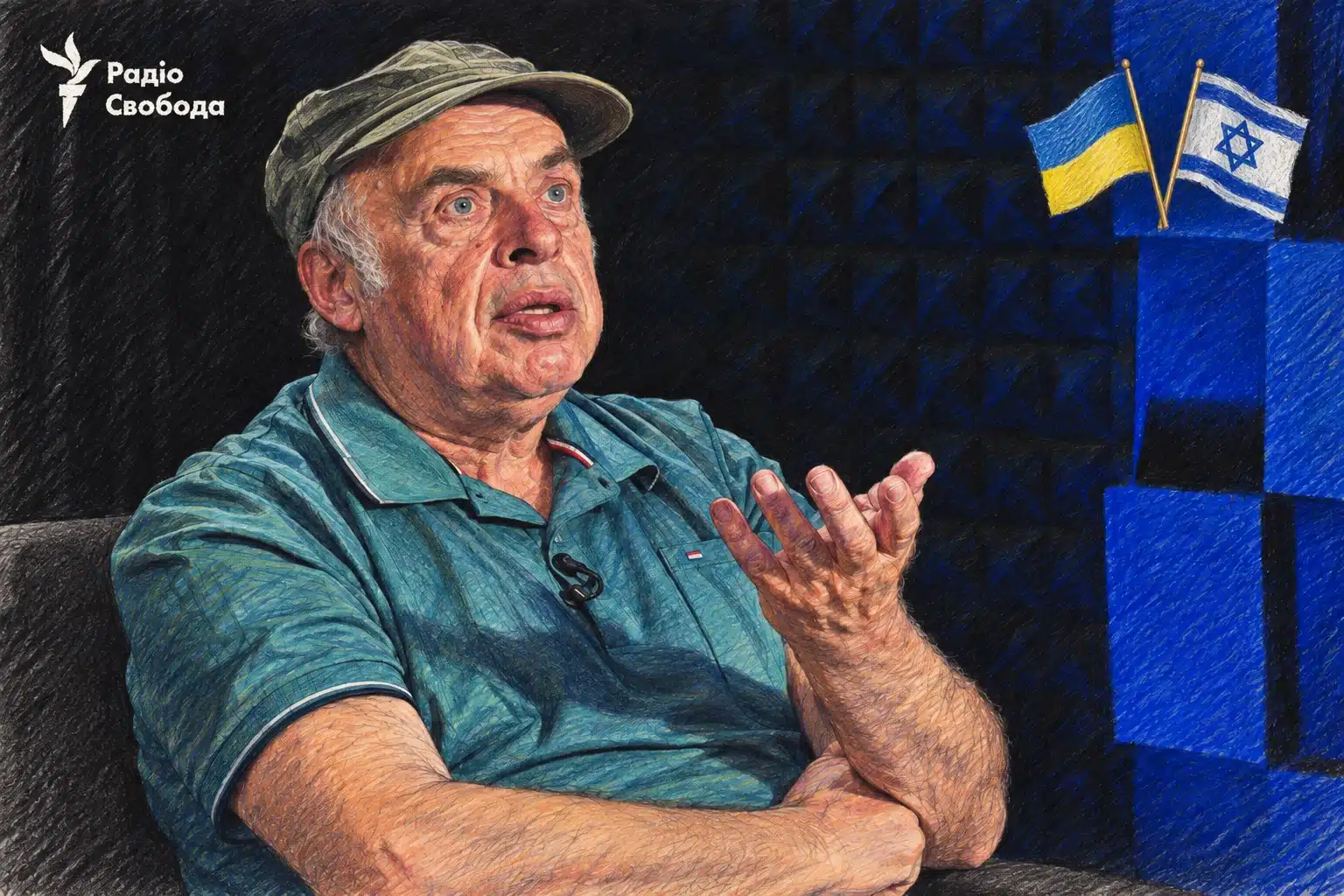
Israeli politician and human rights activist Natan Sharansky believes that Russia’s war against Ukraine may be approaching a turning point, and prolonged hostilities are gradually becoming a threat to Putin’s regime itself. The former Soviet dissident, who personally met with the Russian president, said this in a large interview with Radio Liberty, published on September 6, 2026.
Author: Editorial Staff of NANews
In a conversation with Oksana Maksimlyuk, Sharansky spoke not only about Russia and the possible end of the war. A separate part of the interview is devoted to the relations between Israel and Ukraine, military cooperation, Ukrainian drones, missile defense, elections during the war, and what the two countries can learn from each other today.
NANews — News of Israel gathered the main theses of this conversation. The full interview, lasting more than 50 minutes, can be watched below.
https://www.youtube.com/watch?v=ci4DKDwnLG4
Sharansky: the war weakens Putin as a dictator
One of the central theses of the interview concerns the state of the Russian regime.
Sharansky believes that the continuation of the war destroys the image of Putin, on which a significant part of the Russian political system has relied for many years: the image of a strong leader capable of guaranteeing the elites security and access to resources.
According to him, at the beginning of the war, representatives of the military and economic elites could reason roughly like this: whether they like Putin or not, he remains a strong leader, so it is more profitable to be under his protection.
Now the situation, Sharansky believes, is gradually changing.
The longer the Russian army cannot achieve its goals in Ukraine, the more people die, and the stronger the consequences of the war are felt inside Russia, the more grounds the elites have to doubt Putin’s ability to control the situation.
Sharansky associates this with the intensification of internal repression.
According to his logic, a dictator tightens the screws not when he feels absolutely confident, but when he needs more control to maintain the system.
“A weak dictator cannot survive,” he formulated his assessment.
At the same time, Sharansky suggests that Putin might already want to end the war, but he needs an outcome that can be presented inside Russia as a result, not a defeat. Therefore, the possibility of retaining part of the occupied Ukrainian territory remains a principled issue for the Kremlin.
“We are most likely in the last year of the war”
The most notable statement was made when Sharansky was asked how much longer the Russian elites can tolerate what is happening — are we talking about months, several years, or a much longer period.
He first replied that there is “much less ahead than has passed,” after which he made a more specific assumption:
“I think we are most likely in the last year of the war.”
However, Sharansky himself immediately limited the categoricity of this forecast, adding that these could be his “good wishes.”
Therefore, it is not about a specific date for the end of the war or information about a forthcoming agreement. This is Sharansky’s political assessment, based primarily on his understanding of the internal weakening of the Russian regime.
For him, the key factor remains Ukraine’s ability to continue resisting. The longer the Russian leadership does not achieve results, he believes, the more serious the pressure on the system from within becomes.
Why general mobilization could become a problem for the Kremlin
Another separate block of the conversation is the possible new mobilization in Russia.
Sharansky considers it indicative that the Kremlin has so far preferred various forms of covert recruitment of people to general mobilization.
In his opinion, Putin could have long announced a more large-scale draft if he were not afraid of the reaction of Russian society.
A significant part of the population can distance themselves from the war while someone else is fighting directly: contractors, prisoners, or residents of remote regions. A completely different effect arises when the state demands to go to the front directly from a person or members of their family.
Therefore, the expansion of mobilization, Sharansky believes, can seriously change the internal situation.
He suggests that the Kremlin will continue to primarily expand covert mobilization.
At the same time, Sharansky warns that the behavior of a weakening regime becomes less predictable. Speaking about Putin, he used the definition “wounded beast”, capable of going far.
The man who personally met with Putin
The biography of Sharansky himself gives special weight to this part of the interview.
He said that he met with Putin several times: back in the late 1990s, and then after he came to presidential power. The last such meeting, according to Sharansky, took place in 2005. After that, he decided that continuing such meetings was “indecent” for him.
Sharansky claims that initially, it was extremely important for Putin to be recognized by the West. Russia was supposed to be perceived again as one of the great powers, and the Russian leader himself was to be accepted on equal terms by the leaders of the USA and other Western countries.
Later, according to Sharansky, a turning point occurred.
Putin realized that democratic leaders replace each other, while he himself intends to remain in power indefinitely. At the same time, the former Israeli minister believes, the idea of his own historical mission began to form in the Russian president.
And it is not about the restoration of the Soviet Union as a communist project.
Sharansky believes that Putin is closer to the idea of the Russian Empire — a state that expands its territory and “gathers lands.”
It is through this logic that he views Moscow’s actions in Chechnya, Georgia, Belarus, and Ukraine.
At the same time, the full-scale invasion, according to Sharansky, showed a fundamental miscalculation by the Kremlin. Putin underestimated the formed Ukrainian nation, overestimated the Russian army, and did not expect the West to provide Ukraine with such prolonged support.
Sharansky’s Donetsk and Putin’s myth of “Russian cities”
The topic of Ukraine for Sharansky is not only foreign policy.
He was born in 1948 in Stalino — today’s Donetsk — and lived there for the first years of his life.
Sharansky recalls a predominantly Russian-speaking city, where Ukrainian was the second language. But precisely because of this, he especially sharply rejects the thesis used by the Kremlin that Donbas is supposedly originally part of some exclusively Russian historical territory.
According to him, the assertions of the Putin regime that the Ukrainian nation supposedly did not exist, and the cities of eastern Ukraine are “Russian,” are “nonsense.”
For Sharansky, Donbas is part of Ukrainian history.
After the Russian aggression in 2014, his personal attitude towards Moscow also changed. Sharansky said that he previously had quite good relations with the Russian leadership, but after the start of the war, Putin in his eyes turned into a war criminal.
Sharansky himself, according to him, has since become a kind of lobbyist for Ukraine’s interests in Israel.
Israel and Ukraine: no longer one-sided assistance
One of the most interesting parts of the interview for the Israeli audience concerns the future of relations between the two countries.
Sharansky suggests abandoning the notion that cooperation should look exclusively like Israel helping Ukraine.
Over the years of the war, Ukraine itself has become a source of military and technological experience that other countries are interested in.
Sharansky separately noted the development of Ukrainian drone technologies. Israel, in turn, has vast experience in countering missile threats.
According to his formula, Ukraine has made tremendous progress in drones, Israel — in combating ballistic missiles, so the two countries have much to offer each other.
Moreover, Sharansky claims, such cooperation is already gradually developing.
He separately noted: not everything happens publicly.
The former Israeli minister also acknowledged that Israel’s previous caution regarding military assistance to Ukraine was largely related to Russia.
After the appearance of Russian military forces in Syria, Israel needed to regularly act against Iranian military infrastructure without entering into direct conflict with Moscow. This is what the Israeli leadership long explained as the need to maintain working relations with the Kremlin.
Sharansky himself now considers such a policy a mistake.
The situation, in his opinion, has fundamentally changed also because Russia and Iran have become close partners.
He formulates the interest of the two countries very simply: Iran is Israel’s main enemy, Russia is Ukraine’s main enemy, and Moscow and Tehran act together.
This creates a completely different basis for Israeli-Ukrainian cooperation.
What Sharansky said about Patriot
The interview also included a statement about Patriot systems.
Sharansky claims that American complexes, previously located in Israel, were eventually transferred to Ukraine through the USA.
But the main limitation today, he believes, is not so much the number of installations themselves, but the lack of ammunition for them.
According to him, neither Israel nor the USA previously anticipated wars of such duration and intensity.
At the same time, Ukraine, he believes, has reached such a technological level in certain areas during the war that now even Israel has something to learn from it.
Elections during the war: why Israel and Ukraine are in different conditions
Another topic of conversation is Ukrainian elections.
Sharansky reminded that Israel almost never refuses elections due to war. Military personnel can vote, and the size of the country allows the process to be technically organized even in extremely difficult circumstances.
But he considers it wrong to directly transfer this experience to Ukraine.
Part of Ukrainian territory is occupied. Millions of citizens are abroad. A huge number of people serve in the army. In these circumstances, organizing full-fledged elections becomes not only a political but also a huge technical and security problem.
Therefore, Sharansky says he understands the position of Volodymyr Zelensky.
However, there is another side to the problem: a democratic state cannot exist indefinitely without elections and political accountability of power.
Therefore, any real pause in the war that allows for safe and full voting, Sharansky considers important to use for elections.
“Ukraine is becoming the shield of Europe”
In the interview, Sharansky returns to his own dissident past.
In Soviet camps, he recalls, representatives of various national movements — Ukrainians, Jews, Lithuanians, Armenians — discussed the possible collapse of the USSR.
According to him, they were convinced: if Ukraine becomes independent, the Soviet Union can no longer be preserved.
Sharansky expected that after gaining independence, Ukraine would quickly become one of the most important European powers due to its industrial, scientific, and human potential. Reality turned out to be much more complicated.
But today his assessment has changed again.
According to the former Soviet dissident, Ukraine during this war is effectively completing the process of its entry into the free world and simultaneously becoming its protector.
He formulated this especially vividly:
Ukraine today is possibly becoming one of the greatest nations in Europe and the ‘shield of Europe’.
That is why the final part of the interview is not so much about politics as about freedom.
Sharansky recalls his own nine years in Soviet prisons and camps. According to him, at a certain point, he realized: if the main goal becomes physical survival at any cost, the jailers gain complete power over a person.
But if a person decides to remain free regardless of circumstances, taking away this freedom becomes much more difficult.
He addressed this thought to Ukrainians, tired after many years of war: every day of resistance means that Ukraine continues to exist as a free country.
And this, perhaps, is the main thesis of Sharansky’s entire conversation — much broader than any prediction about whether the war will end in a few months or a few years.
…
Video: Natan Sharansky – “Ukraine today is possibly becoming one of the greatest nations in Europe and the ‘shield of Europe’” - September 7, 2026
- Новости Израиля
Trump was told about the ancient Jewish cemetery in Uman: illegal construction, human remains, and the decision of the Supreme Court of Ukraine - September 6, 2026
- Новости Израиля
El Al removed Moscow until spring 2027: passengers will be sent via Baku - September 5, 2026
- Новости Израиля