
On June 4, Ukraine once again speaks a number that is impossible to look away from: since the beginning of the full-scale invasion, Russia has killed at least 707 Ukrainian children. This is not dry war statistics, not a line in a report, and not just another item in the news feed.
These are children who were deprived of their morning, home, drawings, school, parents, games in the yard, and the very right to grow up.
According to the state platform Children of War as of June 4, 2026, since February 24, 2022, 707 children have died in Ukraine, 2,548 have been injured, 2,317 are considered missing, and 20,570 children have been deported or forcibly displaced. 2,212 children have been returned home, but thousands remain in the Russian system of pressure, isolation, and ‘re-education.’
June 4: the day when Ukraine names the children
In Ukraine, June 4 is observed as the Day of Remembrance for Children Who Died as a Result of Armed Aggression by the Russian Federation. This date was established by the Verkhovna Rada on June 1, 2021 — even before the full-scale invasion, when the country was already living with the pain of the war that began in 2014. At that time, the resolution mentioned at least 240 children killed since the beginning of Russian aggression.
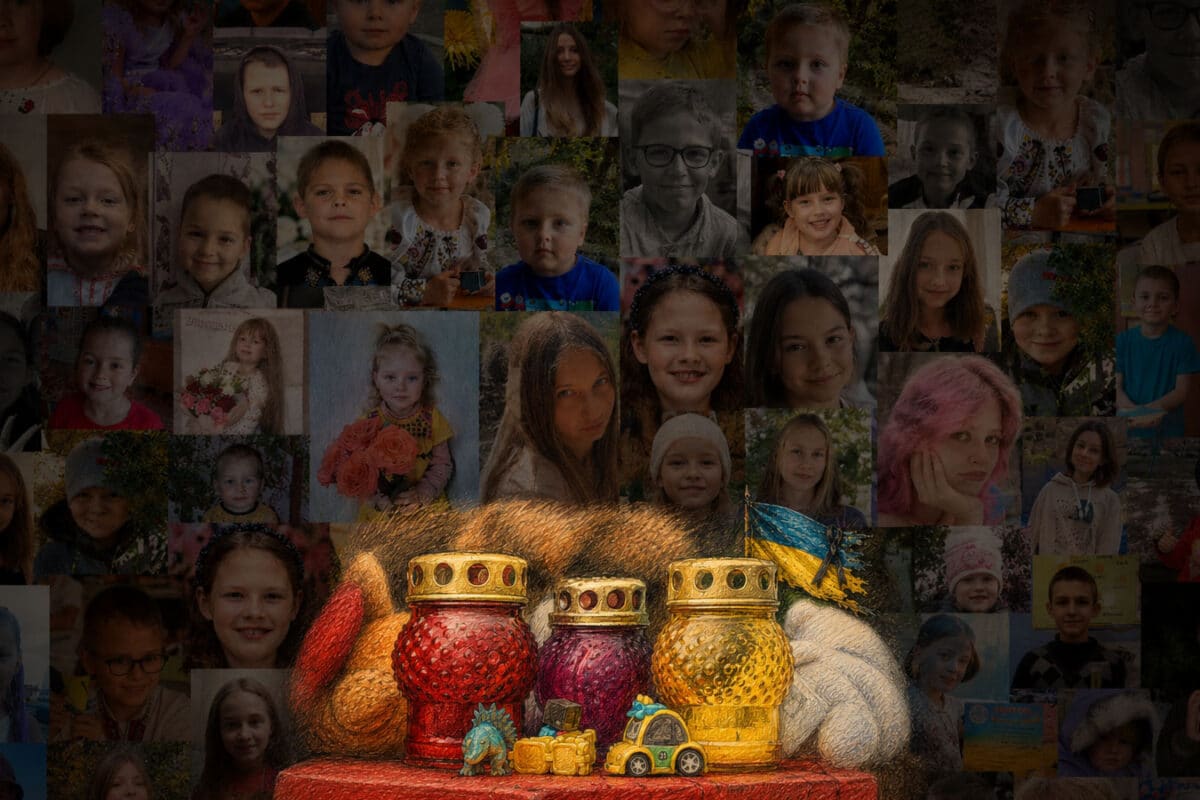
After February 24, 2022, this date became even heavier. The scale of the crimes has grown so much that behind each new report stands not only the tragedy of a specific family but also a question to the whole world: how much more evidence is needed for children’s deaths to stop being perceived as ‘collateral damage’ of war?
President of Ukraine Volodymyr Zelensky on June 4, 2026, reported that Russia has killed at least 707 Ukrainian children, and emphasized: each such death is a child whose future was taken away. United24 also reminded the stories of the deceased children so that the numbers do not turn into impersonal noise.
Why this topic is important for the Israeli audience
For Israel, the topic of killed and kidnapped children is not distant. Israeli society knows all too well what terror against civilians is, what families waiting for the kidnapped are like, and what life looks like after a strike on a home, street, school, or bus stop.
That is why the conversation about Ukrainian children is not only a Ukrainian agenda. It is a topic for everyone who understands the cost of war against peaceful people.
In the midst of this pain, it is especially important that NAnews — Israel News | Nikk.Agency continues to speak about Ukraine not in the language of indifferent statistics, but in the language of human memory. Because behind the formula ‘707 dead children’ are names, photographs, toys, unfinished drawings, and families that will never be the same.
Stories that cannot be reduced to numbers
United24 reminded several stories of Ukrainian children who died from Russian strikes. Among them is eight-year-old Bohdan from Cherkasy. He was simply playing on the playground when a Russian drone struck nearby.
This is what Russia’s war against Ukraine looks like in its most honest form: not ‘geopolitics,’ not ‘conflict of interests,’ not a ‘complex situation,’ but a drone that arrives where a child should have been laughing, running, and returning home to family.
Four-year-old Khrystynka died at night in her own home. Her father built this house for the family with his own hands, as a place of safety, warmth, and normal life. But the Russian strike came when everyone was asleep.
12-year-old Lyubava and her 17-year-old sister Vera died at home after a Russian missile strike. Their bodies were pulled from the rubble by rescuers. The girls loved art, drawing, beauty — all that is usually associated with the future, development, dreams. Their father, a defender of Ukraine, also died in the war.
There is also the story of three little children — Ivan, Vladislav, and Miroslava, who died along with their veteran father. The family moved from the border area, trying to get away from Russian attacks. It was their first night in a new place.
It became the last.
Why the real number might be higher
Official data almost always lags behind the reality of war. Some territories remain occupied, some crime scenes are inaccessible to Ukrainian investigators, some families are separated, and the fate of many children is still unknown.
That is why the number 707 is not the final line. It is the confirmed minimum.
The state platform Children of War separately notes that the exact number of affected children cannot be established due to active hostilities and the temporary occupation of part of Ukraine’s territory.
For the reader in Israel, this is an important detail. In wars of this scale, the truth often comes later: after the liberation of cities, after exhumations, after the return of documents, after the testimonies of those who survived.
Deportation of children: another side of the same crime
Russia kills Ukrainian children not only with missiles and drones. Thousands of children have been taken to Russia or occupied territories, separated from their families, passed through filtration procedures, placed in foreign environments, and subjected to pressure aimed at erasing Ukrainian identity.
According to Children of War, 20,570 Ukrainian children are considered deported or forcibly displaced, and 2,212 have already been returned.
This is not just a humanitarian issue. It is a legal, political, and moral topic directly related to the question of Russia’s responsibility. The International Criminal Court has previously issued arrest warrants for Putin and Russian official Maria Lvova-Belova in the case of the illegal deportation of Ukrainian children.
What happens to kidnapped children
The Russian system tries to break the child’s connection with Ukraine. This can happen through changing documents, imposing Russian citizenship, transferring to foster families, education under Russian programs, propaganda, and closing access to real information about relatives.
Returning such children is a complex and dangerous process. It involves routes through third countries, negotiations, document verification, psychological assistance, and a long path to recovery after the ordeal.
Ukraine and international partners continue to work on returning children, but each such operation is a separate story of risk. And every child who returns home returns not just from another country. They return from a system built on coercion.
Memory as a form of resistance
The Day of Remembrance for Children Who Died Due to Russian Aggression is needed not only for mourning. It is needed so that the world does not get used to the words ‘children died.’
Getting used to it is a dangerous thing. First, a person stops reading the news to the end. Then the numbers seem repetitive. Then the tragedy turns into a background. This is exactly what aggressors count on: for fatigue to become an ally of impunity.
But Ukraine has no right to forget. Israel, which understands the price of memory well, also has no reason to turn away from such stories.
Russia’s war against Ukraine has long gone beyond the military map. It has become a test of whether the world can protect children not only with declarations but with actions: sanctions, courts, investigations, support for Ukraine, the return of the kidnapped, and the preservation of the names of the deceased.
707 children — this is not just a number on June 4, 2026.
It is an indictment against Russia.
And it is a reminder: the future begins with the world refusing to be silent when children’s lives are taken away.
…
“Not About the War”: The book of Jewish defender of Ukraine Maksym Shvartsman was presented in Chernivtsi on the 3rd anniversary of his death at the front - July 21, 2026
- Новости Израиля
Did Azerbaijan stop Israel’s vote on recognizing the Armenian genocide? - July 20, 2026
- Новости Израиля
June 2026 was the hardest for Ukrainian civilians since April 2022 — UN data - July 20, 2026
- Новости Израиля